
外卖

Search documents
美团CEO王兴电话会谈外卖竞争
Xin Lang Cai Jing· 2025-08-27 16:12
Core Insights - Meituan's Q2 revenue reached 91.84 billion yuan, a year-on-year increase of 11.7%, while adjusted net profit fell by 89% to 1.49 billion yuan [2] - CEO Wang Xing emphasized the importance of maintaining market position amidst increasing competition in the food delivery sector, stating that Meituan will continue to focus on quality supply, stable fulfillment, and reasonable pricing [2] - The company is committed to long-term ecological development, benefiting consumers, merchants, and delivery personnel [2] Competition and Market Strategy - In the instant retail sector, Meituan reported a significant growth of 50% in lower-tier markets and plans to enhance differentiated supply and expand product categories [3] - Wang noted that while short-term subsidies may drive aggressive low-price demand, true long-term value creation relies on supply-side optimization and consumer habit formation [3] - Meituan's flash purchase segment has achieved profitability for several consecutive quarters, but the company prioritizes growth over immediate profits [3] International Expansion - Meituan's international business, particularly through Keeta, has shown strong growth in order volume and Gross Transaction Value (GTV) [4] - The company is optimistic about its expansion into Brazil and has already established a local team, while also achieving market leadership in Hong Kong and a top-two position in Saudi Arabia [4] - Meituan aims for Keeta to reach a GMV of 100 billion yuan within the next decade, reflecting confidence in its long-term growth potential [4]



美团二季度营收918亿元 王兴:坚决反对内卷
Xin Jing Bao· 2025-08-27 15:59
Core Viewpoint - Meituan reported a revenue of 91.8 billion RMB for Q2 2025, reflecting an 11.7% year-on-year growth, but adjusted net profit fell by 89.0% to 1.493 billion RMB, indicating significant operational pressure from the ongoing food delivery subsidy war [1] Group 1: Financial Performance - The core local commerce segment generated revenue of 65.3 billion RMB, a 7.7% increase year-on-year [2] - The new business segment achieved revenue of 26.5 billion RMB, growing by 22.8%, with losses narrowing to 1.9 billion RMB [5] Group 2: Market Strategy and Operations - Meituan's CEO emphasized the company's commitment to maintaining its market position amidst intensified competition, focusing on ecosystem development to benefit consumers, merchants, and delivery personnel [1] - The company plans to open over 10,000 brand satellite stores by the end of the year, having already partnered with over 800 major restaurant brands [2] Group 3: Rider Support and Welfare - Meituan will eliminate overtime penalties for riders by the end of 2025 and has implemented full coverage of work injury insurance for riders in 17 provinces [4] - The company has established a 1.6 billion RMB summer rider support fund and expanded the coverage of its illness reimbursement program [4] Group 4: Technological Investment - Meituan invested 6.3 billion RMB in R&D, marking a 17.2% increase year-on-year, and has launched 64 drone delivery routes across several major cities [6]
美团二季度营销开支大增77亿 三季度将加大投入应对竞争
Nan Fang Du Shi Bao· 2025-08-27 15:46
Core Insights - Meituan reported a revenue of 91.84 billion RMB for Q2 2025, representing a year-on-year growth of 11.7%, while adjusted net profit plummeted by 89% to 1.49 billion RMB [2][3] - For the first half of 2025, Meituan's revenue reached 178.3 billion RMB, a 14.7% increase year-on-year, but adjusted net profit decreased by 41% [2] Revenue Breakdown - The core local commerce segment generated 65.3 billion RMB in revenue, up 7.7% year-on-year, but operating profit dropped significantly by 75.6% to 3.7 billion RMB, with a profit margin of 5.7%, down 19.4 percentage points [4] - New business revenue grew by 22.8% to 26.5 billion RMB, contributing 28% to total revenue, primarily driven by grocery retail and overseas business expansion [5] Cost and Marketing Expenditure - Overall sales costs increased by 27% to 61.4 billion RMB, accounting for 66.9% of revenue, up 8.1 percentage points year-on-year [6] - Sales and marketing expenses surged by 51.8% to 22.5 billion RMB, representing 24.5% of revenue, an increase of 6.5 percentage points, largely due to intensified competition in food delivery and instant retail [6] Strategic Focus and Future Outlook - CEO Wang Xing emphasized the company's commitment to maintaining market position amidst fierce competition, focusing on essential service quality and cost-effectiveness [2][4] - For Q3, Meituan anticipates significant losses in core local commerce due to high subsidy levels from competitors, planning to increase investments to ensure competitive pricing and stable service delivery [7]
多只热门中概股下跌,理想跌逾6%,小鹏跌近5%,黄金白银短线跳水
2 1 Shi Ji Jing Ji Bao Dao· 2025-08-27 15:25
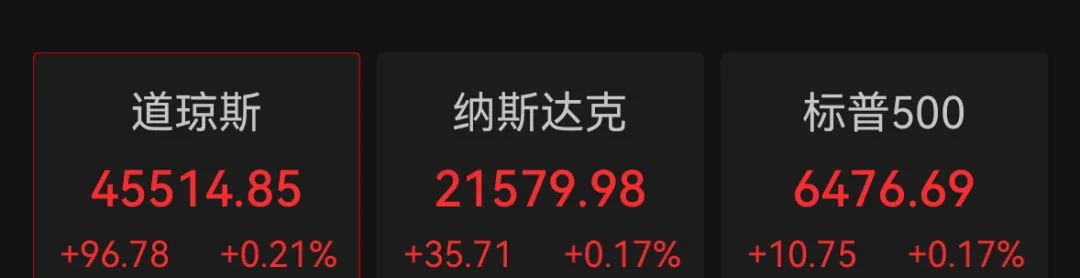
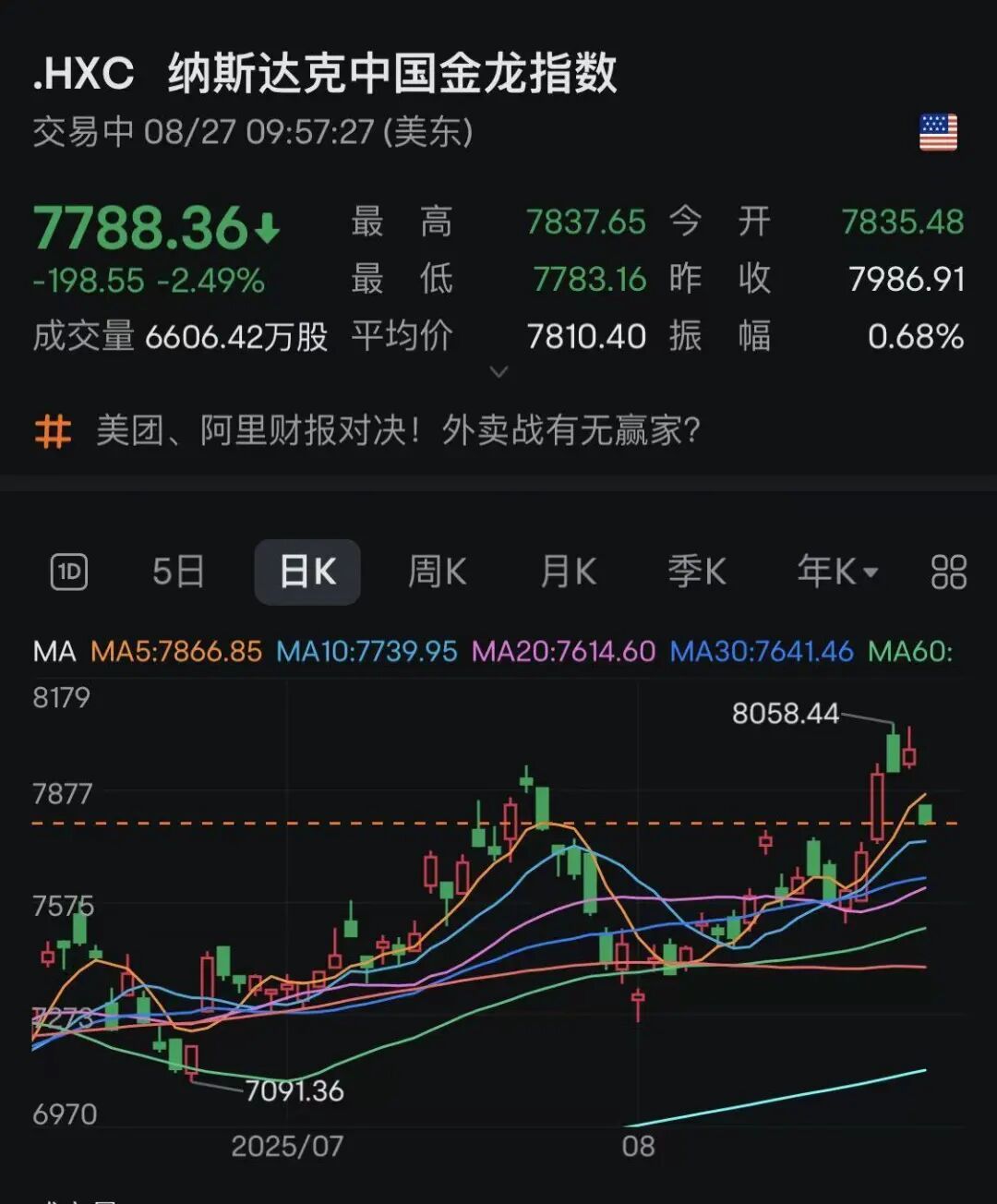
Market Overview - US stock indices opened mixed but turned positive by 10:40 PM [1] - The Nasdaq Golden Dragon China Index fell over 2% by 10:40 PM [3] Chinese Concept Stocks - Several popular Chinese concept stocks declined, with Li Auto down over 6%, Xpeng down nearly 5%, and NIO down over 3% [3][4] - Specific stock performances include: - Li Auto: 22.985, -6.75% - Xpeng: 23.125, -4.95% - NIO: 6.475, -3.36% [4] Food Delivery Giants - Major food delivery companies saw declines, with JD down over 3%, Alibaba down over 2%, and Meituan ADR dropping nearly 10% [5] - Meituan reported Q2 revenue of 918 billion yuan, a year-on-year increase of 11.7%, but adjusted net profit fell by 89% due to "irrational competition" [5] Precious Metals - Spot gold experienced volatility, briefly dropping below $3,380 per ounce [5] - Spot silver also saw a decline, dropping over 1% at one point [6] Federal Reserve Signals - Federal Reserve officials indicated a dovish stance on interest rate cuts [7] - New York Fed President Williams suggested that the upcoming policy meeting will be "live," hinting at potential rate adjustments [8] - Trump's recent actions against a Fed official raised concerns about the Fed's independence, potentially increasing market uncertainty regarding future policy directions [9][10]
深夜!黄金白银跳水,美联储官员鸽派表态
Zheng Quan Shi Bao· 2025-08-27 15:03
晚间(8月27日),美股三大股指开盘涨跌不一。不过截至发稿已悉数翻红。 中概股突现调整 中概股方面,纳斯达克中国金龙指数走低,截至发稿跌超2%,个股方面,新能源汽车股集体下跌,其中,理想汽车跌逾6%,小鹏汽车也跌超3%。 此外,值得注意的是,美团ADR大跌逾11%。消息面上,美团8月27日在港交所公告,于第二季度,公司收入由2024年同期的人民币823亿元增长11.7%至 人民币918亿元。 由于外卖行业竞争激烈,于2025年第二季度,核心本地商业分部的经营溢利同比大幅下降至人民币37亿元。同时,由于海外扩张,新业务分部的经营亏损 同比扩大至人民币19亿元。因此,公司于该期间的经调整EBITDA及经调整溢利净额分别下降至人民币28亿元及人民币15亿元。于2025年第二季度,经营 现金流入净额为人民币48亿元。 黄金方面,现货黄金震荡跳水,跌破3380美元/盎司,现货白银更是跌逾1%。 美联储官员对降息再度鸽派表态。 纽约联储主席威廉姆斯表示,美联储即将召开的政策会议将是"实时"会议,暗示可能进行利率调整,但未明确表示他将支持何种行动方案。 威廉姆斯周三接受采访时表示:"从我的角度来看,我绝对认为每次会议都是实 ...
美团财报公布,美股大跌超14%
Zheng Quan Shi Bao· 2025-08-27 15:03
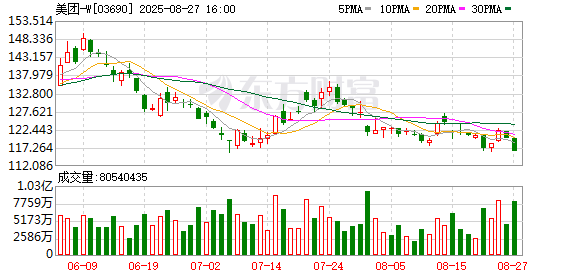
Core Viewpoint - The intense competition in the food delivery industry continues to impact Meituan's financial performance, leading to a significant drop in adjusted net profit despite revenue growth [1][4]. Financial Performance - In Q2, Meituan reported revenue of 91.84 billion RMB, a year-on-year increase of 11.7%, but adjusted net profit fell sharply by 89% to 1.49 billion RMB [4]. - For the first half of 2025, Meituan achieved revenue of 178.398 billion RMB, up 14.7%, with adjusted net profit down 41% to 12.442 billion RMB [4]. - The core local business segment, which is Meituan's main revenue source, generated 65.347 billion RMB in Q2, a 7.7% increase, but the operating profit margin plummeted from 25.1% to 5.7% due to "irrational competition" [5]. Business Segmentation - The new business segment contributed 26.493 billion RMB in Q2, a 22.8% increase, but operating losses expanded by 43.1% to 1.881 billion RMB [6]. - Sales and marketing expenses surged by 51.5% year-on-year to 77 billion RMB, reflecting the intense competition in the food delivery and instant retail sectors [6]. - Sales costs rose by 27% to 61.4 billion RMB, with the cost-to-revenue ratio increasing from 58.8% to 66.9% [7]. User Engagement and Market Position - Meituan's app monthly active users exceeded 500 million, with annual transaction frequency reaching a historical high [7]. - In July, Meituan's instant retail daily order volume peaked at 150 million, setting a new record [7]. Strategic Outlook - CEO Wang Xing indicated that Meituan expects significant losses in Q3 due to strategic investments aimed at maintaining competitive pricing and enhancing delivery services [9]. - Wang emphasized the belief that competition will eventually normalize, despite the current aggressive market dynamics [10]. - The company plans to prioritize growth over immediate profitability, particularly in the instant retail sector, while maintaining a long-term vision for market leadership [10].

深夜!大跌超14%,发生了什么?
券商中国· 2025-08-27 14:53
Core Viewpoint - The competition in the food delivery industry remains intense, impacting Meituan's financial performance significantly [2][7][11]. Financial Performance - Meituan's Q2 revenue reached 91.84 billion RMB, a year-on-year increase of 11.7%, but below expectations [2][7]. - Adjusted net profit for Q2 dropped sharply by 89% to 1.49 billion RMB [2][7]. - For the first half of 2025, Meituan reported revenue of 178.398 billion RMB, up 14.7%, with adjusted net profit down 41% [7]. - The core local business segment, which is Meituan's main revenue source, generated 65.347 billion RMB in Q2, a 7.7% increase, but the operating profit margin plummeted from 25.1% to 5.7% due to "irrational competition" [7][11]. Business Segmentation - New business revenue in Q2 was 26.493 billion RMB, a 22.8% increase, but operating losses expanded by 43.1% to 1.881 billion RMB [8]. - Sales and marketing expenses surged by 51.5% year-on-year to 77 billion RMB, reflecting the high cost of competition in the food delivery and instant retail sectors [9]. - Sales costs increased by 27% to 61.4 billion RMB, with the cost-to-revenue ratio rising from 58.8% to 66.9% [9]. User Engagement and Market Position - Meituan's app monthly active users exceeded 500 million, with annual transaction frequency reaching a new high [9]. - In July, Meituan's instant retail daily order volume peaked at 150 million, setting a new record [9]. Strategic Outlook - CEO Wang Xing indicated that Q3 core business would incur significant losses due to strategic investments aimed at maintaining competitive pricing and delivery service quality [11]. - Wang emphasized that while short-term subsidies may drive aggressive pricing, long-term value creation relies on supply-side optimization and consumer behavior cultivation [12]. - CFO Chen Shaohui reiterated confidence in the long-term growth potential of both core and new businesses, despite current competitive pressures [12].

美团王兴谈外卖大战和出海 将继续捍卫市场地位
2 1 Shi Ji Jing Ji Bao Dao· 2025-08-27 14:31
Core Viewpoint - The intense competition in the market is expected to continue in the short term, negatively impacting financial performance [1] Financial Performance - In Q2 2025, Meituan reported revenue of 91.8 billion RMB, a year-on-year increase of 11.7%, but adjusted net profit fell to 1.49 billion RMB, down 89%, representing a decrease of 12.1 billion RMB compared to the same period last year [2] - The core local business segment's operating profit dropped from 15.2 billion RMB in Q2 2024 to 3.7 billion RMB in Q2 2025, a year-on-year decline of 75.6%, with the operating profit margin decreasing from 25.1% to 5.7% [3] - Sales and marketing expenses surged by 7.7 billion RMB, a 51.5% increase year-on-year, primarily due to the fierce competition in the food delivery and instant retail sectors [3] Competitive Landscape - Meituan's management emphasized the need for increased investment to defend its market position and enhance long-term competitiveness amid ongoing competition [3] - CEO Wang Xing reiterated that Meituan opposes internal competition and has consistently focused on providing quality supply, stable fulfillment, and reasonable pricing to create a good user experience [4] New Business Developments - In Q2, Meituan's new business segment generated revenue of 26.5 billion RMB, a year-on-year increase of 22.8%, but losses expanded by 43.1% to 1.9 billion RMB, primarily due to the costs associated with international expansion [4] - Meituan's international delivery brand Keeta has made significant progress, covering 20 cities in Saudi Arabia and recently launching services in Qatar, with plans to enter Brazil in the coming months [4][5] Legal Challenges - The competition in the overseas food delivery market is also intense, with legal disputes arising between Meituan's Keeta and Didi's 99Food in Brazil over trademark infringement and unfair competition [6] Long-term Goals - Meituan aims for Keeta to achieve a run rate GMV of 100 billion USD within ten years, with a target date set for May 2033 [6]
美团净利润下滑89%,年底取消骑手超时扣款
21世纪经济报道· 2025-08-27 14:25
Core Viewpoint - Meituan's Q2 2025 financial report shows a revenue of 91.84 billion RMB, a year-on-year increase of 11.7%, but a significant net profit decline of 89% attributed to irrational competition starting in the quarter [1][2][3] Financial Performance - Revenue for Q2 2025 reached 91.84 billion RMB, up from 82.25 billion RMB in Q2 2024, marking an 11.7% increase [2] - Adjusted net profit for Q2 2025 was 1.49 billion RMB, down 89% from the previous year [2][3] - Operating profit for the core local commerce segment fell from 15.2 billion RMB in Q2 2024 to 3.7 billion RMB in Q2 2025, a decline of 75.6% [3] Competitive Landscape - The decline in operating profit and profit margin in the core local commerce segment is attributed to intense competition, particularly in the food delivery sector [3] - Meituan's sales and marketing expenses surged by 51.5% year-on-year, increasing by 7.7 billion RMB to counter the fierce competition in food delivery and instant retail [3] Management Insights - CEO Wang Xing indicated that the company maintains a long-term profit assumption of 1 RMB per order and a profit margin of about 3%, despite expected short-term financial pressures due to increased strategic investments [7] - The company plans to eliminate overtime penalties for delivery riders by the end of 2025, addressing concerns raised by the gig economy workforce [7] Market Reaction - Following the financial report, Meituan's ADR fell nearly 13% in after-hours trading, reflecting market concerns over the competitive landscape and profit decline [3]


美团CEO王兴:巴西市场竞争格局复杂 不会仓促行动 Keeta目标“10年内实现1000亿美元GMV”
Mei Ri Jing Ji Xin Wen· 2025-08-27 13:56
Group 1 - The core viewpoint is that Meituan is optimistic about the long-term growth potential of Keeta, aiming for a GMV of $100 billion within 10 years, starting from May 2023 [1] Group 2 - Meituan's CEO Wang Xing stated that the company is conducting preliminary research on the Brazilian market, with a small team already in place to prepare for entry [3] - The company is optimistic about the potential of the Brazilian market, which is one of the top five markets globally in terms of GMV for food delivery, but acknowledges the complex competitive landscape [3] - Meituan plans to expand its team gradually and will not rush into the market until thorough research and a quality team are established [3]