微短剧

Search documents
郑州,太能演了
3 6 Ke· 2025-12-15 10:22
Core Insights - Zhengzhou is rapidly emerging as a hub for micro-short dramas, with a projected market size exceeding 2.3 billion yuan in 2024 and a goal of reaching 10 billion yuan by 2027 [4][7][19] - The city has become a significant player in the micro-short drama industry, producing nearly 40% of China's output, surpassing even established centers like Hengdian [4][16] - Zhengzhou's strategic location, cost advantages, and supportive policies are driving the growth of its micro-short drama sector [15][20][25] Industry Overview - Zhengzhou's micro-short drama industry employs around 40,000 people and hosts over 800 companies, with a daily production rate exceeding 100 new projects [2][4] - The average daily salary for supporting actors ranges from 800 to 1,500 yuan, while lead actors can earn between 2,000 and 10,000 yuan [5][6] - The city has established 15 filming bases, which operate 24/7, accommodating multiple film crews simultaneously [12][15] Market Dynamics - The micro-short drama market in China is expected to reach 51.5 billion yuan in 2024, reflecting a year-on-year growth of 35.1% [8] - Zhengzhou's production costs are estimated to be 30% to 40% lower than those in major cities like Beijing and Shanghai, with a production cycle of 7 to 15 days for a 100-episode series [15][16] - The city has a unique "ten-minute ecosystem" that streamlines the production process, allowing for quick access to resources and locations [12][15] Policy Support - Zhengzhou's government has implemented several policies to support the micro-short drama industry, including talent recruitment and financial incentives for original script development [19][21] - The city aims to transition from being a production hub to a creative center, focusing on original content and high-quality productions [21][24] - Initiatives like the "Cultural Pulse of a Thousand Years" script collection event have attracted numerous talented writers, enhancing the quality of local productions [21][25] Future Outlook - Zhengzhou is positioning itself to not only dominate the domestic market but also to expand internationally, promoting its micro-short dramas at global film festivals [26][27] - The integration of micro-short dramas with tourism and cultural promotion is expected to enhance the city's visibility and attract more visitors [25][26] - The local government is committed to fostering a sustainable and high-quality micro-short drama ecosystem, aiming for a balance between quantity and quality in production [24][25]

微短剧为什么火?为什么爆利?为什么有投资价值?
Sou Hu Cai Jing· 2025-12-14 07:15
Group 1 - The core idea is that the short drama industry is evolving, leveraging human psychology and capital to create significant investment opportunities in the coming year [1][3] - Free micro-short dramas account for 66.3% of the market, with major platforms promoting "ad-free viewing" and even "earning coins while watching," which exploits human weaknesses [4] Group 2 - The industry is shifting from traditional long video platforms to a "attention economy," where platforms that can efficiently capture fragmented time will dominate [1] - The free model disrupts the traditional revenue chain, with platforms becoming the rule-makers and profit distributors, leading to a centralized power structure [1] Group 3 - Investment should focus on "arms dealers" rather than "mercenaries," meaning companies that provide essential tools and services to the ecosystem are more stable investments [1] - Successful brands and companies with strong operational capabilities or deep ties to top short drama platforms are key beneficiaries [1] Group 4 - The evolution of content quality is crucial, as users now seek emotional connection and engagement rather than just entertainment, making quality and sustainability the new currency [1] - The market will reward companies that can produce high-quality content consistently and manage IP development effectively [1] Group 5 - The industry is transitioning from a "traffic competition" to an "ecosystem control" battle, with leading platforms integrating content and connecting consumption to create a closed loop [1] - The current period is seen as a "golden window" for investing in the micro-short drama industry chain, as the market dynamics are becoming clearer and business models validated [1]
“十四五”期间,长沙交出两道“融合命题”新答卷
Chang Sha Wan Bao· 2025-12-13 02:09
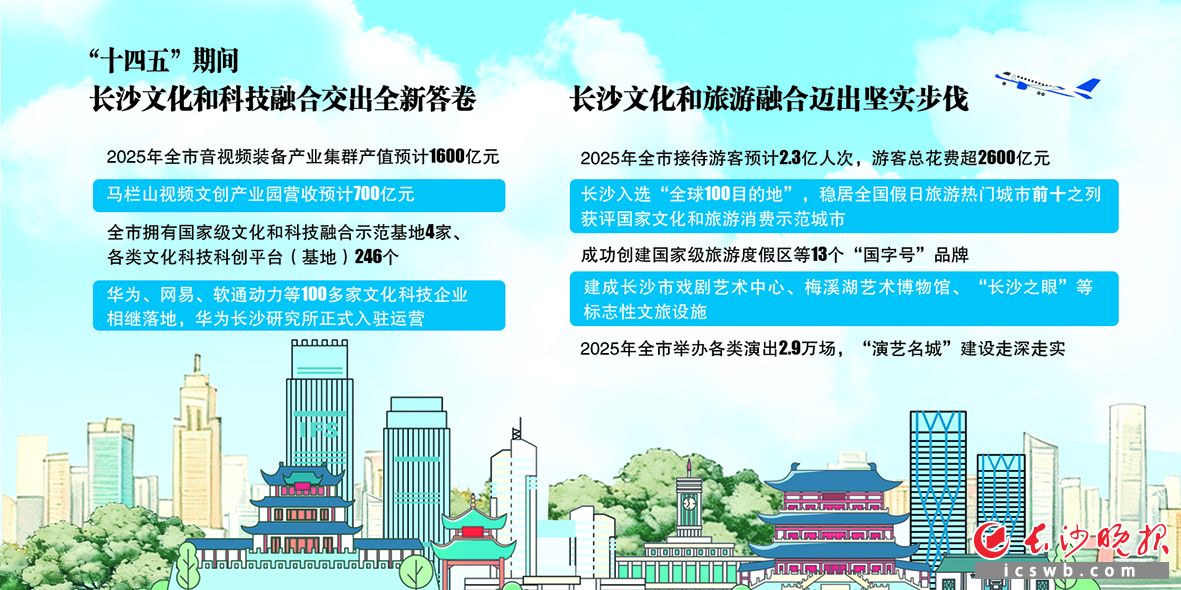
Core Insights - The "14th Five-Year Plan" emphasizes the integration of culture and technology in Changsha, aiming for high-quality development and modernization [2][3] Group 1: Cultural and Technological Integration - By 2025, the revenue of large-scale cultural enterprises in Changsha is expected to reach 170 billion yuan, with the audio-visual equipment industry cluster projected to generate 160 billion yuan [4] - The establishment of 246 cultural and technological innovation platforms has enhanced innovation capabilities, with over 150 patent applications submitted from the Marlan Mountain audio-visual laboratory [4] - More than 100 cultural technology companies, including Huawei and NetEase, have established operations in Changsha, contributing to a growing industrial cluster [4] Group 2: Cultural Heritage and Digitalization - The digital platform "Shanhai" has made 64,000 cultural relics accessible, with over 8.5 million users, showcasing the digital transformation of cultural resources [5] - New cultural venues and projects have emerged, enhancing the visibility and engagement of traditional culture through technology [5] Group 3: Cultural and Tourism Integration - By 2025, Changsha is expected to receive 230 million tourists, with total spending exceeding 260 billion yuan [6][7] - The city has successfully created 13 national-level tourism brands, leading in the central region, with 83 A-level scenic spots [8] - Significant investments in cultural tourism infrastructure have been made, including the establishment of key cultural facilities and the revitalization of historical sites [8] Group 4: Tourism Consumption and Service Quality - The integration of cultural events and performances has led to a surge in tourism consumption, with 29,000 performances planned for 2025 [9] - The city has implemented service quality improvement initiatives, including the launch of 80 new cultural tourism service stations and the enhancement of public facilities [9]
腾讯,坐视字节“通吃”短剧丨文娱变局
2 1 Shi Ji Jing Ji Bao Dao· 2025-12-12 13:04
Group 1 - ByteDance's short drama app, Hongguo, has become a leading player in the micro-short drama market, with monthly active users reaching 245 million by October 2025, surpassing Bilibili and Youku [1] - Since May 2025, Hongguo's daily active users have consistently outperformed other video applications, indicating a strong upward growth trend [1] - The revenue from ByteDance's "Tomato business" (including Hongguo) is reported to exceed 30 billion yuan in 2024, with predictions of doubling to 60 billion yuan in 2025 [2] Group 2 - The micro-short drama market has undergone a regulatory adjustment, with the National Radio and Television Administration implementing strict controls, including the removal of over 25,000 non-compliant micro-short dramas [4][5] - Despite regulatory challenges, the micro-short drama market continues to grow, with the market size reaching 50.5 billion yuan in 2024, surpassing the total box office revenue for that year [7] - Hongguo's free model and significant financial investment have attracted many production companies to sign exclusive agreements, ensuring a stable revenue stream for creators [8] Group 3 - Tencent's WeChat Video Account has maintained a relatively conservative approach to the micro-short drama market, contrasting with ByteDance's aggressive expansion [3][11] - Tencent Video is increasing its involvement in the micro-short drama space, launching initiatives like the Mars Plan PLUS and a script cooperation platform, but faces challenges in matching the rapid response required in this market [12] - The emergence of new formats like "manhua dramas" (comic dramas) is being driven by advancements in AI technology, which significantly reduce production costs [14]
上海3年孵化300部精品微短剧,业界共话如何用AI降本增效
Di Yi Cai Jing· 2025-12-12 11:25
现在AI技术的成本已经有所下降,但也要看具体的需求,基本上肯定比实拍要便宜挺多。 近日,以"海纳百剧 聚微成光"为主题的"2025上海精品微短剧产业促进大会"在上海市杨浦区大创智公 共服务平台数字星球举行。 放眼全国,2025年是中国微短剧行业持续增长、迈向精品化与国际化的关键一年。 在这一从"野蛮生长"向"精品化"转型的关键节点,本次大会通过数据发布、大咖分享与深度论坛,集中 探讨了如何通过技术与机制进行创新。 AI技术目前是微短剧行业热议的话题,目前已经有公司靠AI技术提高了工作效率。据全球短剧发行平 台Dramabyte创始人李忻辰介绍,目前公司自主研发了一套AI基于短剧的智能剪辑系统,用的是 Gemini、MiniMax、DeepSeek、ChatGPT,用了大概5-6种AI模型,这套系统能够把剪辑效率(比人工) 大概提高10-20倍,成本是人工的50%以下。 鹏森(AIGC)总经理,导演许大鹏的感受是,每个片种都可以用AIGC完成,只是有一个最大的难点是 人才,不是所有人都能适应这个赛道。"我面试了两百多个人,能干这个的只有5%,十个人能干,这是 很大的痛点问题。" 网络视听行业协会联合DataEy ...
如何吸引微短剧“拍在上海” 构建全周期扶持体系 投入近4000万元
Jie Fang Ri Bao· 2025-12-12 01:36
Core Insights - The micro-short drama industry has become a significant growth driver for the high-quality development of Shanghai's online audio-visual industry, with a focus on "content refinement, international dissemination, and industrial ecology" [1] - The 2025 Shanghai Boutique Micro-Short Drama Industry Promotion Conference highlighted the rapid growth of the micro-short drama market, with an industry output value nearing 90 billion yuan in 2025, almost doubling from 50.5 billion yuan in 2024 [1][2] - The conference also launched the 2025 Shanghai Boutique Micro-Short Drama Exhibition, featuring 90 premium dramas totaling 3,031 episodes and 119 hours of content [4] Industry Growth - The micro-short drama market in Shanghai is projected to reach an output value of approximately 70 billion yuan in 2024, with nearly 2,000 dramas produced and around 30,000 dramas available on platforms [2][3] - The industry is characterized by three core highlights: rapid and precise policy support, the advantages of a highly concentrated micro-short drama industry chain, and the "micro-short drama+" approach that empowers various sectors [2][3] Industry Ecosystem - Shanghai has established a complete micro-short drama industry chain, from IP reserves to premium production, platform distribution, and technological empowerment [3] - Key players in the upstream include companies like Seven Cats and Yuewen, providing over 4.5 million web literature IPs, while midstream production is led by companies like Li Li Cheng Media and Ningmeng Film [3] Policy and Financial Support - The Shanghai government is actively constructing a full-cycle support system for the micro-short drama industry, focusing on quality creation, technological empowerment, industry collaboration, and international market expansion [3] - A total of 11.97 million yuan has been allocated to support 22 projects, including titles like "Please Answer 1937" and "Auntie's World 3: Auntie in the Workplace," aimed at enhancing the quality and international reach of Shanghai's micro-short dramas [4] Industry Collaboration and Innovation - The conference featured discussions from industry experts on the creation of premium micro-short dramas and strategies for gaining higher exposure in overseas markets [6] - The entry of top IPs, such as those from Ma Boyong, into the micro-short drama sector signifies a shift towards a quality-driven content logic rather than merely chasing traffic [5]
634亿元微短剧市场背后,有人日薪三万,有人焦虑离场
2 1 Shi Ji Jing Ji Bao Dao· 2025-12-11 13:05
因为受不了日复一日地焦虑,编剧蓝克(化名)最近彻底离开了微短剧圈。"很折磨人,每天都活在焦 虑当中。"爆不爆,是微短剧行业衡量成功的唯一标准。 普通的微短剧编剧,写一个剧本花两个月时间,收入两三万。出过爆款的头部编剧,一个剧本收入上百 万。头部编剧还有选择权,可以跟更有保障的片方合作。但即便如此,头部编剧也焦虑:"这个行业节 奏太快,竞争激烈,人员流动性大,写一两部没水花,可能就被淘汰。" (原标题:634亿元微短剧市场背后,有人日薪三万,有人焦虑离场) 据北京日报消息,日前发布的《中国微短剧行业发展白皮书》所预测的2025年微短剧市场规模为634.3 亿元,而在2024年,中国微短剧市场规模已达504.4亿元,首次超越国内电影票房总额。 微短剧演员国超表示:"我现在算是成熟演员,日薪差不多是1000块钱(10小时),'反一'(一号反 派)的话可以到1500元(10小时),超时每1小时再加10%。" 群演收入最低,日薪100元到150元。出过爆款的头部男女主演员收入最高,日薪可以谈到1.5万到3万 元。 在2025年临近尾声的时候,已经没有人能够忽视微短剧。它正从低俗、套路、不入流慢慢往正规化、精 品化发展。 ...
让“国潮”涌动“世界潮”
Ren Min Ri Bao· 2025-12-10 08:11
Group 1 - In the first three quarters of this year, China's export of holiday goods, dolls, and animal-shaped toys exceeded 50 billion yuan, reaching over 200 countries and regions globally, indicating a significant impact on modern global consumer culture [1] - The rise of "interest consumption" is driving the popularity of niche products in the mass market, allowing small-scale products to gain traction [2] - Chinese manufacturing capabilities are advancing towards the high-end of the value chain, supporting the global success of Chinese trendy toys [2] Group 2 - Cultural products' appeal is rooted in their cultural charm, with a diverse range of offerings from traditional arts to modern digital content, reflecting a shift from "single-point breakthroughs" to a "multi-dimensional matrix" in cultural export [2] - Effective communication is crucial for cultural export, as cultural differences and language barriers can affect the acceptance of cultural products abroad [3] - Successful cultural export requires a blend of global vision and local strategies, ensuring respect for local cultures while enhancing understanding of Chinese culture [3] Group 3 - A robust cultural industry and market system are essential for driving innovation and expanding the reach of cultural exports [4] - The performance of companies in the cultural sector is notable, with the number of overseas publishing contracts signed by a major online literature company increasing by 80% year-on-year, and the authorization amount rising by over 200% [4] - As of June this year, over 600 cultural enterprises have settled in the National Cultural Trade Base (Nanjing), with projected total revenue exceeding 30 billion yuan for the 2024 fiscal year [4]
文化“新三样”加速破圈
Ren Min Ri Bao Hai Wai Ban· 2025-12-10 08:11
Core Viewpoint - The article discusses the rising global influence of China's cultural "new three samples" (online literature, web dramas, and online games) and their potential for high-quality development in the digital age, emphasizing the unique advantages of Chinese creators in storytelling and cultural representation [1][2]. Group 1: Cultural "New Three Samples" Overview - The cultural "new three samples" have gained significant traction overseas, with online literature generating an estimated revenue of 4.815 billion yuan in 2024, micro-short dramas achieving nearly 55 million downloads, and self-developed games earning over $18.5 billion in overseas sales [2]. - Popular titles like "Black Myth: Wukong" and dramas such as "Sifeng" and "Changyue Jinming" have topped sales charts in multiple countries, showcasing the global appeal of Chinese narratives [2]. Group 2: Unique Advantages of Chinese Creators - Chinese creators leverage traditional cultural elements to enhance their storytelling, drawing inspiration from classic literature and historical texts [2]. - The integration of traditional culture into online games, such as the martial arts game "Naraka: Bladepoint," highlights the global interest in Chinese cultural themes [2]. Group 3: Technological Role in Cultural Dissemination - Technological advancements, particularly in AIGC (Artificial Intelligence Generated Content), are reshaping the production and distribution of cultural content, with projections indicating a significant increase in animated micro-short dramas by 2025 [4][5]. - Companies are utilizing AI to streamline content creation processes, enhancing efficiency and allowing creators to focus on emotional expression and artistic innovation [5]. Group 4: Quality as a Key to Success - The consensus among industry experts is that high-quality content is essential for successful overseas dissemination, with premium works achieving spontaneous recognition even without translation [6][7]. - The characteristics of quality content include engaging narratives and emotional resonance, which are universally understood [3][7]. Group 5: Industry Ecosystem and Support - The micro-short drama industry is transitioning towards quality enhancement, with leading platforms implementing stricter review standards and support measures to foster a sustainable environment [8]. - Initiatives like the establishment of the "Cultural 'New Three Samples' Innovation Cooperation and International Exchange Center" aim to strengthen the industry ecosystem and promote international collaboration [9].
游戏、网文、微短剧领衔,上海构建全链条文化出海体系
Guo Ji Jin Rong Bao· 2025-12-10 05:21
Core Viewpoint - Shanghai aims to strengthen its position as a national cultural trade hub by 2027, targeting a total import and export volume of cultural products and services reaching $32 billion, with enhanced international influence of cultural trade brands and significant contributions to the new development pattern and Shanghai's status as a socialist international cultural metropolis [1] Group 1: Cultural Trade Development - The "Action Plan" outlines the construction of a comprehensive overseas system for game development, production, distribution, and international operations, supporting the development of original high-quality games for international markets [2] - The plan encourages the integration of local cultural elements into products and supports the digital transformation of cultural heritage and non-material cultural assets [2] - Shanghai will establish a global game distribution platform and provide financial support for qualifying functional platforms, along with the creation of a game export service center [2] Group 2: New Cultural Export Initiatives - The plan emphasizes the development of international micro-short drama industries, encouraging companies to build overseas dissemination platforms and collaborate with foreign channels to expand multilingual markets [3] - The "new three samples" of cultural export, including games, online literature, and micro-short dramas, are positioned as core areas for innovation and development, promoting synergy among related industries [3][4] - The transition of Chinese online dramas from merely exporting works to exporting production capabilities is highlighted, with companies establishing local offices in regions like Southeast Asia and North America [3] Group 3: Traditional Cultural Trade Strengthening - The "Action Plan" does not overlook the foundational role of traditional cultural trade areas, such as performing arts, broadcasting, and publishing, which complement the innovative exploration of the "new three samples" [5][6] - Support for performing arts exports includes encouraging institutions to create original works in genres like opera and dance, and promoting international collaborations for global tours [5] - The plan aims to enhance the quality of cultural product imports, including international art exhibitions and esports events, to enrich the local cultural consumption market and establish Shanghai as a global cultural resource hub [6]