
煤炭开采和洗选业

Search documents
11月物价温和回暖,CPI创21个月新高,PPI环比连涨现企稳信号
Hua Xia Shi Bao· 2025-12-11 08:59
Core Viewpoint - In November, China's macroeconomic policies began to show positive effects, leading to a notable increase in the Consumer Price Index (CPI) and a recovery in consumer spending [2] CPI Analysis - The CPI rose by 0.7% year-on-year in November, an increase of 0.5 percentage points from the previous month, marking the highest level since March 2024 and matching the peak since February 2023 [2] - The core CPI, excluding food and energy, also increased by 1.2% year-on-year, remaining above 1.0% for three consecutive months, indicating a steady recovery in consumer willingness and capacity [2] - Food prices shifted from a decline of 2.9% in October to an increase of 0.2% in November, contributing positively to the CPI [3] Food Price Dynamics - Fresh vegetable prices rose by 14.5% year-on-year after nine months of decline, significantly impacting the CPI [4] - Beef and lamb prices continued to rise, with increases of 6.2% and 3.7% respectively, while pork prices, although still down 15.0%, showed a narrowing decline from 16.0% [4] - Egg prices further declined to -12.5% year-on-year, indicating reduced internal deflationary pressure on food prices [4] Non-Food Price Trends - Service prices and industrial consumer goods prices (excluding energy) increased by 0.7% and 2.1% respectively, contributing approximately 0.29 and 0.53 percentage points to the CPI [5] - Core consumer goods prices rose by 2.1%, marking the seventh consecutive month of growth, with notable increases in gold jewelry (over 50%), household appliances (4.9%), and clothing (2.0%) [5] - Housing rental prices showed a slight decline of 0.2% year-on-year, reflecting a weak real estate market [5] PPI Insights - The Producer Price Index (PPI) decreased by 2.2% year-on-year, but showed a month-on-month increase of 0.1%, indicating a stabilization in industrial prices [6] - The reduction in price declines for certain industries, such as coal mining and photovoltaic equipment, suggests improvements in market competition and pricing structures [7] - New industries, including new materials and intelligent manufacturing, are driving price increases in related sectors, with significant year-on-year rises in external storage devices (13.9%) and integrated circuit manufacturing (1.7%) [7] Consumer Demand and Seasonal Effects - Seasonal demand increases due to winter preparations and supply constraints have led to significant price increases in coal mining and washing industries, with a month-on-month rise of 4.1% [8] - The overall price level remains moderate, with life material prices showing a year-on-year decline of 1.5%, indicating a stable inflation environment [9]


鲜菜鲜果涨价支撑食品改善,服务价格相对稳固
China Post Securities· 2025-12-11 07:48
Group 1: CPI Trends - CPI year-on-year growth has shown a recovery trend for three consecutive months, with a November increase of 0.7%, up 0.5 percentage points from the previous value[8] - Food prices have significantly contributed to the CPI improvement, with fresh vegetables and fruits accounting for 54.29% of the food price increase[12] - The two-year compound growth rate of CPI in November was 0.45%, reflecting a marginal improvement[8] Group 2: Food Price Dynamics - Fresh vegetables and fruits saw year-on-year price increases of 14.5% and 0.7%, respectively, due to supply shortages caused by extreme weather[12] - Beef and lamb prices also maintained stable year-on-year growth, with increases of 6.2% and 3.7% respectively, driven by declining livestock numbers[12] Group 3: PPI Trends - PPI year-on-year growth was -2.2% in November, lower than the expected -2.03%, indicating a continued low-level fluctuation[19] - The year-on-year growth rate of production materials was -2.4%, while living materials saw a decline of -1.5%[20] Group 4: Sector Analysis - The upstream mining sector showed relative price stability, with coal mining and black metal mining prices improving marginally[23] - Downstream consumer prices exhibited weak recovery, with food and beverage prices continuing to show weakness, reflecting ongoing demand issues[24]
多维度感知中国活力 各领域“拔节向上”绘就高质量发展万千气象
Yang Shi Wang· 2025-12-11 06:39
Economic Indicators - In November, China's Consumer Price Index (CPI) rose by 0.7% year-on-year, an increase of 0.5 percentage points from the previous month [3] - The core CPI, excluding food and energy, increased by 1.2% year-on-year, maintaining a growth rate above 1% for three consecutive months [3] - The Producer Price Index (PPI) rose by 0.1% month-on-month in November, marking two consecutive months of increase [3] Light Industry Performance - In the first ten months, revenue of large-scale light industry enterprises reached 19 trillion yuan, a year-on-year increase of 1.9%, with profits of 1.14 trillion yuan, up 1.6% [7] - The added value of large-scale light industry grew by 5.8% year-on-year, with significant growth in battery and plastic furniture manufacturing [7] - Retail sales of 11 categories of light industry products exceeded 7.1 trillion yuan, growing by 9.8% year-on-year, with home appliances and audio-visual equipment sales increasing by 20.1% [9] Robotics and AI Development - The robotics industry has seen rapid development, with service robot production exceeding 13.5 million units in the first three quarters of the year [17] - AI applications have surged, with the number of AI applications reaching 657, a year-on-year increase of 61.8%, and mobile user scale surpassing 700 million [21] - China's AI industry has surpassed 900 billion yuan, with over 6,000 companies contributing to a competitive technological landscape [21] Low-altitude Economy - The State Council has issued guidelines to promote the application of low-altitude economy, including the use of unmanned systems across various sectors [23] - In cities like Jingdezhen and Anyang, low-altitude applications are being utilized for tourism, emergency services, and urban management, significantly improving efficiency [25][27] - By 2024, over 140 new low-altitude logistics routes are expected to be established, with the drone logistics market projected to exceed 1 trillion yuan by 2035, maintaining an annual growth rate of around 20% [29]
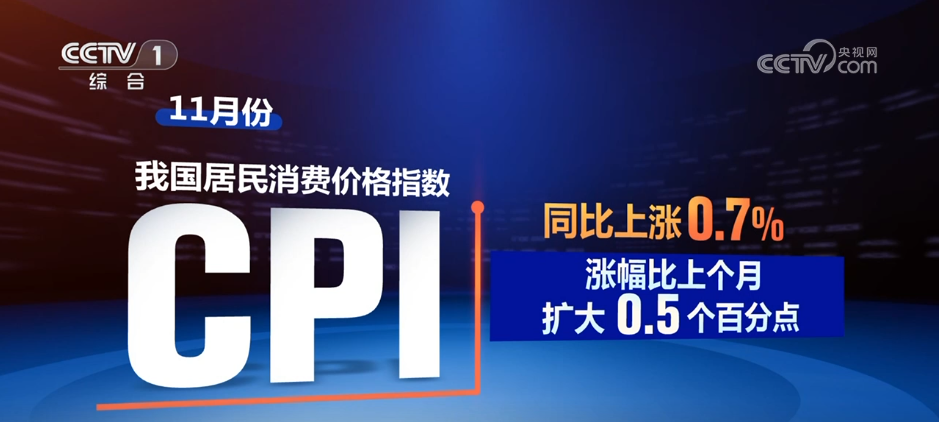
11月国内CPI同比上涨0.7%
Qi Huo Ri Bao Wang· 2025-12-11 05:56
Group 1 - The consumer price index (CPI) increased by 0.7% year-on-year in November, the highest since March 2024, driven mainly by a turnaround in food prices, which shifted from a 2.9% decline to a 0.2% increase [1] - The core CPI, excluding food and energy, rose by 1.2% year-on-year, maintaining above 1% for three consecutive months, indicating stable inflationary pressures in the service and industrial sectors [1] - The producer price index (PPI) decreased by 2.2% year-on-year, with the decline slightly widening compared to the previous month, primarily due to a high base effect from the previous year [1] Group 2 - The PPI data across various industries shows positive trends due to effective macro policies, with price declines in sectors like coal mining, photovoltaic equipment manufacturing, and lithium-ion battery manufacturing narrowing significantly [2] - The "old-for-new" policy has positively impacted prices in the automotive and home appliance sectors, contributing to the recent increase in core CPI [2] - Analysts suggest that while the price level has stabilized, further policies are needed to boost demand and support industrial prices, indicating a cautious outlook for future price movements [2][3]
2025年11月物价数据点评:菜价金价上行,出行链价格下行
BOHAI SECURITIES· 2025-12-11 02:30
Group 1: CPI Analysis - In November 2025, the CPI increased by 0.7% year-on-year, up from a previous increase of 0.2%[10] - The CPI's month-on-month change shifted from an increase to a decrease, primarily due to seasonal declines in service prices and lower energy prices[3] - Fresh vegetable prices rose significantly by 7.2%, exceeding the seasonal average decline of 3.2%, contributing approximately 0.17 percentage points to the CPI increase[13] - Pork prices decreased by 2.2%, impacting the CPI by approximately 0.07 percentage points due to sufficient market supply[13] Group 2: PPI Analysis - In November 2025, the PPI's year-on-year decline widened, while the month-on-month change remained stable[4] - The PPI is expected to show a month-on-month increase in December, with a year-on-year decline projected at -1.8%[24] - The prices of upstream raw materials, such as coal and gas, are expected to rise seasonally due to increased demand[23] - The "anti-involution" policy is expected to gradually improve prices in key industries, positively impacting the PPI in the long term[24] Group 3: Market Outlook - The CPI is projected to maintain a month-on-month growth rate near zero in December, with a year-on-year growth rate of approximately 0.5% expected for 2025[3] - The ongoing OPEC+ production increase is likely to keep oil prices under pressure, affecting the CPI negatively[3] - Core inflation is anticipated to see reduced support from gold prices, while seasonal increases in service prices are expected[3]
11月核心CPI继续上涨 扩内需政策措施继续显效
Zhong Guo Jing Ji Wang· 2025-12-11 00:29
Group 1: Consumer Price Index (CPI) Insights - In November, the CPI increased by 0.7% year-on-year, marking the highest growth since March 2024, with a month-on-month decrease of 0.1% [2][3] - The rise in CPI was primarily driven by a shift in food prices from decline to increase, with fresh vegetable prices rising by 14.5% after nine consecutive months of decline [2][3] - Core CPI, excluding food and energy, rose by 1.2% year-on-year, maintaining above 1% for three consecutive months, indicating stable inflationary pressures [2][3] Group 2: Producer Price Index (PPI) Insights - The PPI increased by 0.1% month-on-month in November, marking the second consecutive month of growth, influenced by seasonal demand increases in certain industries [4] - Year-on-year, the PPI decreased by 2.2%, with the decline slightly widening compared to the previous month, primarily due to high comparison bases from the previous year [4] - The increase in PPI was supported by rising prices in coal and gas sectors, while international oil price fluctuations led to a decrease in domestic oil and gas extraction prices [4] Group 3: Market Trends and Predictions - The ongoing "anti-involution" measures are showing results, with price declines in key industries narrowing, indicating improved market competition [5] - Emerging industries are rapidly developing, contributing to price increases in related sectors, such as a 13.9% rise in external storage devices and components [6] - Future inflation is expected to remain low, providing room for growth-stimulating policies, with a gradual recovery in consumer prices anticipated [7][8]
核心CPI同比涨幅连续3个月保持在1%以上 扩内需政策措施继续显效
Sou Hu Cai Jing· 2025-12-10 23:16
Group 1: Consumer Price Index (CPI) Insights - In November, the CPI increased by 0.7% year-on-year, marking the highest growth since March 2024, with a month-on-month decrease of 0.1% [2][3] - The rise in CPI was primarily driven by a shift in food prices from decline to increase, with fresh vegetable prices rising by 14.5% after a nine-month decline [2][3] - Core CPI, excluding food and energy, rose by 1.2% year-on-year, maintaining above 1% for three consecutive months, indicating stable inflationary pressure [2][3][8] Group 2: Producer Price Index (PPI) Insights - The PPI increased by 0.1% month-on-month in November, marking the second consecutive month of growth, influenced by seasonal demand increases in certain industries [4] - Year-on-year, the PPI decreased by 2.2%, with the decline slightly widening compared to the previous month, primarily due to high comparison bases from the previous year [4][5] - The prices in sectors such as coal mining and gas production saw significant month-on-month increases due to seasonal demand, while oil-related sectors experienced price declines [4][5] Group 3: Market Trends and Future Outlook - The ongoing "anti-involution" measures are showing results, with price declines in key industries narrowing, indicating improved market competition [5][6] - Emerging industries are driving price increases in related sectors, with notable growth in new materials and intelligent technology, suggesting a positive trend for future pricing [6][8] - The potential for moderate price recovery is anticipated, supported by stable domestic demand and effective policy measures aimed at boosting consumption [7][8]
11月CPI同比上涨0.7% 为2024年3月以来最高
Zhong Guo Zheng Quan Bao· 2025-12-10 20:17
Group 1 - In November, the Consumer Price Index (CPI) showed a slight month-on-month decrease of 0.1% but a year-on-year increase of 0.7%, marking the highest growth since March 2024 [1] - The increase in CPI year-on-year was primarily driven by a turnaround in food prices, which shifted from a decrease of 2.9% in the previous month to an increase of 0.2% [1] - The Producer Price Index (PPI) rose by 0.1% month-on-month, marking the second consecutive month of increase, while year-on-year it decreased by 2.2% [2][3] Group 2 - The core CPI, excluding food and energy prices, increased by 1.2% year-on-year, maintaining a growth rate above 1% for three consecutive months, indicating effective demand expansion policies [2] - Seasonal demand increases in certain domestic industries contributed to the rise in PPI, with coal mining and gas production prices increasing by 4.1% and 0.7% respectively [2] - The prices of fresh vegetables saw a significant turnaround, increasing by 14.5% year-on-year after nine months of decline, indicating a tightening supply due to weather and production disruptions [1][4] Group 3 - The prices of essential consumer goods, such as nutritional food manufacturing, increased by 1.1% year-on-year, reflecting the positive impact of consumption-boosting initiatives [4] - The prices of home appliances, including washing machines and air conditioners, experienced a narrowing decline compared to the previous month, suggesting a recovery in consumer demand [4] - The prices in the non-ferrous metal mining sector rose by 2.6% month-on-month, driven by international price increases, while oil and gas extraction prices fell due to declining international oil prices [3]
食品价格回升拉动 CPI涨幅创近21个月新高
Zheng Quan Shi Bao· 2025-12-10 18:54
Group 1 - The Consumer Price Index (CPI) increased by 0.7% year-on-year in November, marking the highest growth since March 2024, primarily driven by a turnaround in food prices [1][2] - The core CPI, excluding food and energy, rose by 1.2% year-on-year, maintaining a growth rate above 1% for three consecutive months [2] - Food prices increased by 0.2% year-on-year, while non-food prices rose by 0.8%, with fresh vegetable prices experiencing a significant increase of 14.5% after a decline of 7.3% in the previous month [1][3] Group 2 - The Producer Price Index (PPI) saw a month-on-month increase of 0.1% for two consecutive months, but the year-on-year decline expanded to 2.2%, influenced by high comparison bases from the previous year [2] - The narrowing of year-on-year price declines in certain industries, such as coal mining and photovoltaic equipment manufacturing, indicates the effectiveness of macroeconomic policies [3] - Emerging industries are driving price increases, with external storage devices and components seeing a year-on-year price rise of 13.9%, and arts and crafts manufacturing prices increasing by 20.6% [3]
11月CPI同比涨幅扩大 PPI连续两个月上涨
Shang Hai Zheng Quan Bao· 2025-12-10 17:56
Group 1: CPI and Core CPI Trends - In November, the Consumer Price Index (CPI) increased by 0.7% year-on-year, marking the highest level since March 2024, with the core CPI rising by 1.2% year-on-year [1][2] - The increase in CPI was primarily driven by a turnaround in food prices, which shifted from a 2.9% decline in October to a 0.2% increase in November [2] - Fresh vegetable prices saw a significant increase, rising by 14.5% year-on-year in November after nine consecutive months of decline, attributed to adverse weather affecting supply [2] Group 2: PPI Trends - The Producer Price Index (PPI) rose by 0.1% month-on-month in November, marking the second consecutive month of increase [1][4] - The rise in PPI was influenced by seasonal demand increases in industries such as coal mining, with coal prices increasing by 4.1% month-on-month [4] - Year-on-year, PPI decreased by 2.2%, with the decline slightly widening compared to October, largely due to high base effects from the previous year [4] Group 3: Emerging Industries and Price Trends - Prices in emerging industries showed signs of recovery, with significant year-on-year increases in sectors such as external storage devices (up 13.9%) and integrated circuit manufacturing (up 1.7%) [5] - The price declines in photovoltaic equipment and lithium-ion battery manufacturing narrowed, indicating a potential stabilization in these sectors [5] - Overall, the outlook for prices suggests a moderate recovery, supported by improving international trade conditions and ongoing domestic demand policies [5]