
运动鞋服

Search documents
港股运动鞋服四巨头:营收普增利润分化 折扣战致毛利率承压
经济观察报· 2025-09-02 11:42
Core Viewpoint - The article highlights the intense competition in the sportswear industry, leading to increased discounting practices that negatively impact profit growth and gross margins [2][4]. Revenue and Growth - In the first half of 2025, the four major sports brands in Hong Kong—Anta Sports, Li Ning, Xtep International, and 361 Degrees—achieved revenue growth, with Anta leading at 38.54 billion yuan and a growth rate of 14.26%. Li Ning, Xtep, and 361 Degrees reported revenues of 14.82 billion yuan, 6.838 billion yuan, and 5.705 billion yuan, with growth rates of 3.29%, 7.14%, and 10.96% respectively [4]. - Over the past three years, except for Anta, the other three brands have shown a decline in growth rates, with Xtep's revenue growth dropping from 14.76% to 7.14%, 361 Degrees from 18.00% to 10.96%, and Li Ning from 12.98% to 3.29% [4]. - Anta's revenue growth is primarily driven by its outdoor brands, while its main brands, Anta and FILA, have seen growth rates decline to single digits [4]. Online Channel Performance - Online channels have become a common growth highlight for the four companies, with Anta, Li Ning, and 361 Degrees reporting online revenue growth rates of 17.6%, 7.4%, and 45% respectively. Xtep did not disclose its overall online growth but noted that its main brand's e-commerce business grew and accounted for over 30% of total revenue [4][5]. - The online business expansion has negatively impacted gross margins, with Anta's gross margin decreasing by 0.7 percentage points to 63.37%, attributed to increased costs and discounts [5]. - Li Ning's gross margin fell by 0.4 percentage points to 50.04%, due to changes in channel structure and increased promotional discounts [5]. Profitability Analysis - Despite 361 Degrees experiencing a slight increase in gross margin by 0.2 percentage points to 41.5%, its net profit margin declined due to a significant rise in sales expenses, which increased by 13.2% to 1.037 billion yuan [6][7]. - Anta's net profit for the first half of 2025 was 7.031 billion yuan, a decrease of 8.9% year-on-year, while Li Ning's net profit fell by 10.99% to 1.737 billion yuan [7]. Industry Trends - The industry is witnessing a trend towards professionalization and specialization, with brands focusing on core categories and launching targeted products [9]. - The "big store" strategy is being adopted by all four brands, with flagship stores exceeding 1,000 square meters, offering a mix of sales, experience, and service [10]. - Overall, while the four major sports brands in Hong Kong reported revenue growth in the first half of 2025, they face challenges of differentiated growth rates and profit pressures, actively responding to industry competition through online initiatives, product segmentation, and channel upgrades [10].




安踏体育(02020):收入利润双增长,户外板块持续贡献高增长
Guosen International· 2025-09-02 11:07
Investment Rating - The report maintains a "Buy" rating for Anta Sports with a target price of HKD 116, reflecting an adjustment based on slightly better-than-expected performance in the first half of 2025 [1][4]. Core Insights - Anta Sports reported a revenue increase of 14.3% year-on-year to RMB 38.544 billion in H1 2025, with a net profit attributable to shareholders (excluding the impact of Amer's listing gains) rising by 14.5% to RMB 7.03 billion [1][2]. - The Amer brand has turned profitable, contributing approximately RMB 430 million in profit, a significant improvement from a loss of RMB 20 million in H1 2024 [2]. - The main brand, Anta, achieved revenue of RMB 16.95 billion in H1 2025, up 5.4% year-on-year, while FILA's revenue grew by 8.6% to RMB 14.18 billion, driven by strong performance in professional sports categories [3]. Financial Summary - The report projects the following earnings per share (EPS) for 2025-2027: RMB 4.84, RMB 5.36, and RMB 5.88, respectively, with an upward revision from previous estimates [1][4]. - Revenue forecasts for 2025, 2026, and 2027 are RMB 78.967 billion, RMB 86.321 billion, and RMB 93.886 billion, respectively, reflecting growth rates of 11.5%, 9.3%, and 8.8% [5][12]. - The gross profit margin is expected to stabilize around 62.2% for 2025, with a net profit margin of 17.2% [5][13]. Brand Performance - The other brands under Anta, including Descente and Kolon, saw a remarkable revenue growth of 61.1% to RMB 7.41 billion in H1 2025, with a gross margin of 73.9% [3]. - Anta's strategy includes targeting different consumer segments through various store formats and product lines, enhancing its market presence [2][3].
港股运动鞋服四巨头:营收普增利润分化 折扣战致毛利率承压
Jing Ji Guan Cha Wang· 2025-09-02 01:56
Core Insights - The four major sports brands in Hong Kong, Anta Sports, Li Ning, Xtep International, and 361 Degrees, all achieved revenue growth in the first half of 2025, but profit performance varied significantly [1][8] - Increased discounting has become a common strategy among these companies, impacting profit growth and gross margins [1][8] - The industry is witnessing a trend towards "opening large stores" and professional upgrades [1][8] Revenue and Growth - Anta Sports led with a revenue of 38.54 billion yuan, growing at 14.26%, while Li Ning, Xtep International, and 361 Degrees reported revenues of 14.82 billion yuan, 6.838 billion yuan, and 5.705 billion yuan, with growth rates of 3.29%, 7.14%, and 10.96% respectively [2] - Over the past three years, except for Anta Sports, the other three brands have shown a decline in growth rates [2] - Anta Sports has maintained double-digit revenue growth for four consecutive years, but its main brands, Anta and FILA, have seen growth rates drop to single digits, with over 10% growth driven by outdoor brands like Descente and Kolon [2] Online Sales Performance - Online channels have become a common growth highlight for all four companies, although they have negatively impacted gross margins [2][3] - In the first half of 2025, online revenue growth rates for Anta Sports, Li Ning, and 361 Degrees were 17.6%, 7.4%, and 45% respectively [2] - The online revenue share for Anta Sports, Li Ning, and 361 Degrees stands at 34.8%, 29%, and 31.8% respectively, indicating the importance of online business [3] Gross Margin Analysis - Anta Sports' gross margin decreased by 0.7 percentage points to 63.37%, attributed to increased costs in professional categories and higher online discounts [3] - Li Ning's gross margin fell by 0.4 percentage points to 50.04%, due to changes in channel structure and intensified promotional discounts [3] - 361 Degrees experienced a unique situation where its gross margin increased by 0.2 percentage points to 41.5%, driven by a "price for volume" strategy [3] Net Profit Performance - The net profit performance among the four brands showed divergence, with Anta Sports and 361 Degrees facing slowing growth, while Li Ning experienced a decline [5] - Li Ning's net profit for the first half of 2025 was 1.737 billion yuan, a decrease of 10.99% year-on-year [5] - Anta Sports reported a net profit of 7.031 billion yuan, down 8.9%, but excluding the impact of Amer Sports' listing, the net profit grew by 14.5% [5] Industry Trends - The industry is characterized by a significant trend towards specialization and upgrading, particularly in the competitive running shoe market [6][7] - All four brands are focusing on original research and development to create and upgrade their flagship running shoe IPs [6] - The trend of "opening large stores" is evident, with flagship stores exceeding 1,000 square meters, offering a mix of sales, experience, and social interaction [7]
361度(01361):大装及童装业务齐头并进
Ping An Securities· 2025-09-01 05:35
Investment Rating - The report gives a "Buy" rating for 361 Degrees, with a target price of HKD 7.20, indicating a potential upside of 13.2% from the closing price on August 29, 2025 [6][68]. Core Views - 361 Degrees is positioned to benefit from both its adult and children's apparel segments, capitalizing on the growth in sports and outdoor activities, as well as the opportunities presented by domestic brands [6][68]. - The company has shown strong revenue growth, with projected revenues of RMB 113.4 billion, RMB 126.6 billion, and RMB 140.8 billion for 2025-2027, reflecting year-on-year growth rates of 12.5%, 11.7%, and 11.2% respectively [6][68]. Summary by Sections Company Overview - 361 Degrees was established in 2003 and focuses on the research, design, production, and brand management of sports footwear and apparel. It has a strong presence in the domestic market with a total of 5,750 adult apparel stores and 2,548 children's apparel stores in China as of 2024 [10][11]. Adult Apparel Business - The adult apparel segment achieved revenue of RMB 73.8 billion in 2024, with a year-on-year growth of 19.1%. The product mix remains balanced, with footwear accounting for 58.1% and apparel for 41.9% of the segment [6][22]. - The company is enhancing its supply chain efficiency and embracing smart manufacturing, which includes a focus on advanced supply chain systems and 5G smart factories [6][50]. Children's Apparel Business - The children's apparel segment is experiencing rapid expansion, with the number of stores increasing from 1,797 in 2017 to 2,548 in 2024, representing a CAGR of 5.1%. The average store size has also increased, enhancing the shopping experience [54][56]. - The company is leveraging technology to enhance product offerings, introducing innovative footwear and apparel designed for children, which includes collaborations with popular IPs to create appealing designs [62][63]. Financial Projections - The report forecasts that the overall revenue for 361 Degrees will grow significantly, with net profits expected to reach RMB 12.9 billion, RMB 14.7 billion, and RMB 16.6 billion for 2025-2027, reflecting growth rates of 12.5%, 13.4%, and 13.0% respectively [6][68]. - The gross margin is projected to remain stable, with expectations of 41.1%, 41.3%, and 41.5% for the years 2025-2027 [6][68]. Valuation and Comparison - The report employs a relative valuation method, comparing 361 Degrees with other domestic sports brands like Anta, Li Ning, and Xtep. The target P/E ratio for 361 Degrees is set at 10.5 times for 2025 [67][69].
安踏体育(02020.HK):集团25H1营收同增14% 多品牌战略驱动中长期业绩增长
Ge Long Hui· 2025-08-30 19:04
Core Insights - Anta Sports achieved a revenue of 38.544 billion yuan in H1 2025, representing a year-on-year growth of 14.3% [1] - The net profit attributable to shareholders, excluding the dilution from Amer Sports' listing, was 7.031 billion yuan, also up 14.5% year-on-year, with a net profit margin of 18.2% [1] - The company plans to distribute an interim dividend of 1.37 HKD per share, with a stable payout ratio of 50.2% [1] Brand Performance - Anta's main brand revenue grew by 5.4% to 16.95 billion yuan in H1 2025, with a gross margin decrease of 1.7 percentage points to 54.9% due to increased investment in professional products and a higher proportion of lower-margin e-commerce sales [2] - FILA's revenue increased by 8.6% to 14.18 billion yuan, with a gross margin decline of 2.2 percentage points to 68.0% [2] - Other brands saw a significant revenue increase of 61.1% to 7.41 billion yuan, with a gross margin and operating profit margin rising to 73.9% and 33.2%, respectively, driven by high-end outdoor brands like DESCENTE and Kolon Sport [2] Channel Performance - Online sales grew by 17.6%, with online revenue accounting for 34.8% of total revenue, an increase of 2.0 percentage points year-on-year [2] - As of mid-2025, Anta's main brand operated 7,187 stores, with various new store formats being introduced [3] - FILA's store count remained stable, while DESCENTE and KOLON SPORT continued to expand rapidly [3] Strategic Initiatives - The multi-brand strategy remains central to the company's operations, with the acquisition of JACK WOLFSKIN and the establishment of a joint venture with MUSINSA to enhance market presence in China [3] - The company is expected to see net profits of 13.814 billion yuan, 15.738 billion yuan, and 17.747 billion yuan from 2025 to 2027, with year-on-year growth rates of -11.43%, 13.93%, and 12.77%, respectively [3] Outlook - The company is expected to maintain stable contributions from its main brand and FILA, while outdoor segments are anticipated to drive growth [4] - The scalability of operations and overseas expansion prospects are viewed positively, leading to a "buy" rating [4]
半年营收创新高,安踏集团并购提速再“添丁”,多元布局寻觅新增长极
Hua Xia Shi Bao· 2025-08-29 10:37
Core Viewpoint - Anta Group is actively pursuing new investment opportunities, including a potential acquisition of Reebok or Puma, while also establishing a joint venture with the Korean fashion group MUSINSA to enhance its market presence and appeal to younger consumers [2][3][4]. Financial Performance - In the first half of the year, Anta Group achieved a revenue of 38.544 billion yuan, representing a year-on-year growth of 14.3% [2][5]. - The net profit for the same period was 7.031 billion yuan, which reflects a decrease of 8.9%, but excluding the impact of a non-cash accounting gain from Amer Sports, the net profit actually increased by 14.5% [5][6]. - Revenue from the Anta brand reached 16.95 billion yuan, growing by 5.4%, while the FILA brand generated 14.18 billion yuan, up by 8.6% [5][6]. Strategic Investments - Anta Group has formed a joint venture named MUSINSA China, where it holds a 40% stake, to develop its own brand "MUSINSA STANDARD" and multi-brand stores in China [3][4]. - The joint venture is expected to be completed by September 2025, pending regulatory approval [3][4]. Acquisition Activity - The company has accelerated its acquisition strategy, having recently completed the acquisition of the German outdoor brand Jack Wolfskin [4][5]. - Anta Group has a history of acquisitions, including brands like FILA and Amer Sports, and aims to continue this trend to expand its market reach [4][5]. Inventory Management - The average inventory turnover days increased by 22 days to 136 days in the first half of 2025, which is significantly higher than competitors like Li Ning and 361 Degrees [7][8]. - The increase in inventory is attributed to a rise in stock levels and the impact of recent acquisitions [8]. Market Challenges - Anta Group's main brands, Anta and FILA, are experiencing a slowdown in growth, with FILA's revenue growth fluctuating significantly compared to previous years [6][9]. - The company faces challenges in global operations, including market control, organizational efficiency, and supply chain optimization, which are critical for its continued expansion [9].
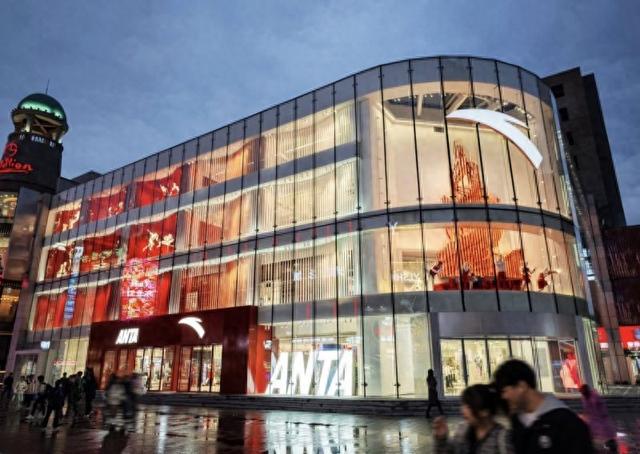
安踏集团股价连跌两日,下半年主品牌怎么走?
Xin Lang Cai Jing· 2025-08-28 12:18
Core Viewpoint - Anta Group's stock price has dropped 7.45% to HKD 95.6 after the release of its mid-year financial report for 2025, highlighting uncertainties in its development despite a revenue increase of 14.3% year-on-year [1][2]. Financial Performance - For the first half of 2025, Anta Group reported revenue of CNY 38.544 billion, a year-on-year increase of 14.3%, and a net profit of CNY 7.031 billion, up 14.5% [1]. - The FILA brand saw an 8.6% increase in revenue to CNY 14.18 billion, while the "all other brands" segment, including Descente and Kolon, experienced a significant revenue surge of 61.1% to CNY 7.41 billion [1]. Brand Performance - Anta's main brand revenue growth was only 5.4%, falling short of the high single-digit growth guidance set at the beginning of the year, attributed to poor performance from franchisees and insufficient online sales during the 618 shopping festival [2][4]. - The operating profit for the main brand increased by 12.6%, with an operating profit margin rising by 1.7%, although the gross profit margin declined by 1.7% due to increased costs and a higher proportion of online sales [4]. Strategic Initiatives - Anta plans to enhance its online channels and encourage franchisees to open collection stores and "lighthouse stores" to capture market share from competitors [6]. - Over 1,200 Anta stores have joined Meituan's flash purchase platform, with a goal of 5,000 stores by the end of the year, aiming to improve inventory turnover and meet consumer demand for instant online shopping [6]. Inventory Management - The average inventory turnover days increased by 22 days to 136 days, primarily due to the acquisition of Jack Wolfskin and pressure on sales from major brands [6][9]. - Anta's new store formats, such as "Super Anta," are designed to improve inventory turnover and increase customer spending [8]. International Expansion - Anta has initiated an "outbound" strategy to mitigate risks associated with the domestic market, with significant growth observed in Southeast Asia and the Middle East [9][10]. - The company plans to implement various marketing strategies in the U.S. market starting in 2024, including collaborations and flagship store openings [10][13]. Investment Strategy - Anta's recent acquisition of Jack Wolfskin and potential acquisition of Reebok reflect a shift in investment strategy towards mid-range outdoor brands and fashion sectors [13][14]. - The partnership with South Korean fashion group MUSINSA aims to establish a joint venture, with Anta holding a 40% stake, pending regulatory approval [14].
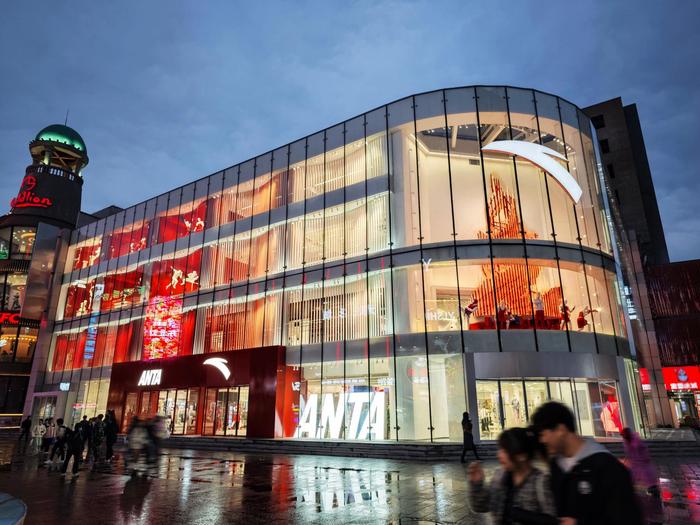
李宁(2331.HK):25H1利润下滑 坚定推进科技升级及奥运营销投入
Ge Long Hui· 2025-08-26 20:07
Core Viewpoint - The company reported a 3% revenue growth but an 11% decline in profit for the first half of 2025, with a focus on optimizing channel structure and investing in marketing resources for events like the Olympics, while maintaining a target for stable revenue and high single-digit net profit margin by 2025 [1][3] Revenue and Profit Performance - The company's revenue increased by 3.3% year-on-year to 14.817 billion, while net profit decreased by 11% to 1.737 billion; the board proposed an interim dividend of 0.3359 per share, with a payout ratio of 50% [1][3] Category Performance - In the first half of 2025, the running and training categories achieved a 15% growth, with professional running shoes sales exceeding 14 million pairs; however, basketball sales declined by 20% [1][2] Channel Performance - E-commerce revenue grew by 7% to 4.3 billion (29% of total), while offline direct sales fell by 3% to 3.4 billion (23% of total); franchise revenue increased by 4% to 6.9 billion (47% of total) [2] Store Performance - As of June 2025, the total number of stores was 7,534, a decrease of 143 stores year-on-year; the average store size for flagship stores was 242 square meters, with an average monthly sales of 300,000, slightly down from 310,000 in the first half of 2024 [2] Inventory Management - The company's channel inventory grew at a low single-digit rate year-on-year, maintaining a healthy inventory-to-sales ratio of 4 months, with 82% of channel inventory being new products within 6 months [2] Profitability Analysis - The gross margin decreased by 0.4 percentage points to 50%, while the management and sales expense ratio fell by 0.7 percentage points to 34.2%; the operating profit margin also declined by 0.2 percentage points to 16.5% [3] Future Projections - The management maintains a target for stable revenue by 2025, with projected revenues of 28.74 billion, 29.96 billion, and 31.11 billion for 2025-2027, reflecting growth rates of 0%, 4%, and 4% respectively; net profit projections are 2.38 billion, 2.53 billion, and 2.72 billion, with year-on-year growth rates of -21%, 7%, and 7% [1][3]
李宁(02331):跑步品类持续引领增长,全年指引维持
Guosen International· 2025-08-25 11:57
Investment Rating - The report maintains a "Buy" rating for Li Ning with a target price of HKD 22.6 for 2025, reflecting a 22x PE ratio [1][4][7]. Core Insights - Li Ning's revenue for the first half of 2025 increased by 3.3% year-on-year, with total revenue reaching RMB 148.17 billion. However, the net profit attributable to shareholders decreased by 11% [1][2]. - The company declared a dividend of RMB 0.3359 per share, with a payout ratio of approximately 50% [1][4]. - The growth in revenue was primarily driven by the running and training categories, which saw a 15% increase in sales. In contrast, the basketball category experienced a 20% decline [3][4]. Revenue Performance - The wholesale business recorded a 5.0% increase in revenue to RMB 64.81 billion, while direct sales revenue fell by 4.3% to RMB 32.34 billion. E-commerce revenue grew by 6.5% to RMB 51.02 billion, indicating strong performance in online sales [2][3]. - The overall gross margin for the first half of 2025 was 50.0%, a decrease of 0.4 percentage points year-on-year, attributed to increased discounting pressures in both online and offline channels [2][4]. Product Category Analysis - The running and training categories led growth, with professional running shoe sales exceeding 14 million pairs in the first half of the year. The three core series—Ultra Light, Red Rabbit, and Flying Electric—together sold over 5.26 million pairs [3][4]. - The sports lifestyle category saw a decline of 7%, while the basketball category is undergoing adjustments, with expectations of future growth following the signing of a new brand ambassador [3][4]. Store and Channel Strategy - As of June 30, 2025, the total number of Li Ning's retail stores was 6,099, reflecting a net decrease of 18 stores since the beginning of the year. The company continues to optimize its channel structure and plans to expand new store layouts as per its strategy [3][4]. Financial Forecast - The report projects earnings per share (EPS) for 2025-2027 to be RMB 0.94, RMB 1.07, and RMB 1.18, respectively, with an upward revision from previous estimates [1][4][5]. - The expected revenue growth rates for the upcoming years are 0.2% for 2025, 6.3% for 2026, and 4.7% for 2027, indicating a cautious outlook [5][10].
李宁(02331):25H1利润下滑,坚定推进科技升级及奥运营销投入
CMS· 2025-08-25 06:04
Investment Rating - The report maintains a strong buy rating for the company [4][8] Core Views - The company experienced a revenue growth of 3% in H1 2025, but net profit declined by 11%. The running category showed good growth, and the management is committed to optimizing channel structure and investing in Olympic marketing resources. The management maintains a guidance for flat revenue and a high single-digit net profit margin for 2025 [1][8] - The projected net profit for 2025-2027 is estimated at 2.38 billion, 2.53 billion, and 2.72 billion yuan, with year-on-year growth rates of -21%, 7%, and 7% respectively. The current stock price corresponds to a PE of 20 times for 2025 [1][8] Revenue Breakdown - E-commerce revenue grew by 7% to 4.3 billion yuan in H1 2025, accounting for 29% of total revenue. Offline direct sales revenue decreased by 3% to 3.4 billion yuan, representing 23% of total revenue, while franchise revenue increased by 4% to 6.9 billion yuan, making up 47% of total revenue [2] Store Performance - As of June 2025, the total number of stores was 7,534, a decrease of 143 stores year-on-year. The average store area for flagship stores was 242 square meters, with an average monthly sales of 300,000 yuan, slightly down from 310,000 yuan in H1 2024 [2] Inventory Management - The company's channel inventory increased by a low single-digit percentage year-on-year, maintaining a healthy inventory-to-sales ratio for four consecutive months. New products within six months accounted for 82% of the channel inventory [2] Financial Performance - The company reported a revenue of 14.817 billion yuan in H1 2025, a 3.3% year-on-year increase, while net profit decreased by 11% to 1.737 billion yuan. The board proposed an interim dividend of 0.3359 yuan per share, with a payout ratio of 50% [7][8] - The gross margin slightly declined by 0.4 percentage points to 50%, while the operating profit margin decreased by 0.2 percentage points to 16.5% [8] Profitability Forecast - The company is expected to maintain its focus on Olympic and technological advancements to enhance brand influence and diversify product offerings. Revenue and profit are under pressure due to weak consumer demand and intensified market competition. The projected revenue for 2025-2027 is 28.744 billion, 29.956 billion, and 31.112 billion yuan, with growth rates of 0%, 4%, and 4% respectively [8][9]