
建材

Search documents
九江市天城建材有限公司成立 注册资本100万人民币
Sou Hu Cai Jing· 2025-10-14 04:19
Core Insights - A new company, Jiujiang Tiancheng Building Materials Co., Ltd., has been established with a registered capital of 1 million RMB [1] Company Overview - The legal representative of the company is Huang Chaofeng [1] - The company’s business scope includes construction engineering contracting, sales of building materials and decorative materials, machinery equipment leasing, earthwork construction, landscaping engineering, sales of concrete structural components, and various consulting services [1] Business Activities - The company is authorized to engage in construction projects that require approval from relevant authorities, and it can operate within the validity period of the licenses obtained [1] - General business activities include sales of construction steel products, metal structures, non-metallic minerals and products, labor services (excluding labor dispatch), processing of non-metallic waste and scraps, and processing of building stones [1]
湖口县沃景建材有限公司成立 注册资本10万人民币
Sou Hu Cai Jing· 2025-10-14 04:19
Core Points - A new company, Hukou County Wojing Building Materials Co., Ltd., has been established with a registered capital of 100,000 RMB [1] - The legal representative of the company is Zhang Zhao [1] - The company's business scope includes sales of various building materials, manufacturing and sales of sealing materials, and sales of metal structures and insulation materials [1] Company Overview - Hukou County Wojing Building Materials Co., Ltd. is engaged in general projects such as building materials sales and construction decoration materials sales [1] - The company also focuses on manufacturing and selling sealing materials, as well as selling metal structures and insulation materials [1] - Additional products include ecological environment materials, fiberglass reinforced plastic products, non-metallic minerals and products, plastic products, and hardware retail [1]
国家发改委发布通知!
中国能源报· 2025-10-14 03:08
Core Viewpoint - The article discusses the implementation of the "Central Budget Investment Management Measures for Energy Conservation and Carbon Reduction," which aims to support key industries in energy conservation and carbon reduction projects, focusing on sectors such as electricity, steel, non-ferrous metals, building materials, petrochemicals, chemicals, and machinery [1][3][4]. Group 1: Investment Focus Areas - The measures support energy conservation and carbon reduction projects in key industries, including electricity, steel, non-ferrous metals, building materials, petrochemicals, chemicals, and machinery [10][11]. - Projects for clean replacement of coal consumption are supported, including low-carbon transformation of coal power units and coal chemical projects, as well as clean energy alternatives for coal-fired boilers in various industries [10][11]. - The initiative promotes circular economy projects, including the construction and transformation of resource recycling bases and the utilization of agricultural and forestry waste [11][12]. Group 2: Support Standards and Funding - The support ratio for energy conservation and carbon reduction projects in key industries, clean coal consumption replacement projects, and circular economy projects is set at 20% of the approved total investment [12]. - For local government investment projects focused on carbon peak and carbon neutrality capacity building, the support ratios vary by region, with eastern, central, western, and northeastern regions receiving 60%, 70%, 80%, and 80% respectively [12]. Group 3: Project Application and Management - Provincial development and reform departments are responsible for project application and must establish a dynamic project reserve mechanism to ensure quality and compliance with national standards [14][15]. - The application for investment funds must include detailed project information, including basic conditions, construction scale, total investment, and expected economic and social benefits [16][17]. - Projects must adhere to strict management and reporting requirements, including performance evaluation and compliance with national laws and regulations [18][19].

当前时点,如何看待周期板块
2025-12-22 01:45
Summary of Key Points from Conference Call Records Industry Overview - **Steel Industry**: - Despite record high pig iron production, the decline in metallurgical coke and iron ore prices, along with increased steel billet exports, has not translated into growth in end demand, leading to a continuous drop in steel prices. Rebar profit margins are near breakeven levels [1][3] - Investment in steel stocks should focus on fundamental indicators and supply-demand relationships. After an initial valuation recovery, stocks fell in late March due to a lack of supporting fundamentals. It is recommended to preemptively invest in second-tier stocks benefiting from falling coke and iron ore prices, such as Liugang, Shougang, and Sansteel Mingguang, with significant profit growth expected in 2025 [1][13] - **Energy Metals**: - Strategic resources like rare earths and tungsten are affected by export control policies, with tungsten prices strengthening. The demand for humanoid robots and stabilization of macro demand are expected to drive a recovery in the rare earth market, with companies like China Rare Earth, Guangsheng Nonferrous, and Northern Rare Earth being noteworthy [1][14][16] - The cobalt market is poised for a second wave of price increases due to export bans from the Democratic Republic of Congo, with companies like Huayou Cobalt and Luoyang Molybdenum being highlighted [1][17] - Nickel prices are supported around $15,000 due to Indonesia's measures to strengthen pricing power, with a planned export ban from the Philippines in June 2025 potentially tightening supply [1][18][19] - **Lithium Carbonate Market**: - The lithium carbonate market has seen a significant downward trend due to weak fundamentals, with prices dropping below previous support levels. However, it is believed to have reached a cyclical bottom, making it a good time for long-term investments [1][20] - **Construction Materials**: - The construction materials sector is stable, with a slight improvement in new home sales. Investment opportunities include domestic alternatives and companies like Keda Manufacturing and China National Materials, which are expected to benefit from AI demand and high-end chip packaging materials [1][21] Key Insights and Arguments - **Steel Production vs. Demand**: - High pig iron production does not necessarily indicate strong downstream demand, as evidenced by the ongoing decline in steel prices. Factors such as lower prices for raw materials and increased exports of semi-finished products contribute to this disconnect [1][5][6][7] - **Investment Strategy**: - The steel sector's key indicators include steel prices and gross profit per ton. If these do not align, it hampers the potential for performance recovery. Investors should closely monitor these metrics to adjust strategies accordingly [1][10][11] - **Future Recommendations**: - For 2025, it is advised to focus on second-tier stocks that will benefit from lower raw material costs, which will enhance profitability. Companies like Liugang and Shougang are expected to show significant profit growth [1][13] Additional Important Content - **OPEC's Impact on Oil and Aviation**: - OPEC's recent production increases are expected to benefit oil transportation and aviation sectors, with a projected 20% decrease in fuel costs leading to improved profitability in the aviation industry [4][22][24] - **Chemical Industry Opportunities**: - The chemical sector is seeing opportunities due to the gradual lifting of export restrictions on fertilizers, with companies like Hualu Hengsheng and Luxi Chemical being highlighted for potential gains [4][26] - **Market Dynamics**: - The coal market is currently under pressure due to high inventory levels and weak demand, but upcoming seasonal demand may stabilize prices. Recommendations include focusing on low-cost producers like Shenhua and Yanzhou Coal [1][45][46][47] This summary encapsulates the critical insights and recommendations from the conference call records, providing a comprehensive overview of the current state and future outlook of the relevant industries.
韩建河山:中标约2.07亿元项目
Mei Ri Jing Ji Xin Wen· 2025-10-13 09:07
Group 1 - The company Han Jian He Shan (SH 603616) announced on October 13 that it has won a bid for the "China Nuclear Construction Zhongke Huaxing Infrastructure Division Land Drainage Project" with a contract value of RMB 206,796,333 [1] - For the year 2024, the company's revenue composition is as follows: construction materials account for 77.76%, environmental protection industry accounts for 21.96%, and other businesses account for 0.28% [1] - As of the report date, the market capitalization of Han Jian He Shan is 2.1 billion RMB [1]

四方新材(605122.SH):前三季度商品混凝土产量同比下降15.94%
智通财经网· 2025-10-13 08:39
智通财经APP讯,四方新材(605122.SH)发布三季度产量快报,前三季度商品混凝土产量252.31万立方 米,同比下降15.94%。 ...

反内卷效果逐显,持续重点推荐青鸟消防
HUAXI Securities· 2025-10-13 08:10
Investment Rating - The industry rating is "Recommended" [4] Core Views - The report highlights the benefits of the new national fire safety standards and the commercialization of fire-fighting robots, recommending Qingniao Fire Protection as a leading beneficiary [6] - The cement industry is experiencing self-discipline and price increases under the "anti-involution" initiative, with recommendations for Huaxin Cement and Conch Cement [6] - The photovoltaic glass industry is seeing price increases from a bottoming out, with recommendations for Qibin Group, Fuyao Glass, and Xinyi Solar [6] - The report emphasizes the high demand for specialty electronic fabrics, recommending China Jushi, China National Materials, and International Composites [6] - The report suggests investing in companies with strong operational resilience and high dividends, such as Weixing New Materials and Tubao [6] Summary by Sections Cement Industry - National cement market prices decreased by 0.4% week-on-week, with average shipment rates below 45% in key regions [2][28] - Price adjustments varied by region, with increases in Hebei and Jiangxi, while declines were noted in Beijing, Tianjin, Jiangsu, Zhejiang, and Anhui [2][28] - The report anticipates continued price fluctuations in the cement market due to insufficient demand support [28] Glass Industry - The average price of float glass increased to 1289.81 CNY/ton, a rise of 5.31% from the previous week [2][67] - The industry maintains a production capacity utilization rate of 82.20%, with no significant changes in production lines [67] Real Estate Market - In the 41st week, new home transaction volume in 30 major cities decreased by 46% year-on-year and 33.94% month-on-month [3][23] - The report indicates a slight improvement in second-hand housing transactions in 15 monitored cities, with a year-on-year increase of 15% [3][23] Specialty Electronic Fabrics - China Jushi reported a revenue of 9.109 billion CNY in the first half of 2025, a year-on-year increase of 17.70% [6] - The company is advancing low-dielectric product development, with significant growth in net profit [6] Investment Opportunities - The report identifies investment opportunities in regions like Xinjiang due to increased infrastructure investments related to the 70th anniversary celebrations [7] - Recommendations include companies like Tianshan Shares and Xinjiang Jiaojian, which are expected to benefit from regional investments [7]




连云港赣榆三家企业跻身“2025江苏瞪羚企业”榜单 科技创新撑起发展“硬脊梁”
Yang Zi Wan Bao Wang· 2025-10-13 07:33
Core Insights - Jiangsu Province's Productivity Promotion Center recently released the evaluation results for "Gazelle Enterprises" in 2025, highlighting the inclusion of Jiangsu Tianyan Pharmaceutical Technology Co., Ltd., Lianyungang Zeyao Building Materials Co., Ltd., and Jiangsu Jerun Pipe Technology Co., Ltd. [1] - The recognition of these companies reflects the technological innovation vitality in the Ganyu District, contributing to high-quality regional development [1] - Gazelle Enterprises are characterized by rapid growth, strong innovation capabilities, and significant development potential [1] Company Summaries - Jiangsu Tianyan Pharmaceutical is one of the few domestic companies with full-chain production capabilities for soft contact lenses, holding 7 Class III medical device registrations and producing 500 million soft lenses annually, with a projected annual revenue exceeding 300 million yuan after the second phase of its project [1][2] - Lianyungang Zeyao Building Materials focuses on new metal materials R&D and smart manufacturing, recognized as a national high-tech enterprise in 2024, with R&D investments totaling 11.6471 million yuan over the past four years and a compound annual growth rate of 55.48% from 2021 to 2024 [2] - Jiangsu Jerun Pipe Technology is a national high-tech enterprise with 46 patents and an R&D investment of 626,100 yuan in 2024, successfully converting over 20 research outcomes into products, including green-certified stainless steel composite pipes [2] Industry Trends - Ganyu District prioritizes the cultivation of innovative enterprises, implementing national and provincial policies to enhance innovation resources and services directed at these companies [2] - The district aims to elevate traditional industries, expand emerging industries, and foster future industrial ecosystems, accelerating the transformation of technological innovations into productive forces [2]

绿色革命下建筑材料产业链的创新之路
Qi Huo Ri Bao Wang· 2025-10-13 00:31
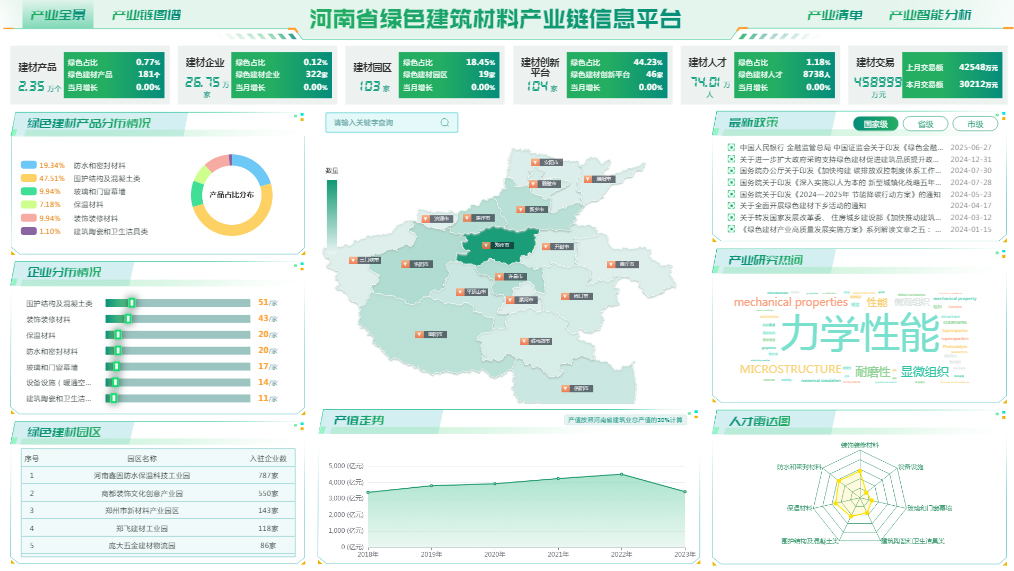
Group 1 - The construction and building materials industry is undergoing a significant green transformation driven by "dual carbon" goals, integrating low-carbon and digital solutions across the entire industry chain [2] - The development concept of scale, intensification, and platformization is providing continuous momentum for this green revolution [2] Group 2 - The Henan Zhongyu Material Trade Co., Ltd. has launched a green building materials industry chain information platform in Henan Province, which includes six major sections: building materials products, enterprises, parks, innovation platforms, talent, and transactions [3] - The platform has registered 1,009 suppliers and 313 purchasing users, with a total transaction volume exceeding 150 million yuan [3] Group 3 - The platform aims to promote collaborative development within the industry chain by connecting various stakeholders, including green enterprises and service institutions [4] - The platform will also integrate with smart warehousing and online freight platforms to provide comprehensive supply chain services, optimizing resource allocation to help enterprises reduce costs and increase efficiency [4] Group 4 - Policy support is crucial for the development of the two platforms, which will assist the Henan building materials industry in pursuing innovation and sustainability [5] - The company is extending its green supply chain system upstream to provide comprehensive raw material supply solutions, including steel and non-ferrous metals [6] Group 5 - The company has innovatively established a value conversion path from solid waste to green building materials, addressing the environmental issues associated with solid waste disposal from power plants [6] - The produced gypsum mortar, which replaces cement mortar, significantly reduces energy consumption by approximately 50% compared to cement production and meets green building material standards [6][7]
【早知道】住建部:研究若干个落实中央城市工作会议精神的配套文件;工信部:开展卫星物联网业务商用试验
Zheng Quan Shi Bao Wang· 2025-10-13 00:28
Group 1 - The Ministry of Housing and Urban-Rural Development will collaborate with relevant departments to formulate supporting documents to implement the spirit of the Central Urban Work Conference [1] - The Ministry of Industry and Information Technology is conducting commercial trials for satellite IoT services [1] - In September, the number of new accounts reached 2.9372 million, representing a year-on-year increase of 60.73% [1] Group 2 - The logistics demand continues to improve, with the logistics industry prosperity index in September showing a month-on-month rebound [1] - The Shanghai government is accelerating the cultivation of industries such as silicon photonics, 6G, fourth-generation semiconductors, and brain-like intelligence [1] - The Ministry of Transport will impose special port service fees on American vessels [1]
