服装

Search documents
爱世纪集团发布中期业绩 股东应占溢利约为440万港元 同比增长100.7%
Zhi Tong Cai Jing· 2025-11-27 12:44
Core Insights - The company reported a revenue of HKD 92.595 million for the six months ending September 30, 2025, representing a year-on-year increase of 2.64% [1] - The profit attributable to the company's owners was approximately HKD 4.4 million, showing a significant year-on-year growth of 100.7% [1] - Basic earnings per share were reported at 1.0 HKD cent [1] Revenue Sources - The group's revenue primarily comes from providing supply chain management services for clothing, with key products including outerwear, woven shirts, pullovers, pants, shorts, T-shirts, and other items such as skirts, vests, caps, and cloaks [1]
你的30年行业经验,是AI时代的“黄金”还是“石头”?
Sou Hu Cai Jing· 2025-11-27 12:36
Core Insights - The article discusses the anxiety traditional industries face in the age of AI, questioning the practical benefits AI can bring to manufacturing, consumer goods, and supply chains [1] - Liu Chen, CEO of Lingdi Technology Style3D, shares his journey from traditional garment manufacturing to leading a tech unicorn, emphasizing the need for AI to address core industry challenges like inventory and efficiency [2][3] - The future of manufacturing may shift from low-cost labor countries to locations closer to consumers as AI and automation reduce labor costs [2][3] AI Integration in Traditional Industries - Liu Chen advocates for a dual approach of combining AI with core technologies (e.g., 3D modeling) to transform traditional industries, rather than relying solely on AI-generated content [4][5] - The integration of AI and core technologies can lead to exponential improvements in productivity, allowing tasks that once took large teams weeks to complete to be done by a single individual in hours [5] Organizational Transformation - The structure of organizations is shifting from linear to networked models, emphasizing the importance of proprietary data for competitive advantage [6] - CEOs must take on the role of "AI architects," understanding data governance and AI workflows to avoid transformation efforts becoming mere IT tasks [7][8] Educational Insights - The course led by Liu Chen aims to provide traditional industries with a framework to leverage technology for business model transformation, applicable across various sectors [9] - Key questions addressed in the course include the integration of general and specialized AI models, data governance, the role of CEOs in AI transformation, and the characteristics of "super individuals" in the AI era [11]


森马服饰11月27日大宗交易成交205.56万元
Zheng Quan Shi Bao Wang· 2025-11-27 11:41
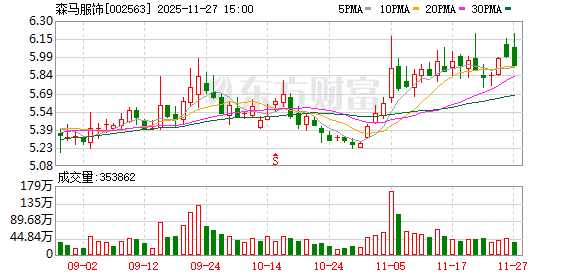
Group 1 - The core transaction on November 27 involved a block trade of 344,900 shares of Semir Apparel, with a transaction value of 2.0556 million yuan and a transaction price of 5.96 yuan, representing a premium of 0.68% over the closing price of the day [2][3] - The closing price of Semir Apparel on the same day was 5.92 yuan, reflecting a decline of 1.17%, with a turnover rate of 1.60% and a total trading volume of 213 million yuan, indicating a net outflow of 6.6917 million yuan in main funds [2][3] - Over the past five days, Semir Apparel's stock has increased by 0.68%, but there has been a cumulative net outflow of funds amounting to 7.4894 million yuan [2][3] Group 2 - The latest margin financing balance for Semir Apparel is 201 million yuan, which has decreased by 4.7669 million yuan over the past five days, representing a decline of 2.31% [3] - Semir Apparel was established on February 5, 2002, with a registered capital of 2.69409 billion yuan [3]

嘉曼服饰(301276) - 2025年11月27日投资者关系活动记录表
2025-11-27 10:52
Sales Performance - The sales situation for the fourth quarter is better than expected, with competitive performance in the autumn and winter product lines [2] - The adult shoe category under Hush Puppies has started self-operation, contributing additional sales revenue, although its current sales proportion remains low [2] Future Planning - The company plans to focus on classic casual styles for Hush Puppies' adult clothing and will continue to optimize products around family and vacation leisure scenarios [2][3] - Hush Puppies' adult shoe business will expand through independent stores and quality channels, despite its current small sales proportion [3] Channel Strategy - The company is optimizing offline channels by opening stores in high-traffic shopping centers and closing underperforming locations [3] - Future development will emphasize direct sales channels for adult clothing and shoes, while also supporting franchise expansion [3] Team Structure - The company has established independent teams for men's and women's clothing and shoes, with the adult shoe team still in the early stages of development [3] Pricing and Discounts - Sales discounts for various brands will remain stable, with slight adjustments based on market conditions and promotional strategies [3] Design and Collaboration - Most products are designed by in-house teams, with some collaborations with well-known designers or design teams [3] Dividend Policy - The company aims to maintain a stable dividend ratio, with potential increases as profitability improves and without significant capital expenditures [4]
12月金股报告:市场胜率波动而非扭转,震荡期需关注赔率空间
ZHONGTAI SECURITIES· 2025-11-27 10:34
Core Insights - The report indicates that market volatility is driven by fluctuations in win rates rather than a complete reversal, suggesting that the index is expected to remain in a state of oscillation [5][6] - The overall market liquidity remains ample, with margin financing balances at 2.46 trillion yuan, placing it in the 97.5th percentile over the past three years [3] - The report highlights that the recent market decline reflects a phase of win rate logic fluctuations, primarily influenced by external factors such as the Federal Reserve's interest rate decisions and concerns over AI-related debt [3][4] Market Analysis - The technology sector continues to face adjustments primarily due to expectation volatility, with the AI industry chain experiencing high valuations and limited upside potential [4] - Defensive demand and a slight recovery in domestic inflation are benefiting dividend and cyclical styles, as indicated by a 0.2% year-on-year increase in October CPI, marking the first positive change in four months [4] - The report notes that the win rate logic has not shifted, with the Federal Reserve's interest rate trajectory remaining below expectations, while the U.S. economy may require further rate cuts [5] Investment Strategy - The report suggests a focus on sectors with lower crowding within technology, such as gaming and media, while also recommending global pricing resources like gold and copper due to the backdrop of overseas rate cuts and fiscal expansion [6] - The December stock selection includes a mix of ETFs and individual stocks across various sectors, emphasizing a defensive strategy amid market oscillation [9][10]





慕诗国际发布中期业绩 股东应占亏损1858.3万港元 同比收窄21.28%
Zhi Tong Cai Jing· 2025-11-27 10:23
Core Insights - Mousse International (00130) reported a revenue of HKD 48.172 million for the six months ending September 30, 2025, representing a year-on-year decrease of 4.74% [1] - The company recorded a loss attributable to shareholders of HKD 18.583 million, which is a year-on-year improvement of 21.28% [1] - The basic loss per share was HKD 0.06 [1]
CFO如何与AI“共舞”?多位CFO热议AI重塑财务领导力
2 1 Shi Ji Jing Ji Bao Dao· 2025-11-27 09:57
Core Insights - The role of CFOs is evolving from traditional financial oversight to becoming strategic leaders who leverage AI for decision-making and value creation [1][3][5] Group 1: Transformation of CFO Role - CFOs are transitioning from being mere accountants to strategic partners, emphasizing the importance of data-driven decision-making [2][3] - The integration of AI in financial management is seen as essential for enhancing efficiency and effectiveness in operations [4][5] Group 2: AI Implementation and Challenges - Companies are adopting AI solutions to streamline processes, with significant reductions in operational burdens, such as an 80% decrease in business financial consulting needs [4] - The importance of data integrity and unified standards is highlighted, as many companies struggle with inconsistent financial data [4][5] Group 3: Risk Management and Compliance - Despite the efficiency gains from AI, human judgment remains crucial in decision-making, particularly in compliance and risk management [5][6] - CFOs must balance the speed of AI with the necessity of maintaining compliance and risk controls, ensuring that AI outputs are validated against business realities [6][7]
森马服饰11月27日现1笔大宗交易 总成交金额205.56万元 溢价率为0.68%
Xin Lang Cai Jing· 2025-11-27 09:26
Group 1 - The core point of the article highlights the trading activity of Semir Apparel, which experienced a decline of 1.17% on November 27, closing at 5.92 yuan [1] - A significant block trade occurred, with a total volume of 344,900 shares and a transaction amount of 2.0556 million yuan, indicating a premium rate of 0.68% [1] - The buyer and seller for the block trade were both from Everbright Securities Co., Ltd., Ningbo Liuting Street Securities Business Department [1] Group 2 - Over the past three months, the stock has recorded only one block trade, with a total transaction amount of 2.0556 million yuan [1] - In the last five trading days, the stock has seen a cumulative increase of 0.68%, while the net outflow of main funds totaled 31.7282 million yuan [1]
中国经济样本观察·县域样本篇 | 72小时定制羽绒服可交付!这座江苏小城如何引领国际时尚
Xin Hua She· 2025-11-27 09:23
Core Insights - The article highlights the impressive growth of Changshu's textile and apparel industry, showcasing a sales figure of 5.2 billion yuan on Douyin during this year's "Double Eleven," marking a 35.8% year-on-year increase [1] - Changshu's textile and apparel exports reached 19.01 billion yuan from January to October, reflecting a 4.7% growth [1] - The city has over 5,000 enterprises producing more than 500 million garments annually, establishing itself as a significant hub in the global textile and apparel industry [3] Industry Overview - Changshu's textile and apparel industry has a production value of nearly 60 billion yuan, growing at approximately 10% annually [3] - The city is a major exporter of down jackets, accounting for a substantial portion of China's exports in this category [3] - The local market connects with 179 countries and regions, with an annual transaction volume exceeding 200 billion yuan [3] Production Efficiency - The complete industrial chain in Changshu, from textile production to garment manufacturing, enhances efficiency [4] - The production process is highly streamlined, with some garments being completed in as little as three to four minutes [3] - The city has developed a robust online and offline sales network, with over 70,000 people engaged in e-commerce, generating over 100 billion yuan in online sales, predominantly in apparel [4] Innovation and Technology - Changshu is focusing on digital transformation and smart manufacturing to adapt to market demands for small-batch and diverse production [8] - The establishment of a rapid intellectual property rights protection center has significantly reduced the patent authorization period for designs to just five days, encouraging innovation [9] - The city is actively promoting the integration of AI and technology in the textile and apparel sector, as outlined in the recently released development white paper [11] Future Development Plans - Changshu aims to elevate its position in the global value chain by focusing on high-end products and innovative designs [10] - The city has launched a three-year action plan for outdoor sports industry development, aiming to create a vibrant market for outdoor apparel [12] - Efforts are being made to attract talented designers and foster a creative ecosystem, positioning Changshu as a source of fashion brands rather than just a manufacturing base [15]
国产品牌加速崛起 高端羽绒服市场格局生变
Sou Hu Cai Jing· 2025-11-27 07:45
Core Insights - The high-end down jacket market in China is experiencing significant changes, with domestic brands like Bosideng, Gao Fan, and Meili Cheng making strong inroads against established international brands such as Canada Goose and Moncler [1][5]. Group 1: International Brands Performance - Moncler reported a revenue of €1.841 billion for the first three quarters of 2025, showing a 1% decline year-on-year when calculated at current exchange rates [2]. - Canada Goose's revenue for the three months ending September 28, 2025, was CAD 273 million, reflecting a 1.8% increase year-on-year at current exchange rates, but an operating loss of CAD 17.6 million was reported [2][3]. - Both brands highlighted strong performance in the Chinese market, which has become a key growth driver despite challenges in other regions [2][3]. Group 2: Domestic Brands Growth - The Chinese down jacket market is projected to exceed ¥227 billion in 2024, with a 15% year-on-year growth, and the high-end segment (priced above ¥2,000) is expected to grow at 20% [5]. - Bosideng has significantly increased its product prices, with flagship items now ranging from ¥2,000 to ¥3,000, and some premium lines exceeding ¥10,000 [6][7]. - Gao Fan is expanding its presence with 23 stores across various provinces, indicating a strategic push into the high-end market [8]. Group 3: Product Innovation and Competition - High-end down jackets are competing on multiple fronts, including filling materials, technology, and design, with goose down becoming a standard for premium products [11]. - Brands are focusing on technological advancements, such as windproof and waterproof materials, to enhance product performance [12]. - Innovative designs and collaborations are being utilized to attract consumers, with brands like Moncler and Gao Fan integrating unique cultural elements into their products [13][15]. Group 4: Consumer Behavior and Market Dynamics - Consumers are increasingly discerning, valuing quality, experience, and brand narratives, which influences their purchasing decisions in the high-end down jacket market [14]. - The competitive landscape is intensifying, with domestic brands challenging international players, necessitating a focus on genuine quality to maintain market positioning [14].