
玻璃制造

Search documents
中信重工:新型自清洁光伏玻璃发布 绿色发展再添动能
Zheng Quan Shi Bao Wang· 2025-09-05 10:07
Core Viewpoint - CITIC Heavy Industries has achieved a significant breakthrough in the high-performance photovoltaic glass sector with the launch of its self-cleaning photovoltaic glass product, addressing key maintenance challenges and contributing to the green low-carbon development of the industry [1] Group 1: Technical Innovation and Performance - The self-cleaning photovoltaic glass features a special functional coating that prevents dust and liquid stains from adhering, allowing for easy removal with rainwater or clean water, thus enhancing the cleaning convenience and power generation efficiency compared to traditional photovoltaic glass [2] - The product exhibits superior physical properties, with a pencil hardness of 5H, significantly exceeding the national standard of 3H, and shows no change after 30 cycles of rubber abrasion; the water contact angle is below 5°, close to 0°, outperforming the national standard of less than 10°, demonstrating excellent hydrophilicity [2] - In the adhesive tape test for dirt resistance, the product showed stable performance, validating its reliability and durability [2] Group 2: Application Prospects and Green Development - The research and development of this product was a collaborative effort involving multiple research institutions, focusing on ultra-fine nanomaterials to overcome key process bottlenecks, achieving full control from technical validation to large-scale production [3] - In the context of the "dual carbon" strategy and green low-carbon development, the application prospects for self-cleaning photovoltaic glass are extensive, with potential uses in solar power plants, high-rise building facades, rail transportation, and automotive glass, promoting broader energy-saving and environmental protection practices [3] - CITIC Heavy Industries aims to leverage this launch to continue its commitment to "innovation-driven, green development," optimizing product performance and accelerating the global application and promotion of new material technologies [3]

玻璃纯碱早报-20250905
Yong An Qi Huo· 2025-09-05 03:24
Report Industry Investment Rating - No relevant content provided Core Viewpoints - No clear core viewpoints are presented in the given content Summary by Related Catalogs Glass - **Price and Spread Changes**: From August 28 to September 4, 2025, the price of 5mm large - plate glass in some regions showed different trends. For example, the price of 5mm large - plate glass of Shahe Great Wall increased by 11.0 week - on - week and 9.0 day - on - day; FG9 - 1 spread increased by 15.0 week - on - week and 6.0 day - on - day [1]. - **Profit Changes**: During the same period, the profit of North China coal - fired glass increased by 19.5 week - on - week and 9.4 day - on - day; the profit of North China natural gas glass increased by 15.2 week - on - week and 9.0 day - on - day [1]. - **Market Conditions**: The production and sales of glass in Shahe factories were average, with low - price sales of Shahe traders around 1113 and average shipments; the price of factories in Hubei Province was around 1000, with average transactions. The production and sales rates of glass in different regions were: Shahe 97, Hubei 106, East China 86, and South China 99 [1]. Soda Ash - **Price and Spread Changes**: From August 28 to September 4, 2025, the price of heavy soda ash in some regions changed. For example, the price of heavy soda ash in Shahe decreased by 10.0 week - on - week and then increased by 20.0 day - on - day; SA09 - 01 spread increased by 7.0 week - on - week and 1.0 day - on - day [1]. - **Profit Changes**: The profit of North China ammonia - soda process decreased by 12.4 week - on - week and then increased by 0.6 day - on - day [1]. - **Market Conditions**: The spot price of heavy soda ash in Hebei delivery warehouses was around 1160, and the price delivered to Shahe was around 1200. The industry showed factory de - stocking and delivery warehouse inventory accumulation, with overall slight de - stocking [1].
玻璃纯碱产业风险管理日报-20250905
Nan Hua Qi Huo· 2025-09-05 01:43
Report Industry Investment Rating - Not provided Core Viewpoints - There is a contradiction between macro expectations and industrial logic, and there are temporary differences in far - month pricing without a clear direction [2] - For glass, the mid - upstream inventory is at a high level, the phased restocking ability is weak, and the market is in a state from weak balance to weak surplus. For纯碱, the pattern of strong supply and weak demand remains unchanged [2][3] Summary by Related Catalogs Price Forecast - The monthly price range forecast for glass is 1000 - 1400, with a current 20 - day rolling volatility of 22.99% and a 3 - year historical percentile of 54.2%. For纯碱, the price range is 1100 - 1500, with a volatility of 26.73% and a 3 - year historical percentile of 42.3% [1] Hedging Strategies Glass - For inventory management with high finished - product inventory, sell FG2601 futures at 1450 with a 50% ratio and sell FG601C1420 call options at 50 - 60 with a 50% ratio. For procurement management with low regular inventory, buy FG2601 futures at 1100 - 1150 with a 50% ratio and sell FG601P1100 put options at 40 - 50 with a 50% ratio [1] 纯碱 - For inventory management with high finished - product inventory, sell SA2601 futures at 1550 - 1600 with a 50% ratio and sell SA601C1500 call options at 60 - 70 with a 50% ratio. For procurement management with low regular inventory, buy SA2601 futures at 1200 - 1250 with a 50% ratio and sell SA601P1200 put options at 40 - 50 with a 50% ratio [1] Core Contradictions - There is a contradiction between macro expectations and industrial logic, and there are differences in far - month pricing direction [2] 利多 and 利空 Analysis - **利多**: Cost has an upward expectation affecting far - month pricing, and policy expectations cannot be completely excluded [2] - **利空**: The mid - upstream inventory of glass and 纯碱 is high, and the downstream's ability to absorb is questionable [2] Glass Fundamentals - The mid - upstream inventory is at a high level, and the phased restocking ability is weak. The daily melting volume on the supply side is stable at around 15.9 - 16 tons with a slight upward expectation. The cumulative apparent demand from January to August decreased by 7%, and the spot market is in a state from weak balance to weak surplus [2][3] 纯碱 Fundamentals - The medium - and long - term supply is expected to remain high. The normal maintenance continues, and the commissioning of Yuanxing Phase II is a focus this year. The fundamentals of photovoltaic glass have improved, and the spot price is expected to rise further. The overall rigid demand for 纯碱 is stable, and the supply - demand pattern of strong supply and weak demand remains unchanged [3] Price and Spread Data Glass - On September 5, 2025, the 05 contract price was 1236, the 09 contract price was 950, and the 01 contract price was 1139. The 5 - 9 month - spread was 286, the 9 - 1 month - spread was - 189, and the 1 - 5 month - spread was - 97 [4] 纯碱 - On September 5, 2025, the 05 contract price was 1357, the 09 contract price was 1160, and the 01 contract price was 1277. The 5 - 9 month - spread was 197, the 9 - 1 month - spread was - 117, and the 1 - 5 month - spread was - 80 [6] Spot Price Data Glass - On September 4, 2025, the average price of沙河 glass was 1124, and prices in various regions were mostly stable [5] 纯碱 - On September 4, 2025, the heavy - alkali market prices in different regions were mostly stable, with the price in沙河 rising from 1176 to 1192 [8]
刷新全球纪录!金晶科技28米超白玻璃巨无霸下线,单片面积突破92.4平方米-财经-金融界
Jin Rong Jie· 2025-09-05 00:23
Group 1 - The successful production of the 92.4 square meter ultra-white glass marks a new record for the largest single piece of ultra-white glass produced by Jinjing Technology, surpassing the previous record of 26 meters [1] - The production process of the ultra-white glass involves complex process control and precise technical operations, requiring high stability of the production line and skill levels of the operators [1] - Jinjing Technology has optimized and upgraded its equipment performance through cold modification of the production line, ensuring stable production of large-sized products [1] Group 2 - The new ultra-white glass product has significant applications in high-end sectors such as building curtain walls and solar photovoltaic fields, providing larger product options for these applications [2] - The introduction of larger ultra-white glass products can reduce the number of joints in building curtain walls, enhancing overall aesthetics and structural stability, while also improving construction efficiency and lowering overall costs [2] - Jinjing Technology plans to continue its innovation-driven and quality-first development approach, aiming to provide more technical solutions for the building and energy sectors through ongoing manufacturing process improvements [2]

2025年,到底是“咬牙买房”还是“尽快卖房”,曹德旺给出忠告:别傻了,再等或许更危险
Sou Hu Cai Jing· 2025-09-04 22:31
Core Viewpoint - The core message from Cao Dewang emphasizes the disconnect between the wealthy who own multiple properties and the ordinary people who genuinely need housing, suggesting that the future real estate market will primarily involve transactions among the wealthy [2][5][10]. Group 1: Real Estate Market Dynamics - Cao Dewang points out that the real estate market is increasingly becoming a game where "rich people sell to rich people," leaving ordinary families unable to afford homes [5][8]. - He warns that the current situation resembles "The Emperor's New Clothes," where everyone knows the truth about the market but is afraid to speak out due to potential repercussions on property values [7][10]. - The hidden costs of property ownership, such as maintenance fees, vacancy losses, and potential property taxes, could lead to significant financial burdens for homeowners [7][10]. Group 2: Advice for Ordinary Buyers - For those who have not yet purchased a home, Cao advises to focus on the primary purpose of housing, which is to live in it, rather than viewing it as an investment [10][21]. - He suggests that individuals with multiple properties should consider selling them before the market becomes less favorable for selling [11][21]. - The emphasis is placed on the importance of being cautious and rational in the current real estate environment, as the market may not always provide the expected returns [10][21]. Group 3: Economic Implications - Cao Dewang expresses concern that the excessive focus on real estate is detrimental to the manufacturing sector, which is essential for economic stability [15][21]. - He highlights that high property prices lead to increased rents, making it difficult for businesses to thrive, as they end up paying substantial amounts to landlords [15][21]. - The overall message is a call for a return to valuing manufacturing and practical economic activities over speculative real estate investments [15][21].


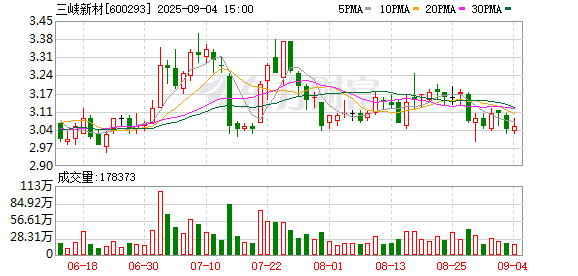
三峡新材:2025年第二次临时股东大会决议公告
Zheng Quan Ri Bao· 2025-09-04 13:36
Group 1 - The company announced that the second extraordinary general meeting of shareholders for 2025 will be held on September 4, 2025 [2] - The meeting will review and approve the proposal to cancel the supervisory board and amend the company's articles of association [2]

菲利华(300395) - 300395菲利华投资者关系管理信息20250904
2025-09-04 09:26
Group 1: Quartz Electronic Fabric Development - In the first half of 2025, the sales revenue of quartz electronic fabric reached 13.12 million yuan, currently in small batch testing and client certification phase [1] - The company is closely monitoring market conditions to plan and build production capacity, but faces uncertainties due to client product iterations and testing [1][2] Group 2: Photomask Substrate Technology - The company is among the few in China engaged in synthetic quartz glass R&D and manufacturing, leading in large-scale production technology [3] - Successfully developed G10.5 generation photomask substrates in 2022, with production capabilities ranging from G4.5 to G10.5 [3] Group 3: Semiconductor Material Localization - The company is advancing technology R&D and process improvements for domestic substitution of quartz glass materials [4] - High-purity synthetic quartz sand project has entered the pilot test phase, with stable production capabilities for black and white quartz and high uniformity synthetic quartz products [4] Group 4: Aerospace Business Progress - The company is one of the few global manufacturers with mass production capabilities for quartz glass fibers, serving as a leading supplier in the aerospace sector [5] - Ongoing development of advanced structural and functional composite materials based on market and client needs [5][6] Group 5: Market Demand and Production Capacity - In the first half of 2025, demand for quartz fibers has rebounded, with multiple high-performance composite material projects successfully developed and one project entering mass production [6]

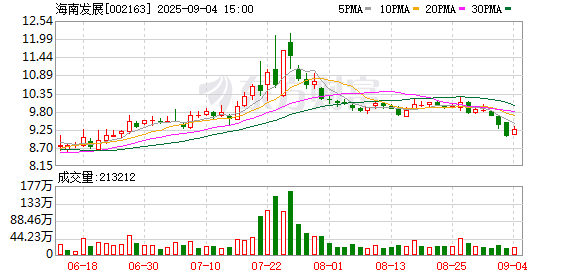
海南发展:核心业务涵盖了从玻璃深加工到幕墙与内装工程的玻璃产业链
Zheng Quan Ri Bao· 2025-09-04 08:37
Core Viewpoint - The company, Hainan Development, has a strong competitive advantage in the glass industry chain, covering deep processing to curtain wall and interior decoration engineering [2] Business Overview - The company's core business includes a comprehensive glass industry chain from deep processing to curtain wall and interior decoration engineering [2] - Hainan Development possesses strong supporting capabilities in both upstream and downstream segments of the industry chain, driven by market needs and vertical expansion [2] - Detailed information on the company's product profitability can be found in the "Management Discussion and Analysis" section of the 2024 annual report and the 2025 semi-annual report [2]

旗滨集团涨2.07%,成交额1.45亿元,主力资金净流出425.33万元
Xin Lang Zheng Quan· 2025-09-04 05:34
Core Viewpoint - Qibin Group's stock price has shown a positive trend with a year-to-date increase of 15.36%, reflecting strong performance in the glass manufacturing sector [1][2]. Financial Performance - For the first half of 2025, Qibin Group reported operating revenue of 7.393 billion yuan, a year-on-year decrease of 6.55%, while net profit attributable to shareholders increased by 9.77% to 891 million yuan [2]. - Cumulative cash dividends since the company's A-share listing amount to 7.92 billion yuan, with 1.666 billion yuan distributed over the past three years [3]. Shareholder Information - As of August 20, 2025, the number of shareholders for Qibin Group is 106,200, a slight decrease of 0.17% from the previous period, with an average of 25,259 circulating shares per person, which increased by 0.17% [2]. - The top ten circulating shareholders include notable entities such as Invesco Great Wall New Energy Industry Stock A and Hong Kong Central Clearing Limited, with changes in their holdings noted [3]. Stock Market Activity - On September 4, Qibin Group's stock rose by 2.07%, reaching 6.42 yuan per share, with a trading volume of 145 million yuan and a turnover rate of 0.85% [1]. - The stock has experienced a 25.51% increase over the past 60 days, indicating strong market interest [1].

玻璃纯碱早报-20250904
Yong An Qi Huo· 2025-09-04 01:18
| | | | | | 纯 碱 | | | | | | | | --- | --- | --- | --- | --- | --- | --- | --- | --- | --- | --- | --- | | | 2025/8/27 | 2025/9/2 | | 2025/9/3 周度变化 日度变化 | | | 2025/8/27 | 2025/9/2 | | 2025/9/3 周度变化 日度变化 | | | 沙河重碱 | 1210.0 | 1170.0 | 1180.0 | -30.0 | 10.0 | SA05合 约 | 1375.0 | 1347.0 | 1357.0 | -18.0 | 10.0 | | 华中重碱 | 1200.0 | 1160.0 | 1160.0 | -40.0 | 0.0 | SA01合约 | 1307.0 | 1267.0 | 1276.0 | -31.0 | 9.0 | | 华南重碱 | 1450.0 | 1320.0 | 1320.0 | -130.0 | 0.0 | SA09合约 | 1191.0 | 1152.0 | 1158.0 | -33.0 | 6.0 | | ...