智能手机

Search documents
“双十一”手机销量同比仅增长3%,苹果iPhone 17独撑大局
Hua Er Jie Jian Wen· 2025-11-27 13:55
Group 1 - The core viewpoint of the articles indicates that Apple dominated the smartphone sales during the Double 11 shopping festival, capturing 26% of the total smartphone sales, while overall smartphone sales increased by 3% year-on-year [1] - Excluding Apple, smartphone sales during the Double 11 period actually declined by 5%, highlighting Apple's strong performance with the iPhone 17 [1] - The Double 11 shopping festival this year saw a total sales figure of 1.70 trillion yuan (approximately 240 billion USD), an increase from last year's 1.44 trillion yuan, although the shorter duration of last year's event affects comparability [2] Group 2 - Huawei's market share decreased from 17% last year to 13% this year, partly due to the missed sales period for its flagship Mate 80 [1] - Xiaomi held the second position with a 17% market share, but its sales declined compared to the previous year, attributed to the early release of the Xiaomi 17 series [1] - Major platforms started their Double 11 promotions significantly earlier this year, with Tmall, JD, and Douyin launching activities on October 15, October 9, and October 9 respectively, extending the shopping festival period to 31-57 days [1]

“摔不碎”的新材料,为啥手机厂商都不太敢宣传
3 6 Ke· 2025-11-27 12:13
Core Viewpoint - The evolution of smartphone materials has shifted from metal and glass to a new composite material, fiberglass reinforced composite, which offers high strength and flexibility while being less fragile than glass [1][10]. Group 1: Material Evolution - The introduction of 5G and wireless charging technologies has led to the decline of metal body designs in smartphones [1]. - Smartphone casing materials have become binary, with low-end models using plastic and high-end models typically featuring metal frames with glass bodies [3]. - Recent trends show that some previously plastic-cased models are upgrading to metal frames and glass backs, while high-end flagship models are less focused on promoting specific types of glass [5][7]. Group 2: New Material Adoption - A new material, fiberglass reinforced composite, is emerging as a popular choice for smartphone backs due to its combination of strength and flexibility [10]. - Different brands are adopting varied marketing strategies regarding this new material, with some avoiding specific mentions and others creating unique names for it [9]. - The historical use of fiberglass reinforced composite in other industries has led to a perception issue, as it is seen as less prestigious compared to traditional glass materials [12][14]. Group 3: Consumer Perception - The lack of "emotional value" associated with fiberglass reinforced composite affects its marketability, as consumers often seek materials that convey a sense of luxury or high status [14]. - Manufacturers tend to use or rebrand this material without highlighting its benefits, as it does not carry the same high-end connotation as other materials like special glass or carbon fiber [12][14].

持续优化供给侧结构 加大资源投入力度推动消费品供需实现更高水平动态均衡
Zhong Yang Ji Wei Guo Jia Jian Wei Wang Zhan· 2025-11-27 10:25
Core Viewpoint - The implementation plan aims to enhance the adaptability of supply and demand in consumer goods, with specific targets set for 2027 and 2030 to promote high-quality development and increase consumption's contribution to economic growth [1][3]. Group 1: Development Goals - By 2027, the plan targets the formation of three trillion-level consumption sectors and ten hundred-billion-level consumption hotspots [1]. - By 2030, the goal is to establish a high-quality development pattern characterized by a positive interaction between supply and consumption [1]. Group 2: Current State of Consumer Goods - China's consumer goods variety has reached 230 million, with over 100 categories, including home appliances and furniture, leading global production [1][2]. - Innovative products such as smart home devices and drones have seen significant supply growth, with smart drone manufacturing increasing by 59.9% and smart vehicle equipment by 25.1% in the first three quarters of 2025 [1]. Group 3: Manufacturing and Quality - Chinese consumer goods companies can rapidly respond to technological upgrades and consumer demand changes, leading to iterative product innovations [2]. - The overall pass rate for quality inspections of daily consumer goods remains high, with over 96% consistency in domestic and international standards [2]. Group 4: Challenges and Structural Issues - Despite advancements, there are still structural mismatches in supply and demand, with some products experiencing oversupply while others face a shortage of quality supply [2][3]. - The plan identifies five key measures to address these mismatches, including expanding new technology applications and optimizing the supply-side structure [3].
从段永平的万字访谈中,帮你梳理好了他的股票投资体系
雪球· 2025-11-27 08:06
Group 1 - The core idea of the article revolves around investment strategies and methodologies shared by prominent investors like Duan Yongping, emphasizing the importance of understanding company culture, business models, and differentiation in stock selection [5][7][39]. - The article highlights the significance of company culture, stating that a strong culture can guide a company back on track, and changes in culture should prompt investors to reassess their investments [10][18][20][24]. - It discusses the importance of a solid business model, using examples like Buffett's investment in Coca-Cola and Duan's success with NetEase, showcasing the need for deep understanding of the business [25][28][29][31]. Group 2 - Differentiation is emphasized as a critical factor in avoiding price wars and maintaining customer loyalty, with Duan mentioning that products lacking differentiation face significant challenges [32][34][37]. - The article advises investors to limit the number of stocks they invest in, suggesting that understanding a few companies deeply is more beneficial than spreading investments too thin [39][41][44]. - It introduces the concept of "full position" investing, where investors should fully commit to stocks they understand, rather than holding cash that may lose value over time due to inflation [46][48][51]. Group 3 - The article warns against short-term trading, explaining that quantitative trading strategies can make it increasingly difficult for retail investors to profit from market fluctuations [54][56][62]. - It contrasts long-term investing with quantitative trading, suggesting that successful investing is akin to nurturing a growing tree, while quantitative strategies focus on short-term price discrepancies [66][70]. - The article clarifies a common misconception about value investing, stating that while long-term holding is essential, investors should also be prepared to sell if better opportunities arise [72][76].


从突围到引领,Mate 80系列开启国产旗舰新篇章
华尔街见闻· 2025-11-27 07:54
Core Viewpoint - The past three years have been pivotal for the Chinese smartphone industry, marked by significant technological breakthroughs and a shift towards independent technological pathways, with Huawei's Mate series playing a crucial role in this transformation [1][6][29]. Product Launch and Features - The Huawei Mate 80 series was officially launched on January 25, featuring four models: Mate 80, Mate 80 Pro, Mate 80 Pro Max, and Mate 80 RS, showcasing innovations such as a full metal design and advanced imaging technology [4][12]. - The Mate 80 series represents a culmination of Huawei's "soft, hard, core, cloud" vertical integration, with the introduction of HarmonyOS 6, resulting in a significant performance boost of 35% for Mate 80 Pro compared to its predecessor [6][13]. Technological Advancements - Huawei has made remarkable strides in self-research and development, achieving what took Western companies decades in less than three years, particularly in operating systems and hardware [7][8]. - The HarmonyOS 6 ecosystem has achieved over 95% compatibility, with more than 27 million devices running the system, reflecting a rapid growth in the software ecosystem [9][26]. Brand Philosophy and Market Position - The Mate series has consistently focused on solving long-standing technical challenges rather than merely competing on specifications, establishing itself as a leader in innovation within the smartphone industry [25][30]. - The Mate 80 series emphasizes a shift from merely addressing shortcomings to redefining the future direction of flagship smartphones, allowing Chinese manufacturers to influence global flagship discussions [29][30]. Unique Features and User Experience - The Mate 80 series introduces an outdoor exploration mode with over 10,000 popular routes and a 700MHz emergency communication feature, enhancing its utility in critical situations [18][21]. - The new ultra-bright screen technology in the Mate 80 Pro Max achieves a peak brightness of 4500 nits, ensuring visibility in bright outdoor conditions [21][24]. - The intelligent voice assistant "Xiao Yi" enhances user experience by streamlining tasks that previously required multiple app interactions into single voice commands [22][24]. Industry Impact and Future Outlook - The Mate series has not only advanced Huawei's technology but has also driven the entire Chinese electronics industry towards higher standards and capabilities, reshaping the technological landscape [26][30]. - The emphasis on exploration and innovation reflects a commitment to creating certainty in an uncertain market, positioning Huawei as a proactive leader in the industry [30][31].

华为低头了
Xin Lang Cai Jing· 2025-11-27 07:27
Core Insights - Huawei's Mate 80 series was launched with a significant price reduction, dropping by 500-800 yuan compared to the previous generation, indicating a strong ambition for increased sales [1][4][9] - The pricing strategy reflects lessons learned from the earlier Pura 80 series, which faced poor sales due to high pricing and an underdeveloped ecosystem [1][5][9] - The Mate 80 series features enhanced specifications, including a 42% performance increase in the new Kirin 9030 Pro chip and significant improvements in camera technology [8][9] Pricing Strategy - The Mate 80 series has adopted a surprising pricing strategy, moving away from the traditional naming conventions and opting for a fruit-themed naming similar to competitors [2] - Despite rising supply chain costs, including a 260% increase in DRAM prices, Huawei has chosen to lower prices, contrasting with competitors who have raised their prices [4][9] Market Position - Huawei's market share has declined, with a drop from 18.1% in Q2 2025 to 15.2% in Q3 2025, falling behind Apple [9][10] - The Mate 80 series is seen as a crucial product to recover from declining sales and regain market position [9][21] Competitive Landscape - The competitive pressure from Apple is significant, with the iPhone 17 series achieving remarkable sales, nearly doubling the previous year's figures [12][13] - Huawei's strategy appears to mimic Apple's approach of enhancing specifications while reducing prices to attract consumers [13] Ecosystem Development - Huawei's ecosystem, particularly the HarmonyOS, is still developing, with a global market share of only 4% compared to iOS at 17% and Android at 79% [19][22] - The company is focused on increasing sales to accelerate the growth of its ecosystem, which is essential for long-term success [21][22]

传承探索基因,实力破圈领航!华为Mate 80系列书写高端旗舰新篇章
Yang Guang Wang· 2025-11-27 04:07
Core Viewpoint - The launch of the Huawei Mate 80 series symbolizes the brand's commitment to innovation and exploration, showcasing its technological advancements and resilience in a challenging global environment [12]. Group 1: Product Innovation - The Huawei Mate 80 series embodies the spirit of exploration, with a focus on technological innovation that has expanded the boundaries of mobile terminal experiences over the past twelve years [3][12]. - The series features a distinctive circular camera module, representing Huawei's respect for its exploration spirit and its commitment to future breakthroughs in mobile technology [3][5]. - The introduction of a full metal body and the industry's first metal light engraving micro-pattern technology enhances both the aesthetic and tactile experience of the device, showcasing advancements in industrial design and manufacturing [5]. Group 2: Display and Imaging Technology - The Mate 80 series introduces the "super transparent Linglong screen," which offers the highest peak brightness in the industry, ensuring a clear visual experience even in bright sunlight [7]. - The second-generation red maple original color imaging technology allows for accurate color reproduction in complex lighting environments, enhancing the quality of images captured [7]. Group 3: Communication and Security Features - The series features the industry's first 700MHz emergency communication technology, enabling communication capabilities even when cellular networks are down, which is crucial for outdoor adventures and emergency situations [9]. - The self-developed "Star Shield Security Architecture" provides comprehensive protection for data storage and privacy, ensuring a secure user experience [9]. Group 4: Ecosystem and Market Position - HarmonyOS 6 has achieved significant milestones, with over 27 million devices adapted and an ecosystem compatibility exceeding 98%, indicating strong growth and user engagement [11]. - The Mate 80 series is set to launch on November 28, with a starting price of 4,699 yuan, reflecting the company's commitment to delivering value to consumers [11]. - The innovations in the Mate 80 series are redefining high-end flagship standards and pushing the industry towards higher quality, establishing Huawei's leadership in the premium market segment [12].
台积电全球扩厂提速:明年10厂齐发;中国首座26米智能型主动波浪补偿栈桥交付丨智能制造日报
创业邦· 2025-11-27 03:51
Group 1 - The first direct current "building charging treasure" in Guizhou has successfully started operation, marking a significant breakthrough in low-carbon park construction in China [2] - TSMC is expected to accelerate global factory expansion with 10 new or expanded wafer fabs next year, with capital expenditure projected to reach $50 billion [2] - China's first 26-meter intelligent active wave compensation bridge has been delivered, contributing to the innovation and development of marine engineering equipment technology [2] - Dongfeng's first Mach power 2.0T engine for low-altitude flight scenarios has been delivered, with a 90% parts commonality with its vehicle engine [2] - Apple is set to surpass Samsung and reclaim the title of the world's largest smartphone manufacturer, driven by the successful launch of the new iPhone series [2][3] Group 2 - The global smartphone market is expected to expand by 3.3% in 2025, with Apple projected to capture a 19.4% market share, marking its first time at the top since 2011 [3]


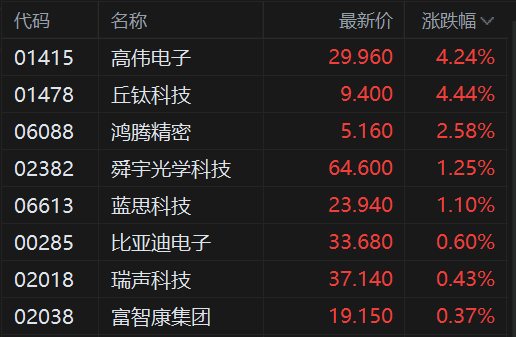
苹果有望超越三星,重登全球手机销冠!苹果概念股普涨,丘钛科技、高伟电子涨超4%,鸿腾精密涨2.6%,舜宇光学、蓝思科技涨超1%
Ge Long Hui· 2025-11-27 03:20
Group 1 - The core viewpoint of the articles indicates that Apple is expected to reclaim its position as the world's largest smartphone manufacturer after more than a decade, driven by strong sales of the new iPhone series and a surge in consumer upgrades [2][3] - Apple is projected to achieve double-digit year-on-year sales growth in both the Chinese and American markets, thanks to the popularity of its new models [2][3] - According to Counterpoint Research, Apple's market share is expected to reach 19.4% in 2025, marking its first return to the top of global smartphone sales since 2011 [3] Group 2 - Several Hong Kong-listed Apple concept stocks have seen significant increases, with companies like Q Technology and GoerTek rising over 4%, and others like Sunny Optical and Lens Technology also experiencing gains [1][2] - The anticipated growth in iPhone shipments is estimated at around 10% for 2025, while Samsung's growth is expected to be only 4.6% [3] - The overall global smartphone market is projected to expand by approximately 3.3% in 2025 [3]

苹果概念股普涨 苹果有望超越三星,重登全球手机销冠
Ge Long Hui· 2025-11-27 03:04
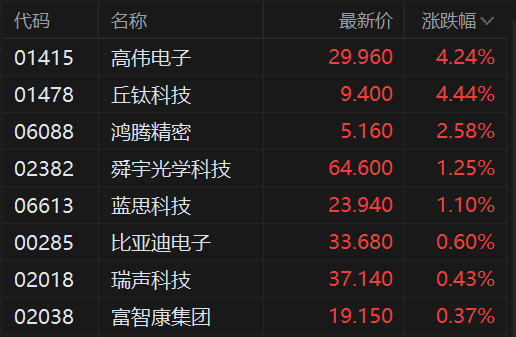
Group 1 - The core viewpoint of the articles indicates that Apple is expected to reclaim its position as the world's largest smartphone manufacturer after more than a decade, driven by strong sales of the new iPhone series and a surge in consumer upgrades [1] - According to Counterpoint Research, Apple's sales in both the Chinese and American markets are projected to achieve double-digit year-on-year growth, significantly boosting its market position [1] - It is anticipated that Apple's iPhone shipments will increase by approximately 10% in 2025, while Samsung's growth is expected to be only 4.6%, allowing Apple to surpass its long-term competitor [1] Group 2 - The Hong Kong stock market saw a general increase in Apple-related stocks, with notable gains including 4.44% for Hillstone Technology and 4.24% for GoerTek [2] - Other companies such as Sunny Optical Technology and Lens Technology also experienced modest increases, reflecting positive market sentiment towards Apple-related stocks [2] - The overall smartphone market is projected to expand by about 3.3% in 2025, with Apple expected to capture 19.4% of the market share, marking its first return to the top of global sales since 2011 [1]