油气

Search documents
欧盟承诺增购油气,骗取美国让步关税?外媒:经济分析师给出缘由
Sou Hu Cai Jing· 2025-07-29 00:18
对于欧盟承诺每年购买2500亿美元的美国油气,欧洲委员会负责人冯德莱恩宣称,欧洲的承诺是基于现有需求的预估,也就是全部放弃俄罗斯的油气,从而 采购美国的油气产品。冯德莱恩宣称美国提供的液化天然气价格更低,并且质量更好。实际上从公开的数据来看,欧洲在2024年从美国仅仅进口了800亿美 元不到的能源。对于欧盟承诺的庞大的数据,经济学家戴维·奥尼格拉公开表示这些数字毫无意义,为此也是凸显了如今欧盟"得过且过"的心态,实际上也 是在美国拿出30%的关税税率之后,欧盟的应激反应的结果。 俄乌冲突期间,欧盟因为坚持制裁俄罗斯,就已经让制造业失去了能源红利,如今欧盟承诺购买更多的美国油气产品,是要让欧洲自己的能源产业陷入危 机,欧盟为了让美国在关税上让步,已经开始卡自己的脖子,从而就有了如今匪夷所思的三年7500亿美元的能源采购规划。在美国的高压态势之下,实际上 如今欧盟已经跪了,在和美国签署的贸易协定之下,欧洲没有拿到一点好处,因为上所谓的15%的关税让步,比起现有的平均关税还要高。 欧盟和美国在7月27日达成了贸易协议,欧盟承诺在三年内购买7500亿美元的美国油气产品,同时还承诺向美国投资6000亿美元,实际上欧盟还 ...


行业轮动ETF策略周报-20250728
Hengtai Securities· 2025-07-28 05:44
Core Insights - The report emphasizes the strategic allocation of ETFs in various sectors, recommending a focus on liquor, real estate, and white goods for the upcoming week [2] - The model portfolio for the week of July 28, 2025, includes continued holdings in real estate ETFs and the addition of oil and gas ETFs, indicating a shift in market focus [2][5] - The report highlights a cumulative return of approximately 1.40% for the strategy from July 21 to July 25, 2025, with an excess return of -0.32% compared to the CSI 300 ETF [2][5] ETF Strategy Summary - The report outlines specific ETFs and their respective values, with the liquor ETF valued at 32.58 billion, real estate ETF at 6.83 billion, and tourism ETF at 30.84 billion, among others [2] - The report provides a detailed performance tracking of various ETFs, indicating that the average return for the ETFs was 1.40% during the specified period [5] - The report includes a table of ETFs with their current holdings and performance metrics, showing that the real estate ETF has a holding signal of 100% and the liquor ETF has a holding signal of 55.71% [2][5]
中国石油 当“数智石油”的领跑者
Zhong Guo Neng Yuan Wang· 2025-07-28 02:50
昆仑大模型,无疑是当下能源行业最火的大模型。 从勘探开发、炼油化工到装备制造,应用场景赋能油气全产业链,3000亿语言大模型参数、100个应用场景、500TB高质量行业数据 集……,5月28日,中国石油发布的昆仑大模型,多项关键突破创业内之最,是能源化工领域首个通过国家备案的行业大模型,标志着公 司数智化建设迈出关键一步。 数字技术与人工智能的发展,正在重构新型工业化的底层逻辑。人们在惊叹它快速发展的同时,开始思考一个新问题:当能源转型和 AI浪潮袭来,传统重资产、高投入、高风险、高科技的油气行业会变成什么样? 这也是我们要深入讨论的点,作为全球最大的能源化工企业之一,中国石油是如何依靠创新驱动数智化发展并领跑油气行业? 锚定数智化战略高地 "努力当好能源化工行业人工智能发展的'排头兵'" 中小站场无人值守、生产异常联动告警、油气生产数据一体化全采集,全区域生产动态、人员、设备、物资"看得见、呼得通、调得 动"…… 这是如今塔里木油田的日常生产场景。 2021年7月,塔里木油田联手昆仑数智启动数智化转型试点建设工作,基于首创二三维一体的可视化集成技术,集成油田前、中、后三 端25个生产相关系统,全业务链生产运 ...


牛弹琴:欧洲五味杂陈,现场一个细节意味深长
Bei Jing Ri Bao Ke Hu Duan· 2025-07-28 01:11
Core Points - The article discusses a recent trade agreement between the United States and the European Union, highlighting mixed reactions from European leaders and the implications for transatlantic relations [1][2][9]. Group 1: Trade Agreement Details - The U.S. will impose a 15% tariff on EU goods, which is higher than the EU's desired 10% but lower than Trump's previous threat of 30% [2][4]. - The EU is committed to purchasing $750 billion worth of U.S. energy and investing an additional $600 billion in U.S. military equipment [2][13]. - The agreement allows for zero tariffs on U.S. exports to the EU, while EU products will face a 15% tariff in the U.S., indicating an imbalance in trade terms [13]. Group 2: Reactions from European Leaders - Ursula von der Leyen stated that the agreement would bring stability and predictability, which is crucial for businesses on both sides of the Atlantic [5]. - German Chancellor Merz expressed a desire for better terms but acknowledged that the agreement prevented unnecessary escalation in trade relations [5]. - French opposition leader Marine Le Pen criticized the agreement as a political, economic, and moral failure, arguing that it undermines EU sovereignty and favors German interests over French ones [6][8]. Group 3: Broader Implications - The agreement signifies increasing European dependence on U.S. energy and military supplies, raising concerns about the loss of European sovereignty [10][13]. - The deal may lead to higher energy costs for Europe and mandatory military spending, contributing to deindustrialization [14]. - The internal divisions within the EU are highlighted, as different member states have varying interests and responses to the agreement [8].

邓正红能源软实力:BP战略大反转 放弃激进可再生能源 重新聚焦油气核心业务
Sou Hu Cai Jing· 2025-07-27 06:45
Core Viewpoint - BP has reversed its aggressive renewable energy goals, refocusing on its core oil and gas business, acknowledging that previous actions were "too aggressive" and aiming to boost stock prices through increased oil production and reduced low-carbon investments [1][2][3]. Group 1: Strategic Shift - BP has abandoned its target to increase renewable energy generation capacity by 20 times by 2030, instead aiming to raise oil production to 2.3 to 2.5 million barrels per day [3]. - The company plans to sell off non-core assets and cut low-carbon investments by $3 to $4 billion to reduce debt and enhance shareholder returns, reflecting investor concerns over profitability [2][3]. - This strategic pivot aligns with current high oil prices and investor preferences, indicating a pragmatic approach to balancing short-term gains with long-term transformation [2][3]. Group 2: Governance and Resource Management - BP's board has undergone personnel changes, appointing Albert Manifold as chairman to strengthen governance in the fossil fuel sector [4]. - The company aims to divest $20 billion in non-core assets, such as wind power shares, to concentrate resources on high-return oil and gas projects, adhering to agile investment management principles [4]. - The shift in strategy highlights the need for energy companies to adapt to market dynamics while maintaining a focus on traditional energy sources to ensure survival during price fluctuations [4]. Group 3: Long-term Perspective - BP's decision is not a complete abandonment of energy transformation but rather a recalibration of its approach, using cash flow from oil and gas to support long-term low-carbon investments [5]. - The company is focusing on strategic agility and resource integration as key competitive factors in the energy sector, balancing shareholder demands, policy pressures, and technological advancements [5].

被俄乌一仗打醒,普京认清现实,俄罗斯靠卖能源,会葬送国家未来
Sou Hu Cai Jing· 2025-07-27 04:03
Group 1 - The core viewpoint is that Putin realizes Russia's reliance on energy exports for foreign trade surplus threatens its sovereignty and technological advancement, prompting a need for economic transformation [1][10] - Energy exports have created a "soft trap" that undermines Russia's strategic autonomy, as the country risks becoming a mere resource supplier if global energy structures shift towards renewables [3] - The ongoing Ukraine conflict has exposed Russia's logistical and technological shortcomings, highlighting the necessity for domestic high-tech development to ensure national security [3][5] Group 2 - International sanctions have significantly weakened Russia's foreign exchange income and forced a reevaluation of its economic structure, with over 30,000 sanctions imposed by Western countries [5][7] - The need for economic transformation is acknowledged, but the path is fraught with challenges, including potential fiscal shortfalls from reduced energy investments and the necessity to attract foreign capital and talent [7][8] - To implement deep reforms, Putin must leverage political capital to establish national technology revitalization plans and promote collaboration between state-owned and private enterprises [8][10]
油气收入影响俄罗斯财政状况
Sou Hu Cai Jing· 2025-07-25 22:21
Core Insights - The Russian federal budget deficit has expanded significantly in the first half of the year, nearing the planned annual limit, primarily due to insufficient oil and gas revenues [1][2][3] Revenue Analysis - Total federal budget revenue for the first half of the year reached 17.59 trillion rubles, a year-on-year increase of 2.8% [1] - Non-oil and gas revenue amounted to 12.85 trillion rubles, growing by 12.7%, while oil and gas revenue fell to 4.74 trillion rubles, a decline of 16.9% [1] - The decline in oil and gas revenue is attributed to falling average oil prices, with June's oil and gas revenue at 494.8 billion rubles, down 33.7% from the previous year [2] Expenditure Analysis - Federal budget expenditures for the first half were estimated at 21.28 trillion rubles, reflecting a 20.2% increase year-on-year [1] - The government has faced challenges in balancing expenditures, with rigid government spending on procurement and low energy revenues contributing to the deficit [2] Deficit Overview - The current federal budget deficit stands at 3.69 trillion rubles, accounting for 1.7% of GDP, compared to 0.3% in the same period last year [2] - The planned deficit for the year is 3.79 trillion rubles, also 1.7% of GDP, indicating that the deficit is approaching the annual target [2] Future Outlook - Experts suggest that maintaining current spending levels could exacerbate the deficit and inflation, while strict spending controls could hinder economic growth [3] - There is a possibility of improved fiscal revenue in the second half due to stable energy exports and a potential gradual depreciation of the ruble [4] - The Ministry of Finance emphasizes the need for balanced budgets at both federal and regional levels, focusing on national development goals [4]
洲际油气: 洲际油气股份有限公司关于选举第十四届董事会职工董事的公告
Zheng Quan Zhi Xing· 2025-07-25 16:37
Core Viewpoint - The announcement details the election of Mr. Zhi Cheng as the employee director of the 14th Board of Directors of Continental Oil and Gas Co., Ltd., following the expiration of the 13th Board's term [1] Group 1: Election Announcement - The 14th Board of Directors was elected during the employee representative meeting held on July 25, 2025 [1] - Mr. Zhi Cheng's qualifications meet the requirements set by relevant laws and regulations, and he has not faced any administrative penalties or disciplinary actions from the China Securities Regulatory Commission [1][1] Group 2: Mr. Zhi Cheng's Background - Mr. Zhi Cheng was born in 1984 and holds dual bachelor's degrees in Engineering and Finance from the University of Science and Technology of China, as well as a master's degree in Economics from Peking University and a master's degree in Finance from the University of Hong Kong [1] - He has over 15 years of experience in the economic, financial, and natural resources sectors, including roles at CICC, CITIC Securities, EMR Capital Resources Fund, and as CEO of Weifa International Group [1] - Since December 2023, he has served as the CEO of Hong Kong Derui Energy Development Co., Ltd., a wholly-owned subsidiary of Continental Oil and Gas [1]

《财富》中国500强中的大宗玩家
Tai Mei Ti A P P· 2025-07-25 04:02
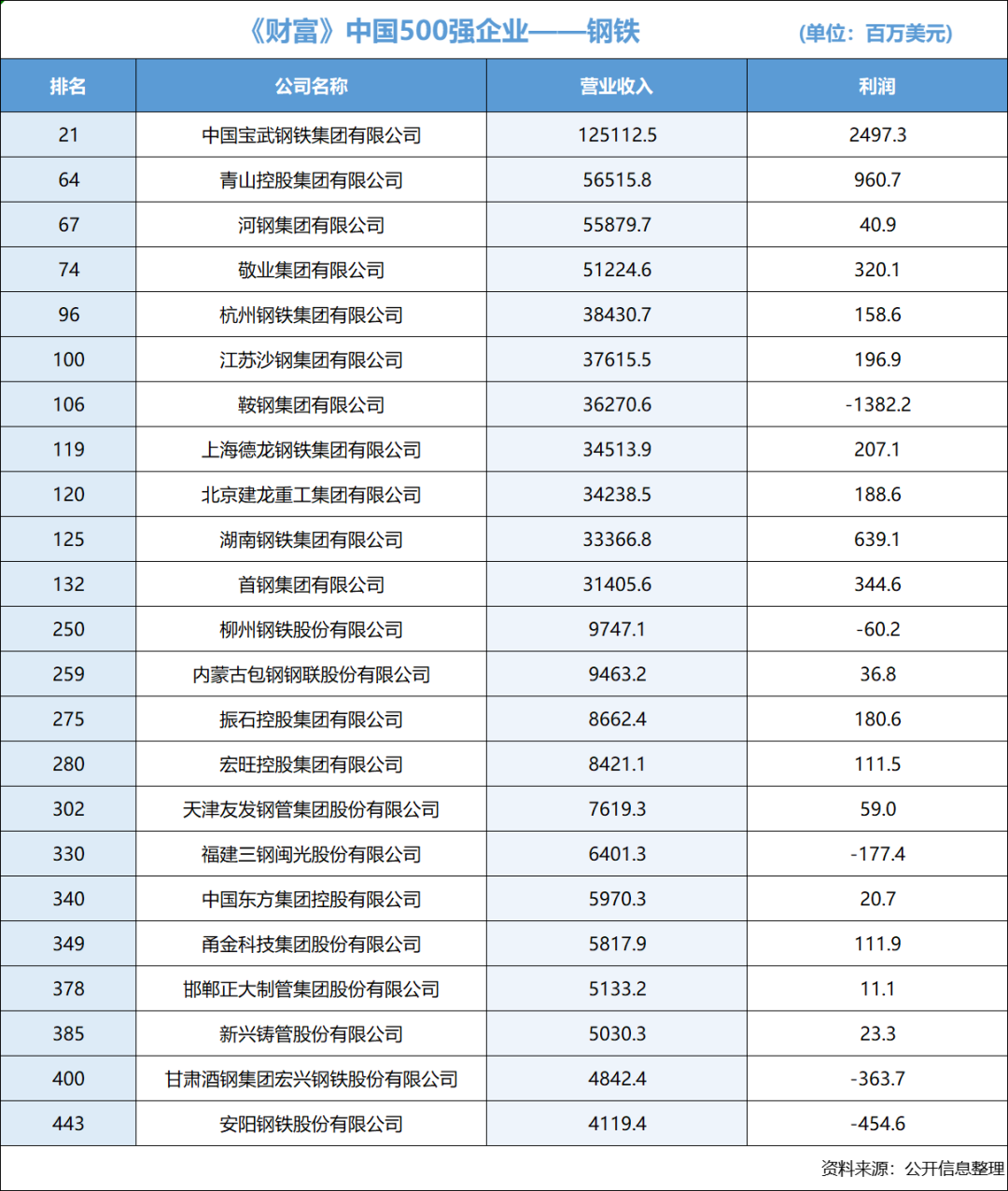
Core Viewpoint - The 2025 Fortune China 500 list highlights the performance and market dynamics of leading companies in the commodity sectors, particularly steel, non-ferrous metals, coal, and oil and gas, reflecting the ongoing trends of industry consolidation and competitive differentiation. Steel Sector - The steel sector remains a pillar of the national economy, with 23 companies making the Fortune China 500 list, indicating a significant increase in market concentration after years of mergers and restructuring [2] - China Baowu Steel Group continues to lead the industry with a revenue of $125.1 billion and a profit of $2.5 billion, despite a drop in ranking from 12th to 21st [3][4] - The profitability of Baowu accounts for nearly 50% of the total profit of all steel companies on the list, highlighting the increasing "Matthew effect" in the industry [3] - Several large state-owned steel companies, such as Ansteel and Liuzhou Steel, reported significant losses due to high raw material prices and low market demand [4][5] - Private steel companies like Qingshan Holding and Jingye Group have shown competitive advantages by focusing on niche markets, achieving better profitability compared to state-owned enterprises [4][5] Non-Ferrous Metals Sector - The non-ferrous metals sector shows strong growth, with 29 companies on the Fortune China 500 list, reflecting ongoing expansion and superior profitability compared to steel and coal industries [7] - China Minmetals leads the sector with a revenue of $115.8 billion, followed by Jiangxi Copper and Shandong Weiqiao with revenues of $77.7 billion and $77.6 billion, respectively [6][7] - The aluminum industry, particularly companies like China Hongqiao and Shandong Nanshan Aluminum, demonstrates high profit margins, benefiting from the demand in lightweight materials for new energy vehicles [8] - The sector is characterized by significant internationalization, with leading companies like Zijin Mining and Luoyang Molybdenum achieving over 30% of their revenue from overseas operations [8][9] Coal Sector - The coal sector shows a general recovery in profitability, with 13 out of 14 listed companies reporting profits, reflecting improved operational conditions supported by energy supply policies [10][11] - China National Energy Investment Group leads the sector with a revenue of $107.7 billion and a profit of $6.9 billion, benefiting from an integrated operational model [11] - The sector faces challenges, with medium-sized coal companies struggling to maintain profitability due to rising environmental costs and market pressures [12][13] - Companies are increasingly diversifying into renewable energy and clean energy sectors, indicating a shift towards sustainable practices [13] Oil and Gas Sector - The oil and gas sector is characterized by a high concentration of revenue among a few major players, with China National Petroleum and China Petroleum & Chemical Corporation together accounting for over 90% of the sector's total revenue [14] - China National Petroleum leads with a revenue of $412.6 billion and a profit of $22.4 billion, showcasing its strength in upstream exploration and development [14] - The sector is under pressure to transition towards cleaner energy sources, with traditional companies needing to adapt to changing market dynamics and regulatory environments [15] Conclusion - The 2025 Fortune China 500 list illustrates the importance of resources and technology, the impact of industry chain integration on profitability, and the necessity for innovation and transformation in traditional commodity sectors [15]


聚焦全球能源 | 油气离退出舞台还远得很,全球需求何时见顶?
彭博Bloomberg· 2025-07-24 03:34
Core Viewpoint - The oil and gas industry has a promising long-term outlook, but faces short-term challenges due to deteriorating consumer spending and demand concerns [3]. Group 1: Oil and Gas Demand - Oil and natural gas remain core pillars of the global energy structure, currently accounting for approximately 55% of the energy mix, and are expected to maintain resilience for many years [3]. - Despite predictions that oil demand may peak by 2030, even the most optimistic forecasts suggest that oil, particularly natural gas, will still play a significant role in global energy supply at least until 2040 [3]. - The growth in demand for oil is expected to be driven by developing countries, as well as increased demand for aviation fuel and petrochemical products in the short to mid-term [3]. Group 2: OPEC vs IEA Demand Forecasts - OPEC's outlook for global oil demand from 2025 to 2026 remains more optimistic than that of the International Energy Agency (IEA), with OPEC projecting demand to reach 106.4 million barrels per day in Q4 2023 and continue growing to 107.5 million barrels per day by Q4 2026 [5]. - In contrast, the IEA predicts a more gradual growth path, with demand expected to rise from 104.8 million barrels per day in Q3 2023 to 105.5 million barrels per day by Q3 2026 [5]. - The divergence between OPEC's optimistic view of emerging markets and the IEA's narrative of slowing growth highlights increasing uncertainty regarding structural changes in the transportation sector [5]. Group 3: Energy Investment Trends - Investment in oil supply has been a recurring theme, with the industry needing sustained high oil prices to attract sufficient new investments [10]. - Major oil companies are showing renewed confidence in production growth towards 2030, as capital expenditures have been low in recent years due to financial pressures and the transition to low-carbon energy [10]. - The UAE has indicated that due to underinvestment, global oil production capacity has been declining, with plans to increase capacity from 4 million barrels per day to 5 million barrels per day by 2027 [10]. Group 4: Sustainability and Energy Transition - The focus on climate and decarbonization has shifted in the past 12-18 months, with energy security becoming a central issue amid rising geopolitical risks [13]. - Many energy companies are slowing their investments in clean energy and energy transition initiatives due to concerns over sustainable returns, even in Europe where the transition was previously led [13]. - A survey by Bloomberg Intelligence indicates that the peak of oil demand may occur later than expected, with over one-third of respondents anticipating that demand will peak after 2035 [13].