金融

Search documents
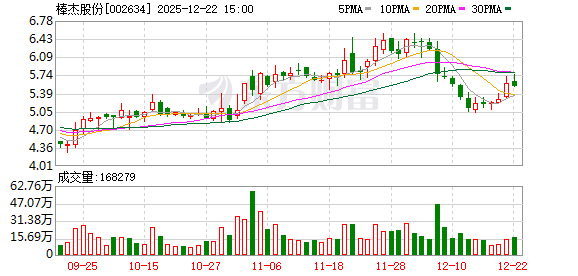
棒杰股份:关于持股5%以上股东部分股份解除质押及再质押的公告
Zheng Quan Ri Bao· 2025-12-22 14:14
Core Viewpoint - On December 22, the company announced that a major shareholder, Suzhou Qingsong Enterprise Management Partnership, released a pledge of 5,500,000 shares on December 18 and subsequently re-pledged the same amount to Wuxi Rural Commercial Bank for personal funding needs [2] Group 1 - The shareholder involved holds more than 5% of the company's shares [2] - The shares were both released and re-pledged on the same day, indicating a potential liquidity need [2] - The re-pledge was specifically for personal funding requirements, which may reflect the shareholder's financial strategy [2]


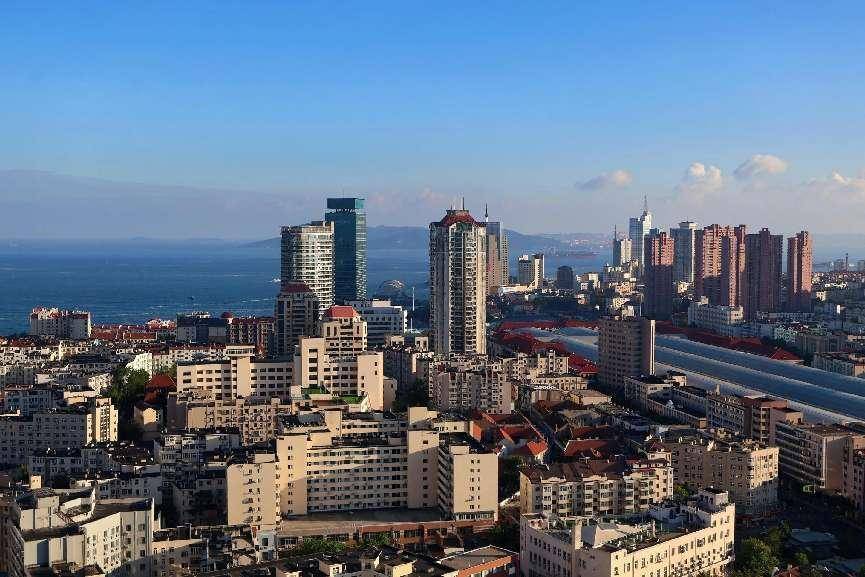
山东第一大服务业企业:营收超过2700亿元,拥有7家上市公司
Sou Hu Cai Jing· 2025-12-22 12:47
Group 1: Industrial Strength of Shandong - Shandong is a major industrial province in China, possessing all 41 industrial categories defined by the United Nations, with 197 out of 207 industrial types and 603 out of 666 subcategories [1] - The province's industrial added value reached 3.3 trillion yuan, with manufacturing accounting for approximately 28% of GDP, and it is home to 274 national champions and 1,163 "little giant" enterprises [1] Group 2: Growth in Service Sector - In 2024, the service sector's added value is projected to reach 52.34 billion yuan, growing by 5.4% year-on-year, contributing 50.2% to the province's economic growth [3] - The top 50 service enterprises in Shandong have a total revenue of 1.49 trillion yuan, with 31 companies exceeding 10 billion yuan in revenue [3] Group 3: Key Enterprises in Qingdao - Qingdao hosts four of the top ten enterprises in Shandong, including Shandong Port Group, which achieved a revenue of 186.03 billion yuan in 2024, marking a 20.8% increase [5] - Shandong Port Group operates four major ports and has a cargo throughput of over 1.8 billion tons, ranking first globally [5][6] Group 4: Key Enterprises in Jinan - Jinan also has four of the top ten enterprises, with Shandong High-speed Group leading at 279.31 billion yuan in revenue, a 7.4% increase [8] - The group manages 9,116 kilometers of highways, with significant investments in highway construction during the 14th Five-Year Plan [8]

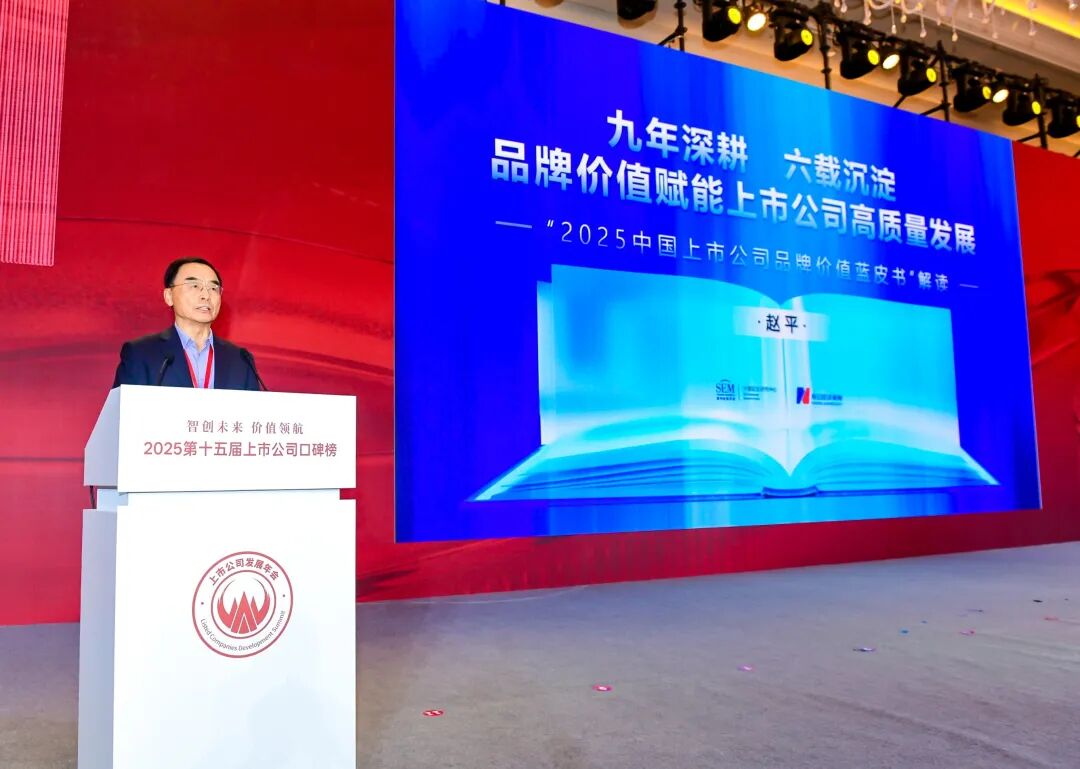
《2025中国上市公司品牌价值蓝皮书》发布
Xin Lang Cai Jing· 2025-12-22 11:19
2025年12月11日至13日,每日经济新闻与海南国际经济发展局联合主办的2025第十四届上市公司发展年会在海口举行。在12日举行的"2025资本市场荣誉 盛典"上,清华大学经济管理学院中国企业研究中心(以下简称研究中心)主任赵平教授发布了《2025中国上市公司品牌价值蓝皮书》(以下简称"蓝皮 书"),并以"九年深耕,六载沉淀,品牌价值赋能上市公司高质量发展"为主题对蓝皮书进行解读。 赵平解读蓝皮书 赵平介绍,从2017年第一个中国品牌日开始,研究中心与每日经济新闻紧密合作,共同评估和发布中国上市公司品牌价值榜系列榜单。到今年为止,这项 工作已经持续了九年。从2020年开始,在中国上市公司品牌价值研究和数据沉淀的基础上,双方合作连续六年发布蓝皮书。 上榜企业品牌价值总量超33万亿元,同比增长8.8% 蓝皮书评估了2025年1月1日之前在A股上市的所有公司,在香港上市的所有中资公司和品牌起源于内地的公司,以及在国外股票交易市场公开上市的所有 中概股公司。 从总体情况看,今年蓝皮书上榜企业的品牌价值持续增长。3000家上市公司总计品牌价值332416亿元,较2024年增长了8.8%。蓝皮书入门公司的品牌价 值为6 ...
恒指夜期开盘(12.22)︱恒指夜期(12月)报25799点 低水3点
智通财经网· 2025-12-22 09:27
智通财经APP获悉,12月22日,恒生指数夜期(12月)开市报25800点。截至北京时间17:16,恒指夜期(12 月)报25799点,跌15点或0.058%,低水3点,成交量为160张。未平仓合约总数为122240张,未平仓合约 净数报44940张。 ...
ST华扬:向控股股东提供1亿元反担保,累计担保26亿余元
Xin Lang Cai Jing· 2025-12-22 09:25
ST华扬公告称,为满足经营资金需求,公司向华夏银行长沙分行申请5000万元流动资金贷款、向中信 银行长沙分行申请5000万元商业承兑汇票保贴业务,控股股东湘江集团提供担保,公司与其签署反担保 协议,提供等额连带责任反担保,并支付0.5%/年的担保费。公司曾审议通过向湘江集团新增10亿元融 资担保额度,总担保限额调至20亿元。截至公告日,公司及控股子公司对外担保总额26.02亿元,占最 近一期经审计净资产的609.19%,无逾期担保。 ...
推动有序化解存量债务 多部门联合发布地方政府债务风险问题整改情况
Xin Hua Cai Jing· 2025-12-22 09:13
(一)关于"5个地区指定国企垫资建设、承诺由财政资金偿还等,新增政府隐性债务59.09亿元。11 个 地区15户融资平台等通过发行非标金融产品、借款等方式,向1600多人、45家公益组织和村集体融资, 新增隐性债务1.5亿元"的问题。财政部组织有关地区全面排查违规新增隐性债务问题,督促地方通过统 筹财政收支、压减非刚性支出、盘活存量政府资产资源等偿还隐性债务。3 个地区已偿还由国企垫资建 设、承诺由财政资金作为还款来源的 32.27 亿元。2 个地区已偿还违规向公益组织等融资的新增债务 1.15 亿元。 据审计署22日发布有关部门对审计查出突出问题的整改情况。其中,财政部、中国人民银行、金融监管 总局关于地方政府债务风险问题的整改情况如下: 一、整改工作部署 针对审计查出的问题,财政部进一步加强债务风险防控力量建设;严肃查处违规新增政府隐性债务的地 方和单位,在全国公开通报12起问责典型案例;印发工作通知,进一步加强对隐性债务新增、问责、化 解等全链条监管。中国人民银行、金融监管总局组织摸排地方融资平台违规融资情况,加强对融资平台 涉众募资等违法违规金融活动及其账户资金监测,通过督促收回问题贷款、封闭或冻结账 ...
量化择时周报:市场情绪细分指标出现修复、改善-20251222
Shenwan Hongyuan Securities· 2025-12-22 08:40
Group 1: Market Sentiment Model Insights - The market sentiment score has slightly decreased to 1.1 as of December 21, down from 1.35 the previous week, indicating a neutral view from a sentiment perspective [7][11] - There is a notable improvement in the overall sentiment index score this week, with signs of a rebound in market trading activity [7][11] - The price-volume consistency indicator has shown improvement, suggesting a recovery in market sentiment, although structural differentiation remains [11][12] Group 2: Trading Activity and Volume - The total trading volume for the entire A-share market decreased by 9.86% week-on-week, with an average daily trading volume of 17,604.84 billion yuan [15] - The highest trading volume was recorded on December 17 at 18,343.65 billion yuan, indicating a peak in market activity [15] Group 3: Industry Performance and Trends - As of December 19, industries such as beauty care, pharmaceuticals, non-bank financials, agriculture, and retail have shown upward trends in short-term scores [39] - The communication sector has the highest short-term score of 79.66, indicating strong performance potential [39][40] - The industry crowding indicator shows a strong positive correlation with weekly price changes, with sectors like retail and light manufacturing leading in gains [44] Group 4: Leverage and Risk Appetite - The proportion of financing balance continues to rise, reaching a new high for the phase, indicating an increase in leveraged funds and a structural recovery in risk appetite [27][29] - The RSI indicator has shown a slight recovery, suggesting improved short-term upward momentum, although it remains in a low range [30][33] Group 5: Style and Growth Signals - The current model indicates a preference for small-cap and growth styles, with signals suggesting that growth style may strengthen further [39][49] - The short-term view for the growth style remains positive, while the small-cap style is also favored, although there are indications of potential weakening in future signals [49]
政策双周报:中央经济工作会议部署明年工作-20251222
Yin He Zheng Quan· 2025-12-22 08:04
中央经济工作会议部署明年工作 ——政策双周报(2025 年第 11 期) 许冬石:中国银河证券宏观分析师、新发展研究院学术委员会执行负责人 路自愿:中国银河证券新发展研究院区域经济研究员 www.chinastock.com.cn 证券研究报告 请务必阅读正文最后的中国银河证券股份有限公司免责声明。 政策双周报(2025 年第 11 期) 中央经济工作会议部署明年工作 ——政策双周报(2025 年第 11 期) 2025 年 12 月 22 日 分析师 许冬石 :010-8357-4134 :xudongshi_yj @chinastock.com.cn 分析师登记编码:S0130515030003 路自愿 :136-7105-7587 :luziyuan_yj@chinastock.com.cn 分析师登记编码:S0130525070001 风险提示 请务必阅读正文最后的中国银河证券股份有限公司免责声明。 1 ⚫ 12 月上半月,提示重点关注中央经济工作会议:会议直面困难挑战,明确指 出供强需弱突出。明年宏观政策要求"跨""逆"结合 。货币政策表态更加积 极。同时,会提注重做好统筹内外部均衡 ,在外部压力暂 ...
从“四个关键词”看江苏经济这一年
Xin Hua Ri Bao· 2025-12-22 07:45
Core Viewpoint - Jiangsu province has demonstrated resilience and growth in its economy despite external challenges, with a projected GDP exceeding 14 trillion yuan for the year, reflecting its commitment to economic recovery and development [1] Group 1: Economic Stability - The province has implemented the "Four Stabilities" strategy to consolidate and expand economic recovery, focusing on stabilizing employment, enterprises, markets, and expectations [2][3] - As of November, the "Private Credit Loan" initiative has provided credit to 27,348 private enterprises, amounting to 37.44 billion yuan, addressing financing difficulties for private businesses [2] - In the first ten months, urban employment increased by 1.183 million, supporting the livelihood of residents [3] Group 2: Innovation and Development - Jiangsu has launched initiatives to integrate technology and industry, with 18 high-tech zones collaborating with 37 universities to foster innovation [6][7] - The province has organized 45 major technology projects and established a matrix of research institutions to convert scientific achievements into productive forces [7] - High-tech industries accounted for 51.8% of the province's industrial output in the first three quarters, indicating a shift towards advanced manufacturing [8] Group 3: Reform and Opening Up - Jiangsu has been proactive in reforming its economic structure, with 347 specific reform tasks aimed at enhancing market efficiency and breaking down barriers to high-quality development [10] - The province's foreign trade has shown resilience, with a 5.9% increase in imports and exports from January to October, maintaining its position as a favorable investment destination [11] Group 4: Regional Collaboration - Jiangsu has actively participated in the Yangtze River Delta integration strategy, forming alliances to enhance manufacturing and technological innovation across the region [13] - The province has developed a three-year action plan for the integration of the Ning-Zhen-Yang urban area, aiming to elevate regional development levels [14]
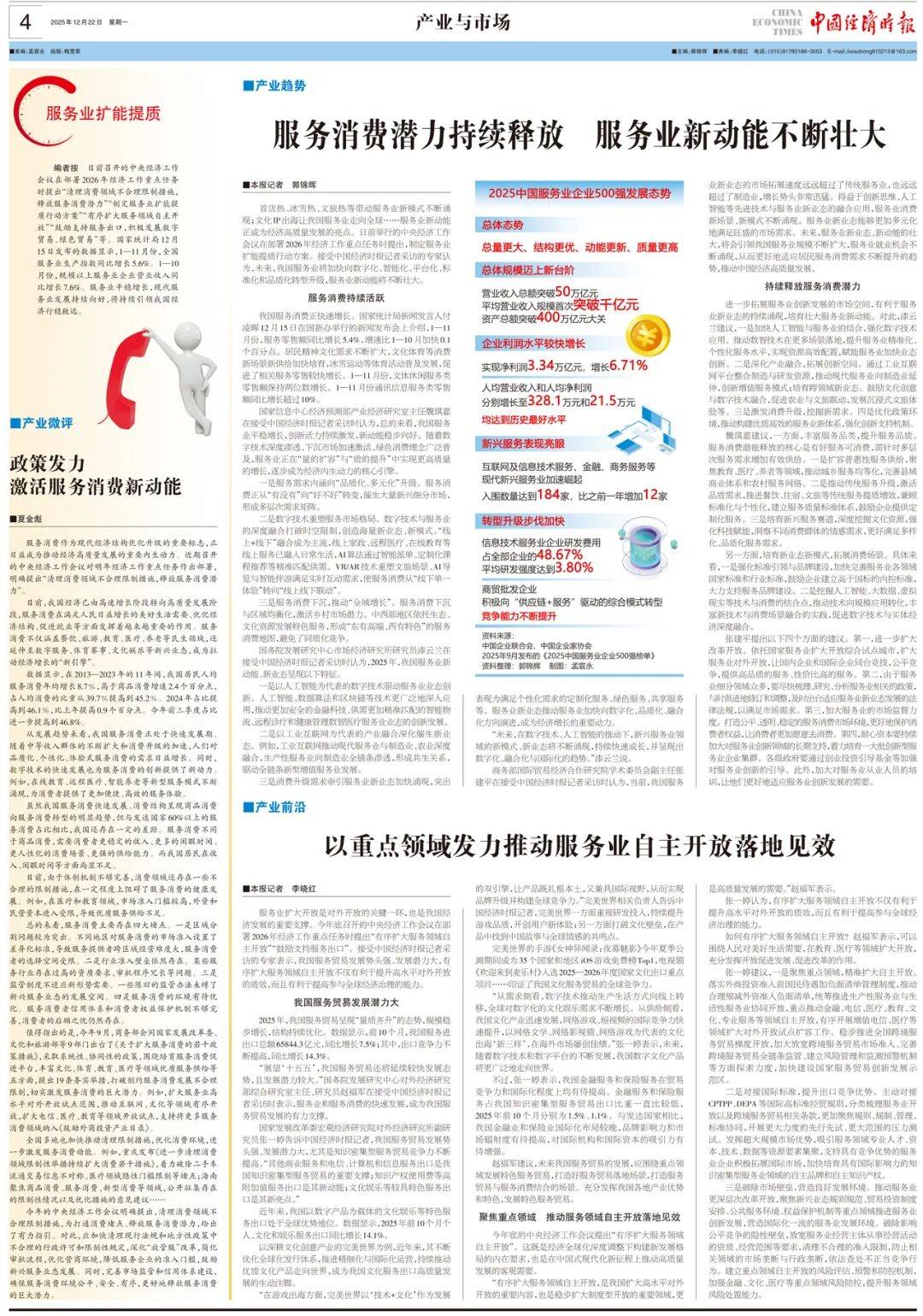
产业与市场丨政策发力 激活服务消费新动能
Sou Hu Cai Jing· 2025-12-22 07:26
Core Insights - The central economic work conference emphasized the need to "eliminate unreasonable restrictions in the consumption sector to unleash service consumption potential" and to "formulate an action plan for expanding and improving the service industry" [1][2][5] - The service industry is showing steady growth, with the national service production index increasing by 5.6% year-on-year from January to November, and revenue from large-scale service enterprises growing by 7.6% year-on-year from January to October [1][2] Group 1: Service Consumption Trends - Service consumption is becoming a significant internal driving force for high-quality economic development, covering areas such as dining, tourism, education, healthcare, and emerging sectors like digital services and cultural entertainment [2][3] - From 2013 to 2023, the average annual growth rate of per capita service consumption in China was 8.7%, surpassing the growth rate of goods consumption by 2.4 percentage points, with the share of service consumption in per capita consumption rising from 39.7% to 45.2% [2][3][4] - The share of service consumption is projected to increase to 46.1% in 2024, with a further rise to 46.8% in the first three quarters of this year [2][3] Group 2: Challenges in Service Consumption - There are four main bottlenecks in service consumption: regional segmentation, industry access barriers, outdated regulatory systems, and an inadequate consumer protection environment [4][5] - High market entry barriers in sectors like healthcare and education limit the supply of quality services, as foreign and private capital face restrictions [3][4] Group 3: Policy Initiatives - The government has introduced 19 practical measures to stimulate service consumption, including expanding high-level pilot programs for service industry openness and promoting orderly opening in sectors like telecommunications, healthcare, and education [4][5] - Local governments are also taking steps to eliminate restrictive measures and optimize the consumption environment, such as Chongqing's initiatives to address information asymmetry in the second-hand car market and hidden barriers in healthcare [5][8] Group 4: Future Outlook - The service industry is expected to accelerate its transformation towards digitalization, intelligence, platformization, standardization, and quality enhancement, with new service models emerging [8][9] - The integration of digital technology into service consumption is creating new market opportunities, with online services becoming mainstream and enhancing consumer experiences [9][10]