半导体

Search documents
固收视角看配置系列二:3月大类资产怎么看?
ZHESHANG SECURITIES· 2026-03-06 07:58
Group 1: Macro Trading Themes - The uncertainty brought by tariff policies is expected to intensify, as tariffs have become an integral part of the Trump administration's policy framework, serving multiple purposes including fiscal revenue, manufacturing return, and international relations [1][16][21] - The current tariff policy, based on the 1974 Trade Act Section 122, imposes a 10% tariff on most goods, but its future direction remains complex, with potential legal challenges and limitations on duration and rates [2][23][24] - The impact of tariffs on the U.S. economy is significant, with projections indicating a decrease in effective tariff rates and potential positive effects on GDP growth following the Supreme Court's ruling against previous tariffs [3][27][31] Group 2: AI Replacement Effects - The rapid development of AI technologies is causing significant disruptions across various sectors, leading to concerns about job displacement and economic downturns as companies increasingly replace human labor with AI [4][35][40] - The narrative of an "AI crisis" suggests a cycle where cost savings from AI lead to layoffs, reduced consumer spending, and further reliance on AI, potentially resulting in a recession driven by technological advancements [5][41][42] - Despite concerns, there are alternative pathways to mitigate negative impacts, including the creation of new job categories and the potential for AI to coexist with human workers, enhancing productivity rather than solely replacing jobs [41][42] Group 3: Asset Performance Review - In February 2026, global risk assets showed a significant shift from upward momentum to a period of consolidation, with notable performance disparities among equity markets, particularly with South Korea leading due to AI-related demand [7][43][45] - The bond market experienced a general decline in yields, with U.S. Treasury yields dropping significantly, influenced by tariff uncertainties and weaker GDP data [8][43] - Commodity markets displayed structural divergence, with gold prices rising sharply due to geopolitical tensions, while other metals like silver faced corrections after previous gains [8][43]
电装向罗姆提出收购要约
日经中文网· 2026-03-06 07:40
Core Viewpoint - Denso has proposed a takeover bid for semiconductor giant Rohm, aiming to acquire all shares through a TOB (Tender Offer Bid), with an estimated acquisition amount of 1.3 trillion yen, which would significantly strengthen its position in the power semiconductor sector for electric vehicles (EVs) and data center power control in Japan [2][4]. Group 1: Acquisition Details - Denso's acquisition bid for Rohm is expected to reach 1.3 trillion yen, positioning Denso as a major player in the power semiconductor market in Japan if successful [2]. - The acquisition is seen as a shift from previous cooperative strategies in the industry to a more aggressive merger and acquisition approach [2]. - Rohm's total market value was approximately 1.1 trillion yen as of March 5, and the acquisition could involve a premium, potentially raising the total cost to 1.3 trillion yen [4]. Group 2: Industry Context - Japanese companies traditionally excel in the power semiconductor field, but overcapacity has emerged due to the rise of Chinese competitors, prompting the Ministry of Economy, Trade and Industry in Japan to encourage industry consolidation [4]. - Denso and Rohm had previously announced a collaboration in May 2025 to develop analog semiconductors for EV sensors, with Denso increasing its stake in Rohm from 0.3% to nearly 5% [4][5]. Group 3: Rohm's Financial Situation - Rohm is projected to incur a loss of 50 billion yen in the fiscal year 2024, marking its first loss in 12 years, after a profit of 53.9 billion yen in the previous fiscal year [5]. - The company aims to return to profitability with an expected profit of 10 billion yen in the fiscal year 2025, highlighting the challenges it faces [5]. Group 4: Strategic Relationships - Rohm has a close relationship with Toshiba, having invested 300 billion yen in Toshiba during its privatization, and both companies received substantial subsidies from the Ministry of Economy, Trade and Industry for joint equipment investments [5]. - Tensions arose between Rohm and Toshiba when Toshiba's subsidiary announced a technology collaboration with a Chinese wafer giant, which Rohm opposed, indicating a potential rift in their partnership [5].


空欢喜!英伟达H200停产
Xin Lang Cai Jing· 2026-03-06 07:32
Core Viewpoint - Nvidia has ceased production of its H200 processors tailored for the Chinese market, indicating a lack of short-term sales expectations for this product in China [1][3]. Group 1: Production Changes - Nvidia has informed TSMC to reallocate production capacity away from the H200 to focus on the Vera Rubin chip [3]. - This decision reflects Nvidia's pessimism regarding the H200's sales prospects in the Chinese market [3]. Group 2: Regulatory Context - In mid-January, the U.S. government announced a relaxation of export regulations for Nvidia's H200 chips to China, which led Nvidia's CEO Jensen Huang to state that the supply chain for H200 had been restarted and that demand from Chinese customers was "very high" [3]. - Despite the U.S. government's approval for limited H200 product exports to China, Nvidia's CFO Colette Kress revealed that the company has not sold any H200 chips to Chinese firms and remains uncertain about future sales [3]. Group 3: Market Sentiment - Commentary from C114 suggested that Nvidia's ability to conduct substantial and long-term business in China is hindered by a lack of mutual trust between the U.S. and China [3]. - Bloomberg reported that ongoing tightening of advanced AI chip export controls by the U.S. has imposed multiple restrictions on the sales of the H200 in the Chinese market [3].

2025Q4半导体排名:五大存储厂增27%
芯世相· 2026-03-06 07:12
Core Insights - The semiconductor market is projected to grow significantly, with a 25.6% year-on-year increase in 2025, reaching a total market size of $792 billion, the highest growth rate since the post-pandemic recovery in 2021 [7] - Major memory manufacturers, including Samsung, SK Hynix, Micron, Kioxia, and SanDisk, are expected to see strong performance driven by AI demand, with an average growth of 27% in Q4 2025 [4][7] - NVIDIA leads the semiconductor sales ranking with $68.1 billion in revenue for Q4 2025, reflecting a 20% quarter-on-quarter growth, primarily due to AI demand [4][5] Group 1: Market Performance - In Q4 2025, the top semiconductor companies achieved significant revenue growth, with Samsung at $30 billion (33% growth) and SK Hynix at $22.4 billion (34% growth) [4][5] - A total of 16 out of the top 20 semiconductor companies reported quarter-on-quarter sales growth, indicating a robust market environment [6][7] - The memory segment's growth is particularly notable, with companies like Micron and SanDisk also reporting substantial increases in sales [5][7] Group 2: Future Outlook - For Q1 2026, Micron anticipates a 37% increase in sales, Kioxia expects a 64% increase, and SanDisk projects a 52% increase, driven by AI demand and data center needs [8] - Despite the strong performance in the memory sector, challenges are anticipated in the PC and smartphone markets due to storage shortages, with Intel and Qualcomm projecting declines in sales [8][9] - The semiconductor market is expected to maintain a growth rate of over 20% in 2026, supported by stable demand in AI, industrial, and automotive sectors [9]



【买卖芯片找老王】260306 华邦/美光/海力士/南亚/迈来芯/顺络
芯世相· 2026-03-06 07:12
Core Insights - The article discusses the challenges of managing excess inventory in the semiconductor industry, highlighting the financial burden of storage and capital costs associated with unsold materials [1] - It promotes a service called "Chip Superman," which has served 22,000 users and offers rapid inventory clearance, claiming transactions can be completed in as little as half a day [10] Group 1: Inventory Management - Excess inventory of 100,000 units incurs monthly storage and capital costs of at least 5,000, leading to a potential loss of 30,000 after six months [1] - The article emphasizes the difficulty in promoting and selling surplus materials, suggesting that companies can seek assistance from Chip Superman to improve sales [1] Group 2: Inventory Offerings - A list of available semiconductor components for sale is provided, including various brands and models, with quantities ranging from 3,000 to 180,000 units [4][5][6] - The inventory includes products from major manufacturers such as Micron, Samsung, and Infineon, indicating a diverse selection for potential buyers [4][5][6] Group 3: Demand for Components - The article also lists specific components that are in demand, with quantities requested ranging from 1,300 to 50,000 units, indicating ongoing needs in the market [7][8] - This demand highlights the dynamic nature of the semiconductor market, where certain components are sought after despite the presence of excess inventory [7][8] Group 4: Company Capabilities - Chip Superman operates a 1,600 square meter smart warehouse with over 1,000 models and 50 million chips in stock, valued at over 100 million [9] - The company also has an independent laboratory in Shenzhen for quality control, ensuring that each component meets quality standards [9]


东微半导(688261):营收实现稳健增长,利润端显著修复:东微半导(688261.SH)
Hua Yuan Zheng Quan· 2026-03-06 06:14
Investment Rating - The investment rating for the company is "Accumulate" (maintained) [5] Core Views - The company has achieved steady revenue growth and significant profit recovery, driven by product structure optimization and a rebound in downstream demand [7] - The company reported a revenue of 1.253 billion RMB for 2025, representing a year-on-year increase of 24.87%, and a net profit attributable to shareholders of 44.06 million RMB, up 9.50% year-on-year [7] - The company is focusing on enhancing its product mix and increasing R&D investment for technology upgrades and new product development, while also expanding into emerging markets [7] Financial Summary - Revenue Forecast: - 2023: 973 million RMB - 2024: 1,003 million RMB (3.12% YoY growth) - 2025E: 1,253 million RMB (24.87% YoY growth) - 2026E: 1,576 million RMB (25.84% YoY growth) - 2027E: 2,017 million RMB (27.94% YoY growth) [6] - Net Profit Forecast: - 2023: 140 million RMB - 2024: 40 million RMB - 2025E: 44 million RMB (9.50% YoY growth) - 2026E: 145 million RMB (228.58% YoY growth) - 2027E: 222 million RMB (53.26% YoY growth) [6] - Earnings Per Share (EPS): - 2023: 1.14 RMB - 2024: 0.33 RMB - 2025E: 0.36 RMB - 2026E: 1.18 RMB - 2027E: 1.81 RMB [6] - Return on Equity (ROE): - 2023: 4.89% - 2024: 1.39% - 2025E: 1.50% - 2026E: 4.74% - 2027E: 6.87% [6] - Price-to-Earnings Ratio (P/E): - 2023: 78.71 - 2024: 273.91 - 2025E: 250.15 - 2026E: 76.13 - 2027E: 49.67 [6]

600745,直线拉升!中国区员工办公账号遭禁用,已启动应急预案!
证券时报· 2026-03-06 06:09
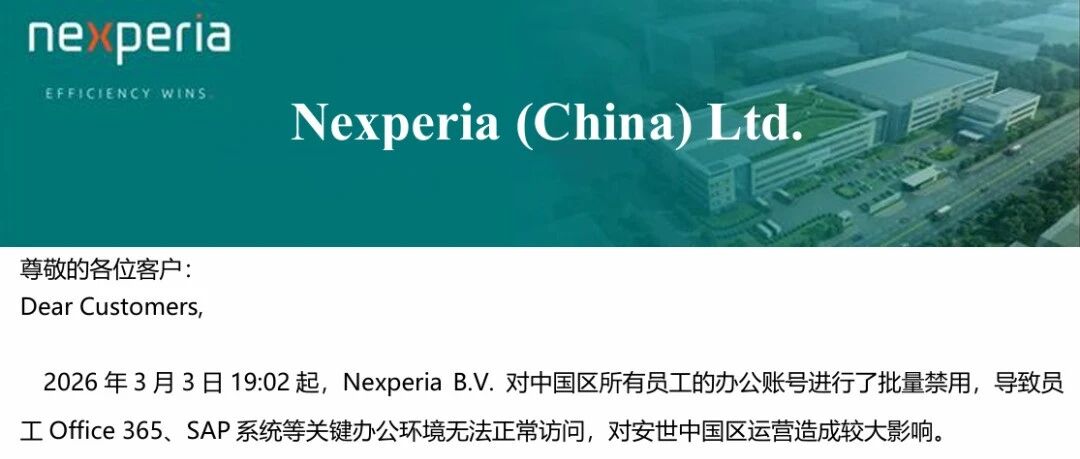
Core Viewpoint - The stock price of Wentech Technology (600745) has surged nearly 8% following significant operational disruptions at Nexperia B.V. due to the disabling of employee accounts in China, which has impacted production processes [5][1]. Group 1: Operational Impact - Nexperia B.V. announced that starting from March 3, 2026, it disabled all employee office accounts in China, leading to major disruptions in critical operational environments such as Office 365 and SAP systems [1]. - Some production processes, particularly the transition of customer-supplied wafers to production orders in SAP, were interrupted, although orders already in production were unaffected [1]. - As of now, most operations have resumed, ensuring basic production capabilities, and the company is actively working to minimize potential impacts on future production and delivery [2]. Group 2: Legal and Governance Issues - On February 11, a Dutch court announced an investigation into Nexperia B.V. for alleged mismanagement, prompting a response from the Chinese Ministry of Commerce emphasizing the need to stabilize the global semiconductor supply chain [7]. - Wentech Technology expressed disappointment over the court's decision, which did not lift temporary measures against Nexperia and failed to restore Wentech's control as a shareholder [7][8]. - The court's ruling expanded the investigation to include the current interim management of Nexperia, confirming several claims made by Wentech regarding the dispute [8]. - Wentech reiterated that the only viable solution to restore Nexperia and stabilize the global supply chain is to lift all temporary measures and restore Wentech's shareholder rights [8].


突发!安世荷兰 “一刀切” 封禁中国区账号
是说芯语· 2026-03-06 06:03
Core Viewpoint - Nexperia B.V. has disabled all office accounts for its employees in China, significantly impacting operations and production processes in the region [1]. Group 1: Operational Impact - The disabling of accounts occurred on March 3, 2026, at 19:02, leading to employees being unable to access critical systems such as Office 365 and SAP [1]. - This disruption particularly affected the production process, especially the "customer-supplied wafers to factory SAP order to production" stage, causing interruptions [1]. - However, orders that had already been entered into the production process in SAP were not affected by this incident [1]. Group 2: Response and Recovery - Following the incident, the IT and business departments in China initiated an emergency response plan to prioritize the restoration of critical systems and production scheduling [1]. - As of the announcement, most business operations had resumed, and basic production operations were secured [1]. - The company is making efforts to minimize the potential impact of this event on future production and delivery [1].
每日市场观察-20260306
Caida Securities· 2026-03-06 05:53
Market Overview - The Shanghai and Shenzhen markets opened higher, driven by a rebound in technology stocks, with the Shanghai Composite Index rising by 0.64%, the Shenzhen Component Index by 1.23%, and the ChiNext Index by 1.66% [1][4] - The trading volume in the Shanghai and Shenzhen markets exceeded 2.4 trillion yuan, showing a slight increase compared to the previous day [1] Industry Dynamics - The State Grid announced plans to enhance the capacity of power grid resource allocation and improve the ability to accommodate renewable energy during the 14th Five-Year Plan period, aiming for over 120 million kilowatts of pumped storage capacity by 2030, with renewable energy accounting for over 30% of the power generation in its operational area [1] - The power sector is expected to benefit from strong dividends and has shown resilience amid market fluctuations, indicating potential investment value [1] Fund Flow - On March 5, net inflows into the Shanghai Stock Exchange were 12.723 billion yuan, while the Shenzhen Stock Exchange saw net inflows of 5.837 billion yuan, with the top three sectors receiving funds being power grid equipment, optical optoelectronics, and semiconductors [5] Government Policies - The government work report emphasized the need to deepen reforms in key areas, enhance the long-term funding mechanism for capital markets, and improve investor protection systems [6] - The proposed budget deficit rate for 2026 is around 4%, with a deficit scale of 5.89 trillion yuan, an increase of 230 billion yuan from the previous year [8] Industry Trends - The Ministry of Industry and Information Technology plans to promote the development of new-generation artificial intelligence products, including brain-computer interfaces and autonomous vehicles, to meet the growing demand for intelligent products across various sectors [11] - Some small and medium-sized banks have begun to lower deposit interest rates, reflecting a shift in the banking sector's development philosophy from competing on interest rates to controlling costs and improving efficiency [12][13] Fund Dynamics - Since the beginning of 2026, 41 public fund managers have invested 890 million yuan in their own funds, demonstrating a commitment to long-term investment strategies [14] - The scale of private equity funds has reached a record high, with a total management scale of 22.44 trillion yuan as of the end of January 2026, marking continuous growth over the past four months [15]
霍尔木兹海峡局势变化,十大产业链危机脉络梳理
财联社· 2026-03-06 05:33
Core Viewpoint - The modern world order is built around efficiency and minimal costs, creating a highly interdependent system that can lead to widespread crises from localized disruptions, particularly in energy supplies like oil and LNG, which can trigger inflation and food shortages [1] Group 1: Supply Chain Vulnerabilities - The global polyester supply chain starts with petrochemical products, and disruptions in raw materials like naphtha or PTA can lead to significant reductions in polyester production, affecting the apparel industry [2][3] - The nitrogen fertilizer chain begins with natural gas; interruptions can lead to increased costs for farming inputs and pressure on the food system within a single planting cycle [3] - The extraction of copper and cobalt relies on sulfuric acid, which is dependent on the supply of sulfur; any disruption can halt copper extraction operations, impacting electrical and automotive sectors [4] - The polypropylene supply chain, starting from propylene, faces shortages in packaging and medical supplies if propylene supply is interrupted [5] - The chlor-alkali industry, reliant on salt and electricity, will see immediate pressure on water treatment and PVC production if disrupted [6] - The tire industry, starting from natural and synthetic rubber, will face production cuts and extended replacement cycles due to supply interruptions [7] - The steel industry, dependent on iron ore and metallurgical coal, will experience production cuts and delays in construction and manufacturing if raw materials are restricted [8] - The aluminum supply chain, starting from bauxite and requiring significant electricity, will see reduced smelting capacity affecting packaging and transportation sectors [9] - The flat glass supply chain, reliant on soda ash and natural gas, will face production challenges impacting construction and solar energy sectors if inputs are disrupted [10] - The semiconductor supply chain, starting from ultra-pure gases and stable electricity, will see yield issues and delivery delays if these inputs are affected [11] Group 2: Impact Timeline - The first level of impact involves disruptions in maritime energy transport, with significant daily oil and LNG logistics bottlenecks [13] - The second level involves shortages in refining and industrial chemicals due to the depletion of sour crude oil, leading to immediate sulfur shortages [15] - The third level sees mining and metal extraction affected by sulfur shortages, halting copper and cobalt extraction processes [17] - The fourth level indicates a worsening copper shortage affecting power transformers and electrical hardware, leading to extended delivery times [19] - The fifth level highlights semiconductor supply chain disruptions due to LNG shortages in Taiwan, causing voltage drops in manufacturing equipment [21] - The sixth level indicates a freeze in data center expansion due to silicon supply constraints and transformer unavailability [23] - The seventh level focuses on capital markets, where raw material cost inflation leads to severe profit compression and stock revaluation [25] - The eighth level discusses national responses involving strategic oil reserves, constrained by physical limitations [27] - The ninth level addresses the restructuring of trade frameworks, marked by a shift towards non-dollar energy settlements [29] - The tenth level emphasizes social stability, where energy and fertilizer inflation leads to structural food crises in emerging markets [30] - The eleventh level indicates a shift in industrial structure, with aluminum replacing copper facing engineering limits [31] - The twelfth level represents a long-term redesign of social civilization, prioritizing resource security over economic efficiency [33]