
自动驾驶

Search documents
Robotaxi规模化突围,文远知行找到自动驾驶“造血”密钥
财富FORTUNE· 2025-12-02 14:36
Core Insights - The autonomous driving industry is experiencing a significant divide, with idealists failing in a capital winter while pragmatic players are achieving scalable commercial success [1][3] - The competition has shifted from algorithm precision and testing mileage to a comprehensive contest of business capabilities, global vision, and strategic endurance [1] - WeRide's latest Q3 financial report showcases a remarkable growth trajectory, with total revenue increasing by 144.3% to 171 million yuan, gross profit soaring by 1,123.9%, and net loss reduced by 70.5% [1][4] Financial Performance - WeRide's total revenue reached 171 million yuan, driven by a transformative business model [4] - Robotaxi revenue surged to 35.3 million yuan, a year-on-year increase of 761%, now accounting for 20.7% of total revenue [4] - The gross profit margin of 32.9% leads the industry, indicating a potential path to profitability as losses narrow significantly [4][24] Operational Efficiency - In Q3, WeRide's order volume in Guangzhou increased several times, with each vehicle completing up to 25 rides in 24 hours [5][6] - The launch of pure unmanned Robotaxi operations in Abu Dhabi marks a critical commercial milestone, demonstrating the viability of autonomous driving in real-world environments [7] Cost Control and Technology - WeRide's collaboration with Lenovo has led to a 50% reduction in Robotaxi GXR's autonomous driving suite costs, with an 84% decrease in lifecycle costs compared to previous generations [8] - The company plans to expand its fleet in the Middle East to 1,000 vehicles by 2026 and deploy hundreds of thousands globally by 2030 [12] Global Expansion and Licensing - WeRide holds licenses in eight countries, establishing a significant compliance barrier in the autonomous driving sector [13][16] - The recent acquisition of key licenses in the UAE and Switzerland supports WeRide's global commercialization efforts [14][16] Strategic Partnerships and Local Adaptation - WeRide's partnerships with local entities, such as Swiss Federal Railways and ride-hailing giants like Uber and Grab, enhance its market presence and operational efficiency [18] - The integration of a universal autonomous driving platform allows for consistent deployment across different regions, reducing engineering costs and ensuring technology uniformity [17] Future Prospects and Market Position - WeRide is exploring further commercialization opportunities, including autonomous minibuses, with contracts secured in Guangzhou and Shenzhen [20] - The company uniquely combines L4-level autonomous driving with L2+ assisted driving solutions, creating a competitive advantage in the market [22] - Following the release of its financial results, WeRide's stock prices surged, reflecting market confidence in its diversified business model and operational capabilities [24]

中信证券助力佑驾创新再次成功完成新股配售
Xin Lang Cai Jing· 2025-12-02 13:08
(来源:中信证券发布) 2025年12月2日,深圳佑驾创新科技股份有限公司(以下简称佑驾创新,2431.HK)完成2.09亿港元新股 配售,中信证券担任本项目的牵头整体协调人和牵头配售代理。 中国渐进式智能驾驶发展先锋 来源:市场资讯 (股票代码:2431.HK) 佑驾创新(MINIEYE)成立于2014年,是中国领先的智能驾驶和智能座舱解决方案供应商。佑驾创新 坚持技术创新,持续迭代升级,用行业领先的技术为出行体验创造更多价值,为智能汽车赋予更多可 能。 落地又一单新股配售项目 持续助力佑驾创新发展 中信证券坚持服务国家战略,积极践行科技金融等五篇大文章,为科技创新企业提供全周期、全方位资 本运作服务。继2024年12月牵头保荐佑驾创新登陆港交所、2025年7月独家助力佑驾创新完成新股配 售,中信证券再次助力佑驾创新完成上市后第二次新股配售。 中信证券结合近期港股市场行情及投资者反馈,基于对自动驾驶行业及其业务逻辑的深入理解,量身定 制融资方案,帮助佑驾创新成功把握发行窗口,在11月25日收盘后迅速启动交易;凭借专业判断,成功 吸引了各类型市场化投资者的大量需求,顺利协助佑驾创新实现融资及折价目标。中信证券 ...

英伟达开源最新VLA,能否破局L4自动驾驶?
Tai Mei Ti A P P· 2025-12-02 13:01
Core Insights - NVIDIA has officially open-sourced its latest autonomous driving Vision-Language-Action (VLA) model, Alpamayo-R1, which can process vehicle camera images and text instructions to output driving decisions [2][3] - The Alpamayo-R1 model emphasizes "explainability," providing reasons for its decisions, which aids in safety validation and regulatory review [3][4] - The VLA model is seen as the next core technology in intelligent driving, with various companies, including Li Auto, Xpeng Motors, and Great Wall Motors, already implementing it in production [3][4] Group 1: Model Features and Benefits - Traditional end-to-end models are often "black boxes," making them difficult to interpret, especially in complex scenarios [4] - VLA introduces a language modality as an intermediary layer, enhancing the model's ability to handle complex situations and providing a more human-like decision-making process [4][5] - The Alpamayo-R1 model has shown significant performance improvements, including a 12% enhancement in trajectory planning performance and a 25% reduction in near-collision rates [5][6] Group 2: Industry Impact and Ecosystem Development - NVIDIA aims to position itself as the "Android" of the autonomous driving sector, moving beyond being just a hardware supplier [6][8] - The company has announced plans to deploy 100,000 Robotaxis starting in 2027, collaborating with firms like Uber and Mercedes to create the world's largest L4 autonomous driving fleet [7][8] - The open ecosystem proposed by NVIDIA could facilitate data sharing among companies, potentially accelerating technological advancements in the industry [8][9] Group 3: Challenges and Future Considerations - Despite the advancements, the Alpamayo-R1 model requires high-performance hardware to meet automotive-grade latency, indicating a dependency on NVIDIA's hardware solutions [10][11] - The effectiveness of VLA technology is still under evaluation, and there are concerns about the limitations imposed by NVIDIA's platform on developers [11][12] - The successful commercialization of L4 autonomous driving will also depend on regulatory frameworks and the ability to balance data privacy with operational safety [11][12]


中国自动驾驶企业Momenta提交香港IPO申请
Xin Lang Cai Jing· 2025-12-02 11:53
两名知情人士透露,中国自动驾驶技术研发企业 Momenta 已秘密提交香港首次公开募股(IPO)申请。 知情人士表示,在美国与中国紧张局势加剧的背景下,Momenta 放弃了在纽约上市的计划,目前它正 加入越来越多、拟在这座亚洲金融中心挂牌的中国企业行列。 路透社曾在 9 月报道,由于中国证券监管机构此前授予的赴美上市许可已于 6 月到期,Momenta 正考 虑将 IPO 地点从纽约改为香港。 目前,该公司香港 IPO 计划的具体细节(包括发行规模和时间表)尚未公布。 Momenta 的投资方包括日本丰田汽车(Toyota Motor)和德国汽车零部件供应商博世(Bosch)等。截 至发稿,Momenta 未立即回应路透社的置评请求;香港市场运营商香港交易及结算所有限公司 (HKEX,简称 "港交所")也拒绝置评。 因相关信息未公开,上述知情人士要求匿名。 2025 年是香港交易所自 2021 年以来新股上市表现最好的一年。据迪罗基(Dealogic)数据显示,截至 11 月中旬,香港 IPO 市场募资总额已达 320 亿美元,较去年同期增长超 200%。 目前,该公司香港 IPO 计划的具体细节(包括发行 ...
秒级接单,滴滴自动驾驶车在广州街头全天候24小时试运行
Nan Fang Du Shi Bao· 2025-12-02 09:59
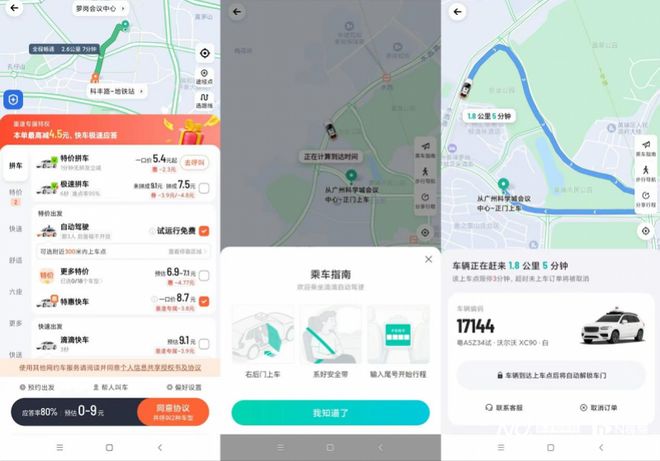
Core Insights - Didi Autonomous Driving has launched 24/7 fully driverless passenger testing in designated areas of Guangzhou, following its previous service at the 15th National Games [1][8] - The service area includes high-frequency travel locations such as subway stations, schools, shopping centers, office buildings, and residential communities [1] - Users can request driverless vehicles through the Didi app, which will intelligently match vehicles based on various factors [1][3] Group 1 - The testing service is available all week, allowing users to call for autonomous vehicles at any time [1][7] - Passengers can unlock the vehicle doors via the app or automatically as they approach, and they have the option to modify their destination during the ride [5][7] - Didi Autonomous Driving has been conducting comprehensive testing in various conditions for over 1,900 days, ensuring safety and reliability [7] Group 2 - Didi Autonomous Driving received a Series D funding round totaling 2 billion yuan, aimed at enhancing AI research and advancing L4 autonomous driving applications [8] - The company is collaborating with GAC Aion to develop a new generation of autonomous vehicles, expected to be delivered by the end of 2025 [8] - Didi is actively participating in the smart city development in Guangzhou, having provided official autonomous driving services during the recent National Games [8]

美股异动丨小马智行盘前续涨2.5% 此前已录得5连升 持续获机构唱好
Ge Long Hui· 2025-12-02 09:16
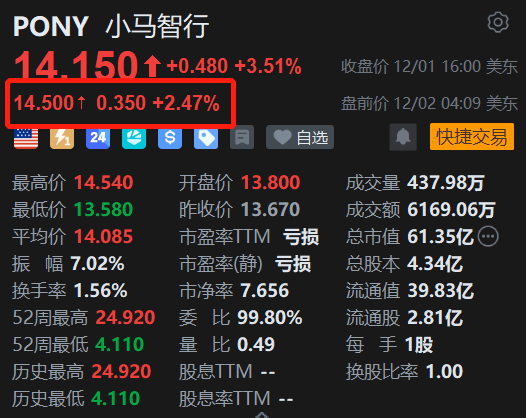
Core Viewpoint - Pony.ai (PONY.US) continues to rise in pre-market trading, up 2.5%, following a five-day consecutive increase, driven by strong revenue growth in its latest earnings report [1] Group 1: Financial Performance - For Q3 2025, Pony.ai reported total revenue of 181 million yuan, representing a 72% year-over-year increase, marking three consecutive quarters of revenue growth [1] - The revenue growth is primarily attributed to strong performance in Robotaxi and technology licensing and application revenues [1] Group 2: Analyst Revisions - Following the earnings report, multiple investment banks have raised their revenue forecasts for Pony.ai for 2026 [1] - Bank of America has increased its revenue projections for Pony.ai for 2025 to 2027 by 5%, 4%, and 9% respectively, and has raised the stock's target price from $20 to $21, maintaining a "Buy" rating [1]
做空英伟达后,大空头对特斯拉开火
Xin Lang Cai Jing· 2025-12-02 09:15
Core Viewpoint - Michael Burry, known for predicting the 2008 financial crisis, has turned his attention to Tesla, claiming its market value is "absurdly overvalued" and has been for a considerable time [2] Group 1: Valuation Concerns - Burry questions Tesla's valuation and suggests that the proposed $1 trillion compensation plan by Elon Musk would dilute existing shareholder equity and weaken earnings per share [2] - Tesla's current price-to-earnings (P/E) ratio exceeds 250, significantly higher than other major tech companies, with Apple at approximately 30, Amazon at about 50, and Microsoft at around 35 [3] - Jim Chanos, another prominent short-seller, has previously stated that Tesla's high market value is disconnected from its actual revenue and profit levels, indicating overly optimistic market expectations regarding its future business [3] Group 2: Market Share and Competition - Tesla's market share in the U.S. electric vehicle market has declined from over 50% in 2022 to 41% in 2025, facing increasing competition from traditional automakers and Chinese brands [4] - In Europe, Tesla's new car registrations fell by 48% year-on-year in October, while Chinese brand BYD saw a 195% increase in new car registrations during the same period [4] Group 3: Strategic Shifts and Future Plans - Tesla has shifted its business focus multiple times, from electric vehicle manufacturing to autonomous driving technology, and now to humanoid robot development, but has struggled to maintain a solid competitive edge [2] - Elon Musk emphasizes that Tesla is not just a car manufacturer but also an AI company, with significant potential in its humanoid robot project, Optimus, and plans to expand its Robotaxi fleet [4] - Tesla is preparing to expand its Texas Gigafactory to support the mass production of the Optimus robot, aiming for an annual production capacity of 10 million units, although these initiatives lack a clear commercialization timeline [4]
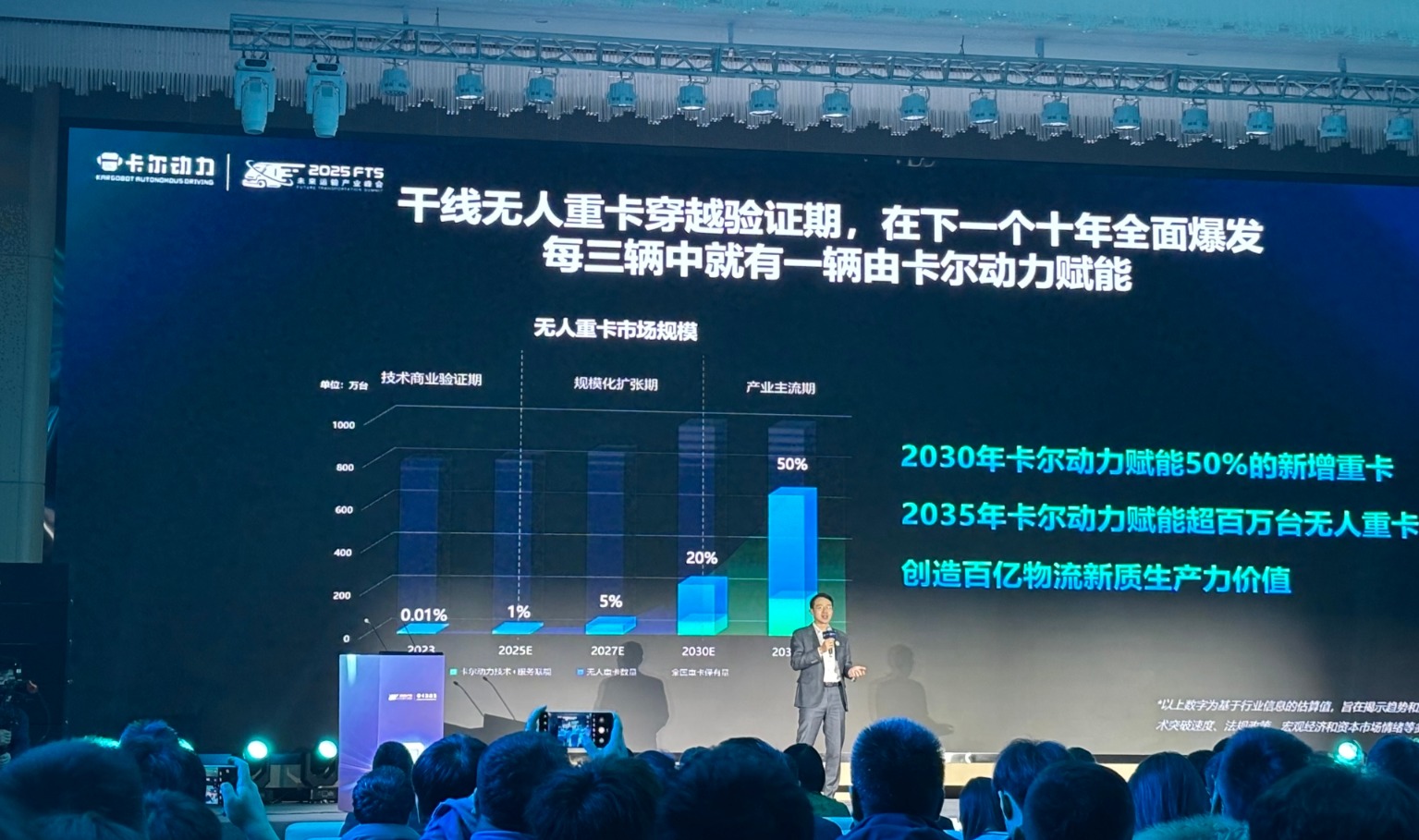
自动驾驶重卡商业价值远超Robotaxi?卡尔动力韦峻青:不追求100%无人化,更关注路线级盈利
Mei Ri Jing Ji Xin Wen· 2025-12-02 09:08
Core Insights - The focus of the industry is shifting towards L4 autonomous driving, particularly in the heavy-duty truck sector, which is seen as a high-value market with significant potential for commercialization [1][5] - The global market for autonomous trucks is expected to exceed 400 billion yuan by 2030, with full automation entering a validation phase by 2025 [1][5] - The company emphasizes that achieving profitability and scaling operations is more critical than pursuing 100% automation [1][4] Company Overview - The company, established in 2021 and incubated by Didi, has built a fleet of over 400 autonomous trucks, accumulating over 35 million kilometers in operational mileage and transporting a total of 1.2 billion tons [3][5] - The annual revenue of the company is approximately 500 million yuan, with a hardware cost of about 90,000 yuan per unit, offset by savings of over 100,000 yuan in driver costs annually [3][5] - The company aims to reduce overall logistics costs by 20% to 25% through autonomous driving technology and expects further efficiency gains from warehouse transport robots [3][5] Market Strategy - The company plans to focus on practical applications of autonomous driving, targeting a 50% to 80% reduction in labor costs while achieving scalable operations [4][5] - The company has received the first commercial operation qualification for autonomous freight transport in the country and aims to validate profitability on specific routes before scaling up [3][6] - The company has completed approximately 300 million yuan in Series A+ financing and does not currently face funding pressures, indicating strong market confidence in the potential of the autonomous truck sector [5][6] Future Projections - The company expects to add over 50 autonomous driving licenses by the end of the year, with plans to reach hundreds in the following year [6] - The company anticipates that the penetration rate of autonomous vehicles will double annually, with the potential for rapid scaling of profitable routes [6] - The company has developed seven mass-produced vehicle models and is accelerating the replication of successful operational models in new markets [6]
特斯拉再添一把火,「世界模型」如何重塑自动驾驶?
Tai Mei Ti A P P· 2025-12-02 09:05
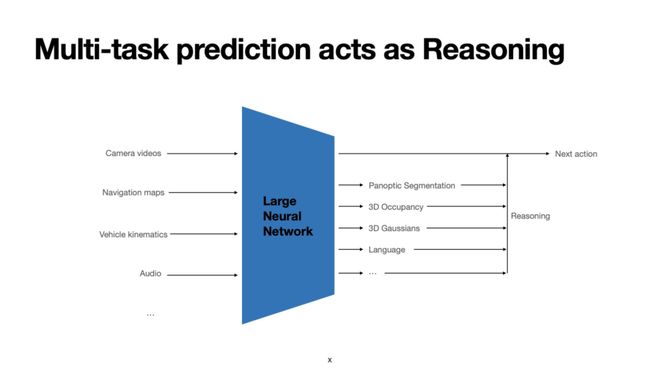
Core Insights - The article discusses the advancements in Tesla's Full Self-Driving (FSD) technology, particularly focusing on the integration of end-to-end models and world models, which are crucial for the evolution of autonomous driving technology [1][3][17]. Group 1: Tesla's FSD Developments - Tesla's AI VP Ashok Elluswamy shared significant updates on FSD, highlighting the use of a multi-modal input system that combines video, navigation maps, and audio signals into a single end-to-end neural network [1][3]. - The end-to-end architecture allows for direct output of control signals, enhancing the system's performance and reducing latency [3][4]. - The challenges faced in building an effective end-to-end system include the "curse of dimensionality," where the input data volume can explode, making real-time processing difficult [4][5]. Group 2: World Model Concept - The world model is described as a generative spatiotemporal neural system that compresses multi-modal inputs into latent states, enabling future environment predictions [18][20]. - It allows for action-conditioned future predictions, providing insights into how different actions will affect the environment, thus enhancing decision-making capabilities [21][22]. - The integration of world models with planning and control systems enables a closed-loop feedback mechanism, allowing for real-time evaluation of actions and risk assessment [22][24]. Group 3: Comparison of Approaches - The article contrasts world models with Visual-Language-Action (VLA) models, noting that world models focus on physical simulation and long-term evaluations, while VLA models leverage language processing for decision-making [46][49]. - World models are seen as more aligned with the physical nature of autonomous driving, while VLA models offer advantages in handling rare scenarios through language-based reasoning [49][50]. - The ongoing debate between these two approaches suggests that the future of autonomous driving may involve a combination of both methodologies [49]. Group 4: Developments in China - Chinese companies like NIO and Huawei are actively developing their own world models, with NIO's NWM (Nio World Model) being a notable example that integrates multi-modal information for future scene predictions [28][30]. - Huawei's WEWA architecture emphasizes direct perception-to-action pathways, avoiding language abstraction to enhance real-time decision-making capabilities [36][40]. - SenseTime's "KAIWU" world model focuses on generating high-fidelity simulation data, showcasing the growing importance of world models in the Chinese autonomous driving landscape [41][45].

港股异动 | 小马智行-W(02026)涨超3% 公司商业化拐点确立 三季度Robotaxi业务强劲
智通财经网· 2025-12-02 07:21
消息面上,小马智行近期发布2025年第三季度财报,宣布第七代Robotaxi在广州实现单车盈利转正,公 司将提前完成Robotaxi千辆规模目标,2026年底将扩至3000辆以上。三季度该公司实现总营收1.81亿元 人民币,同比增长72%,连续三个季度实现营收增长。Robotaxi业务三季度收入达4770万元人民币,同 比增长89.5%,其中乘客车费收入同比上涨超200%。东吴证券指出,公司商业化拐点确立,多维能力构 建护城河。随技术进步与政策推进,公司有望持续受益于自动驾驶行业从"技术验证"走向"规模化量 产"的红利。 智通财经APP获悉,小马智行-W(02026)涨超3%,截至发稿,涨3.37%,报113.5港元,成交额6744.18万 港元。 ...