Securities

Search documents
徐翔重出江湖?社交平台AI生成“李鬼”泛滥,都有哪些欺骗套路
Feng Huang Wang· 2025-08-21 01:38
Core Viewpoint - The resurgence of prominent investors like Xu Xiang and Lin Yuan in the stock market has led to a surge in retail investor participation, accompanied by a rise in fraudulent stock recommendation activities disguised as educational content [1][4][14]. Group 1: Market Trends - The Shanghai Composite Index has reached new highs, indicating the start of a slow bull market, which has attracted a significant influx of retail investors into the stock market [1]. - Financial content on social media platforms has seen rapid growth, with tags related to "investment" and "finance" garnering billions of views, particularly on platforms like Xiaohongshu [3]. Group 2: Fraudulent Activities - There has been a notable increase in fake stock recommendation accounts and content, with some using the names of well-known investors to attract viewers and promote illegal activities [4][7][14]. - Social media platforms have been criticized for their inadequate ability to distinguish between legitimate financial advice and fraudulent content, leading to a proliferation of misleading information [3][10]. Group 3: Regulatory Response - Regulatory bodies and financial institutions have begun to take action against fraudulent activities, with multiple securities firms issuing warnings about scams that impersonate their names and offer fake stock trading advice [14][15]. - The Shanghai Stock Exchange has initiated educational campaigns to raise awareness about the dangers of illegal stock recommendations, featuring public figures to enhance outreach [16].


居民存款正在跑步“入市”,真是这样吗?
Hu Xiu· 2025-08-20 23:57
Market Performance - The A-share market has shown strong performance, with a bullish atmosphere becoming increasingly evident [1] - On August 20, major indices collectively rose, with the Shanghai Composite Index reaching a new high not seen in 10 years [2] Index Movements - As of the market close, the Shanghai Composite Index increased by 1.04% to 3766.21 points, the Shenzhen Component rose by 0.89% to 11926.74 points, the ChiNext Index saw a slight increase of 0.23% to 2607.65 points, and the Sci-Tech Innovation 50 Index surged by 3.23% to 1148.15 points [3] Trading Volume - The trading volume in the Shanghai and Shenzhen markets reached 24,082 billion yuan, a decrease of 1,801 billion yuan compared to the previous trading day [4] - Despite the decline in trading volume, the overall bullish sentiment in the market remains strong, as indicated by the continuous rise in indices [4] Capital Flow - Recent data from the central bank shows a significant reduction in household deposits by 1.11 trillion yuan in July, while non-bank financial institutions saw an increase of 2.14 trillion yuan, the highest level recorded since 2015 [4] - This shift in deposits has sparked discussions about the "migration" of household savings into the capital market through funds and stocks [4] Investment Trends - Analysts suggest that the increase in non-bank deposits is often associated with household funds entering the stock market, making it a crucial indicator for observing capital flows [4] - The improvement in the basic expectations of the equity market and the recovery of the perceived profitability are necessary conditions for the migration of household deposits [5] Future Outlook - The expectation of a turning point in A-share profitability is becoming clearer, indicating that the conditions for household deposit migration are maturing [6] - The influx of incremental funds from household deposits is expected to push up the valuation levels and indices of A-shares [6] Market Sentiment - The current market sentiment is influenced by the performance of the equity market, with analysts noting that the migration of household deposits is a significant potential driver for the bull market [7] - However, some analysts express caution, indicating that the migration of household deposits is not yet fully accelerated and remains at historically low levels [7] Economic Factors - The decline in deposit rates and the shift in household asset allocation towards financial assets are contributing to the trend of deposit migration [8] - Future improvements in corporate profitability are crucial for sustaining the attractiveness of the stock market and encouraging further household deposit migration [8] Liquidity Expectations - A significant amount of deposits is expected to mature in the coming years, which could lead to substantial liquidity impacts on the asset markets [9] - However, uncertainties in macroeconomic trends, policy adjustments, and external environments may influence household asset allocation decisions and capital flows [9]
华泰证券:资金活跃度高位延续 外资及险资或为后续主要增量来源
Xin Lang Cai Jing· 2025-08-20 23:57
Core Viewpoint - The report from Huatai Securities indicates that the A-share market has seen a significant increase in trading volume, surpassing 2 trillion, with both trading volume and price rising, while the activity of trading funds remains high without clear signs of overcrowding [1] Group 1: Market Activity - The influx of retail funds has boosted the activity of trading funds, with the number of active traders reaching a year-to-date high [1] - The financing activity has also hit a year-to-date peak, indicating strong market engagement [1] Group 2: Private Equity and Institutional Investment - The number of private equity product registrations remains high, with 666 new products registered in early August, reflecting a 6% increase from July [1] - Foreign and insurance capital are expected to be major sources of incremental investment, with insurance capital's market entry ratio expected to rise in Q2 2025 [1] Group 3: Asset Allocation Trends - The proportion of equity assets in personal insurance has exceeded the high point of Q3 2024, although it is still below the policy limit [1] - Foreign capital trading activity has rebounded, but the trend of net inflows from allocation-type foreign capital has not yet formed, which may be a key factor for future market trends [1]

基金托管牌照扩容降温 年内6家券商撤回申请
2 1 Shi Ji Jing Ji Bao Dao· 2025-08-20 23:10
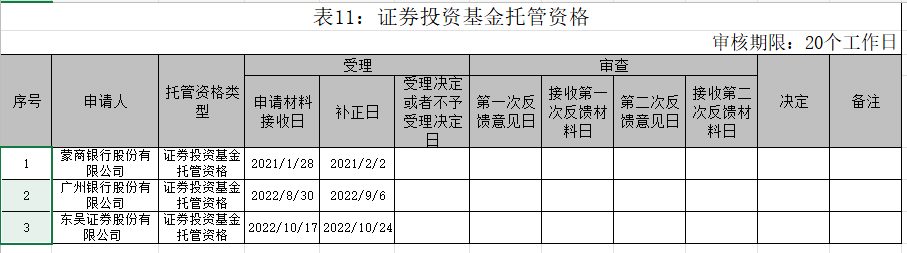
Core Viewpoint - The recent regulatory changes have led to a significant reduction in the number of brokerages applying for fund custody qualifications, with only three institutions remaining in the queue, primarily due to heightened entry barriers established by new regulations [1][2][3]. Group 1: Regulatory Changes and Impact - The China Securities Regulatory Commission (CSRC) has published a notice indicating that only three institutions are currently applying for fund custody qualifications, down from seven in the past [1][3]. - In just over eight months, six brokerages have withdrawn their applications for fund custody qualifications, primarily due to the new regulations that have raised the entry threshold significantly [2][5]. - The new regulations aim to shift the industry focus from "quantity expansion" to "quality competition," implementing "hard thresholds and dynamic supervision" to reshape the industry ecosystem [2][5]. Group 2: Financial Requirements - The new regulations require brokerages to have a net asset of at least 300 billion yuan, which has led many smaller brokerages to withdraw their applications as they do not meet this requirement [5][6]. - Prior to the new regulations, the minimum net asset requirement was 200 billion yuan, indicating a substantial increase in the standards for obtaining custody qualifications [5][6]. Group 3: Industry Concentration and Trends - The fund custody industry is experiencing a trend towards concentration, with banks and a few large brokerages controlling approximately 80%-90% of public and private fund custody [7]. - Over 70% of brokerages have not obtained fund custody qualifications, highlighting a growing disparity between larger and smaller firms in the industry [7][8]. - The top five brokerages in terms of fund custody account for 65.71% of the total custody numbers, indicating a significant concentration of business among leading firms [8]. Group 4: Future Outlook and Strategies - Smaller brokerages that cannot meet the new requirements may need to explore differentiated survival strategies, such as partnering with larger institutions for operational support [9][10]. - The custody license is shifting from being a "scarce resource" to a "capability certification," suggesting that larger brokerages will leverage technology to maintain their advantages while smaller firms may transition to service outsourcing roles [10].

股票型ETF成交额连续6个交易日超千亿元,释放什么信号?
Sou Hu Cai Jing· 2025-08-20 14:55
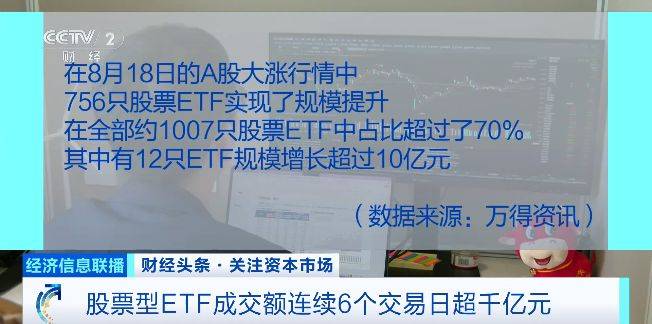
Group 1 - The core viewpoint of the article highlights the recent surge in trading activity of stock ETFs, indicating a significant channel for capital entering the market [1] - As of August 20, stock ETFs have seen over 100 billion yuan in trading volume for six consecutive trading days, with 756 out of approximately 1007 stock ETFs experiencing growth, representing over 70% [3] - 12 ETFs have reported a scale increase of over 1 billion yuan, reflecting strong market enthusiasm driven by recent A-share rallies [3] Group 2 - According to Yang Chao, Chief Strategy Analyst at China Galaxy Securities, the growth in ETF scale aligns with current market volume and index rise rates, although a shift in investor expectations and momentum from major funds will take time [5] - The competition among brokerages to attract new clients has intensified, with some ETF and convertible bond commissions dropping to as low as 0.05% [7] - On August 18, the scale of stock ETFs increased from 32,097.75 billion yuan to 32,506.13 billion yuan, marking a growth of 408.38 billion yuan, or 1.27% [7] Group 3 - Zhang Wenlang, Chief Macro Analyst at CICC, noted that while daily trading metrics for stock ETFs have been improving, investors should be cautious of potential profit-taking fluctuations following recent gains [10] - It is essential to monitor changes in market liquidity from a mid-term perspective [10]
A股搜索热度尚未大幅提升 机构看好“慢牛”格局持续演绎
Zhong Guo Jin Rong Xin Xi Wang· 2025-08-20 11:57
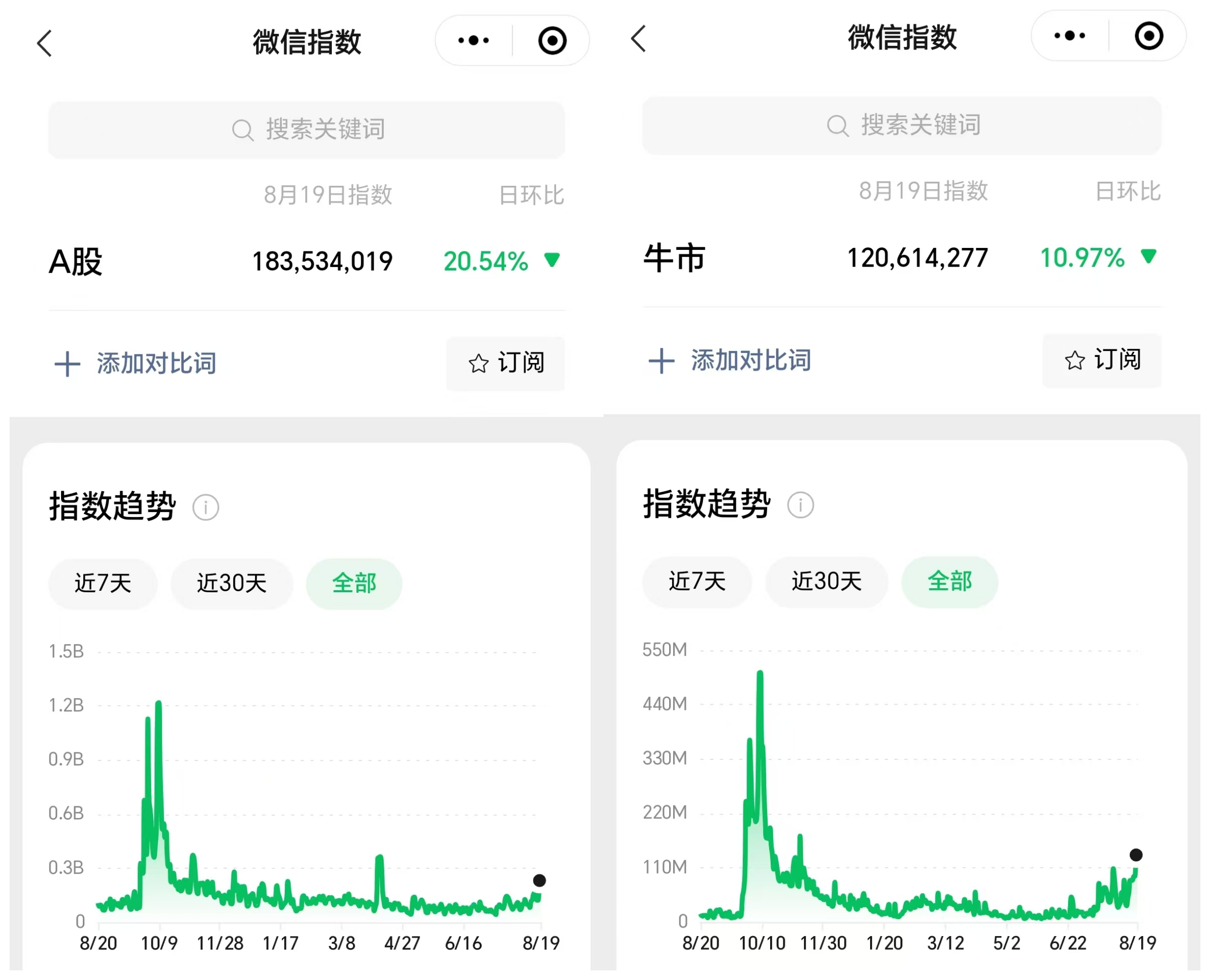
Market Performance - The A-share market continues its upward trend, with the Shanghai Composite Index closing up 1.04%, reaching a ten-year high as of August 20 [1] - The trading volume in the Shanghai and Shenzhen markets exceeded 2.4 trillion yuan, maintaining above 2 trillion yuan for six consecutive trading days, marking the first occurrence since November 2024 [1] - Since the second half of 2025, the A-share market has shown significant acceleration, with the Shanghai Composite Index up 9.34%, the Shenzhen Component Index up 13.97%, and the ChiNext Index up 21.12% as of August 20 [1] Market Sentiment and Public Interest - Despite the market's upward movement, the public interest in keywords like "A-share" and "bull market" on platforms like WeChat and Baidu has not significantly increased compared to last year's "924" market rally [4][7] - The Baidu search index for "A-share" has risen, but the interest in "bull market" remains relatively unchanged, indicating a disparity between market performance and public engagement [4] Market Structure and Characteristics - The current market rally is characterized by a slower pace and structural features, with 617 stocks declining and 2,466 stocks underperforming the Shanghai Composite Index since the beginning of the second half of the year [7] - In contrast, during last year's "924" rally, only 5 stocks declined, highlighting the structural differences in the current market dynamics [7] Investment Dynamics - Analysts suggest that the current market rally is not solely driven by sentiment but is supported by policy expectations and industry trends, with a focus on AI, advanced manufacturing, and anti-involution themes [8] - The influx of long-term capital and the deepening of internationalization in the A-share market may lead to a more sustainable "slow bull" market, reflecting China's economic transformation and enhancing its position in the global capital market [8]
居民存款“搬家入市”?机构:潜在入市规模超5万亿
天天基金网· 2025-08-20 11:27
Core Viewpoint - The recent surge in A-shares, with the Shanghai Composite Index breaking through 3731 to reach a ten-year high, is largely driven by the influx of incremental funds from residents moving their savings into the stock market [5]. Group 1: Market Performance - The Shanghai Composite Index has reached a ten-year high of 3731, with trading volume exceeding 2 trillion yuan [5]. - As of the end of July, the total market capitalization of stocks in Shanghai and Shenzhen was 94.91 trillion yuan, an increase of 4.1 trillion yuan from the previous month [5]. Group 2: Resident Savings and Stock Market Correlation - Resident savings balance stood at 160.91 trillion yuan at the end of July, showing a decrease of 1.11 trillion yuan from the previous month [5]. - The ratio of resident savings to total stock market capitalization is currently at 1.7, indicating a significant negative correlation between resident savings and stock market value [5]. - Historically, this ratio has ranged between 1.1 and 2.0, suggesting that the current high level of 1.7 indicates potential for further funds moving into the market [5]. Group 3: Drivers of Fund Movement - The initial signs of savings moving into the stock market were observed in June and July, driven by factors such as increased market risk appetite, alleviation of "asset scarcity," weakening of the US dollar leading to the return of overseas funds, and weak real investment [5]. - Potential funds that could enter the market from resident savings are estimated to be between 5 to 7 trillion yuan, which may exceed the amounts seen during previous market rallies in 2016-2017 and 2020-2021 [5].

撤回潮!6家券商撤回基金托管申请
Zhong Guo Ji Jin Bao· 2025-08-20 05:53
Core Viewpoint - Six out of seven brokerages have withdrawn their applications for fund custody qualifications, leaving only Dongwu Securities remaining in the queue [1][2]. Group 1: Regulatory Changes - The China Securities Regulatory Commission (CSRC) has raised the asset requirement for securities firms from 20 billion yuan to 30 billion yuan for fund custody qualifications [4]. - The new regulations also introduced a "holding license" requirement, where institutions with an average custody scale below 5 billion yuan for 36 consecutive months may lose their qualifications [4]. Group 2: Industry Impact - The withdrawal of applications by smaller brokerages is attributed to increased resource demands for system construction, client promotion, and risk control [3]. - Currently, there are 66 financial institutions with custody qualifications, with a significant concentration among the top firms, as the top five brokerages account for 65.71% of the custody volume [5]. Group 3: Future Trends - The custody industry is expected to evolve from basic custody services to value-added services such as performance evaluation and compliance monitoring, forming a "custody+" service model [5]. - Major brokerages like Citic Securities and Guotai Junan are enhancing their service offerings and operational efficiencies to capture a larger market share [6].

中信建投证券获易方达基金增持23.35万股
Ge Long Hui· 2025-08-20 00:22
| 股份代號: | 06066 | | --- | --- | | 上市法國名稱: | 中信建投証券股份有限公司 - H股 | | 日期 (日 / 月 / 年): | 20/07/2025 - 20/08/2025 | 格隆汇8月20日丨根据联交所最新权益披露资料显示,2025年8月13日,中信建投证券(06066.HK)获易方达基金管理有限公司在场内以每股均价13.70港元增 持23.35万股,涉资约319.9万港元。 增持后,易方达基金管理有限公司最新持股数目为8828.05万股,持股比例由6.98%上升至7.00%。 | 表格序號 | 大股東/董事/最高行政人員名 作出披露的買入 / 賣出或涉及的 每股的平均價 | | | | | 持有權益的股份數目 佔已發行的 有關事件的日 相關法 | | --- | --- | --- | --- | --- | --- | --- | | | | | 股份數目 | | | (語参関上述*註 有投票權股期(日/月/ 份權益 | | | | | | | | 份自分比 年) | | CS20250818E00281 | 易方达基金管理有限公司 | 1101(L) | | ...


双2万亿元 本轮股市行情有何不同
Shang Hai Zheng Quan Bao· 2025-08-19 19:25
Group 1 - The core point of the article highlights that the A-share market has experienced a significant trading activity, with both the financing balance and daily trading volume exceeding 20 trillion yuan for consecutive days [2][2][2] - As of August 18, the financing balance of A-shares reached 20,881.05 billion yuan, marking the sixth consecutive day above the 20 trillion yuan threshold [2][2][2] - The current A-share market rally is characterized by a shift in funding sources from "institutional clustering" to a "diverse coexistence," indicating a maturing market ecosystem [2][2][2] Group 2 - The trading volume in the A-share market was 25,884 billion yuan on August 19, continuing the trend of exceeding 20 trillion yuan for five consecutive trading days [2][2][2] - Industry experts believe that the ongoing market recovery and the resulting profit effects are attracting new capital into the market, which, combined with the gradual emergence of institutional advantages, may lead to a positive feedback loop in the current rally [2][2][2]