
发电

Search documents
下周A股领涨板块可能大变样?别错过这些重要事件
Mei Ri Jing Ji Xin Wen· 2025-11-09 05:23
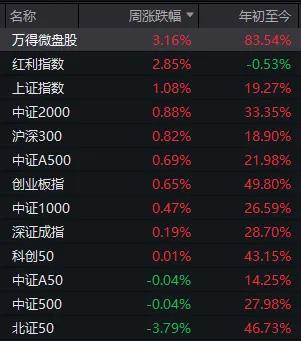
Core Viewpoint - The A-share market experienced a rebound during the week of November 3 to 7, maintaining a high-level fluctuation pattern, with micro-cap and dividend stocks performing notably well while other indices showed mixed results [1][3]. Market Performance - The performance of major indices for the week and year-to-date is as follows: - Wind Micro-Cap Index: Weekly increase of 3.16%, Year-to-date increase of 83.54% - Dividend Index: Weekly increase of 2.85%, Year-to-date decrease of 0.53% - Shanghai Composite Index: Weekly increase of 1.08%, Year-to-date increase of 19.27% - CSI 2000: Weekly increase of 0.88%, Year-to-date increase of 33.35% - CSI 300: Weekly increase of 0.82%, Year-to-date increase of 18.90% - ChiNext Index: Weekly increase of 0.65%, Year-to-date increase of 49.80% - CSI 1000: Weekly increase of 0.47%, Year-to-date increase of 26.59% - Shenzhen Component Index: Weekly increase of 0.19%, Year-to-date increase of 28.70% - Sci-Tech 50: Weekly increase of 0.01%, Year-to-date increase of 43.15% - CSI 50: Weekly decrease of 0.04%, Year-to-date increase of 14.25% - CSI 500: Weekly decrease of 0.04%, Year-to-date increase of 27.98% - North Exchange 50: Weekly decrease of 3.79%, Year-to-date increase of 46.73% [2]. Stock Movement - The number of stocks that rose during the week increased slightly compared to the end of October, but overall, the market remained mixed with both gains and losses [5]. - On November 7, the number of stocks that rose was 2,977, while 2,423 stocks fell, compared to 2,861 rising and 2,523 falling on October 31 [6]. Sector Rotation - The market saw sector rotation due to the narrow fluctuation of indices without significant volume breakthroughs, with recent hot sectors experiencing ups and downs, while long-term low-performing sectors showed signs of recovery [7]. - The leading sectors for the week included power generation, chemicals, and certain regional stocks, while the sectors that declined were primarily those that had performed well in the previous week, such as pharmaceuticals and AI applications [7]. Investment Recommendations - Short-term investment advice suggests a balanced allocation towards sectors with upward policy and industry trends, such as new energy (wind power, energy storage, solid-state batteries), machinery (robots), non-ferrous metals, media (gaming), computing (AI applications), and pharmaceuticals [10]. - Sectors that may benefit from the "14th Five-Year Plan" and potential marginal improvements in fundamentals include consumption (food, retail), military (commercial aerospace), electronics (AI hardware), and communications (computing power) [10]. External Demand Concerns - There is a growing discussion regarding the weakening of external demand, which may lead to increased focus on domestic demand themes in the upcoming week [12]. - In October, China's total import and export value was 3.7 trillion yuan, a slight increase of 0.1%, with exports at 2.17 trillion yuan, down 0.8%, marking the first negative growth in monthly export growth since the second half of this year [12][13]. Upcoming Events - Important upcoming events include the China Robot Industry Development Conference on November 10, the International Summit on Battery New Energy Industry in Suzhou on November 11, and the World Power Battery Conference on November 12, among others [17].

皖能电力:11月6日召开董事会会议
Mei Ri Jing Ji Xin Wen· 2025-11-07 08:41
Group 1 - The core point of the article is that WanNeng Power announced the results of its board meeting held on November 6, 2025, which included discussions on the 2024 annual salary for management and the performance assessment results for the incentive income for the 2022-2024 term [1] - For the first half of 2025, WanNeng Power's revenue composition was as follows: 79.28% from the power generation industry, 17.97% from the coal industry, 1.52% from the transportation industry, 1.09% from waste treatment, and 0.14% from other sources [1] - As of the time of reporting, WanNeng Power had a market capitalization of 19 billion yuan [1]

国家能源局召开学习贯彻党的二十届四中全会精神座谈会
国家能源局· 2025-11-07 01:51
Core Viewpoint - The article emphasizes the importance of implementing the spirit of the 20th Central Committee's Fourth Plenary Session within the energy sector, highlighting the need for political awareness and alignment with the central government's decisions [3][4]. Group 1: Key Messages from the Meeting - The meeting focused on the significance of understanding and implementing the achievements of the "14th Five-Year Plan" period, which are attributed to the leadership of the Central Committee and the guidance of Xi Jinping's thoughts [3]. - It is crucial to grasp the core essence of the plenary session's spirit, including the strategic tasks and major principles for the "15th Five-Year Plan" period [3][4]. - The meeting underscored the necessity of strengthening the Party's leadership as a fundamental guarantee for advancing modernization in China [4]. Group 2: Energy Development Strategies - The energy sector must prioritize energy security by enhancing domestic supply capabilities and diversifying overseas resource supplies to ensure a stable energy supply chain [4]. - There is a commitment to advancing the green and low-carbon transformation of energy, focusing on building a new energy system and promoting green energy consumption [4]. - The importance of technological innovation in the energy sector was highlighted, with an emphasis on smart, green, and integrated development to drive quality and efficiency changes [4]. - The meeting called for deepening energy system reforms and enhancing the market framework to stimulate vitality and optimize the business environment [4]. - Strengthening international cooperation in the energy sector is essential, with a focus on maintaining strategic confidence and expanding high-level openness while ensuring energy security [4]. Group 3: Regional Focus on Gansu Province - Gansu Province is recognized as a significant energy province, responsible for both meeting its energy needs and undertaking key tasks like "West-to-East Power Transmission" [5]. - The province has unique advantages in developing and utilizing renewable energy, which can facilitate its transition to a green and low-carbon energy system [5][6]. - The energy sector in Gansu is encouraged to leverage its strengths, accelerate technological innovation, and deepen market system construction to contribute to high-quality energy development [6].
同方股份:暂时没有参与钍基发电项目
Ge Long Hui· 2025-11-06 08:44
Core Viewpoint - The company has stated that it is currently not involved in thorium-based power generation projects [1] Group 1 - The company, Tongfang Co., Ltd. (600100.SH), has communicated its position on thorium-based power generation through an interactive platform [1]

碳市场“游戏规则”巨变!官方宣布“十五五”迈向总量控制
Zhong Guo Neng Yuan Wang· 2025-11-06 01:56
Group 1: National Carbon Market Development - The national carbon market is transitioning from intensity control to total control during the 14th Five-Year Plan period, with a focus on total carbon emission control [2] - The inclusion of the steel, cement, and aluminum industries in the carbon trading market is expected to enhance their green and low-carbon transformation [2][3] - By 2027, priority will be given to implementing total quota control for industries with relatively stable carbon emissions [2] Group 2: Low-Carbon Investment and Technology Innovation - The carbon market has driven low-carbon investments and accelerated the innovation and promotion of green technologies [3] - The overall reduction cost in the power generation sector has decreased by approximately 35 billion yuan through carbon trading in the first two compliance cycles [3] - The expansion of the carbon market will encourage more enterprises to reduce carbon emissions through technological innovation and management efficiency improvements [3] Group 3: Voluntary Carbon Market Growth - The national voluntary greenhouse gas reduction trading market has entered a critical phase of rapid development, with 31 projects registered and a total transaction volume of 3.25 million tons of CCER [4][5] - The market has established a framework for management systems, technical methods, and infrastructure, enhancing the integrity and standardization of voluntary reduction projects [4] - The Ministry of Ecology and Environment is actively soliciting opinions on various voluntary reduction project methodologies to support diverse project development [4][5] Group 4: Carbon Footprint Management System - The average carbon footprint factor for electricity in 2024 is reported to be 0.5777 kg CO2 equivalent per kWh, a 6.9% decrease from 2023 [6][7] - The establishment of a product carbon footprint management system is a key focus for deepening ecological civilization reforms [6] - The Ministry of Ecology and Environment plans to continue enhancing the research and publication of carbon footprint factors for electricity and other key products [7]
债市基本面高频数据跟踪:车市零售月底走强:2025 年 10 月第5 周
SINOLINK SECURITIES· 2025-11-05 14:19
Report Industry Investment Rating No relevant content provided. Core Viewpoints of the Report - Economic growth shows a strengthening trend in the auto market retail at the end of the month, while production is restricted by environmental protection measures. The inflation situation features a bottom - oscillating pork price and an oscillatingly strong oil price [1][2][3]. Summary by Relevant Catalogs 1. Economic Growth: Strengthening Auto Market Retail at the End of the Month 1.1 Production: Environmental Protection Restricts开工 - **Production End: Slowing Decline in Power Plant Daily Consumption** - On November 4, the average daily consumption of 6 major power - generating groups was 75.7 tons, a 1.4% decrease from October 28. On October 30, the daily consumption of power plants in eight southern provinces was 180.5 tons, a 2.9% decrease from October 22. Although the consumption has slowed down, industrial electricity consumption has increased due to the positive impact of Sino - US negotiations on the black - series products [5][12]. - **Production End: Local Sharp Decline in Blast Furnace Operating Rate** - On October 31, the national blast furnace operating rate was 81.7%, a 3.0 - percentage - point decrease from October 24, and the capacity utilization rate was 88.6%, a 1.3 - percentage - point decrease. In Tangshan, the blast furnace operating rate of steel mills was 68.3%, a 25.1 - percentage - point decrease from October 24. The start - up rate has dropped significantly due to the start of heavy - pollution weather warnings in many places [15]. - **Production End: Moderate Decline in Tire Operating Rate** - On October 30, the operating rate of all - steel tires for trucks was 65.3%, a 0.2 - percentage - point decrease from October 23, and the operating rate of semi - steel tires for cars was 73.4%, a 0.3 - percentage - point increase. The operating rate of downstream looms in the Jiangsu and Zhejiang regions reached a new high for the year [17]. 1.2 Demand: Strengthening Auto Market Retail at the End of the Month - **Demand End: Improved Monthly - on - Monthly New Home Sales in 30 Cities** - From November 1 - 4, the average daily sales area of commercial housing in 30 large and medium - sized cities was 155,000 square meters, a 145.6% increase from October, but a 53.3% decrease from November last year. Sales in first - tier, second - tier, and third - tier cities decreased year - on - year [22]. - **Demand End: Strengthening Auto Market Retail at the End of the Month** - In October, retail sales increased by 6% year - on - year, and wholesale sales increased by 7% year - on - year. In the fifth week of October, retail and wholesale reached daily averages of 155,000 and 210,000 vehicles respectively, with significant year - on - year and month - on - month growth [26]. - **Demand End: Weak Steel Prices** - On November 4, the prices of rebar, wire rod, hot - rolled coil, and cold - rolled coil changed by - 1.2%, 0%, - 2.4%, and + 0.3% respectively compared to October 28. Since November, these varieties have shown different year - on - year and month - on - month changes. Steel inventories are seasonally decreasing [31]. - **Demand End: Oscillatingly Strong Cement Prices** - On November 4, the national cement price index increased by 0.1% compared to October 28, but prices in the East China and Yangtze River regions decreased. The year - on - year decline in cement prices has widened [32]. - **Demand End: Narrow - Range Oscillation of Glass Prices** - On November 4, the active glass futures contract price was 1,103 yuan/ton, a 0.5% decrease from October 28. Since November, glass prices have shown a month - on - month and year - on - year decline [37]. - **Demand End: Strong Increase in Container Shipping Freight Index** - On October 31, the CCFI index increased by 2.9% and the SCFI index increased by 10.5% compared to October 24. Since October, both indices have shown different year - on - year and month - on - month changes [39]. 2. Inflation: Bottom - Oscillating Pork Price 2.1 CPI: Bottom - Oscillating Pork Price - **Pork Price Bottom - Oscillating** - On November 4, the average wholesale price of pork was 18.0 yuan/kg, a 0.1% decrease from October 28. The supply has increased while the demand is weak, and the month - on - month decline has narrowed [45]. - **Slowing Growth Rate of Agricultural Product Price Index** - On November 4, the agricultural product wholesale price index increased by 0.9% compared to October 28. Different agricultural products showed different price changes. Since November, the index has shown year - on - year and month - on - month increases [51]. 2.2 PPI: Oscillatingly Strong Oil Price - **Oil Price Oscillatingly Strong** - On November 4, the spot prices of Brent and WTI crude oil were 65.5 and 60.6 dollars/barrel respectively, increasing by 1.6% and 0.7% compared to October 28. OPEC's decision to suspend production increase in the first quarter of next year supports the oil price [54]. - **Decline in Copper and Aluminum Prices** - On November 4, the prices of LME 3 - month copper and aluminum decreased by 2.9% and remained flat respectively compared to October 28. Since November, they have shown different year - on - year and month - on - month changes [58]. - **Most Industrial Product Prices Continue to Decline Month - on - Month** - Since November, industrial product prices have shown mixed changes. Most of the year - on - year declines have converged, but the year - on - year declines in cement and glass prices have widened [62].
宁夏68家企业纳入全国碳市场 为绿色转型注入强劲动力
Zhong Guo Xin Wen Wang· 2025-11-04 17:24
Core Insights - Ningxia has released a list of 68 key emission units in the power generation, steel, cement, and aluminum smelting industries for the year 2026, aiming to enhance the role of market mechanisms in controlling greenhouse gas emissions and promoting green low-carbon transformation [1] Group 1: National Carbon Market Overview - The national carbon market has been expanding since its launch in July 2021, with increasing policy incentives and constraints [1] - The newly added 21 key emission units in Ningxia are expected to increase carbon dioxide emissions coverage by approximately 31 million tons, enhancing the market's breadth and depth in the region [1] Group 2: Performance of Ningxia Enterprises - In the first compliance period, 35 key enterprises in Ningxia were included in quota management, with a total carbon dioxide emission of about 294 million tons and a quota compliance rate of 98.12% [2] - The number of enterprises under management increased to 39 in the second compliance period, with total emissions of approximately 327 million tons and 29 enterprises participating in trading, resulting in a significant increase in transaction volume and value [2] - In 2023, 37 key enterprises were managed, with emissions around 169 million tons and a compliance rate of 99.43%, indicating a sustained increase in market activity and enterprise participation [2] Group 3: Data Management and Future Goals - Reliable carbon emission data is essential for the stable operation of the national carbon market, emphasizing the importance of daily management of data quality [3] - The Ningxia Ecological Environment Department plans to enhance policy promotion and guidance to improve enterprises' carbon trading capabilities and management levels, aiming for a new stage in green low-carbon development [3]
中国华电发布“华电智”大模型
Zhong Guo Dian Li Bao· 2025-11-04 09:41
Core Viewpoint - China Huadian Group officially launched the "Huadian Smart" large model at the 2025 China Huadian New Power System Technology Innovation Forum, establishing an "AI+" innovation system tailored to the energy sector, which supports the digital transformation of the entire power industry chain and the construction of a new power system [1][2]. Group 1 - The "Huadian Smart" large model is centered around one industry model, featuring two key capabilities in AI supply and governance, supported by six technical pillars, empowering five business areas, and generating over 300 intelligent agents [2]. - The model is characterized by its application-oriented approach and deep integration with business, featuring a unique "vertical and horizontal" large model system that includes a three-tier architecture covering "industry-profession-scenario" across the entire lifecycle of "planning, construction, operation, maintenance, and management" [2]. - The model has demonstrated significant application results, including a 5% improvement in prediction accuracy for runoff forecasting, increasing the utilization rate of hydropower in the Wujiang River Basin from an average of 5.8% over the past decade to 10.8% [2]. Group 2 - During the "14th Five-Year Plan" period, China Huadian will fully implement the "AI+" initiative, promoting the application of artificial intelligence in high-value scenarios such as "desertification, water, wind, and solar" to contribute to the digital transformation of energy and the construction of a digital China [3].

可持续发展实践获国际权威认可 中国电力MSCI ESG评级跃升至A级
Zhi Tong Cai Jing· 2025-11-04 06:26
近日,全球最大指数公司明晟(MSCI)公布2025年度ESG评级结果。中国电力(02380)凭借其在清洁能源 转型、公司治理与社会责任等方面的卓越表现,实现ESG评级从BBB级到A级的跃升。 值得注意的是,这一评级是中国发电类央企在该评级体系中获得的最高等级,并创下连续两年持续提升 的纪录,标志着中国电力的可持续发展实践已达到国际优秀水平,卓越的ESG管理能力与长期投资价值 获得充分肯定。 在环境方面,公司大力推进清洁能源项目建设,显著提升风电、光伏等新能源装机比重,以实际行动助 力国家碳减排目标。在履行社会责任方面,公司持续关注员工权益与社区发展,通过如普安发电"映山 红.中电光明行"爱心助学等活动积极回馈社会,展现了央企的担当。同时,中国电力不断优化董事局结 构,强化合规管理与信息披露质量,为公司治理注入了更强韧性与透明度。 展望未来,中国电力表示将继续围绕国家"双碳"战略,加强低碳转型与创新引领,进一步深化ESG体系 建设,加强低碳转型与创新引领,致力于为推动能源可持续发展贡献更多力量。 近年来,中国电力将ESG理念深度融入企业战略与日常运营,积极对标国际先进管理经验,构建了系统 化、专业化的ESG管理 ...

可持续发展实践获国际权威认可 中国电力(02380)MSCI ESG评级跃升至A级
智通财经网· 2025-11-04 06:21
Core Viewpoint - MSCI has upgraded China Power's ESG rating from BBB to A for the year 2025, marking the highest rating achieved by a Chinese state-owned power generation enterprise in this rating system, reflecting the company's commitment to sustainable development and strong ESG management capabilities [1] Group 1: ESG Rating and Achievements - China Power has achieved the highest ESG rating among Chinese state-owned power generation companies, with a continuous improvement record over the past two years [1] - The upgrade to an A rating signifies recognition of the company's sustainable development practices reaching international standards [1] Group 2: ESG Management and Initiatives - The company has integrated ESG principles into its corporate strategy and daily operations, benchmarking against international best practices to establish a systematic and professional ESG management mechanism [1] - In environmental efforts, China Power has significantly increased the proportion of installed capacity from renewable energy sources such as wind and solar power, contributing to national carbon reduction goals [1] - The company actively engages in social responsibility initiatives, focusing on employee rights and community development through programs like the "Ying Shan Hong·China Power Bright Action" educational assistance [1] - China Power has optimized its board structure and enhanced compliance management and information disclosure quality, improving governance resilience and transparency [1] Group 3: Future Outlook - Looking ahead, China Power plans to continue strengthening its low-carbon transition and innovation leadership in alignment with the national "dual carbon" strategy, further deepening its ESG system construction [2]