
新茶饮

Search documents
2025出海标杆榜单揭晓:做好世界的合伙人
虎嗅APP· 2025-11-23 13:41
Core Insights - The article discusses the transformation of Chinese companies in their overseas expansion, marking the beginning of "Overseas 2.0" era, characterized by a shift from price competition to organizational strength, innovation, and localized operations [2][3]. Group 1: Strategic Upgrades - In the past year, there has been a significant upgrade in overseas strategies, with more companies establishing global operational systems, transitioning from product export to brand export [3]. - Many manufacturing and emerging consumer brands are setting up localized teams and data management units in specific regions, enhancing innovation, service, and marketing at community and user touchpoints [3][4]. Group 2: External Challenges - The external environment for overseas expansion is becoming increasingly complex, with geopolitical factors significantly impacting companies' strategies [4]. - Trade barriers in Europe and the U.S., data protection regulations in Southeast Asia, and market access issues in the Middle East require companies to possess higher strategic sensitivity and local adaptability [4][5]. Group 3: Local Adaptation and Risk Management - Compliance has become a critical threshold, necessitating that Chinese companies develop cross-border risk control and emergency response capabilities [5]. - Companies are moving from a "hit-and-run" approach to a more rooted strategy, focusing on local talent, data, ecosystems, and teams to withstand external risks and achieve resilient growth [5][6]. Group 4: Evolving Competitive Landscape - The competitive landscape and philosophies of Chinese companies are evolving, transitioning from product sales to creating value ecosystems [6]. - The most promising sectors for overseas expansion by 2025 include smart manufacturing, consumer electronics, renewable energy, and cross-border e-commerce brands [7][8]. Group 5: Benchmark Enterprises - The article emphasizes that true benchmark enterprises are not just defined by high revenue or size but by their continuous evolution of capabilities and ecological innovation [11][12]. - The evaluation criteria for benchmark enterprises include innovation capability, localization, organizational resilience, and sustainable growth [12]. Group 6: Award Winners - The article lists several companies recognized for their outstanding performance in overseas markets, including Haier, Lenovo, Midea, Didi, and Changan Automobile, highlighting their contributions to global brand building and market penetration [16][19][20][21][22][23][24][25][26][27][28]. - New emerging companies like United Imaging, Baseus, and Fantuan are also acknowledged for their rapid rise and innovative business models in overseas markets [30][31][32][33][34][35][36][37][38][39]. Group 7: Service Providers - The article identifies key service providers that support overseas enterprises, including logistics, marketing, and payment solutions, which help lower the barriers for Chinese brands to reach global users [41][42][43][44][45][46][47][48][49][50][51]. Group 8: Future Outlook - The future of Chinese companies' overseas expansion is expected to be defined by the integration of localization capabilities, data-driven strategies, and ecological collaboration [51]. - The evolution of Chinese brands in the global market is not a sprint but a long-term contest of organizational strength, innovation, and belief [51].








揭秘蜜雪冰城4元柠檬水背后的产业链
Mei Ri Jing Ji Xin Wen· 2025-11-22 14:35
Core Insights - The lemon industry in Chongqing's Tongnan district has grown into a nearly 10 billion yuan industry, with an expected total output of 350,000 tons and a comprehensive output value exceeding 9 billion yuan by 2025 [1] Industry Summary - The lemon harvesting season has begun in Chongqing's Tongnan and surrounding areas, covering an area of 320,000 acres [1] - The rise of the lemon industry is significantly attributed to the company "Xue Wang" (Snow King), which has played a crucial role in promoting lemon products [1] Company Summary - The company "Mixue Ice City" has popularized fresh lemon water at a price point of 4 yuan, making it accessible to a broader consumer base [1] - In the first ten months of 2025, sales of fresh lemon water have exceeded 1.5 billion cups [1] - Mixue Ice City collaborates with Tongnan lemon farms, providing long-term orders and ongoing scientific planting methods and technical guidance to farmers [1] - The success of Mixue Ice City has led to a trend where other companies in the industry are also launching lemon-based beverages, elevating lemons from a single raw material to a "basic currency" in the new tea beverage sector [1]
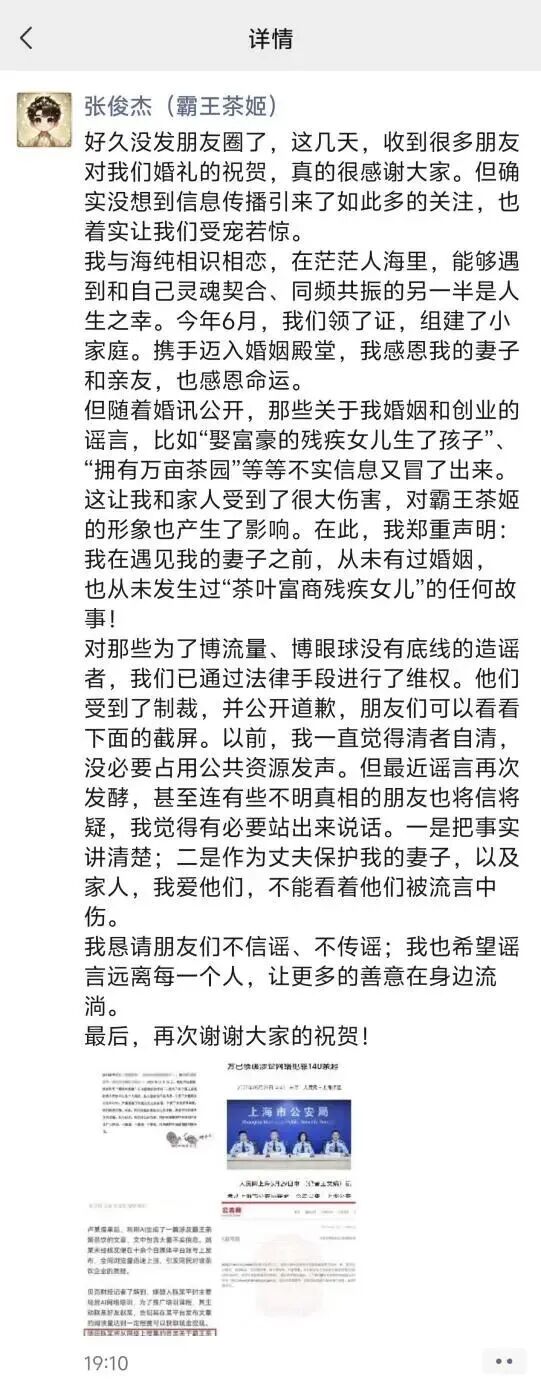
霸王茶姬创始人张俊杰辟谣:此前从未有过婚姻,也从未发生“茶叶富商残疾女儿”的任何故事
Zhong Guo Ji Jin Bao· 2025-11-22 03:29
Core Viewpoint - Zhang Junjie, the founder of Bawang Tea Ji, publicly refuted rumors regarding his marriage and personal life while confirming his marriage to Gao Haichun, the co-chairman of Trina Solar [1][3][4]. Group 1: Rumor Refutation - Zhang Junjie stated that he had never been married before meeting his wife and denied various rumors, including those about a "tea merchant's disabled daughter" [1][3]. - The decision to address the rumors was prompted by their resurgence and the need to protect his family [3]. - Legal actions have been taken against those spreading false information, resulting in penalties and public apologies from the offenders [4]. Group 2: Personal and Professional Background - Zhang Junjie, a grassroots entrepreneur born in the 1990s, began his career in the milk tea industry at the age of 17 and founded Bawang Tea Ji in 2017 [4]. - Under his leadership, Bawang Tea Ji has expanded to over 7,000 stores globally, with plans for a public listing on NASDAQ in April 2025, marking it as the fifth listed company in the new tea beverage sector [4]. Group 3: Marriage Details - The couple is set to hold their wedding banquet on December 15, as confirmed by circulating wedding invitations [5]. - Gao Haichun, born in 1993 and a graduate of Brown University, is recognized as the daughter of Gao Jifan, the founder of Trina Solar, and has been serving as co-chairman since January 2025 [6].
张俊杰、高海纯已登记结婚,“相识于青年企业家学习活动”!600亿跨界联姻不止甜
Mei Ri Jing Ji Xin Wen· 2025-11-21 08:12
Core Viewpoint - The recent marriage between Zhang Junjie, founder of Bawang Chaji, and Gao Haichun, daughter of Gao Jifan, founder of Trina Solar, has garnered significant market attention due to their connections to well-known publicly listed companies [3][10]. Company Summaries Bawang Chaji - Founded in 2017, Bawang Chaji has rapidly expanded to over 7,000 stores globally, making it one of the fastest-growing companies in the new tea beverage sector [3][10]. - The company went public on NASDAQ, marking a significant milestone in its growth trajectory [4][8]. - For the first half of 2025, Bawang Chaji reported a net profit of 1.31 billion yuan, reflecting a year-on-year increase of 6.8% [10]. - The company focuses on fresh-brewed tea beverages and has adopted a strategy of offering fewer, high-quality products compared to competitors [10]. Trina Solar - Established in 1997, Trina Solar is a leading player in the photovoltaic industry, with a market capitalization exceeding 40 billion yuan [3][10]. - The company has faced challenges in recent times, with a reported revenue of 49.97 billion yuan for the first three quarters of 2025, representing a year-on-year decline of 20.87% [12]. - Gao Haichun, who has been involved in the family business since 2017, currently serves as the co-chairman of Trina Solar, indicating her rising influence within the company [6][8]. Industry Context New Tea Beverage Sector - The new tea beverage industry is experiencing intense competition, with 2025 being referred to as the "IPO year" for new tea brands [10]. - Bawang Chaji's unique positioning in the market, focusing on fresh tea and a streamlined product line, sets it apart from other brands that offer a wider variety of products [10]. Photovoltaic Industry - The photovoltaic sector is characterized by its cyclical nature and has been undergoing significant adjustments, impacting companies like Trina Solar [12]. - Trina Solar's founder, Gao Jifan, is recognized as one of the early pioneers in the solar energy field in China, contributing to the company's long-standing presence in the industry [12].

霸王茶姬创始人张俊杰与天合光能千金高海纯联姻
Zhong Guo Jing Ying Bao· 2025-11-21 02:31
Group 1 - The marriage between Gao Haichun, daughter of photovoltaic tycoon Gao Jifan, and Zhang Junjie, founder of Bawang Chaji, has sparked significant online discussion, with netizens humorously referring to it as "tea and light complementing each other" [1][3] - Gao Haichun, born in 1993 and a graduate of Brown University, is seen as the successor of the photovoltaic industry, with her father founding Trina Solar in 1997. The company specializes in photovoltaic modules and energy storage, ranking among the top in global shipments [1] - Trina Solar is currently facing challenges, reporting a revenue of 49.97 billion yuan for the first three quarters of 2025, a year-on-year decline of 20.87%, and an expanded net loss of 4.201 billion yuan compared to a loss of 847 million yuan in the same period last year [1] Group 2 - On November 20, 2025, Trina Solar's stock closed at 19.15 yuan per share, down 5.06%, with a total market capitalization of 41.735 billion yuan [2] - Gao Haichun has been working at Trina Solar since 2017, holding various positions including Vice General Manager of the Strategic Investment Department and Chairman of Trina Wealth. She will officially become Co-Chairman of Trina Solar on January 3, 2025 [2] - Bawang Chaji, founded in 2017 and listed on NASDAQ, reported over 6.7 billion yuan in revenue in the first half of 2025, with Zhang Junjie, who shares the same birth year as Gao Haichun, serving as its Chairman and CEO [2]



霸王茶姬创始人与光伏大佬千金联姻,网友戏谑称“茶光互补”!
Zhong Guo Jing Ying Bao· 2025-11-21 02:13
Group 1 - The marriage between Gao Haichun, daughter of Gao Jifan, and Zhang Junjie, founder of Bawang Chaji, has been confirmed, generating significant public interest [3] - Gao Haichun, born in 1993 and a graduate of Brown University, is seen as the successor in the photovoltaic industry, with her father founding Trina Solar in 1997 [3][4] - Trina Solar is currently facing challenges, reporting a revenue of 49.97 billion yuan for the first three quarters of 2025, a year-on-year decline of 20.87%, and an expanded net loss of 4.201 billion yuan [3][4] Group 2 - On November 20, 2025, Trina Solar's stock closed at 19.15 yuan per share, down 5.06%, with a total market capitalization of 41.735 billion yuan [4] - Gao Haichun has been involved with Trina Solar since 2017, holding various positions and becoming co-chairperson in January 2025 [4] - Zhang Junjie, also born in 1993, is the chairman and CEO of Bawang Chaji, which was listed on NASDAQ in 2023 and reported over 6.7 billion yuan in revenue for the first half of 2025 [4] Group 3 - The union of Gao Haichun and Zhang Junjie has been humorously referred to as "tea and light complementarity," suggesting a potential innovative agricultural model combining photovoltaic power generation with tea cultivation [5]

600亿豪门联姻:霸王茶姬创始人迎娶 “光伏女神”
Sou Hu Cai Jing· 2025-11-21 02:07
Core Viewpoint - The marriage between Zhang Junjie, founder of Bawang Tea, and Gao Haichun, chairwoman of Trina Solar, has garnered significant attention due to their influential positions in the new tea beverage and photovoltaic industries, with a combined market value exceeding 60 billion yuan [3][4]. Group 1: Background of the Individuals - Zhang Junjie, born in 1993, has a remarkable rags-to-riches story, having started from a challenging childhood and eventually founded Bawang Tea, which has grown to over 6,000 stores globally and achieved a GMV exceeding 10 billion yuan [8][12]. - Gao Haichun, also born in 1993, graduated from Brown University and has rapidly ascended within Trina Solar, becoming co-chairwoman and president of the solutions business group, focusing on transforming the company into a comprehensive energy solutions provider [6][19]. Group 2: Industry Context - The marriage symbolizes a broader trend of "young leadership" in A-share listed companies, with a significant number of executives from the post-80s and post-90s generations taking on leadership roles, indicating a shift in the corporate landscape [4][17]. - The union of Bawang Tea and Trina Solar represents a unique intersection of the new consumption and renewable energy sectors, potentially leading to innovative collaborations, such as utilizing Bawang Tea's store rooftops for Trina Solar's distributed photovoltaic systems [12][14]. Group 3: Future Implications - The combination of these two young entrepreneurs may create unique business opportunities, leveraging their respective industries' strengths to foster growth and innovation [14][19]. - The trend of younger leaders in the corporate world is expected to continue, with more founders passing the baton to the next generation, leading to a noticeable "youthification" of boards across various industries [21].

新能源与新消费的双向奔赴:最美“光二代”与霸王茶姬创始人联姻
2 1 Shi Ji Jing Ji Bao Dao· 2025-11-20 16:01
Core Viewpoint - The marriage between Gao Haichun, daughter of Trina Solar's founder, and Zhang Junjie, founder of Bawang Tea, symbolizes a union between the renewable energy and new consumption sectors, highlighting the intersection of two thriving industries [1][4]. Company and Industry Summaries Zhang Junjie's Entrepreneurship - Zhang Junjie, who founded Bawang Tea in 2017, has transformed the brand into a leading player in China's tea market, with plans to go public on NASDAQ in April 2025 [2]. - Bawang Tea's current market value is approximately $2.6 billion, having halved since its IPO, reflecting a decline in performance with a significant drop in revenue growth [2]. - The company's Q2 2025 financial results showed a net income of 3.332 billion yuan, a 10.2% year-on-year increase, but a stark contrast to the previous year's growth exceeding 300% [2]. Gao Haichun's Role in Trina Solar - Gao Haichun has been serving as Co-Chairman of Trina Solar since January 2025 and has taken on various roles within the company, starting from grassroots positions [3]. - Trina Solar reported a revenue of 49.97 billion yuan in the first three quarters of 2025, with a loss of 4.201 billion yuan, attributed to a cyclical downturn in the photovoltaic industry [3]. - The company is actively expanding its energy storage business, securing contracts totaling over 11 GWh in recent months, which is seen as a potential avenue for revenue growth [4].
属实!霸王茶姬创始人张俊杰,将迎娶天合光能联席董事长高海纯
Sou Hu Cai Jing· 2025-11-20 12:59
Core Insights - The wedding of Zhang Junjie, founder of Bawang Chaji (stock code: CHA), and Gao Haichun, co-chairman of Trina Solar (stock code: 688599), is confirmed to take place on December 15 [1][3] - Gao Haichun, known as the "most beautiful second generation of light" and "photovoltaic goddess," is the daughter of Gao Jifan, the founder of Trina Solar [1][3] - Bawang Chaji is set to go public on NASDAQ in April 2025, becoming the fifth listed company in the new tea beverage industry and the first in the U.S. stock market [4] Company Overview - Trina Solar is a leading global provider of photovoltaic smart energy solutions, with a market capitalization exceeding 40 billion [3] - Gao Haichun has held various significant positions within Trina Solar, including Senior Manager of Investor Relations and Vice General Manager of Strategic Investment [3] - Bawang Chaji, founded in 2017 by Zhang Junjie, has grown to over 7,000 stores by mid-2025 [7]

霸王茶姬张俊杰将迎娶“光伏二代”高海纯?天合光能:已登记结婚,双方相识于青年企业家学习活动
Xin Jing Bao· 2025-11-20 12:55
Group 1 - Tianhe Solar's founder Gao Jifan and Wu Chunyan confirmed the wedding of Zhang Junjie and Gao Haichun, expressing gratitude for the blessings [1] - Zhang Junjie, a notable entrepreneur in the new tea beverage industry, founded the brand Bawang Chaji in November 2017, expanding its presence to over 7,000 stores globally [1] - Bawang Chaji went public on NASDAQ in April this year, becoming the first new tea beverage stock in the US, with a current stock price of $14.22 and a market capitalization of approximately $2.61 billion [1] Group 2 - Gao Haichun, born in 1993, has been involved with Tianhe since 2017 and became the chairman of Tianhe Fuhua in June 2022, which focuses on distributed household photovoltaic business [2] - Tianhe Solar initiated the plan to spin off Tianhe Fuhua for an IPO in April 2023, but the plan was terminated in December 2024 [2] - Gao Haichun joined the board of Tianhe Solar in June 2024 and was elected co-chairman in January this year, aiming to lead the company's transformation into a smart energy solution provider [2]