
智能网联新能源汽车

Search documents
以赛育才,锻造新质生产力“生力军”——全国工业和信息化技术技能大赛破解人才瓶颈观察
Zheng Quan Shi Bao Wang· 2025-11-27 10:55
Core Viewpoint - The development of new quality productivity is essential for promoting high-quality development in China, driven by technological breakthroughs and the need for high-quality technical talent [1] Group 1: Talent Gap and Skills Demand - The rise of new industries and the transformation of traditional industries have created a significant talent gap, particularly for interdisciplinary and composite talents in fields like smart connected vehicles and artificial intelligence [2] - By 2025, the talent shortage in smart connected vehicle technology is expected to reach 256,000 personnel, highlighting the urgent need for skilled workers who understand both industrial mechanisms and digital technologies [2] Group 2: Competition and Industry Relevance - The national industrial and information technology skills competition is designed to address the talent gap by focusing on real industry challenges, ensuring that the competition topics are derived from actual pain points faced by enterprises [3] - The competition's practical assessment model simulates real industrial scenarios, aiming to quickly cultivate composite talents capable of solving practical problems [3] Group 3: Market Value of Skills - Participants who excel in the competition become highly sought after by companies, demonstrating the market value of the skills acquired through the competition [3] - The shift in focus from traditional qualifications to practical problem-solving abilities reflects a new talent perspective under the framework of new quality productivity [4] Group 4: Knowledge Transfer and Mentorship - The competition serves as a platform for knowledge transfer between generations of skilled workers, exemplified by the mentorship relationship between teachers and students [5][6] - The integration of new technologies such as big data and artificial intelligence into the competition reflects an ongoing evolution in skill development, ensuring that the talent pool remains relevant and innovative [6] Group 5: Overall Impact on Manufacturing - The national industrial and information technology skills competition embodies a model for talent cultivation that combines competition with education, providing robust support for the development of new quality productivity [6][7] - The competition not only showcases skilled elites but also fosters the growth of future craftsmen, contributing to the high-end, intelligent, and green transformation of China's manufacturing industry [7]
六部门发文,到2027年我国将形成3个万亿级消费领域!
Ren Min Ri Bao· 2025-11-27 10:12
Core Viewpoint - The State Council's executive meeting emphasizes enhancing supply-demand adaptability as an effective measure to unleash consumption potential and facilitate economic circulation. The Ministry of Industry and Information Technology, along with five other departments, has issued an implementation plan aiming to establish three trillion-level consumption sectors and ten billion-level consumption hotspots by 2027 [1]. Group 1: Development of New Technologies and Models - Focus on key industries such as smart connected new energy vehicles, smart home, consumer electronics, modern textiles, food, and green building materials, launching a dual-hundred innovation application initiative to create a hundred iconic products and a hundred innovative enterprises [1]. - Promote flexible and customized manufacturing models, implementing a "thousand factories, thousand faces" transformation plan, and establishing a digital system that connects user demand, intelligent design, and flexible production [3]. - Encourage the application of artificial intelligence across the entire consumer goods industry, promoting generative AI and 3D digital design tools [4]. Group 2: Expansion of New Product Supply - Adapt to the trend of green and low-carbon consumption by improving energy efficiency and water efficiency standards for consumer goods, and revising national standards for volatile organic compounds (VOCs) and heavy metals [8]. - Encourage the development of energy-efficient appliances and green building materials, as well as the promotion of green low-carbon consumption in sectors like new energy vehicles [8]. - Support the development of rural-friendly high-efficiency products and enhance rural commerce infrastructure [9]. Group 3: Targeted Consumer Matching - Promote the development of high-quality, intelligent products for infants and children, focusing on feeding, travel, outdoor activities, and educational toys [20]. - Encourage the design of protective writing tools and personalized learning kits for students, integrating traditional stationery with smart hardware [23]. - Enhance the development of age-friendly products for the elderly, including care robots and multifunctional nursing beds [26]. Group 4: Cultivation of New Consumption Scenarios and Business Models - Support the establishment of flagship stores and new concept stores, and organize product launch events to enhance consumer engagement [28]. - Develop new business models such as live e-commerce and instant retail, leveraging AI to match user needs with products and services [29]. - Promote the development of shared consumption models, including shared bicycles and wheelchairs in public spaces [32].


事关促消费!六部门印发重磅文件→
Sou Hu Cai Jing· 2025-11-27 03:26
Core Insights - The Ministry of Industry and Information Technology, along with several other government departments, has issued a plan to enhance the adaptability of supply and demand in consumer goods, aiming for consumption upgrades to lead industrial upgrades and achieve a dynamic balance between supply and demand by 2027 [1][4]. Summary by Sections Overall Requirements - The plan aims to optimize the supply structure of consumer goods by 2027, creating three trillion-level consumption sectors and ten hundred-billion-level consumption hotspots, while fostering high-quality consumer goods with cultural significance [4]. Accelerating Innovation in New Technologies and Models - Focus on key industries such as smart connected new energy vehicles, smart home products, and modern textiles to develop innovative applications and create a hundred landmark products and enterprises [5]. - Promote flexible and customized manufacturing models, establishing a digital system that connects user demand with intelligent design and flexible production [6]. - Encourage the integration of artificial intelligence across the consumer goods industry, promoting smart products that provide various life services [6]. Expanding Supply of Unique and New Products - Adapt to the trend of green and low-carbon consumption by improving energy efficiency standards and promoting green building materials [7]. - Support the development of high-quality leisure and sports products to meet new demands from the sports economy [8]. - Encourage innovation in health products, focusing on special dietary foods and high-end medical devices [9]. Precise Matching of Different Consumer Needs - Enhance the supply of quality children's products, promoting safety and quality standards [10]. - Expand the supply of fashionable "trendy" products, focusing on sustainable materials and high-end brands [12]. - Develop age-appropriate products for the elderly, emphasizing comfort and functionality [13]. Cultivating New Consumption Scenarios and Business Models - Support the establishment of flagship stores and new concept stores to enhance consumer experience [13]. - Encourage the development of new business models such as live e-commerce and instant retail, leveraging advanced technologies for immersive shopping experiences [14]. Creating a Favorable Development Environment - Strengthen financial support for the consumer goods industry, promoting policies for equipment upgrades and trade-in programs [15]. - Organize promotional activities to highlight quality consumer products and brands, aiming to cultivate a strong consumer market [16]. - Maintain market order by addressing issues like local protectionism and ensuring product safety standards are updated [16].
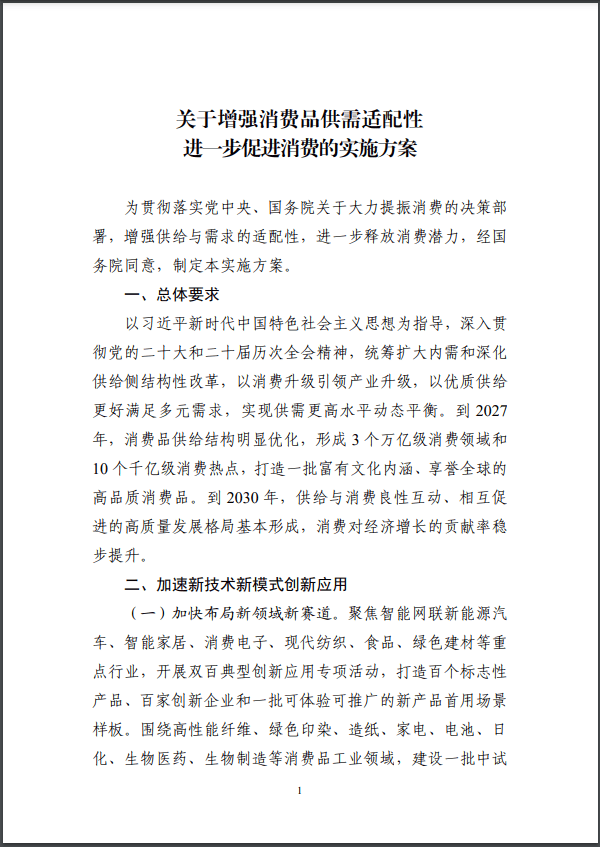
事关促消费!工信部等六部门部署增强消费品供需适配性
中汽协会数据· 2025-11-27 02:13
Core Viewpoint - The article discusses the implementation plan for enhancing the adaptability of supply and demand in consumer goods, aiming to promote consumption and achieve a dynamic balance between supply and demand by 2027 and 2030 [1][5][22]. Group 1: Overall Requirements - By 2027, the plan aims to optimize the supply structure of consumer goods, forming three trillion-level consumption fields and ten hundred-billion-level consumption hotspots, while creating high-quality consumer goods with cultural connotations [5][20]. - By 2030, a high-quality development pattern characterized by positive interaction between supply and consumption is expected to be established, with a steady increase in the contribution of consumption to economic growth [5][22]. Group 2: Key Tasks - The plan outlines five main areas with 19 key tasks, including expanding new technologies and innovative applications, enhancing the supply of unique and new products, accurately matching different demographic needs, cultivating new consumption scenarios and business formats, and creating a favorable development environment [2][6][9]. Group 3: Expanding Unique and New Product Supply - The plan emphasizes promoting green product expansion and iteration, enhancing rural consumer goods quality, and developing leisure and sports products to meet new demands [9][10][25]. - It also focuses on innovating health products, increasing the influence of historical classic products, and expanding diverse interest consumption supplies [10][11][26]. Group 4: Precise Matching of Different Demographic Needs - The plan aims to enrich the supply of baby and children's products, enhance the quality of student supplies, and expand the supply of fashionable "trendy" products [12][13][27]. - It also includes optimizing the supply of age-appropriate products for the elderly [13]. Group 5: Cultivating New Consumption Scenarios and Business Formats - The plan supports the establishment of flagship stores and new concept stores, promoting the launch of new products and enhancing the core business district's capabilities [14][28]. - It encourages the orderly development of platform consumption, including live e-commerce and circular e-commerce, while standardizing shared consumption [15][28]. Group 6: Creating a Favorable Development Environment - The plan highlights the importance of financial support for consumption, promoting the use of old-for-new policies, and enhancing consumer finance products and services [16][29]. - It also emphasizes maintaining market order, strengthening network market supervision, and updating safety and environmental standards for consumer goods [17][30].

到2027年形成3个万亿级消费领域和10个千亿级消费热点
Zheng Quan Ri Bao· 2025-11-26 23:23
Core Insights - The implementation plan aims to enhance the adaptability of supply and demand in consumer goods, targeting significant optimization of the supply structure by 2027, with the goal of establishing three trillion-level consumption sectors and ten hundred-billion-level consumption hotspots [1][2] - By 2030, a high-quality development pattern characterized by positive interaction between supply and consumption is expected to be formed, with a steady increase in the contribution of consumption to economic growth [1] Group 1: Innovation and Technology - The plan emphasizes accelerating the application of new technologies and models, focusing on key industries such as smart connected vehicles, smart home products, consumer electronics, modern textiles, food, and green building materials [1][2] - It proposes the establishment of a digital system encompassing user demand, intelligent design, and flexible production, promoting the use of artificial intelligence across the entire consumer goods sector [1][2] Group 2: Product Supply Enhancement - The plan outlines measures to expand and upgrade the supply of green products, improve rural consumer goods, and innovate health products, while also enhancing the influence of historical classic products [2] - Specific actions include adapting to the trend of green and low-carbon consumption by revising national standards for volatile organic compounds (VOCs) and heavy metal content in products [2] Group 3: Consumer Demand Matching - The plan aims to diversify product offerings to meet the needs of different demographics, including enhancing the supply of quality children's products, fashionable items, and age-appropriate products [2] - It emphasizes the development of refined, quality, and intelligent products for infants and children, as well as outdoor and educational toys [2] Group 4: New Consumption Scenarios and Business Models - The plan encourages the promotion of new consumption scenarios and business models, including the establishment of flagship stores and the development of live e-commerce and instant retail [2] - It also supports the regulation of shared consumption models, such as shared bicycles and wheelchairs in public spaces [2] Group 5: Supportive Environment - The plan highlights the importance of financial and fiscal support, organizing special events, and maintaining market order to create a conducive environment for the consumer goods industry [3] - Specific measures include leveraging policies for large-scale equipment updates and trade-in programs for consumer goods [3]
六部门发文增强消费品供需适配性 2027年形成3个万亿级消费领域和10个千亿级消费热点
Zhong Guo Zheng Quan Bao· 2025-11-26 21:00
Core Viewpoint - The implementation plan aims to enhance the adaptability of supply and demand in consumer goods, promoting consumption upgrades to lead industrial upgrades and achieving a dynamic balance between supply and demand [1][3] Group 1: Key Areas of Focus - The plan outlines 19 key tasks across five areas, focusing on industries such as smart connected vehicles, smart home products, consumer electronics, modern textiles, food, and green building materials [1] - It emphasizes the development of innovative applications and the creation of flagship products and enterprises, along with establishing testing platforms in various consumer goods sectors [1] Group 2: Expanding Product Supply - The plan advocates for the development of leisure and sports products, targeting new demands from event economies and outdoor activities, and promoting high-quality sports equipment [2] - It aims to diversify product offerings for specific demographics, including children's products, quality student supplies, trendy items, and age-appropriate products [2] Group 3: Innovation and Internal Demand Activation - By 2027, the plan targets a significant optimization of the consumer goods supply structure, aiming to create three trillion-level consumption fields and ten hundred-billion-level consumption hotspots [3] - The policy is expected to positively impact various industries, including smart vehicles, home products, and health-related goods, by fostering technological innovation and responding to new market demands [3][4] Group 4: Focus on Specific Demographics - The policy particularly addresses the needs of specific consumer groups, promoting the refinement and quality enhancement of products for children, students, and the elderly [4] - New consumption formats such as live e-commerce and instant retail are expected to develop in an orderly manner, injecting vitality into core business districts and new product launches [4]
六部门发文增强消费品供需适配性
Zhong Guo Zheng Quan Bao· 2025-11-26 20:20
Core Viewpoint - The implementation plan aims to enhance the adaptability of supply and demand in consumer goods, promoting consumption upgrades to lead industrial upgrades and achieving a dynamic balance between supply and demand [1][2]. Group 1: Key Areas of Focus - The plan outlines 19 key tasks across five areas, focusing on industries such as smart connected vehicles, smart home products, consumer electronics, modern textiles, food, and green building materials [1]. - It emphasizes the development of leisure and sports products, targeting new demands from event economies, outdoor economies, and winter sports, while promoting high-quality sports equipment [1][2]. Group 2: Targeted Consumer Needs - The plan aims to match diverse consumer needs by enriching the supply of baby products, enhancing quality student supplies, expanding trendy products, and optimizing products for the elderly [2][3]. - It also seeks to cultivate new consumption scenarios and business models, including the promotion of product launches, orderly development of platform consumption, and regulated shared consumption [2]. Group 3: Future Goals - By 2027, the plan targets a significant optimization of the consumer goods supply structure, aiming to create three trillion-level consumption fields and ten hundred-billion-level consumption hotspots [2]. - By 2030, it envisions a high-quality development pattern where supply and consumption interact positively, with a steady increase in consumption's contribution to economic growth [2]. Group 4: Industry Impact - The implementation of the plan is expected to positively impact multiple industries, including smart connected vehicles, smart home products, consumer electronics, and green building materials, driving technological innovation through the creation of flagship products and innovative application scenarios [2][3]. - The sports and leisure product sectors are anticipated to benefit from new demands arising from event and outdoor economies, gaining new growth momentum [2].
六部门合力优化供给 到2027年形成3个万亿级消费领域
Zheng Quan Shi Bao· 2025-11-26 18:16
Core Viewpoint - The Ministry of Industry and Information Technology and five other departments issued a plan to enhance the adaptability of supply and demand in consumer goods, aiming for consumption upgrades to lead industrial upgrades and achieve a dynamic balance between supply and demand [1][2]. Group 1: Development Goals - The plan outlines a two-step development goal: by 2027, the supply structure of consumer goods will be significantly optimized, forming three trillion-level consumption sectors and ten hundred-billion-level consumption hotspots; by 2030, a high-quality development pattern of mutual interaction between supply and consumption will be basically formed, with a steady increase in the contribution rate of consumption to economic growth [1]. Group 2: Key Tasks - The plan deploys 19 key tasks across five areas: expanding incremental supply, deepening existing supply, segmenting markets, empowering scenarios, and optimizing the environment [1]. - In expanding incremental supply, the focus is on innovation in technology and models, particularly in smart connected new energy vehicles, smart home products, and consumer electronics [2]. - The "Thousand Factories, Thousand Faces" transformation plan aims to cultivate flexible manufacturing factories in industries such as home appliances, furniture, and cosmetics, enhancing production responsiveness to personalized demands [2]. Group 3: Artificial Intelligence and Market Optimization - The plan emphasizes the role of artificial intelligence, promoting the application of generative AI and 3D digital design across the consumer goods sector, and encourages the development of smart home products and experience centers for elderly-friendly products [2]. - For optimizing existing markets, the plan aims to expand the supply of unique and new products, particularly in leisure, sports, and health consumption sectors, addressing new demands from event and outdoor economies [2]. Group 4: Targeted Supply Matching - The plan specifies supply matching requirements for different consumer groups, including children, students, fashion items, and elderly products, encouraging actions to promote quality elderly products and home modifications for the elderly [3]. - It also highlights the importance of a favorable consumption environment, reinforcing financial support through fiscal subsidies and special loans to support technological innovation and product upgrades in consumer goods companies [3]. Group 5: Implementation and Coordination - The Ministry of Industry and Information Technology will work with relevant departments to promote the plan, strengthen collaboration, and guide local regions and industry associations in its implementation, aiming to continuously create new consumer products, scenarios, and hotspots to unleash consumption potential [3].
增强消费品供需适配性 进一步促进消费
Qi Huo Ri Bao Wang· 2025-11-26 17:08
Core Insights - The Ministry of Industry and Information Technology, along with five other departments, has issued a plan to enhance the adaptability of supply and demand in consumer goods, aiming for consumption upgrades to lead industrial upgrades [1] - By 2027, the plan targets a significant optimization of the consumer goods supply structure, establishing three trillion-level consumption sectors and ten hundred-billion-level consumption hotspots [1] - By 2030, a high-quality development pattern characterized by positive interaction between supply and consumption is expected to be largely formed, with a steady increase in the contribution of consumption to economic growth [1] Group 1: Key Tasks and Focus Areas - The plan outlines 19 key tasks across five areas: accelerating the application of new technologies and models, expanding the supply of unique and new products, precisely matching the needs of different demographics, cultivating new consumption scenarios and business formats, and creating a favorable development environment [1] - Emphasis is placed on expanding new fields and tracks, promoting efficient manufacturing models, and enhancing the integration of artificial intelligence [1] - Key industries targeted include smart connected new energy vehicles, smart home products, consumer electronics, modern textiles, food, and green building materials, with goals to create hundreds of iconic products and innovative companies [1] Group 2: Market Segmentation and Product Development - The plan also focuses on deepening existing markets by promoting the expansion and iteration of green products, enhancing the quality of rural consumer goods, and significantly developing leisure and sports products [2] - It aims to adapt to the trends of green and low-carbon consumption by improving the energy and water efficiency standards of consumer goods [2] - Specific market segments targeted include enriching the supply of baby and children's products, enhancing quality student supplies, expanding fashionable "trendy" products, and optimizing products for the elderly [2]
重庆制造业筑基强市之路 2027年工业总量将达4万亿元
Zhong Guo Jing Ying Bao· 2025-11-26 17:06
Core Viewpoint - Chongqing is focusing on building a modern manufacturing cluster system called "33618" to enhance its industrial capabilities, aiming for an industrial output of 4 trillion yuan by 2027, with significant growth in key sectors such as intelligent equipment, food processing, and software services [1][2]. Group 1: Manufacturing Development - The manufacturing sector is the foundation of Chongqing's economy, with a target industrial output exceeding 2.7 trillion yuan by 2024 [1]. - The city has established a solid industrial base covering 39 industrial categories and all 31 categories of manufacturing [1]. - Chongqing's logistics system has achieved connectivity with 127 countries and regions globally, enhancing its industrial competitiveness [1]. Group 2: Key Industries - The three leading industries in Chongqing are experiencing significant growth, particularly in intelligent connected vehicles, with an expected production of 953,000 units in 2024 [2]. - The new generation of electronic information manufacturing is leading globally, with notebook computer production ranking first worldwide [2]. - The advanced materials industry has made breakthroughs, notably in nylon 66, breaking international monopolies [2]. Group 3: Industrial Cluster System - The "33618" modern manufacturing cluster system aims to promote high-quality development in manufacturing, focusing on three trillion-yuan leading industry clusters: intelligent connected vehicles, new generation electronic information manufacturing, and advanced materials [2]. - The system also includes upgrading to 500 billion yuan pillar industry clusters in intelligent equipment, food processing, and software services, along with developing six billion-yuan specialty industry clusters [2]. Group 4: Talent Development - The "14th Five-Year Plan" emphasizes the need for a high-quality technical talent pool to support industrial modernization and technological advancements [3]. - The third National Industrial and Information Technology Skills Competition focuses on integrating talent development with industry needs, promoting new technologies and processes [3].