光伏

Search documents
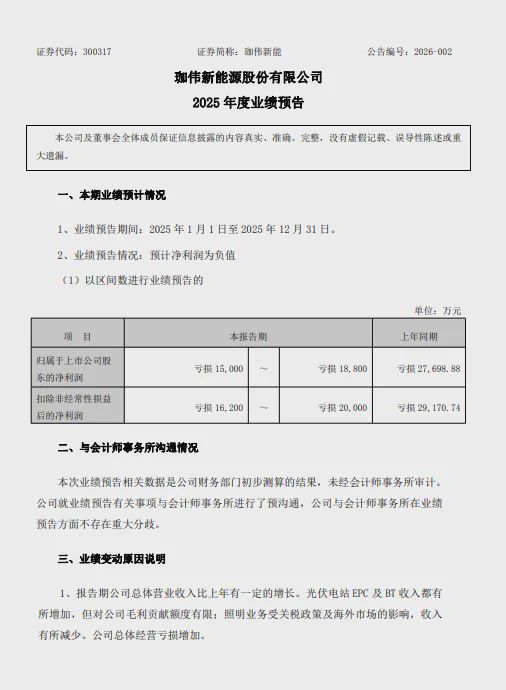
珈伟新能预亏15000万-18800万元
Xin Lang Cai Jing· 2026-02-05 07:10
Core Viewpoint - The company, Jiawei New Energy, forecasts a net loss for 2025, with expected losses ranging from 150 million to 188 million yuan, compared to a loss of approximately 276.99 million yuan in the previous year [1][6]. Financial Performance Summary - The projected net profit attributable to shareholders for 2025 is a loss of 150 million to 188 million yuan, while the previous year's loss was 276.99 million yuan [1][6]. - The expected net profit after deducting non-recurring gains and losses for 2025 is a loss of 162 million to 200 million yuan, compared to a loss of 291.71 million yuan in the previous year [1][6]. Reasons for Performance Changes - The overall operating revenue of the company has seen a slight increase compared to the previous year, with growth in revenue from photovoltaic power station EPC and BT services, although the contribution to gross profit is limited. However, the lighting business has experienced a decline in revenue due to tariff policies and impacts from overseas markets, leading to an increase in overall operational losses [4][9]. - The company has made provisions for asset impairment and bad debt during the reporting period, including approximately 40 million yuan for asset impairment related to power stations, 23 million yuan for inventory impairment due to planned shutdowns of certain overseas subsidiaries, and 14 million yuan for bad debt provisions related to ongoing litigation for accounts receivable, along with an additional 6 million yuan for bad debt provisions for the subsidiaries planned for shutdown [4][9]. - The company has also reported an increase in exchange losses of approximately 12 million yuan compared to the previous year due to currency fluctuations [5][10].


180—240GW!中国光伏行业协会:预计2026年光伏装机规模触及低点后将回升
Bei Jing Shang Bao· 2026-02-05 07:04
中国光伏行业协会预测,国内光伏新增装机规模短期调整后将重回增长态势,据曲线图,2026年装机规 模触及低点,之后回升,其中预计2035年国内新增装机规模将达到280—350GW。 本文来源:北京商报 2月5日,在中国光伏行业协会主办的"光伏行业2025年发展回顾与2026年形势展望研讨会"上,第十版 《中国光伏产业发展路线图》(以下简称《路线图》)发布。据《路线图》,预计2026年中国光伏新增 装机规模180-240GW。 风险提示及免责条款 市场有风险,投资需谨慎。本文不构成个人投资建议,也未考虑到个别用户特殊的投资目标、财务状况或需要。用户应考虑本文中的任何 意见、观点或结论是否符合其特定状况。据此投资,责任自负。 ...
市场监管总局:2025年组织开展汽车、互联网平台等领域200余家企业海外合规培训
Ren Min Wang· 2026-02-05 06:49
Core Viewpoint - The State Administration for Market Regulation (SAMR) is enhancing its antitrust review process for business mergers and acquisitions, aiming to foster a competitive market environment and support high-quality economic development by 2025 [1][2]. Group 1: Service Improvements - SAMR is establishing a "bridge of service" to reduce costs and clarify directions for enterprises in merger applications, including a classification and grading review system and a tool for self-assessing administrative penalties [1]. - The introduction of the "Administrative Penalty Self-Calculator" and the publication of guidelines for merger applications aim to create a transparent and predictable policy environment for businesses [1]. Group 2: Acceleration of Review Process - In 2025, SAMR concluded 706 merger cases, a 9.8% increase year-on-year, with 83% of cases resolved within 30 days during the preliminary review phase [2]. - The focus on key sectors such as automotive, photovoltaic, and lithium battery industries emphasizes a balance between expedited reviews and maintaining quality standards [2]. Group 3: Regulatory Enforcement - SAMR has taken a firm stance in critical sectors like semiconductors and shipping, approving five merger applications with conditions and prohibiting one to safeguard fair competition [2]. - The agency has publicly addressed four illegal merger cases, imposing fines totaling 6.95 million yuan [2]. Group 4: Support for Overseas Expansion - SAMR is assisting domestic companies in navigating foreign antitrust reviews during overseas mergers, providing training for over 200 companies in sectors like automotive and integrated circuits [2]. - The agency aims to help domestic enterprises avoid risks and ensure stable international operations by interpreting foreign legal regulations and sharing typical case studies [2]. Group 5: Future Outlook - By 2026, SAMR plans to continue refining its merger review system to enhance efficiency and quality, aiming to stimulate market vitality while safeguarding the competitive environment [2].
行业深度():钙钛矿电池渗透率提升及太空光伏发展将推动盐市场进入结构性扩张新周期
Dongxing Securities· 2026-02-05 06:48
Investment Rating - The report maintains a positive outlook on the industry, specifically highlighting the potential of the perovskite solar cell market and its impact on the rubidium and cesium market [2]. Core Insights - The perovskite solar cells (PSCs) are emerging as a new type of thin-film solar cell with advantages such as low cost, high efficiency, lightweight, flexibility, and effective performance in low light conditions [4][31]. - The stability of perovskite cells is a key challenge for their industrialization, with rubidium and cesium salts potentially playing a crucial role in enhancing their performance and stability [5][33]. - The penetration rate of perovskite solar cells in the photovoltaic market is expected to increase significantly, with projections indicating a rise from 1.3% in 2025 to 30% by 2030 [6][48]. Summary by Sections 1. Perovskite Cell Advantages - Perovskite solar cells offer significant cost advantages over traditional silicon cells, with lower production energy requirements and investment costs [31]. - The theoretical efficiency of perovskite cells is higher than that of silicon cells, with potential efficiencies exceeding 40% for tandem cells [32]. 2. Market Penetration and Applications - The perovskite solar cell market is expected to see rapid growth, with applications in traditional photovoltaic settings as well as emerging fields such as building-integrated photovoltaics (BIPV), wearable devices, and space photovoltaics [36][40]. - The flexibility and lightweight nature of perovskite cells make them suitable for various applications, including automotive and portable electronics [41]. 3. Space Photovoltaics Development - The development of space photovoltaics is anticipated to significantly boost the demand for perovskite cells, with projections indicating a substantial increase in rubidium demand due to the growth of space solar power initiatives [11][13]. - SpaceX's plans for satellite launches and the establishment of a space computing center are expected to drive the demand for perovskite solar cells in the space sector [12][56]. 4. Rubidium and Cesium Market Expansion - The demand for rubidium and cesium salts is projected to grow at a compound annual growth rate (CAGR) of 94% from 2026 to 2030, driven by the expansion of the perovskite solar cell industry [14][48]. - The report identifies key companies in the rubidium and cesium supply chain, such as Jinyinhai and Zhongkuang Resources, which are positioned to benefit from this growth [15].
光伏“退税补贴时代”将结束 企业如何应对?
Jing Ji Ri Bao· 2026-02-05 06:22
Core Viewpoint - The Ministry of Finance and the State Taxation Administration announced the cancellation of the export VAT refund for photovoltaic products starting April 1, 2026, marking the end of a decade-long support policy aimed at nurturing the solar industry in China [1][2]. Group 1: Policy Background and Rationale - The export VAT refund policy was introduced in October 2013 to support the recovery of the solar industry during a challenging period marked by anti-dumping investigations and market shrinkage [1]. - The policy aimed to enhance international competitiveness by offsetting costs and encouraging companies to explore overseas markets, thus helping the industry overcome domestic market bottlenecks [1]. - The cancellation of the export VAT refund is seen as a necessary adjustment in response to the solar industry's evolution and the need for high-quality development, as the industry now holds over 70% of the global market share [2]. Group 2: Impacts of Policy Change - Short-term effects may include a temporary surge in exports, leading to increased production and export figures within the industry [3]. - In the medium to long term, leading companies with technological advantages and strong brand recognition are expected to strengthen their bargaining power, while those relying solely on low prices may face reduced demand [3]. - The policy change is likely to accelerate the exit of small and medium-sized enterprises lacking core technologies and low-profit margins, while top-tier companies with advanced technology and cost control will likely expand their market share [3]. Group 3: Strategic Recommendations for Companies - Companies must enhance their capabilities for international expansion by focusing on technology and brand value, investing in R&D for next-generation battery technologies and improving product efficiency [4]. - A global strategy should be adopted, transitioning from merely exporting to establishing a local presence in key markets, which is essential for mitigating trade risks and understanding local market needs [4]. - Companies should optimize their entire cost structure through digitalization and intelligent management, while exploring new applications such as space photovoltaics and deepening the integration of photovoltaic and energy storage systems to create new market demands and profit opportunities [4].
光伏深度回调,光伏ETF国泰(159864)跌近6%,太空光伏有望打开光伏需求成长空间,回调或可布局
Mei Ri Jing Ji Xin Wen· 2026-02-05 06:15
Group 1 - The core viewpoint indicates that the domestic photovoltaic (PV) installed capacity is expected to reach a record high of 31,507 MW in 2025, driven in part by the promotion of the 136 document [1] - For 2026, the forecast for new domestic PV installations is maintained at 200-250 GW, considering adjustments in electricity pricing mechanisms and consumption issues, while the PV manufacturing industry will face significant supply-demand imbalances and pressure on profitability [1] - The industry outlook suggests that companies with competitive advantages in high-efficiency battery technology are likely to take the lead as the PV manufacturing sector accelerates its clearing process in 2026 [1] Group 2 - The Guotai Photovoltaic ETF (159864) tracks the photovoltaic industry index (931151), which selects listed companies involved in various segments of the PV industry, including silicon materials, battery cells, modules, and inverters, to reflect the overall performance and development trends of related securities [1] - Long-term prospects for space-based photovoltaics are anticipated to open up growth opportunities for PV demand [1]
“十四五”期间中国创造世界一半以上太阳能电池效率纪录
Xin Lang Cai Jing· 2026-02-05 06:14
Core Insights - During the "14th Five-Year Plan" period, China's cumulative new installed capacity of photovoltaic (PV) power is 4.5 times that of the "13th Five-Year Plan," and the cumulative new power generation is 3.6 times that of the previous plan [1][2] - From 2023 to 2025, the annual new installed capacity of PV will exceed the cumulative amount during the "14th Five-Year Plan," and the power generation in 2025 will surpass the cumulative amount of the "13th Five-Year Plan" [1] Research and Development Achievements - A total of 11 Chinese research institutions and enterprises have broken the NREL (Natural Resource Ecology Laboratory) efficiency records 27 times during the "14th Five-Year Plan," accounting for 55% of the global total, which is more than double the 21% during the "13th Five-Year Plan" [2] - By the end of 2025, 9 Chinese institutions will maintain 10 NREL efficiency records, indicating a strong presence in global PV efficiency advancements [2] - Notably, in 2025, 6 institutions achieved 9 breakthroughs in NREL efficiency records, marking the highest number of records broken in a single year during the "14th Five-Year Plan," suggesting an accelerating trend in laboratory efficiency breakthroughs despite industry challenges [2]

光伏告别出口退税后怎么办?王勃华:倒逼企业转向高质量高附加值竞争
Xin Lang Cai Jing· 2026-02-05 05:52
Core Insights - The Chinese photovoltaic industry will enter a new market-driven phase focused on technology, cost, and brand starting April 1, 2026, as it phases out the value-added tax export rebate [1][2][3] - This transition will compel companies to shift from low-price competition to high-quality, high-value competition, aiming to build sustainable global competitiveness [1][2] Industry Transformation - A significant transformation in development philosophy and logic is anticipated, moving from scale and price competition to value competition [3] - Two key areas for this transformation include: - Policy level: Implementing a combination of policies to promote industry upgrades and create a healthy development environment [3] - Corporate level: Companies need to explore second growth curves by building technological moats and fostering collaborative industry ecosystems [3] Manufacturing Development - The manufacturing sector should focus on three key directions: intelligent, green, and integrated development, which are interrelated and mutually reinforcing [2][3] - Intelligent development encompasses smart R&D, production, and operation of power plants, as well as contributing to societal smart transformation [2][3] - Green development involves promoting green energy use within the photovoltaic industry and advancing energy-saving and carbon-reducing technologies [2][3] - Integrated development includes deep integration with other industries and active participation in the electricity market [2][3]
刚刚,崩了!大面积暴跌!
天天基金网· 2026-02-05 05:21
Market Overview - On February 5, the A-share market opened lower, with all three major indices declining over 1% [2] - The Shanghai Composite Index fell by 1.02%, the Shenzhen Component dropped by 1.8%, and the ChiNext Index decreased by 1.92% [3] - A total of 3,690 stocks declined, while 1,644 stocks rose, with 43 stocks hitting the daily limit up [4] Sector Performance - The large technology sector continued to adjust, with significant declines in the CPO and semiconductor sectors [2] - The photovoltaic sector experienced a sharp drop, with stocks like Junda Co. and Shuangliang Energy hitting the daily limit down [7] - Precious metals and non-ferrous metals indices saw substantial declines, with the non-ferrous metals index dropping over 5% [2] Consumer Sector - The consumer sector performed well, with liquor stocks achieving a four-day winning streak [2] - The restaurant and tourism sectors, along with soft drink stocks, showed active performance [2] - Notable gains included Kweichow Moutai rising by 1.41% to a price of 1546.46 yuan per share, increasing its market capitalization to 19,366 billion yuan [10] Banking Sector - The banking sector saw a positive trend, with all related stocks rising [15] - Xiamen Bank increased by over 6%, while Chongqing Bank rose by over 4% [16] - The People's Bank of China held a meeting emphasizing the importance of financial services for key sectors, which is expected to benefit the banking sector [16]




2500亿!马斯克团队秘密访华,美国太空光伏梦,只有中国能“接单”
Sou Hu Cai Jing· 2026-02-05 05:19
Group 1 - Elon Musk has become the world's first billionaire with a net worth exceeding $800 billion while facing scrutiny over past communications with Jeffrey Epstein [1] - Musk's companies, SpaceX and Tesla, are reportedly expanding their business by sourcing materials in China, particularly in the booming sector of space photovoltaics [3][16] - The core challenge for Musk's ambitious plans, including sending humans to Mars and establishing a satellite network, is the need for reliable energy sources in space, which solar energy can provide [5] Group 2 - Musk has announced a goal to achieve 100 gigawatts of solar energy capacity within three years, equivalent to the output of several large nuclear power plants, to power AI data centers and future extraterrestrial bases [7] - The merger of Musk's AI company xAI with SpaceX has resulted in a valuation exceeding $1 trillion, aimed at addressing the energy demands of AI operations in space [7] - The production of "space-grade" solar cells is limited, and the most viable manufacturing capabilities are found in China, which has a complete and efficient solar industry supply chain [9][13] Group 3 - Chinese companies are leading in the production of advanced solar technologies, such as heterojunction (HJT) and perovskite solar cells, which are essential for space applications due to their high efficiency and durability [11] - The U.S. lacks the manufacturing capacity to meet Musk's ambitious solar energy production goals, making reliance on Chinese manufacturing necessary for the success of his space photovoltaic plans [13][15] - Chinese solar firms are not only focused on terrestrial applications but are also proactively developing technologies for space photovoltaics, aligning with SpaceX's requirements [15][16]