
进出口贸易

Search documents
继续领跑,深圳上半年续为“外贸第一城”
2 1 Shi Ji Jing Ji Bao Dao· 2025-07-22 08:54
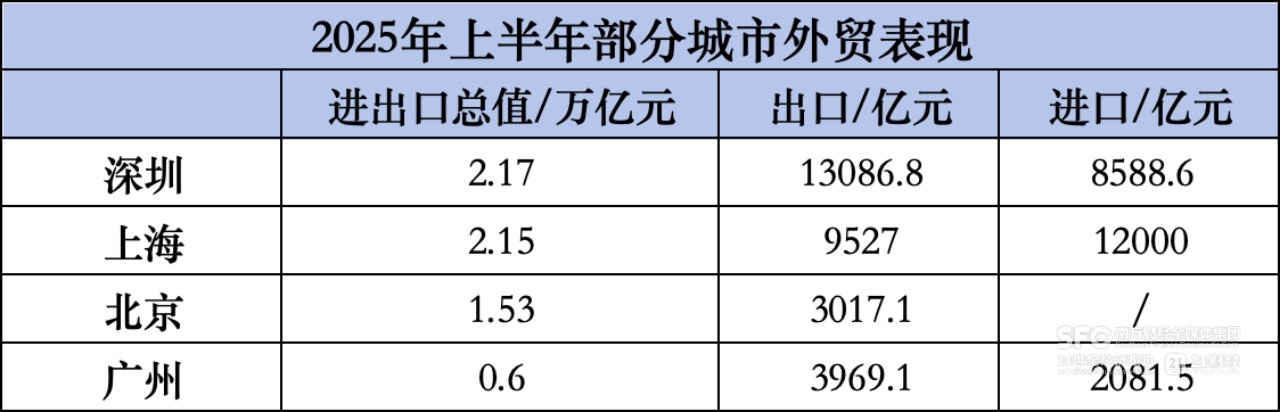
Core Insights - In the first half of 2025, Shenzhen's total import and export value reached 2.17 trillion yuan, accounting for 9.9% of the national total, with exports at 1.31 trillion yuan and imports at 858.6 billion yuan, reflecting a year-on-year growth of 9.5% [1][2]. Trade Performance - Shenzhen ranked first among mainland cities in terms of total import and export value and achieved a record high in import scale for the same period [2]. - The import and export value of Shenzhen's general trade exceeded half of the total, with a value of 1.19 trillion yuan, representing 54.8% of the total [3]. - The bonded logistics sector saw a growth of 15.1%, reaching 585.4 billion yuan, accounting for 27% of the total [3]. - Processing trade remained stable at 3.81 trillion yuan, making up 17.6% of the total [3]. Trade Entities - Private enterprises dominated Shenzhen's trade, accounting for nearly 70% of the total import and export value, with a total of 1.51 trillion yuan [3]. - Foreign-invested enterprises experienced a growth of 9%, reaching 563.1 billion yuan, which constituted 26% of the total [3]. - State-owned enterprises contributed 891.4 billion yuan to the import and export value [3]. Trade Partners - The top ten trading partners accounted for 78.3% of Shenzhen's total trade, with ASEAN, Hong Kong, and Taiwan being the largest partners [3]. - Trade with ASEAN reached 358.3 billion yuan, while trade with Hong Kong and Taiwan was 340.0 billion yuan and 252.1 billion yuan, reflecting growth rates of 7.2% and 33% respectively [3]. Product Composition - Mechanical and electrical products were the mainstay of Shenzhen's trade, with exports exceeding 74.9% of total exports and imports exceeding 82.6% of total imports [4]. - Exports of mechanical and electrical products amounted to 980.3 billion yuan, growing by 3.5%, with significant increases in computers and components (14.6%) and integrated circuits (34.7%) [4]. - Imports of mechanical and electrical products reached 709.1 billion yuan, growing by 17.1%, with integrated circuits growing by 17.9% and computer components by 75.1% [4].

上半年深圳进出口规模居内地城市首位,进口值创历史同期新高
Nan Fang Du Shi Bao· 2025-07-22 08:06
Core Insights - Shenzhen's import and export value reached 2.17 trillion yuan in the first half of 2025, accounting for 9.9% of the national total, with exports at 1.31 trillion yuan and imports at 858.6 billion yuan, marking a year-on-year growth of 9.5% [2] Group 1: Trade Characteristics - General trade accounted for over half of the total trade, with a value of 1.19 trillion yuan, representing 54.8% of Shenzhen's total import and export value. Bonded logistics saw a 15.1% increase, totaling 585.4 billion yuan, while processing trade remained stable at 381.5 billion yuan, making up 17.6% [2] - Private enterprises contributed nearly 70% of the trade, with a total import and export value of 1.51 trillion yuan, representing 69.8%. Foreign-invested enterprises saw a 9% increase to 563.1 billion yuan, accounting for 26%, while state-owned enterprises contributed 891.4 billion yuan [2] Group 2: Trade Partners - The top ten trading partners included ASEAN, Hong Kong, and Taiwan, with trade values of 358.3 billion yuan, 340.0 billion yuan, and 252.1 billion yuan respectively, showing growth rates of 7.2% and 33%. Trade with the EU, the US, India, and the UK reached 218.3 billion yuan, 205.8 billion yuan, 41.8 billion yuan, and 33.5 billion yuan respectively [3] - Trade with countries involved in the Belt and Road Initiative reached 781.6 billion yuan, while trade with other RCEP member countries totaled 603.0 billion yuan [3] Group 3: Export Products - Mechanical and electrical products accounted for over 70% of exports, totaling 980.3 billion yuan, with a growth of 3.5%, representing 74.9% of total exports. Notable growth was seen in computers and components at 153.4 billion yuan (14.6% growth), integrated circuits at 108.9 billion yuan (34.7% growth), and lithium batteries at 382.8 billion yuan (39.5% growth) [4] Group 4: Import Products - Mechanical and electrical products made up over 80% of imports, totaling 709.1 billion yuan, with a growth of 17.1%, representing 82.6% of total imports. Integrated circuits accounted for 379.1 billion yuan (17.9% growth), while computer components surged to 165.1 billion yuan (75.1% growth) [4][5] - Agricultural imports reached 50.5 billion yuan, growing by 3.3%, with significant increases in edible aquatic products at 5.3 billion yuan (36.1% growth) and grains at 4.6 billion yuan (76% growth) [5]

上海外贸“成绩单”:上半年进出口同比增2.4%,二季度规模为历史同期之最
Di Yi Cai Jing· 2025-07-22 07:30
Core Viewpoint - Shanghai's foreign trade demonstrates resilience and vitality in the face of a complex external environment, achieving high-quality development characterized by five aspects: resilience, strong market vitality, new momentum in exports, excellent performance of open platforms, and smooth international logistics [1] Group 1: Trade Development Resilience - Shanghai's foreign trade has shown a "first decline, then rise" resilience curve, with a record high import and export value of 1.14 trillion yuan in Q2, growing by 7.2% compared to Q1, marking the highest growth rate in nearly eight quarters [1] - Exports remained stable with a growth of 11.1% year-on-year, while imports rebounded from a 12.6% decline in Q1 to a 5.4% increase in Q2 [1] Group 2: Market Vitality - The number of private enterprises engaged in import and export reached 41,000, a 7.6% increase year-on-year, with "specialized, refined, distinctive, and innovative" small giant enterprises growing their exports by 7%, surpassing the overall growth rate [2] - Some small and medium-sized enterprises have emerged as "invisible champions" in their respective fields, showcasing that smaller companies can achieve significant success [2] Group 3: New Export Momentum - High-tech product exports reached 239.64 billion yuan, accounting for 25.2% of the total export value, with notable growth in liquefied natural gas transport vessels (42% increase) and surgical robots (3.9 times increase) [2] - The export shares of biomedicine, medical devices, and electric vehicles each exceeded 10% nationally [2] Group 4: Performance of Open Platforms - The ten customs special supervision areas in Shanghai achieved a total import and export value of 864.45 billion yuan, growing by 7.3%, with the Waigaoqiao Free Trade Zone accounting for 23% of the city's total trade [3] - The Yangshan Special Comprehensive Bonded Zone has seen over 20% growth in import and export value, leveraging integrated management advantages [3] Group 5: International Logistics - Shanghai's port accounts for nearly one-quarter of the national import and export value, maintaining its position as the largest port in China for 11 consecutive years, with sea and air transport covering 24.4% and 50.8% of national totals, respectively [3] - The port facilitated the import of significant industrial raw materials and high-quality consumer goods, with fruit imports reaching 12.97 billion yuan [3] Group 6: Customs and Trade Facilitation Measures - Shanghai Customs implemented 33 measures to promote cross-border trade facilitation, enhancing policy support and customs clearance efficiency [4] - The introduction of a "1+N" inspection model has significantly reduced processing times for various products, including fresh vegetables and imported cosmetics [4] Group 7: Support for Key Industries - The customs authority has optimized regulatory models for imported goods, supporting over 3,000 batches of eligible imports with flexible inspection measures [5] - The implementation of a dual-function warehouse model has saved costs for enterprises, with 892,900 tons of bonded fuel oil exported in the first half of the year [5] Group 8: Effective Policies for Enterprises - The expansion of "immediate enjoyment" policies has improved the experience for enterprises, with tax reductions amounting to 253 million yuan for high-tech companies [6] - The customs authority has streamlined cross-border e-commerce export regulations, enhancing efficiency for 363,800 sea freight export packages [6]
上海上半年进出口增加值超500亿元 进出口超50亿元的贸易伙伴达50个
Xin Hua Cai Jing· 2025-07-22 06:32
Group 1 - The core viewpoint is that Shanghai's foreign trade has shown resilience and vitality in the first half of the year, with continuous growth in imports and exports despite external uncertainties [1][2] - In the first half of the year, Shanghai's total import and export value reached 2.15 trillion yuan, a year-on-year increase of 2.4%, setting a historical record for the same period [1] - The export value was 952.7 billion yuan, reflecting a year-on-year growth of 11.1%, while imports were 1.2 trillion yuan, showing a decline of 3.6% [1] Group 2 - In the second quarter, Shanghai's import and export value reached 1.14 trillion yuan, marking a historical high for the same period and a year-on-year increase of 7.2% [1] - In June alone, the import and export value was 367.84 billion yuan, with a year-on-year growth of 5.4%, and both exports and imports experienced growth [1] - Over 5,000 out of more than 7,700 recorded products in Shanghai saw growth, indicating deep integration into the global supply chain [2] Group 3 - High-tech product exports from Shanghai amounted to 239.64 billion yuan, accounting for one-quarter of the city's total exports [2] - Notable growth was observed in specific sectors, such as liquefied natural gas transport ships, which saw a 42% increase in export value, and surgical robots, which experienced a 3.9-fold increase [2] - The number of enterprises with import and export records exceeded 50,000, with private enterprises accounting for 41,000, reflecting a 7.6% year-on-year increase [2]
上海外贸连续5月增长 上半年进出口总值达2.15万亿元
news flash· 2025-07-22 03:02
智通财经7月22日电,上海海关通报了今年上半年上海市货物贸易进出口情况。今年以来,面对复杂严 峻的外部环境,上海外贸顶住压力、稳健前行,以高质量发展的确定性应对外部环境的不确定性,展现 出较强的韧性和活力。上半年,上海市实现外贸进出口2.15万亿元,同比增长2.4%。其中,出口9527亿 元,增长11.1%;进口1.2万亿元,下降3.6%。 上海外贸连续5月增长 上半年进出口总值达2.15万亿元 ...
美媒爆料,特朗普政府动手了,王毅开门见山,送给美国12个字
Sou Hu Cai Jing· 2025-07-22 02:49
Core Viewpoint - The Trump administration is actively reshaping global trade rules by imposing significant tariffs on allies and restricting trade with China, which has led to a notable decline in trade volumes between the U.S. and China [1][3]. Trade Impact - U.S. tariffs have resulted in a 20.8% year-on-year decline in trade between the U.S. and China in the second quarter, reversing the growth seen in the first quarter [3]. - In the first half of the year, the total trade value between China and the U.S. was 2.08 trillion yuan, a decrease of 9.3% compared to the previous year [1]. Trade Recovery Signs - June data showed a recovery in trade, with imports and exports between China and the U.S. exceeding 350 billion yuan, a significant increase from May's figures [3]. - The recovery is attributed to a temporary agreement reached in May, which paused tariff increases for 90 days, leading to increased imports from China as U.S. importers stockpiled goods [3]. China's Trade Resilience - Despite U.S. pressures, China's total goods trade in the first half of the year reached 21.79 trillion yuan, a 2.9% increase year-on-year, with exports growing by 7.2% [3][5]. - China has diversified its trade partnerships, with significant growth in trade with ASEAN (9.6% increase) and Africa (14.4% increase) [5]. U.S. Domestic Policy Disputes - There are increasing divisions within the U.S. regarding tariff policies, with some officials advocating for a more cautious approach to avoid negative economic consequences [5]. - The uncertainty surrounding U.S. trade policy is reflected in the internal conflicts within the Trump administration regarding the Federal Reserve's leadership [5]. Future Trade Negotiations - As the deadline for the tariff pause approaches, there is speculation about the potential for further negotiations between the U.S. and China, with both sides showing a willingness to avoid escalating tensions [8][10]. - China's recent trade agreements and zero-tariff policies for least developed countries are seen as efforts to stabilize its trade amidst external pressures [8].

美媒:面对美关税紧逼,德国转向强硬
Huan Qiu Shi Bao· 2025-07-21 22:47
Group 1 - The core viewpoint of the articles indicates a significant shift in Germany's stance towards the U.S. regarding trade tariffs, moving from a more conciliatory approach to a stronger opposition, aligning more closely with France's hardline position [1][4][5] - The U.S. has raised its demands in trade negotiations with the EU, seeking to impose minimum tariffs of 15% to 20% on EU goods, which could provoke retaliatory measures from the EU [2][3] - Germany's initial strategy was to quickly reach an agreement with the U.S., but recent developments have led to a unified stance among EU countries to prepare for potential retaliation against U.S. tariffs [4][5][6] Group 2 - The EU is still hopeful for a trade agreement with the U.S., but the increasing demands from the U.S. have made it difficult to reach a consensus [2][3] - Germany's economic dependence on the U.S. market has historically influenced its more moderate approach, but the current aggressive stance from the U.S. has forced Germany to consider stronger countermeasures [6][7] - The shift in Germany's position may encourage other EU member states to adopt a similar hardline approach, potentially leading to a more unified EU response against U.S. tariffs [7]
上半年浙江出口规模突破2万亿元 出口增长贡献率居全国首位
Mei Ri Shang Bao· 2025-07-21 22:19
Core Insights - Zhejiang's foreign trade import and export reached 2.73 trillion yuan in the first half of the year, a year-on-year increase of 6.6% [1] - Exports exceeded 2 trillion yuan, reaching 2.07 trillion yuan, with a growth rate of 9.1% [1] - Zhejiang's contribution to national export growth was 19.8%, ranking first in the country [1] Trade Market Performance - Zhejiang maintained growth in major markets excluding the U.S., with imports and exports to the EU and ASEAN growing by 11% and 16.3% respectively [1] - Trade with emerging markets in the Middle East, Latin America, and Africa grew by 5.4%, 2.7%, and 10.6% respectively [1] - Trade with Belt and Road countries reached 1.56 trillion yuan, a growth of 9.3%, accounting for 57.1% of the province's total trade [1] Foreign Trade Entities - Over 110,000 foreign trade enterprises were active in Zhejiang, an increase of 6.8% [1] - Private enterprises accounted for 2.24 trillion yuan in imports and exports, growing by 8.1% and representing 81.9% of the province's total foreign trade [1] - Foreign-invested enterprises had imports and exports of 337.01 billion yuan, growing by 4.7% [1] Export Product Categories - Major product categories maintained positive growth, with mechanical and electrical products exports at 970.54 billion yuan, a growth of 10.7% [2] - High-end equipment exports reached 67.51 billion yuan, growing by 19.9% [2] - Automotive exports saw significant growth, with complete vehicle exports increasing by 30.7% and auto parts by 13.1% [2] Import Dynamics - The expansion of domestic demand led to a rebound in imports, with mechanical and electrical products imports growing by 23.1% to 106.23 billion yuan [2] - High-tech product imports increased by 35.2% to 52.58 billion yuan [2] - Bulk commodity imports totaled 1.25 billion tons, with energy product imports at 47.968 million tons, an increase of 3.5% [2] New Business Models - New business models showed strong export performance, with market procurement trade exports at 324.45 billion yuan, growing by 22.8% [2] - Cross-border e-commerce exports grew rapidly, with cross-border direct purchase exports reaching 97.17 billion yuan, a growth of 79.7% [2]
2025年6月贸易数据解读:6月对美出口降幅显著收窄推动整体出口增速回升,上半年外部经贸环境剧烈波动下出口韧性突出
Dong Fang Jin Cheng· 2025-07-21 08:56
Export Performance - In June 2025, China's exports increased by 5.8% year-on-year, a rise of 1 percentage point compared to May[3] - Exports to the US fell by 16.1% year-on-year in June, but the decline narrowed by 18.4 percentage points from the previous month, contributing approximately 2.7 percentage points to overall export growth[4] - For the first half of 2025, China's exports grew by 5.9% year-on-year, an acceleration of 2.2 percentage points compared to the same period last year[6] Import Trends - In June 2025, imports rose by 1.1% year-on-year, with a 4.5 percentage point increase from May[7] - Imports from the US decreased by 15.5% year-on-year in June, with the decline narrowing by 2.6 percentage points from the previous month[7] - Cumulatively, imports in the first half of 2025 fell by 3.9% year-on-year, a slowdown of 6.0 percentage points compared to the same period last year[10] Market Dynamics - The reduction in US tariffs following the Geneva talks in May has led to a significant recovery in exports to the US, although tariffs remain high at approximately 41.3%[4] - The "temporary suspension" of global tariffs by the US has allowed Chinese companies to continue exporting to markets outside the US, with exports to ASEAN growing by 16.8% year-on-year in June[4] - The overall trade environment remains volatile, with expectations of a decline in export growth to around 1.0% in July due to ongoing high tariffs and weakening external demand[6]
湖北2025年上半年 进出口规模首破4000亿
Chang Jiang Shang Bao· 2025-07-20 22:38
Group 1 - Hubei Province's total import and export value exceeded 400 billion yuan in the first half of 2025, reaching 402.3 billion yuan, a year-on-year increase of 28.4%, marking a historical high for the same period [1][2] - Exports amounted to 292.8 billion yuan, up 38.5% year-on-year, while imports were 109.5 billion yuan, increasing by 7.4% [1][2] - The city of Wuhan's import and export value reached 214.3 billion yuan, a growth of 22.3%, accounting for 53.3% of Hubei's total [4] Group 2 - Hubei's import and export value has maintained year-on-year growth for seven consecutive quarters, with the second quarter of 2025 seeing a 39.1% increase compared to the previous year, surpassing the national average by 34.6 percentage points [2] - The number of foreign trade enterprises in Hubei reached 8,393, an increase of 713 compared to the same period in 2024, with private enterprises accounting for 71.2% of the total import and export value [2] Group 3 - Hubei's trade with countries involved in the Belt and Road Initiative reached 220.8 billion yuan, a growth of 32.6%, making up 54.9% of the total [3] - Exports of labor-intensive products were 43.6 billion yuan, growing by 24.1%, while imports of mechanical and electrical products were 44.1 billion yuan, increasing by 17.1% [3] Group 4 - The growth of imports and exports was balanced across various regions, with 14 out of 17 cities showing double-digit growth [4][5] - Ezhou's import and export value surged by 273.9%, the highest among all cities, highlighting the logistical advantages of Huahu International Airport [5][6] Group 5 - Huahu International Airport has become a key logistics hub, with its cargo flight volume ranking fourth among national airports, achieving 90% of the total cargo volume for 2024 within just six months [5][6] - The airport has established 103 cargo flight routes, connecting to 15 Asian countries, 10 European countries, 4 American countries, and 1 African country, forming a global freight network [6]