
资产管理

Search documents
欧洲最大资产管理机构重磅发声!
中国基金报· 2025-10-31 07:25
Group 1 - China is developing artificial intelligence to benefit ordinary people, indicating a strategic focus on technology for societal improvement [2][5][25] - Geopolitical pressures and central bank reserve diversification are ongoing, with gold expected to have upside potential due to these factors [5][12][14] - The real estate sector in China is gradually correcting its imbalances, transitioning from investment-driven to consumption-driven growth [5][24] Group 2 - The Federal Reserve is anticipated to cut interest rates twice more this year and possibly another two times next year, with a terminal rate expected around 3.50% [7][10] - Concerns regarding the independence of the Federal Reserve are more perceptual than actual, with current market data not reflecting significant worries [9][12][15] - The market has shown resilience in the face of tariff uncertainties, with companies adjusting through inventory management and supply chain strategies [16][19] Group 3 - The demand for reducing U.S.-centric asset allocation is increasing, with a gradual decline in the dollar's central role in global portfolios [22][23] - Foreign capital inflows into China are influenced by geopolitical factors, but the long-term trend remains positive, particularly in the context of the AI revolution [24][25] - Major risks for 2025 and 2026 include inflation, liquidity, and the independence of the Federal Reserve, with geopolitical risks also being a long-term concern [26][27]


十余年深耕破局!深圳量道投资以AI驱动筑量化壁垒,产品创新拓宽量化边界|独家专访
私募排排网· 2025-10-31 07:00
Core Viewpoint - Quantitative investment is transitioning from a marginal role to a mainstream strategy in the volatile A-share market, with Shenzhen Liangdao Investment leveraging its strong quantitative technology foundation and systematic strategy framework to advance in the competitive asset management industry [2]. Company Overview - Shenzhen Liangdao Investment was established in April 2015, with a founding team that has been dedicated to quantitative investment and algorithmic trading since 2010. The company has research centers in Xiamen, Beijing, and Shanghai, and its core personnel have over 10 years of experience in quantitative strategy research and risk control [2]. - The name "Liangdao" signifies the "path of quantitative investment," reflecting a deep understanding of the essence of investment—finding the optimal solution between returns and risks [2]. Performance Highlights - Liangdao Investment's quantitative stock and CTA (Commodity Trading Advisor) products have shown outstanding performance this year. As of September 30, 2025, its "Liangdao Shunfeng No. 1 A-class share" and "Liangdao Chengfeng No. 1 A-class share" ranked in the top 10 for excess returns among similar-sized institutions in their respective strategies [3]. - The "Liangdao CTA Selected No. 17 A-class" product achieved a return of ***%, ranking 4th among private equity firms with over 5 billion in assets [3]. Differentiation Strategies - The company attributes its performance to four key differentiating features: 1. Low correlation with the market, achieved through an independent research system and various machine learning models, resulting in an average correlation of 0.40 with excess returns [8]. 2. Utilization of GNN (Graph Neural Network) technology to uncover hidden style rotation opportunities through dynamic relationships between stocks [8]. 3. A unique alternative database that enhances the robustness and stability of price-volume factors in event-driven markets [8]. 4. A specialized risk control system that combines the Barra system with A-share characteristics, such as additional controls for dividends and micro-cap stocks [8]. AI Model Optimization - Liangdao Investment has made significant improvements to its AI models, focusing on input layer optimization and dynamic graph structure construction, which sets it apart from traditional models [10]. - The company employs AI and machine learning algorithms to explore non-linear relationships between factors and returns, enhancing the ability to capture hidden signals from unstructured data [10]. Risk Control Mechanisms - The company's risk control strategy encompasses pre-trade, in-trade, and post-trade measures, ensuring comprehensive oversight throughout the investment process [12]. - Pre-trade controls involve constraints on major style factors and market characteristics, while in-trade controls utilize third-party systems to monitor trading activities [13][14]. - Post-trade controls are implemented through a self-built system that analyzes account holdings and ensures consistency with investment strategies [15]. Market Adaptation Strategies - To adapt to the rapidly changing styles and themes in the A-share market, Liangdao Investment has developed a "multi-dimensional, multi-model" investment system that allows for quick responses to market changes [16]. - The company regularly updates its factor versions and model training to incorporate the latest market characteristics, ensuring its strategies remain relevant [16]. Future AI Strategy - Liangdao Investment's future AI strategy focuses on four main areas: enhancing AI applications in strategy development, strengthening data mining and analysis capabilities, optimizing risk control systems, and cultivating AI talent [21].

中国光大银行股份有限公司
Shang Hai Zheng Quan Bao· 2025-10-31 06:51
Group 1 - The company will hold its third extraordinary general meeting of shareholders on November 14, 2025, at 15:00 in Beijing [3][10][11] - Voting will be conducted through both on-site and online methods, with specific time slots for each [4][6][7] - The meeting will include various resolutions, with specific provisions for minority shareholders and related party voting exclusions [4][20][21] Group 2 - The company has established a comprehensive credit limit of RMB 11.5 billion for Everbright Securities, with a term of 12 months [19][24] - A non-committed revolving loan of USD 2.6 million (approximately RMB 186.8 million) has been approved for Everbright Holdings, with a term of 360 days [19][24] - The company has disclosed that it will engage in related party transactions amounting to approximately RMB 15.31595 billion over the past 12 months, exceeding 0.5% of its latest audited net assets [21][24][25] Group 3 - The company has a structured voting process for shareholders, including provisions for cumulative voting for directors [6][16][30] - The company will utilize a reminder service to ensure that minority shareholders are informed and able to participate in the voting process [7][8] - The company has established guidelines for the registration and participation of shareholders in the meeting [9][10][11] Group 4 - The company has confirmed that the related party transactions do not constitute a major asset restructuring [21][25] - The transactions with related parties have been approved by the board and will require shareholder approval at the upcoming meeting [21][31][32] - Independent directors have expressed that the transactions are fair and in the best interest of the company and its shareholders [32]

12月不降息可能性增大 白银多头力度或有限
Jin Tou Wang· 2025-10-31 02:54
周四(10月30日)亚洲时段,现货白银试图突破48.00美元,并吸引了一些空头,欧市盘中,现货白银价格 震荡上涨,现报47.90美元/盎司,最高触及47.95美元/盎司,最低下探47.24美元/盎司。银价正逼近48.30 美元/盎司水平。今晚关注美联储理事鲍曼发表预先录制的讲话。 【要闻聚焦】 作为美联储下任主席的潜在人选之一,贝莱德首席投资官里德周三表示,他认为美联储降息符合"明显 放缓"的劳动力市场现状,而美联储主席鲍威尔在会后新闻发布会上的表现"比预期更为鹰派"。里德表 示,"我们认为,12月会议跳过降息的可能性增大,这将使进一步的宽松举措推迟到新的一年,甚至可 能推迟到新主席上任。" 另外"美联储传声筒"Nick Timiraos评美联储主席鲍威尔的讲话,他说:"鲍威尔的新闻发布会表明, FOMC整体上并不认同市场此前对12月降息的高度定价。"鲍威尔表示:"对于12月如何行动,我们的看 法存在很大分歧。"他强调,12月的降息"不应被视为已成定局。事实上,远非如此。" 17:00德国第三季度未季调GDP年率初值 18:00欧元区第三季度GDP年率初值 这已经超出了他们通常所说的免责声明,即"政策并非按照 ...
10月30日上期所沪金期货仓单较上一日持平
Jin Tou Wang· 2025-10-31 02:11
| 上期所指定交割金库 | 期货 | 增减 | | --- | --- | --- | | | 87816 | 0 | 为美联储下任主席的潜在人选之一,贝莱德首席投资官里德周三表示,他认为美联储降息符合"明显放 缓"的劳动力市场现状,而美联储主席鲍威尔在会后新闻发布会上的表现"比预期更为鹰派"。 里德表示,"我们认为,12月会议跳过降息的可能性增大,这将使进一步的宽松举措推迟到新的一年, 甚至可能推迟到新主席上任。" 上海期货交易所指定交割仓库期货周四(10月30日)仓单日报显示,黄金期货总计87816千克,今日仓 单较上一日持平。 沪金主力盘内高位震荡,周四(10月30日)黄金期货开盘价919.70元/克,截至目前最高920.24元/克, 最低896.00元/克。截止发稿报912.16元/克,涨幅0.82%,成交量为412100手,持仓为163611手,日持仓 减少5080手。 上海期货交易所黄金期货仓单日报(单位:千克) ...
桥水基金创始人达利欧:黄金是最安全的货币
Hua Er Jie Jian Wen· 2025-10-31 00:00
Core Viewpoint - Ray Dalio, founder of Bridgewater Associates, emphasizes the importance of gold as a form of currency that is difficult to devalue or confiscate, and he has compiled a FAQ on gold due to numerous inquiries [1][2] Historical Context of Currency - Dalio categorizes historical currencies into two types: "hard asset-backed currencies" like gold and silver, and "fiat currencies" which are government-issued without asset backing [2] - He notes that when countries operated under the gold standard, excessive debt relative to gold reserves often led to monetary system issues, resulting in either debt defaults or currency devaluation [2][3] - The end of the gold standard in 1933 and 1971 are highlighted as significant historical events that shaped the current fiat currency system [2][3] Gold as an Investment - Dalio argues that gold outperforms fiat currencies during periods of high debt and insufficient money supply, making it a reliable store of value [3][4] - He points out that while fiat currencies can provide better returns in high-interest environments, gold becomes more attractive when currency devaluation or credit risks rise [3][4] - Gold is viewed as a "fundamental money" rather than a speculative asset, and it should be part of a long-term investment strategy [5][6] Strategic Asset Allocation - Dalio suggests that gold should be analyzed similarly to stocks, bonds, or cash, focusing on expected returns, risks, correlations, and liquidity [6] - The ideal allocation for gold in a diversified portfolio is typically between 5% to 15%, depending on the investor's overall asset composition and risk tolerance [6][7] - Tactical adjustments to gold holdings may be warranted during monetary crises or increased confiscation risks, while stable periods may allow for reductions [7] Conclusion on Gold's Role - Despite not being a high-yield asset, gold is recommended as a long-term holding due to its unique properties as a currency that is less susceptible to confiscation or loss of value [7]

Jefferies之后贝莱德也遭殃?被爆卷入借贷方“惊天”欺诈案
Hua Er Jie Jian Wen· 2025-10-30 19:56
Core Insights - BlackRock's private credit division, HPS Investment Partners, is embroiled in a significant fraud case involving the alleged forgery of accounts receivable as loan collateral, with claims exceeding $500 million against Bankim Brahmbhatt, owner of Broadband Telecom and Bridgevoice [1][2][3] Group 1: Fraud Allegations - HPS Investment Partners has accused Bankim Brahmbhatt of systemic fraud, claiming that all customer emails used to verify invoices were forged, and that false customer contracts date back to 2018 [3][6] - The investigation revealed that emails purportedly from Carriox's clients were sent from fake domains, raising red flags about the legitimacy of the transactions [2][3] - Brahmbhatt's companies have filed for bankruptcy, and he has also filed for personal bankruptcy, indicating severe financial distress [4][6] Group 2: Market Impact - The incident has heightened concerns about the risks associated with asset-backed financing, particularly in the private credit market, which has seen significant growth but also recent failures [5][6] - The recent collapses of First Brands and Tricolor have led to increased scrutiny of risk management practices within the private credit sector, with Wall Street fearing these events may signal deeper issues in the U.S. credit market [1][6] - BlackRock's HPS manages $179 billion in assets, and while this incident is a small part of their portfolio, it has raised alarms about due diligence and risk controls in the broader $2 trillion private credit industry [6]

金融监管总局:支持理财公司与保险资管公司等持牌资管机构依法开展合作
Bei Jing Shang Bao· 2025-10-30 15:15
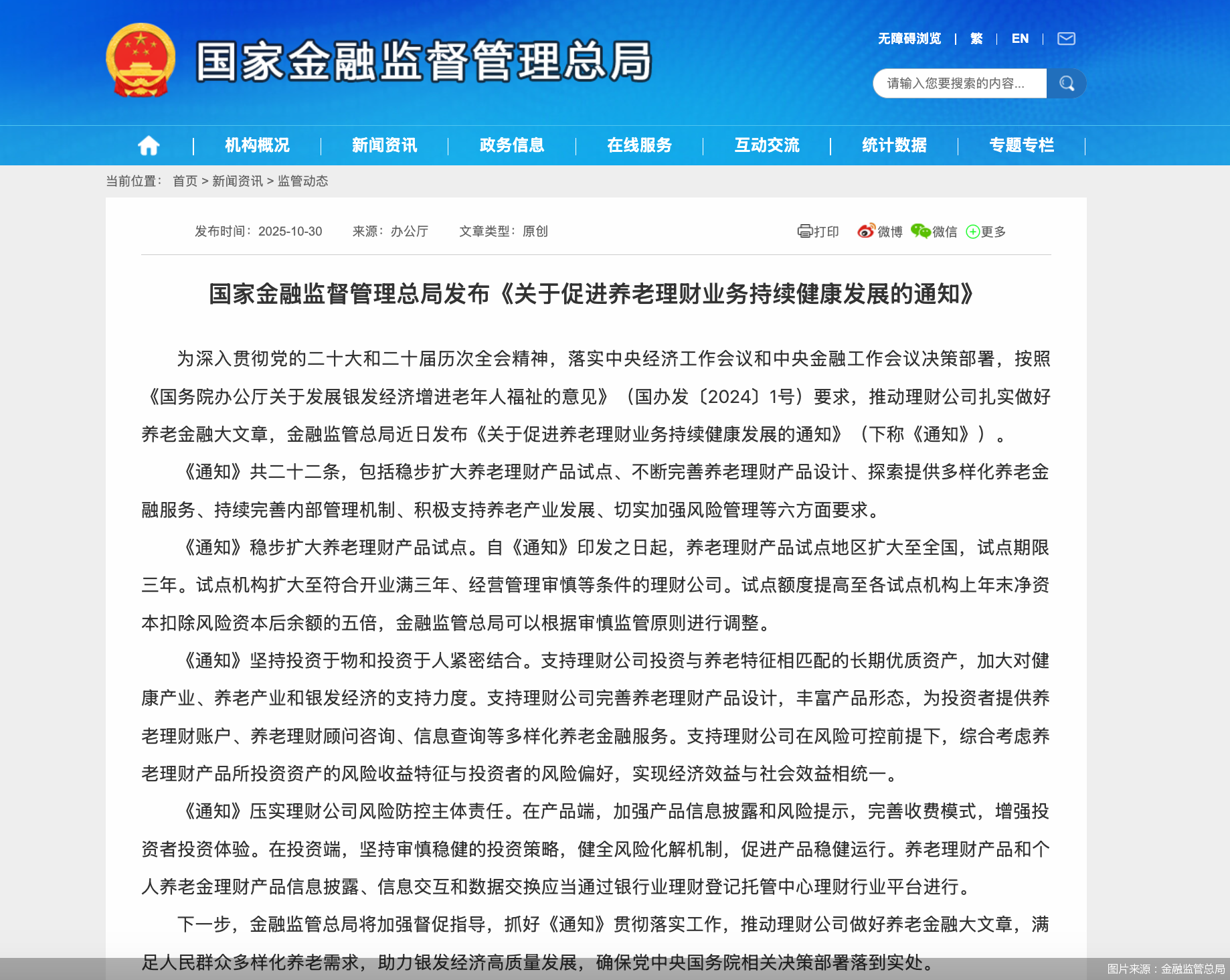
Core Viewpoint - The Financial Regulatory Administration has issued a notification to promote the sustainable and healthy development of pension financial management business, emphasizing collaboration among various licensed asset management institutions to better serve the pension industry [1] Group 1 - The notification encourages cooperation between wealth management companies and other licensed asset management institutions such as trust companies, insurance asset management companies, securities companies, and public funds [1] - The aim is to achieve complementary advantages in areas like special account management, operational custody, and transaction execution [1] - This initiative is designed to enhance services for the development of the pension industry [1]
*ST中地披露三季报:重大资产重组完成 净资产转正
Zheng Quan Ri Bao Wang· 2025-10-30 11:45
Core Viewpoint - The company *ST Zhongdi has reported a significant turnaround in its financial performance for the first three quarters of 2025, achieving a revenue of 14.293 billion yuan, a year-on-year increase of 16.48%, and a net profit of 4.827 billion yuan, marking a return to profitability [1] Group 1 - The company completed a major asset transfer to its controlling shareholder, China Communications Real Estate Group, which involved the divestiture of its real estate development assets and liabilities [1] - As of September 30, 2025, the company's total assets amounted to 2.258 billion yuan, with net assets attributable to shareholders reaching 1.248 billion yuan, indicating a recovery from negative to positive net assets compared to the previous year [1] - The asset restructuring is part of a strategic initiative by the controlling shareholder, China Communications Construction Group, aimed at shifting the company towards a lighter operational model to restore profitability and sustainable operations [1] Group 2 - The company plans to focus on "full city services" and "full transportation services," aiming to create a comprehensive life service and asset management system [2] - *ST Zhongdi is accelerating the establishment of a dual-driven model centered on "property management + asset management and operation," leveraging synergies within the China Communications Group [2] - The company emphasizes high-quality development, aiming to solidify its core businesses in property and asset management while enhancing market confidence through actual performance [2]
黄金大幅回调还能买吗?专家最新研判
Feng Huang Wang Cai Jing· 2025-10-30 11:19
Group 1 - The core driver of the recent rise in gold prices is geopolitical tensions leading to significant increases in global central bank gold reserves and the efficiency of market participation through gold ETFs [1][2] - Historical data shows that gold prices have experienced two major upward cycles from 1970-1980 and 2000-2010, with central banks projected to purchase 1136 tons, 1037 tons, and 1045 tons of gold from 2022 to 2024, marking one of the fastest accumulation rates in modern history [1][2] - China's central bank has resumed gold purchases since November 2024, increasing its holdings for 11 consecutive months, while global central bank net gold purchases in Q1 2025 reached 244 tons, indicating a slowdown in buying speed [1][2] Group 2 - The recent significant drop in gold prices below the $4000 mark is attributed to its safe-haven properties, asset allocation diversification benefits, and market sentiment, with expectations of a new interest rate cut cycle emerging due to weak U.S. employment data and manageable inflation [2][3] - The ongoing high debt levels in major economies are prompting investors to prepare for "currency devaluation trades," thereby maintaining the long-term logic supporting gold prices [3]