
公用事业

Search documents
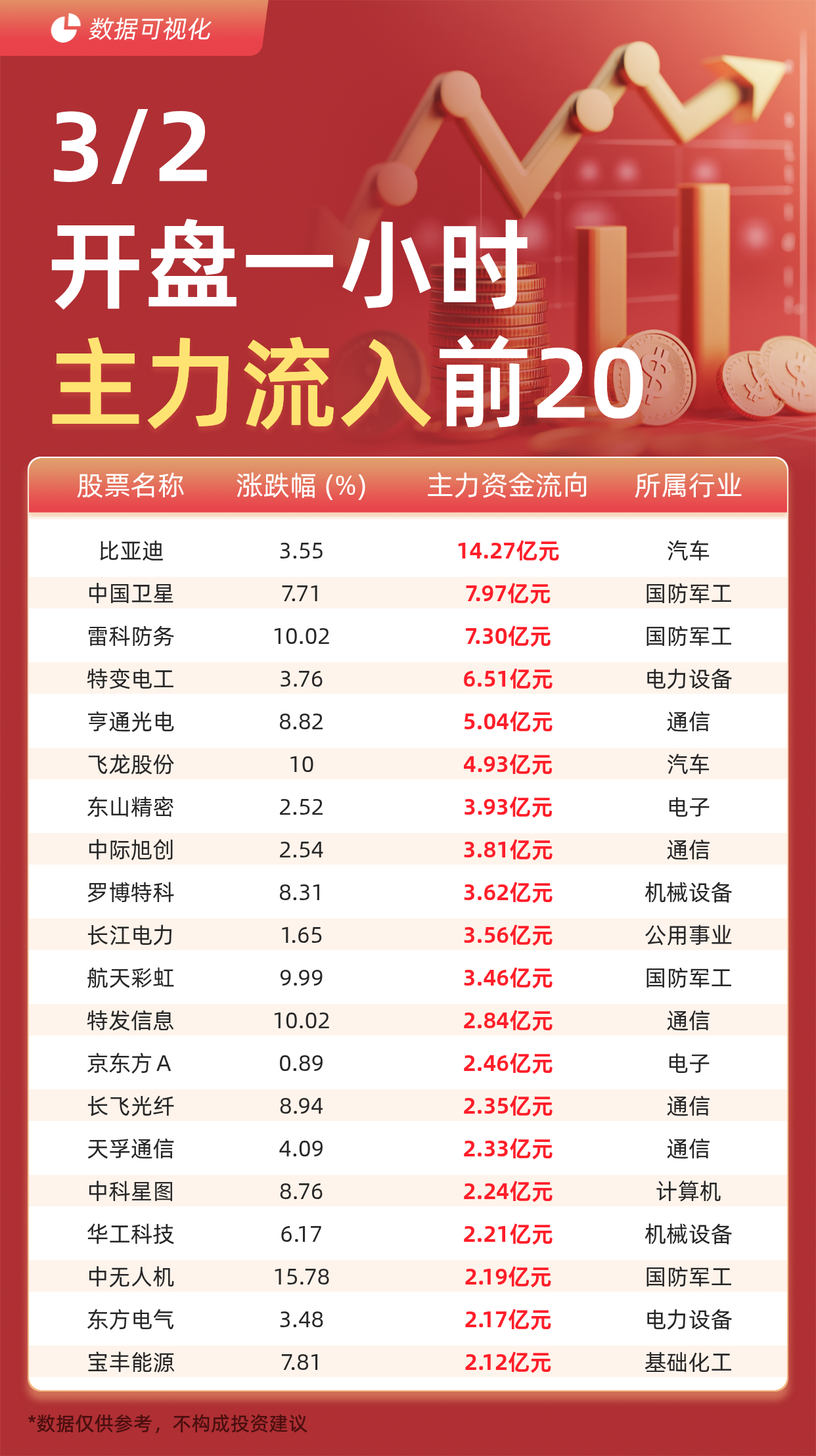
主力资金流入前20:比亚迪流入14.27亿元、中国卫星流入7.97亿元
Jin Rong Jie· 2026-03-02 02:59
Core Insights - The main focus of the news is the significant inflow of capital into various stocks, indicating strong investor interest in specific sectors and companies. Group 1: Stock Performance and Capital Inflow - BYD saw a capital inflow of 1.427 billion, with a price increase of 3.55% [1][2] - China Satellite experienced a capital inflow of 0.797 billion, with a price increase of 7.71% [1][2] - Aerospace Rainbow had a capital inflow of 0.346 billion, with a price increase of 9.99% [1][2] - The stock with the highest capital inflow was BYD, followed by China Satellite and Raytheon Defense [1][2] Group 2: Sector Analysis - The automotive sector, represented by BYD and Feilong Co., showed strong performance with inflows of 1.427 billion and 0.493 billion respectively [1][2] - The defense sector, including China Satellite and Raytheon Defense, also attracted significant capital, with inflows of 0.797 billion and 0.730 billion respectively [1][2] - The communication sector, represented by companies like Hengtong Optic-Electric and Tianfu Communication, saw inflows of 0.504 billion and 0.233 billion respectively [1][2][3]







中国银河证券:紧扣“十五五”开局 港股结构性机会如何把握?
智通财经网· 2026-03-02 01:55
Core Viewpoint - The technology sector remains the long-term investment focus in the Hong Kong stock market, with concerns surrounding AI creating buying opportunities. The rise of China's AI capabilities is expected to boost market confidence, although full recovery will take time [1]. Group 1: Market Performance - During the week from February 23 to February 28, global major stock indices showed mixed performance. The Hang Seng Index rose by 0.82%, while the Hang Seng Tech Index and the Hang Seng China Enterprises Index fell by 1.41% and 1.12%, respectively [1]. - In terms of industry performance, five sectors in the Hong Kong stock market increased while six sectors decreased. The materials, real estate, and utilities sectors saw the highest gains, rising by 5.36%, 2.48%, and 1.60%, respectively. Conversely, healthcare, information technology, and consumer discretionary sectors experienced the largest declines, falling by 4.20%, 1.80%, and 1.55% [1]. Group 2: Market Liquidity - The average daily trading volume on the Hong Kong Stock Exchange for the week was HKD 241.836 billion, an increase of HKD 116.578 billion from the previous week [2]. - Cumulative net inflow of southbound funds reached HKD 6.705 billion, a decrease of HKD 21.095 billion compared to the previous week [2]. - For the week ending February 25, global active foreign funds saw a net inflow of USD 238 million into Chinese stocks, while passive foreign funds had a net inflow of USD 2.186 billion, with respective changes of a decrease of USD 83 million and an increase of USD 1.489 billion from the previous week [2]. Group 3: Valuation and Risk Appetite - As of February 27, 2026, the PE and PB ratios of the Hang Seng Index were 11.98 times and 1.23 times, respectively, placing them at the 77% and 55% percentile levels since 2010 [3]. - The yield on 10-year U.S. Treasury bonds decreased by 11 basis points to 3.97%, with the risk premium of the Hang Seng Index at 4.38%, which is -1.40 standard deviations from the 3-year rolling mean, placing it at the 8% percentile since 2010 [3]. - The AH share premium index for the Hong Kong-Shanghai Stock Connect rose by 1.77 points to 118.17, which is at the 12.21% percentile level since 2014 [3]. Group 4: Investment Outlook - Internationally, the U.S. and Israel have launched attacks on Iran, targeting its highest leaders. The U.S. is planning a multi-day operation, with economic issues being a key focus in recent political discussions [4]. - The market may continue to digest emotional disturbances in the short term, but the long-term supportive factors remain unchanged [4].

伊朗问题对股债商汇等大类资产的影响
Soochow Securities· 2026-03-02 00:02
Geopolitical Impact - On February 28, 2026, military strikes by the US and Israel against Iran escalated geopolitical tensions in the Middle East, leading to retaliatory actions from Iran and explosions in several Gulf countries[1] - The Strait of Hormuz, a critical oil transport route, handles approximately 20% of global oil consumption, with a daily transport volume of about 20 million barrels; any blockage could lead to a significant spike in international oil prices[3] Commodity Market Effects - Short-term market reactions indicate a surge in gold and oil prices due to heightened risk aversion, with inflation expectations likely driving up prices of industrial metals like copper, aluminum, and nickel[3] - If the geopolitical situation escalates into a prolonged regional conflict, it could disrupt global supply chains and lead to sustained high oil prices, potentially forcing central banks to adopt tighter monetary policies[4] Currency Market Dynamics - The US dollar is expected to strengthen in the short term due to inflows of risk-averse capital, but may face long-term depreciation pressures if the conflict leads to increased US fiscal deficits[3] - The Chinese yuan is projected to maintain a stable appreciation trend, supported by strong domestic demand and a favorable trade balance, with a short-term trading range against the dollar expected between 6.80 and 6.95[3] Stock Market Reactions - Initial impacts of the geopolitical conflict may lead to downward pressure on global stock markets, including A-shares, but the long-term outlook for A-shares remains positive due to strong domestic economic fundamentals[4] - Sectors directly benefiting from the conflict, such as gold, oil, and military industries, may see positive performance, while other sectors could experience short-term volatility[4] Bond Market Outlook - Increased risk aversion is likely to drive capital into the bond market, particularly Chinese government bonds, which are favored during periods of yuan appreciation[5] - The direction of the Chinese bond market will primarily depend on domestic fiscal and monetary policies, with expectations of continued liquidity support from the central bank[5]
A股2月收官,沪指月线斩获3连阳
Dongguan Securities· 2026-03-01 23:32
Market Overview - The A-share market closed February with the Shanghai Composite Index achieving three consecutive monthly gains, closing at 4162.88, up 0.39% [1] - The Shenzhen Component Index and the ChiNext Index showed slight declines, with the former down 0.06% and the latter down 1.04% [1] Sector Performance - The top five performing sectors included Steel (up 3.37%), Coal (up 3.20%), and Non-ferrous Metals (up 3.10%), while the worst performers were Building Materials (down 1.45%) and Communication (down 1.38%) [2] - Notable concept indices that performed well included Lead Metal, Zinc Metal, and Cobalt Metal, while sectors like National Big Fund Holdings and PCB Concepts lagged [2] Future Outlook - The market showed mixed performance with significant trading volume, reaching 2.5 trillion, indicating a slight decrease but maintaining above 2 trillion for four consecutive days [5] - Technical analysis suggests a strong overall market sentiment, with the Shanghai Composite Index stabilizing above short-term moving averages and MACD in a bullish zone [5] - The upcoming Two Sessions are expected to positively influence the market, supported by policy expectations and improving corporate earnings, particularly in cyclical sectors and technology [5]
财信证券宏观策略周报(3.2-3.6):中东冲突升级,关注商品、军工及“HALO交易”-20260301
Caixin Securities· 2026-03-01 10:36
Group 1 - The report highlights concerns regarding the escalation of conflicts in the Middle East, which may impact market sentiment and risk appetite, particularly due to uncertainties surrounding U.S. tariffs and geopolitical tensions [4][7] - It is anticipated that the A-share market will experience a return to fundamental trends as the spring rally concludes and the earnings disclosure season approaches, with a wide fluctuation expected until the end of April [4][7] - The report suggests that the recent geopolitical tensions have already been priced into global commodity and equity markets, indicating that the current Middle East conflict may only affect short-term market sentiment without altering the overall market direction [4][7] Group 2 - Investment opportunities are identified in sectors such as energy, oil transportation, precious metals, and military industries, driven by the geopolitical conflict [4][14] - The "HALO trading" strategy is highlighted as beneficial for sectors like utilities, transportation infrastructure, and metals, as investors seek hard assets that are less likely to be replaced by technology [11][17] - The report emphasizes the importance of monitoring the upcoming National People's Congress for economic policy directions, which are expected to maintain a "double easing" stance to support economic recovery [8][9] Group 3 - The report notes that the A-share index has shown a positive trend, with the Shanghai Composite Index rising by 1.98% and the Shenzhen Component Index by 2.80% in the previous week [16] - It mentions that the average daily trading volume in the two markets was approximately 24,227.7 billion yuan, indicating robust market activity [16] - The report also discusses the performance of various sectors, with steel, non-ferrous metals, and basic chemicals showing significant gains [16][19]
公用事业行业周报(2026.02.23-2026.02.27):低位实物资产,宏观交易催化价值重估
Orient Securities· 2026-03-01 10:25
Investment Rating - The report maintains a "Positive" investment rating for the utility sector [4] Core Viewpoints - The utility sector is expected to experience steady growth in electricity demand, with macroeconomic trading catalyzing the revaluation of low-asset physical utilities [7] - The anticipated recovery in pessimistic earnings expectations supports the current upward trend in the sector, with the first quarter of 2026 expected to outperform market expectations [7] - The report emphasizes the need for further reforms in electricity pricing to support the increasingly complex new energy system in China [7] Summary by Sections Industry Performance - The utility sector outperformed the broader market indices, with the Shenwan Utility Index rising by 5.7%, surpassing the CSI 300 Index by 4.6 percentage points [41] - The sector's performance is driven by a combination of low physical asset valuations and macroeconomic factors [7] Electricity Prices - In Guangdong, the average spot electricity price decreased by 23.6% year-on-year, while in Shanxi, it fell by 62.3% year-on-year [10][13] - The average spot electricity price in Jiangsu also saw a decline of 6.9% week-on-week [10] Coal Prices - The price of Qinhuangdao Q5500 thermal coal increased by 4.0% week-on-week, reaching 751 RMB/ton, while the price of imported Indonesian coal rose by 5.7% [16][18] - Port coal inventories are showing signs of recovery, with Qinhuangdao port coal inventory increasing by 5.6% week-on-week [26] Investment Recommendations - The report recommends focusing on utility stocks, particularly in the thermal power sector, where companies like Jiantou Energy and Huadian International are highlighted as buy candidates [7] - For hydropower, it suggests investing in high-quality river basin hydropower stocks [7] - The nuclear power sector is noted for its strong long-term growth potential, while wind and solar sectors are expected to see significant growth under carbon neutrality expectations [7]





A股策略周报:中国即HALO,实物即方舟
SINOLINK SECURITIES· 2026-03-01 10:24
Group 1: AI Disruption Concerns - Nvidia's Q4 2025 earnings exceeded market expectations by 5.5%, yet its stock price fell over 8% in three trading days, marking the largest decline in three years[3] - Since November 2022, Nvidia's stock price has diverged from its EPS, indicating ongoing market concerns about AI disruption[3] - The capital expenditure of major tech companies remains high, with a projected total of $670 billion for 2026, reflecting a growth rate of over 60%[3] Group 2: Market Trends and Asset Resilience - A-share companies have a higher proportion of tangible assets compared to their US counterparts, indicating stronger resilience against potential AI disruptions[4] - The manufacturing and materials sectors in China contribute a higher value-added percentage compared to other developed economies, enhancing their attractiveness to global investors[4] - In the US, heavy asset sectors like utilities, energy, and materials have significantly outperformed light asset sectors in Q4 2025, with revenue and profit exceeding expectations by over 5% and 15% respectively[3] Group 3: Resource Commodities and Geopolitical Factors - The US government is increasing its focus on strategic resources, as evidenced by the "Treasury Plan" and Zimbabwe's suspension of lithium exports, indicating a rising demand for key minerals[5] - Current US copper inventory is approximately 30% of annual consumption, suggesting room for growth compared to historical levels[5] - Geopolitical tensions in the Middle East could lead to oil prices rising to $90 per barrel, which may reverse the downward trend in US inflation[6]
A股2026年3月观点及配置建议:地缘加剧,资源科技-20260301
CMS· 2026-03-01 10:05
Core Views - The market is expected to experience limited index space and focus on structural trends in March, influenced by geopolitical factors and policy expectations surrounding the upcoming Two Sessions and the 14th Five-Year Plan [2][12][23] - The geopolitical situation, particularly the US-Iran conflict, is identified as a significant variable affecting A-shares, with potential implications for commodity prices and global macroeconomic logic [4][12][14] - The market style is anticipated to become more balanced, with small and mid-cap stocks likely to continue outperforming, driven by liquidity from financing and quantitative private equity [4][12][15] Industry and Sector Recommendations - Key sectors to focus on include non-ferrous metals (industrial metals, energy metals, and minor metals), basic chemicals, machinery (automation and engineering), power equipment (batteries, grid equipment, wind power), electronics (semiconductors), and public utilities (electricity) [4][5][18] - The report emphasizes the importance of cyclical price increases and the expansion of AI hardware as core investment themes for March [4][12][18] - The anticipated policy support for traditional infrastructure and consumer services is expected to catalyze investment opportunities in these sectors [4][12][18] Market Liquidity and Capital Supply - March is projected to see continued net inflows of incremental capital, with a focus on the dynamics between financing funds and ETF redemptions [4][12][15] - The macro liquidity environment is expected to remain stable and abundant, supported by the central bank's monetary policy stance and the upcoming Two Sessions [4][12][15] Economic and Profitability Outlook - Profit expectations have been adjusted upward, particularly in resource products, information technology, and midstream manufacturing sectors [5][12] - The report notes that the profitability growth rate for the entire A-share market and non-financial sectors for 2026 has been slightly revised upward, indicating a positive outlook for these industries [5][12]
公用事业行业周报(2026.02.23-2026.02.27):低位实物资产,宏观交易催化价值重估-20260301
Orient Securities· 2026-03-01 09:14
Investment Rating - The report maintains a "Positive" investment rating for the utility sector [4] Core Viewpoints - The utility sector is expected to experience steady growth in electricity demand, with macroeconomic trading catalyzing the revaluation of low-asset physical utilities [7] - The anticipated recovery of pessimistic earnings expectations supports the current upward trend in the sector, with expectations for better-than-expected performance in Q1 2026 for thermal power companies [7] - The report emphasizes the need for further reforms in electricity pricing to support the increasingly complex new energy system in China [7] Summary by Sections Industry Performance - The utility sector outperformed the broader market indices, with the Shanghai and Shenzhen 300 Index rising by 1.1% and the Wind All A Index by 2.7%, while the Shenwan Utility Index increased by 5.7% [41] - The report highlights that the thermal power sector has shown the largest weekly increase of 8.9% [43] Electricity Prices - In Guangdong, the average spot electricity price decreased by 23.6% year-on-year to 295 yuan/MWh [10] - Shanxi's average spot electricity price saw a significant drop of 62.3% year-on-year, averaging 156 yuan/MWh [13] Coal Prices - The price of Qinhuangdao Q5500 thermal coal rose to 751 yuan/ton, a week-on-week increase of 4.0% [16] - The report notes that the price of imported coal from Indonesia has also increased, with the Guangzhou port price reaching 852 yuan/ton, up 5.7% week-on-week [18] Inventory Levels - As of March 1, 2026, coal inventory at Qinhuangdao port was 5.25 million tons, reflecting a week-on-week increase of 5.6% [26] - The report indicates that the daily coal consumption of power plants in 25 provinces rose by 30.5% week-on-week [29] Investment Recommendations - The report recommends focusing on the utility sector as a long-term investment, particularly in thermal power companies such as Jiantou Energy, Huadian International, and Guodian Power [7] - For hydropower, it suggests investing in high-quality large hydropower projects [7] - The report also highlights the growth potential in nuclear power and wind energy sectors, recommending companies like China General Nuclear Power and Longyuan Power [7]
策略周报:两会前后市场如何演绎?
Guoxin Securities· 2026-02-28 10:50
Market Performance Insights - Historical data shows a high probability of market gains before and after the Two Sessions, with the probability of increase being 76.2% for the Shanghai Composite Index in the 20 trading days before the sessions[19] - The average gain for the Shanghai Composite Index before the Two Sessions is 1.8%, while the average gain after is 3.1%[20] - The probability of small-cap stocks outperforming large-cap stocks is nearly 90% before the Two Sessions, but drops to 50% afterward[20] Sector Analysis - Resource sectors such as steel and non-ferrous metals have shown high probabilities of gains before the Two Sessions, with probabilities exceeding 80%[22] - Consumer sectors tend to perform better during the Two Sessions, with a 60% probability of gains in industries like food and beverage[20] - Post-Two Sessions, real estate and consumer sectors have a high probability of gains, with real estate at 76.2%[20] Policy Impact - The Two Sessions serve as a critical window for observing economic policy directions, influencing market sentiment and performance[24] - Pre-Two Sessions, there is typically an increase in growth-stabilizing policy expectations, leading to active trading[24] - Post-Two Sessions, the acceleration of policy implementation often boosts optimistic market expectations, particularly for cyclical sectors[24] Current Market Conditions - The spring market rally continues, with the Shanghai Composite Index showing a 3.7% increase since February 3, and a recent weekly gain of 2.0%[1] - Recent trading volumes have increased, with average daily trading rising from 2.1 trillion to 2.4 trillion yuan[1] - Leverage funds have shifted from outflows to inflows, indicating improved market sentiment, with net purchases reaching 258.7 billion yuan recently[1] Investment Strategy - A balanced allocation strategy is recommended, focusing on sectors like AI applications, resources, and real estate, given the current market dynamics[29] - The anticipated continuation of the spring rally is supported by positive macroeconomic policies and increased liquidity in the market[28] - The focus on expanding domestic demand is expected to be a key theme in the upcoming Two Sessions, influencing investment opportunities[24]