农产品种植与加工

Search documents
前10个月越南木薯出口大幅增长,中国市场占九成多
Shang Wu Bu Wang Zhan· 2025-11-19 17:29
累计前10个月,越南出口木薯及木薯制品逾334万吨,突破10亿美元,数量和金额同比分别增长 59.8%和8.5%。其中对中国出口316万吨木薯,9.6274亿美元,同比分别增长63.8%和10.3%。 (原标题:前10个月越南木薯出口大幅增长,中国市场占九成多) 越南《越南经济》11月18日报道,据越南海关统计,2025年10月,越南出口木薯及木薯制品26万 吨,8853万美元,出口数量和出口金额同比分别增长47.6%和16.3%。中国仍为越南木薯出口的主要市 场,占越南木薯出口总量的92.5%以上,逾24万吨,价值8130万美元,同比分别增长45.6%和15.8%。 ...
“中国大蒜之乡”济宁金乡乡村振兴的“共富密码”
Zhong Guo Xin Wen Wang· 2025-11-19 06:24
Core Insights - The article highlights the transformation of Jining's Jinxiang County, known as "China's Garlic Town," into a thriving agricultural and industrial hub, leveraging the garlic industry for rural revitalization and shared prosperity [1][5]. Group 1: Industry Development - Jinxiang County has transitioned from traditional garlic farming to a diversified industrial cluster, with 116 enterprises related to the garlic industry established in Cuikou Village [1][2]. - The area has developed a comprehensive industrial chain encompassing planting, purchasing, cold storage, processing, and export, supported by high-end research institutions and over 50 skilled professionals [1][2]. Group 2: Economic Impact - Cuikou Village's collective annual income has reached 5.6 million RMB, with at least 30% returned to villagers, resulting in an average annual income of 60,000 RMB per villager [2]. - The garlic storage business has proven to be more lucrative than traditional farming, with storage prices around 300 RMB per ton and a typical storage period of over six months [2]. Group 3: Technological Integration - The "Garlic Easy Pass" digital agriculture platform by Zhongsu Group utilizes big data and IoT technologies for intelligent management of the garlic industry, aiming to improve market transparency and pricing [5]. - The region is also focusing on the full utilization of garlic, with a 100% utilization rate leading to the development of various deep-processing products and organic feed from garlic stalks [5][7]. Group 4: Market Expansion - Jinxiang County cultivates garlic on 600,000 acres, influencing over 2 million acres in surrounding areas, with garlic yielding 4,000 RMB more per acre compared to crops like wheat [7]. - The local company, Shandong Xinnuo Food Technology Co., has innovated with a "0 additive fresh garlic paste" technology, filling a gap in the domestic high-end health sauce market and exporting products to over 30 countries [7].

冬藏薯香浓 盛会启新篇!云浮市云城区第八届乡村美食(番薯)旅游季邀您共赴暖冬之约
Nan Fang Nong Cun Bao· 2025-11-18 14:36
Core Viewpoint - The article highlights the upcoming 8th Rural Food (Sweet Potato) Tourism Season in Yunfu City, Yuncheng District, emphasizing the significance of sweet potatoes as a local agricultural product and their role in rural tourism development [1][25]. Group 1: Sweet Potato as a Key Agricultural Product - Sweet potatoes have transformed from a staple food to a delicacy that warms the winter, showcasing local culinary traditions [9][10]. - Yunfu City, particularly Yuncheng District, has developed a complete industrial chain for sweet potatoes, with a planting area of 23,000 acres and over 20 cooperative societies, providing employment for more than 2,000 villagers [20][21]. - The region's sweet potatoes are characterized by unique varieties such as "Qianfeng Sweet Potato" and "Futian Sweet Potato," which are well-suited to the local climate and soil conditions [18][19]. Group 2: Tourism and Economic Impact - The 8th Rural Food (Sweet Potato) Tourism Season will take place from December 5, 2025, to March 5, 2026, featuring various activities that celebrate local culture and agriculture [26][27]. - Previous events attracted significant attendance, with traffic reaching 138,000 vehicles and total visitor numbers hitting 418,000, leading to a substantial increase in agricultural product sales [41][42]. - The integration of agriculture and tourism has enhanced the region's appeal, creating a vibrant rural economy and improving the quality of life for local residents [39][40]. Group 3: Community and Cultural Engagement - The upcoming event will include competitions, cultural performances, and exhibitions, fostering community engagement and showcasing local heritage [30][33]. - The "Yun City Village Bowl" event will allow attendees to experience local cuisine while enjoying cultural performances, enhancing the festive atmosphere [38]. - The ongoing "Hundred Million Project" has significantly contributed to rural revitalization, improving infrastructure and promoting sustainable agricultural practices [44][45][52].

【学习贯彻四中全会精神在基层】贵州:挖掘文旅资源 激发乡村发展活力 安徽:加快融入长三角 扎实推进乡村振兴
Yang Shi Wang· 2025-11-18 11:53
Core Points - The 20th Central Committee's Fourth Plenary Session emphasizes accelerating agricultural and rural modernization and promoting comprehensive rural revitalization [1] Group 1: Guizhou's Rural Development - Guizhou is leveraging its unique cultural tourism resources to stimulate rural development, with Huanggang Village receiving the title of "Best Tourism Village" by the UN in 2025 [2] - Since the 14th Five-Year Plan, Huanggang Village has attracted nearly 100,000 visitors annually by revitalizing old buildings and promoting e-commerce in rural industries [2] - Guizhou has constructed over 12,000 kilometers of rural roads to connect ethnic villages, identifying 560 key rural tourism villages [2] Group 2: Anhui's Integration into the Yangtze River Delta - Anhui's pear planting base in Dezhou has been designated as a major supply base for Shanghai, enhancing its market reach [3] - The province aims to integrate into the Yangtze River Delta, establishing itself as a key supplier of agricultural products, including rice, vegetables, and fruits [3] - Anhui is focusing on improving agricultural production capacity and developing high-quality agricultural resources in line with the Fourth Plenary Session's spirit [3]
河南方城:多举措激活花生产业发展动能
Zhong Guo Jing Ji Wang· 2025-11-18 07:50
Group 1 - Guangyang Town in Fangcheng County, Henan Province, is recognized as a top ten oilseed production town and "China's Hometown of Quality Peanuts," with over 65,000 acres dedicated to peanut cultivation, contributing to local agricultural income [1] - The town produces over 26 million kilograms of high-quality peanuts annually, and to address seasonal funding shortages for major peanut producers, local financial institutions have introduced a "Peanut Loan" product, providing 110 million yuan in funding to over 500 farmers this year [1] Group 2 - To overcome the challenge of promoting high-quality peanuts, local entrepreneur Bao Jinhui has leveraged digital opportunities by initiating live-streaming sales, showcasing fresh peanuts directly from the fields, which has resulted in over 1 million annual orders and expanded the market reach to over 20 provinces [2] - The live-streaming initiative has encouraged more local residents to become "field anchors," transforming the live-streaming platform into a new stage for showcasing agricultural products [2] Group 3 - As a pilot area for rural revitalization, Guangyang Town emphasizes party leadership in development, integrating "Party Building + Industry Employment" models, and focusing on the peanut industry as a key area for agricultural development [3] - The town has established 42 peanut cooperatives and provides professional guidance on peanut cultivation, achieving yields of over 1,000 pounds per acre [3] - Plans are in place to build an e-commerce logistics center to enhance the packaging and transportation of deep-processed products, improving the entire supply chain from planting to sales [3] Group 4 - Efforts in financial support, live-streaming marketing, and strategic planning have significantly increased the value of high-quality peanuts in Guangyang Town [4] - The town aims to deepen the "Party Building + Specialty Industry" development model, focusing on extending the peanut processing chain to include products like peanut oil and peanut butter, thereby enhancing industry value [4] - Continuous policy support and service guarantees will be reinforced to promote standardized peanut planting, refined processing, and brand-oriented sales [4]
“头雁”领航,2025年广东乡村产业振兴带头人培训项目启动
Nan Fang Nong Cun Bao· 2025-11-18 06:33
Core Points - The "Leading Goose" project for cultivating rural industry leaders in Guangdong was officially launched on November 18, 2023, at Zhongkai University of Agriculture Engineering [2][8] - The project aims to enhance rural talent cultivation and support the high-quality development of rural areas in Guangdong [6][12] - Since its inception in 2022, the project has trained a total of 3,200 rural industry leaders, contributing to the income increase of 300,000 farming households [11][18] Group 1 - The theme of the event was "Leading Goose Navigation, Lingnan Prosperity" and was guided by the Ministry of Agriculture and Rural Affairs [3][4] - The project has established a comprehensive support system that includes institutional guarantees, precise training, and continuous assistance [13][14] - The project has facilitated over 500 financial support instances and school-enterprise cooperation projects [18][19] Group 2 - The training program includes a diverse curriculum covering digital transformation, supply chain management, and integration of primary, secondary, and tertiary industries [68][69] - The project emphasizes practical learning through a combination of classroom instruction, online learning, field studies, and mentorship [35][39] - The initiative aims to produce leaders who are knowledgeable in technology, management, and operations to drive rural revitalization [69][70] Group 3 - The event featured an award ceremony recognizing outstanding teachers, mentors, and students for their contributions in 2024 [21][22] - The project has seen successful case studies, such as a participant who developed a new product from local agricultural resources, significantly increasing demand [43][44] - The program encourages participants to engage in innovative agricultural practices and community collaboration to enhance rural economies [62][64]
聚焦大湾区农交会|"媒体+"解码粤北地标:山水灵秀孕育岭南珍馈
Nan Fang Nong Cun Bao· 2025-11-17 01:09
Core Insights - The article highlights the development of unique agricultural products in the northern Guangdong region, emphasizing the transformation of local specialties into significant economic drivers for rural revitalization [9][67]. Group 1: Agricultural Development in Northern Guangdong - The northern Guangdong region, including cities like Qingyuan, Shaoguan, Yunfu, and Heyuan, is leveraging its unique mountainous and water-rich environment to enhance agricultural productivity [7][9]. - Qingyuan is focusing on five major billion-yuan industries, with an investment of approximately 45 million yuan in 2023 to develop products like Qingyuan chicken and Yingde black tea, aiming for a total agricultural output value of 400.67 billion yuan, which has doubled from 192 billion yuan in 2021 [16][20]. - Shaoguan is building a multi-layered brand system under the "Shanmei Shaonong" brand, with significant contributions from local products like the Danxia Gonggan, which has a projected output value of 1.8 billion yuan in 2024 [30][32]. Group 2: Specific Agricultural Products and Their Impact - Yunfu, known as the "Hometown of Southern Medicine," has over 1.35 million acres of medicinal plants, contributing significantly to the province's agricultural output [41][42]. - Heyuan is recognized for its ecological products, with a focus on oil tea and unique tea varieties like the Zijin cicada tea, which has a projected output value exceeding 2.5 billion yuan in 2024 [56][60]. - The article mentions the upcoming Greater Bay Area Agricultural Products Trade Fair, which will provide a platform for over 1,000 core buyers to connect with northern Guangdong's agricultural products, enhancing market reach [68][70].
聚焦大湾区农交会|“媒体+”解码粤西地标:山海相逢孕育南粤瑰宝
Nan Fang Nong Cun Bao· 2025-11-16 05:34
Core Viewpoint - The 2025 Greater Bay Area Agricultural Products Trade Fair will be held in Guangzhou, showcasing landmark agricultural products from the Guangdong West region, aiming for brand and internationalization through a "media+" service model [8][10]. Group 1: Agricultural Products and Their Economic Impact - Zhanjiang is recognized as both a "blue granary" and a "tropical fruit garden," with over 3,600 deep-sea fish farming nets producing more than 100,000 tons of fish annually, accounting for about 40% of national output, and an industry value exceeding 13 billion yuan [13][14][22]. - Xu Wen, known as the "hometown of pineapples," has a planting area of 350,000 mu, yielding over 700,000 tons annually, which is one-third of the national total. The local industry is extending its value chain by developing processed products like pineapple mooncakes [17][18][20]. - Maoming's lychee industry has a planting area exceeding 1.35 million mu, with an annual output of over 500,000 tons, contributing to a total industry value of over 12 billion yuan in 2024. The products are exported to over 20 countries and regions [31][32][34]. - The medicinal plant Huajuhong, known as "Southern ginseng," has a planting area of 116,000 mu, with a product value exceeding 3.5 billion yuan. The local government is investing in research and development to enhance its health product offerings [36][40][46]. Group 2: Industry Innovations and Trends - Yangjiang, known for its black bean paste, produces over 50,000 tons annually, capturing about 70% of the national market share, with an industry value surpassing 1.5 billion yuan. The local industry is innovating with high-value products like ready-to-eat sauces [52][53]. - The integration of traditional agriculture with modern technology is evident as the region transitions from scattered practices to standardized, digitalized, and large-scale operations. This includes the development of new business models such as "agriculture + tourism" and "agriculture + e-commerce" [65][66]. - The "media+" platform is expected to accelerate the internationalization of unique agricultural products from Guangdong West, transforming them from mere "taste memories" to recognized "industry brands" on a global stage [68][70].
少见放低姿态!美国公开喊话:中国若采购大豆,请优先考虑美方
Sou Hu Cai Jing· 2025-11-15 18:11
Core Insights - The article highlights the significant shift in the U.S.-China soybean trade dynamics, illustrating how the U.S. soybean industry has faced severe challenges due to China's pivot towards South American suppliers, particularly Brazil and Argentina [1][3][4]. Group 1: Trade Dynamics - In 2024, Brazil's soybean exports to China reached 74.65 million tons, accounting for 71% of China's total soybean imports, surpassing the U.S. as the largest supplier [4]. - Argentina's decision to eliminate soybean export taxes in September 2025 led to a surge in orders from China, with 1.3 million tons ordered, nearly one-third of Argentina's total exports to China last year [4]. - China's logistics enhancements, including the opening of the QianKai Port in Peru, have reduced shipping times for Brazilian soybeans to Asia by seven days, further solidifying its diversified supply chain [4]. Group 2: Technological and Regulatory Measures - China has implemented a blockchain traceability system that successfully intercepted 300,000 tons of U.S. soybeans attempting to misrepresent their origin, highlighting the effectiveness of its regulatory measures [6]. - The promotion of domestic feed soybean meal reduction technology is projected to decrease soybean demand by 11 million tons annually, equivalent to one-third of the U.S. soybean exports to China in previous years [6]. Group 3: U.S. Industry Challenges - In the summer of 2025, the U.S. soybean shipment volume to China was recorded at "0.0," indicating a complete halt in exports, which has severely impacted U.S. soybean farmers [7]. - The U.S. soybean export volume to China in the first half of 2025 plummeted by 85% year-on-year, totaling less than 3 million tons [7]. - The U.S. agricultural sector is experiencing a surge in bankruptcies, with a 55% increase in farm bankruptcies in the Midwest, as farmers struggle with unsold soybeans and plummeting prices [9]. Group 4: Political and Market Responses - The Trump administration's failure to deliver promised agricultural subsidies of $12-13 billion has left most soybean farmers without support, exacerbating their financial struggles [9]. - Despite the challenges, China signed an intention order for 870,000 tons of soybeans during the 2025 Import Expo, indicating a cautious approach to re-engaging with U.S. suppliers [9][10]. - The U.S. attempts to diversify its soybean markets have been largely unsuccessful, with traditional markets like Mexico and Japan unable to absorb the volume lost from China, and emerging markets already dominated by South American competitors [12]. Group 5: Global Agricultural Landscape - The ongoing trade tensions reflect a profound transformation in the global agricultural landscape, with China moving towards a more secure and diversified food supply chain, reducing its reliance on a single source [13].

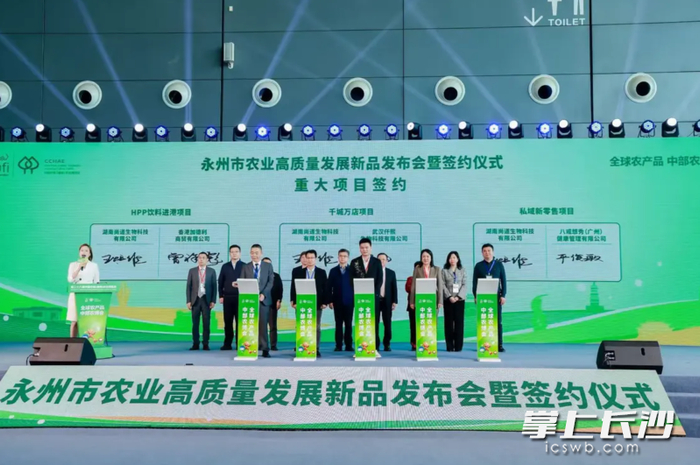
永州升级农业全链战略 农博会签约11.5亿元
Chang Sha Wan Bao· 2025-11-15 15:57
Core Insights - The 26th Central Agricultural Expo showcased a variety of high-quality agricultural products from Yongzhou, resulting in the signing of 11 key projects worth a total of 1.15 billion yuan [1] Group 1: Product Quality and Market Expansion - Yongzhou's agricultural products, branded as "Yong" products, are making strides towards national and international markets, with a focus on high-standard planting bases and a digital management system [3] - The city has maintained the highest vegetable export volume among prefecture-level cities in China, with projected fruit and vegetable export value reaching 13.89 billion yuan in 2024 [3] Group 2: Technological Innovation and Value Addition - Hunan Shangdao Biotechnology Co., Ltd. has developed high-value products using innovative fermentation and preservation technologies, enhancing the market value of local agricultural products [4] - The company has signed a cooperation agreement with Hong Kong's Gaderi Trading to promote Yongzhou's HPP beverages in the Hong Kong market, while also establishing a comprehensive sales network through partnerships with other companies [4] Group 3: Strategic Development and Market Positioning - Yongzhou is focusing on a full industry chain strategy to upgrade agriculture from production to processing and sales, aiming to maintain a competitive edge for its high-quality agricultural products [4]