
光模块

Search documents
嘉元科技5亿跨界光模块:锂电铜箔龙头的AI新基建突围战
Xin Lang Cai Jing· 2025-09-04 07:46
Core Viewpoint - The strategic investment of 500 million yuan by Jia Yuan Technology in En Da Tong marks a significant move into the rapidly growing optical module sector, reflecting the transformation anxiety of traditional manufacturing and the capital's pursuit of hard technology under the AI infrastructure wave [1][5]. Group 1: Optical Module Sector - The global optical module market has grown from 77.5 billion yuan in 2020 to an estimated 126.7 billion yuan in 2024, with a compound annual growth rate of 13.1%, projected to exceed 295.4 billion yuan by 2029 [2]. - En Da Tong, established in 2017, has quickly entered the market with high-speed optical modules and active/passive devices, achieving revenues of 1.477 billion yuan and a net profit of 97.94 million yuan in 2024, with 2025 H1 revenues nearing 1.316 billion yuan and net profits reaching 121 million yuan [2]. Group 2: Jia Yuan Technology's Transformation - Jia Yuan Technology, a leader in lithium battery copper foil, has faced challenges such as industry overcapacity and intensified price wars, leading to a significant loss in net profit in 2024 [3]. - The investment in En Da Tong is seen as a critical strategy for Jia Yuan Technology to tap into the growth potential of the optical module sector, leveraging synergies in customer base, product offerings, and supply chain integration [3]. - The collaboration is expected to enhance financial performance, with En Da Tong's original shareholders committing to a minimum net profit of 143 million yuan in 2025, providing Jia Yuan Technology with a safeguard for its investment [3]. Group 3: Industry Insights - The case of Jia Yuan Technology illustrates a new paradigm for traditional manufacturing transformation, emphasizing the importance of strategic equity investments to enter high-growth sectors while maintaining core business operations [5]. - This approach allows companies to mitigate the risks associated with direct transformation and share in industry benefits through financial investments, highlighting the shift from product-centric competition to ecosystem-based competition in the AI era [5].

“易中天”暴跌,创业板人工智能ETF(159363)午后重挫超9%,基金经理最新解读来了!
Xin Lang Ji Jin· 2025-09-04 07:45
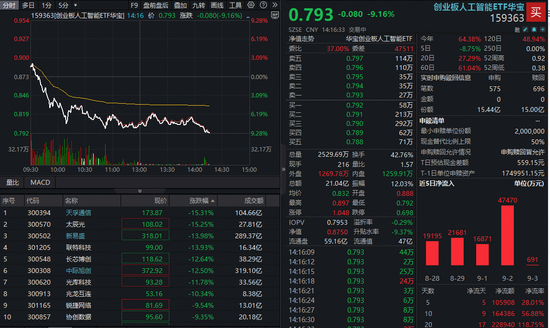
Core Viewpoint - The AI market experienced significant volatility on September 4, with a sharp decline in optical module stocks, particularly affecting the entrepreneurial board AI index, which has over 51% optical module content [1] Group 1: Market Performance - The leading optical module companies, including "Yizhongtian" (Xinyi Sheng, Zhongji Xuchuang, Tianfu Communication), saw declines exceeding 12% [1] - The entrepreneurial board AI ETF (159363), which tracks the largest and most liquid index, experienced a drop of over 9%, potentially marking its largest single-day decline since April 8, with a real-time transaction volume exceeding 2.1 billion [1] Group 2: Fund Manager Insights - Fund manager Cao Xuchen noted that the optical module sector had become a focal point for market investment due to strong fundamentals and profit effects, leading to significant gains [3] - The rapid increase in stock prices led to profit-taking by short-term investors, resulting in a potential sell-off if new capital fails to sustain price increases [3] - The current market is characterized by short-term profit-taking and long-term investors gradually entering the market, with initial short-term pressures likely dominating [3] Group 3: Investment Recommendations - It is recommended to focus on the entrepreneurial board AI ETF (159363) and its associated funds, which allocate approximately 70% to computing power and 30% to AI applications, effectively capturing AI market trends [4] - As of September 3, 2025, the entrepreneurial board AI ETF (159363) reached a new high of over 5.1 billion, with an average daily transaction volume exceeding 700 million over the past month, ranking first among six ETFs tracking the entrepreneurial board AI index [4]



富时中国系列指数季度“大洗牌”,高成长牛股成“新宠”
Bei Ke Cai Jing· 2025-09-04 07:20
Core Viewpoint - The recent quarterly review by FTSE Russell on multiple indices involving China indicates a significant shift in fund flows, particularly favoring high-growth sectors such as innovative pharmaceuticals and AI computing power, while traditional sectors like utilities and telecommunications are being sidelined [1][12]. Group 1: Index Changes - The FTSE China A50 Index has added companies such as BeiGene, NewEase, WuXi AppTec, and Zhongji Xuchuang, while removing China Nuclear Power, China Unicom, Guodian NARI, and Wanhua Chemical [3][4]. - Newly included companies have market capitalizations exceeding 280 billion yuan, reflecting a preference for high-quality large-cap growth stocks [3]. - The passive funds tracking the FTSE China A50 Index exceed 10 billion USD, indicating that changes in index composition can lead to significant capital flows, potentially in the hundreds of millions or even billions [1]. Group 2: Market Performance - The newly added stocks have shown remarkable performance, with all four companies experiencing over 100% growth this year, and the highest growth reaching 350% [4]. - The market is currently favoring technology growth sectors, as evidenced by the inclusion of companies from the optical module sector and innovative pharmaceuticals [11][12]. Group 3: Industry Trends - The adjustments in the index reflect a broader trend of market funds embracing technology growth sectors while showing a decline in preference for cyclical sectors [12]. - The demand for high-speed optical modules has surged due to advancements in AI technology and increased computing power needs, benefiting companies like Zhongji Xuchuang and NewEase [13]. - The innovative pharmaceutical industry is gaining competitiveness in both domestic and international markets, supported by increased policy backing and enhanced R&D capabilities among domestic firms [14][15].


新易盛、中际旭创昨日融资买入额位居市场前2,占创业板人工智能ETF成分权重超39%
Zheng Quan Zhi Xing· 2025-09-04 07:07
Core Viewpoint - The technology sector, particularly artificial intelligence, experienced a pullback, while leveraged funds continued to invest in leading AI computing power companies [1] Group 1: Market Activity - The margin financing and securities lending balance in the Shanghai and Shenzhen markets reached 22,811.21 billion yuan [1] - A total of 3,442 stocks received margin buying, with the top three being Xinyi Technology (51.06 billion yuan), Zhongji Xuchuang (50.48 billion yuan), and Shenghong Technology (50.25 billion yuan) [1] Group 2: Index Performance - The AI index on the ChiNext board, which has over 50% weight in optical modules, attracted significant capital, with the top three weighted stocks being Xinyi Technology (20.3%), Zhongji Xuchuang (18.8%), and Tianfu Communication (6.5%) [1] - The Huaxia AI ETF (159381), which has the lowest fee rate in the same category, saw a net inflow of 310 million yuan over the past ten trading days [1] Group 3: Industry Outlook - Guosheng Securities noted that the optical module and computing power sectors are currently experiencing a hot market, raising questions about the progress and sustainability of the optical module market [1] - The report suggests that the optical module market is just beginning, transitioning from rapid earnings growth to a critical phase of valuation enhancement, with leading companies moving from "earnings realization" to "value reassessment" [1] - The driving factors for stock prices are expected to shift from business-driven to a dual drive of earnings and valuation [1]
通信ETF(515880)盘中10cm跌停,把握通信板块回调布局机会
Mei Ri Jing Ji Xin Wen· 2025-09-04 06:52
Group 1 - The Shanghai Municipal Economic and Information Commission has announced the implementation of the national "Artificial Intelligence +" initiative, focusing on high-quality industrial development and the integration of AI with key areas such as technology, industry, consumer quality, public welfare, and governance capabilities [1] - Institutions indicate that short-term fluctuations do not alter the long-term growth trajectory of AI, with North America experiencing rapid growth in cloud revenue that supports infrastructure, creating a positive feedback loop [1] - The optical module market is expected to maintain high prosperity due to ongoing investments in computing infrastructure, with the communication ETF (515880) exceeding 12 billion yuan and showing a strong representation of computing hardware fundamentals [1]
通信ETF(515880)回调超8%,把握通信板块回调布局机会,“光模块ETF”哪里找?布局光模块占比50%通信ETF
Mei Ri Jing Ji Xin Wen· 2025-09-04 06:36
Group 1 - The short-term fluctuations do not alter the long-term growth outlook for AI, with a clear trend emerging in the industry [1] - North America is experiencing rapid growth in cloud revenue, which is positively impacting computing infrastructure, creating a virtuous cycle [1] - Domestic cloud vendors are also showing similar trends, indicating a broader acceleration in AI growth [1] Group 2 - The release of high-performance large models this year, following the launch of NVIDIA's GB200, has supplemented computing resources for cloud vendors [1] - The software development pace has also improved, contributing to the industrialization of AI, which is currently in its early to mid-stage of growth [1] - The market for optical modules and PCB is expanding, with growth rates likely not peaking this year, suggesting potential for upward valuation adjustments [1] Group 3 - Continuous investment in computing infrastructure both domestically and internationally is expected to maintain high demand in the optical module market [1] - As of September 3, the scale of the communication ETF (515880) exceeded 12 billion, with "optical modules + servers + copper connections + optical fibers" accounting for over 77% [1] - Optical modules represent 50% of this composition, highlighting investment opportunities in related sectors [1]
跌超7%,“AI牛”遭遇本轮行情最大单日调整,创业板人工智能ETF(159363)5天逆市吸金超10亿元
Mei Ri Jing Ji Xin Wen· 2025-09-04 05:46
Group 1 - The AI sector experienced a significant pullback on September 4, marking the largest single-day decline in the current AI bull market, with the ChiNext AI index dropping over 7% at one point [1] - Key stocks such as Zhongji Xuchuang, Tianfu Communication, and Xinyi Sheng fell over 10%, while Taichuang and other companies also saw declines exceeding 7% [1] - The leading AI ETF (159363) saw a drop of over 7% but later narrowed its losses, with investors taking the opportunity to increase their positions, accumulating over 1 billion yuan in the past five days [1] Group 2 - The first AI ETF on the ChiNext (159363) tracks the ChiNext AI index, with approximately 70% of its portfolio focused on computing power and 30% on AI applications, emphasizing leading companies in the optical module sector [2] - As of September 3, 2025, the latest scale of the ChiNext AI ETF reached over 5.1 billion yuan, setting a new record since its launch, with an average daily trading volume exceeding 700 million yuan over the past month [2] - The ETF ranks first among six ETFs tracking the ChiNext AI index in terms of scale and liquidity [2] Group 3 - Guosheng Securities anticipates that the current optical module market is just the beginning, as the industry transitions from rapid earnings growth to a critical phase of valuation enhancement [1] - Leading companies are moving from "earnings realization" to "value reassessment," with stock price drivers shifting from business performance to a combination of earnings and valuation [1] - The outlook for the industry remains positive, supported by three key factors: AI closed-loop systems, new fund inflows, and ongoing industry innovation [1]
刚刚,这一板块,全面爆发!
Zhong Guo Ji Jin Bao· 2025-09-04 04:51
Market Overview - A-shares experienced a collective pullback on September 4, with the Shanghai Composite Index down 1.97% to 3738.32 points, Shenzhen Component Index down 2.37%, ChiNext Index down 3.2%, and the Sci-Tech Innovation 50 Index down 5.38% [1] - The North Exchange 50 Index rose 0.58% against the trend [2] - The micro-cap stock index increased by 1.32% [3] - The total trading volume in the Shanghai and Shenzhen markets reached 1.59 trillion yuan, an increase of 142.7 billion yuan compared to the previous trading day [4] - A total of 2629 stocks rose, 32 stocks hit the daily limit, and 2606 stocks fell [5] New Energy Sector - The new energy sector saw a significant surge, with multiple new energy ETFs performing well and several stocks hitting the daily limit [6] - The power battery index, energy storage index, and lithium battery index rose by 2.65%, 2.32%, and 1.43% respectively [6] - Yiwei Lithium Energy (300014) surged by 6.17% to 67.96 yuan per share, with a market capitalization of 139 billion yuan [6] - Notable performers included Tianhong Lithium Battery, which hit the daily limit, and other companies like Tongrun Equipment and Tianji Technology, which also saw substantial gains [7][8] - Data from the Passenger Car Association indicated that 1.079 million new energy passenger vehicles were sold in August, a year-on-year increase of 5% and a month-on-month increase of 9%, with a penetration rate of 55.3% [9] CPO Concept Stocks - CPO concept stocks, including optical modules and optical chips, experienced a significant decline after a previous surge [11] - The CPO concept sector fell by 10% on September 4, following a 7.04% increase on September 1 [12] - Major stocks like Xinyi Technology, Zhongji Xuchuang, and Tianfu Communication led the decline, each dropping over 11% [13] - The FTSE Russell announced changes to the FTSE China 50 Index and FTSE China A50 Index, including the addition of companies like BeiGene and Xinyi Technology [14] Consumer Sector - The consumer sector showed activity, with the restaurant and tourism sector rising by 2.85% and the retail sector increasing by nearly 2% [15] - Companies such as Lingnan Holdings and Changbai Mountain saw significant gains, with some hitting the daily limit [15] - The Ministry of Culture and Tourism projected that domestic tourism will reach 1.43 billion trips by 2025, recovering to 112% of 2019 levels [15] - A report from Caitong Securities indicated that the restaurant industry is in a recovery phase, with government policies expected to stimulate consumption, particularly in wedding and group dining scenarios [15]





帮主郑重午评:科创50暴跌5.38%!三路资金大逃亡,午后紧盯两盏信号灯
Sou Hu Cai Jing· 2025-09-04 04:12
Group 1 - The market experienced a significant divergence, with the ChiNext 50 Index dropping by 5.38%, while sectors like retail tourism and photovoltaic storage saw gains, indicating a major fund reallocation rather than a market crash [1][3] - Institutional investors sold off military stocks, leading to a net outflow of 1.125 billion in the military sector, with stocks like Changcheng Military and Inner Mongolia First Machinery Group hitting the daily limit down due to unsustainable valuations [3] - Concerns over intensified competition in AI chips led to a sell-off in computing stocks, with companies like Cambricon and Zhongji Xuchuang experiencing over 10% declines [3] Group 2 - Afternoon trading will focus on two key indicators: whether the ChiNext 50 can hold above 1230 points and if the brokerage sector can initiate a rebound, particularly if Citic Securities leads the charge [3] - Retail investors are advised to reduce holdings in military and computing stocks if they break below their 10-day moving averages, while targeting resilient sectors like consumption and photovoltaic [4] - Despite the market turmoil, the foundation for a bull market remains intact, supported by expectations of interest rate cuts from the Federal Reserve and domestic liquidity easing [5] Group 3 - The military sector has a high price-to-earnings (PE) ratio of 80.62, while its net profit growth is only 18%, indicating potential overvaluation [7] - The ChiNext 50 has a PE ratio of 172.93, but the semiconductor sector reported improved earnings in Q1, suggesting a potential recovery [7] - The market is witnessing a shift of funds from high-priced thematic stocks to undervalued performance stocks, which is a healthy sign for the bull market [5]
CPO回调,159381跌超7%,富时中国A50指数纳入新易盛、中际旭创两大算力牛股,怎么看?
Mei Ri Jing Ji Xin Wen· 2025-09-04 03:33
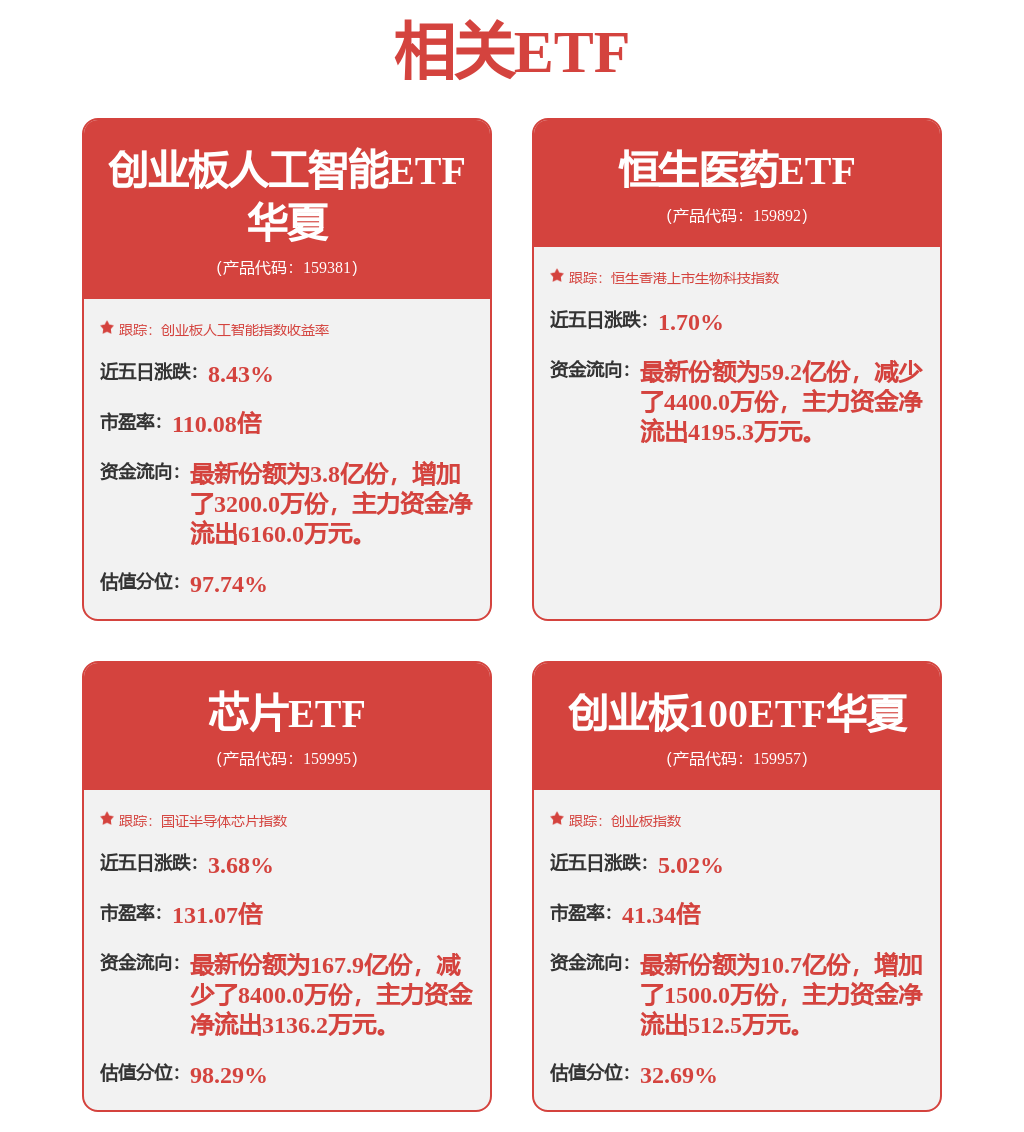
Group 1 - The A-share market experienced a collective pullback, with the AI sector, particularly CPO optical modules, showing significant declines, as the ChiNext AI Index dropped over 8% [1] - The Huaxia ChiNext AI ETF (159381) saw a rapid increase in trading volume, surpassing 380 million yuan, with net inflows of 210 million yuan over the past 10 trading days [1] - Analysts suggest that the market's volatility is a necessary phase for digestion and consolidation after previous gains, emphasizing the importance of sector rotation for a sustainable market rally [1] Group 2 - The FTSE Russell announced changes to the FTSE China A50 Index, adding companies like BeiGene and WuXi AppTec, effective September 22, which reflects ongoing investment interest in AI-related sectors [2] - AI penetration in traditional industries is still in its early stages, with significant growth potential, supported by national policies and initiatives [2] - The Huaxia ChiNext AI ETF focuses on leading companies in the AI industry chain, with over 50% weight in CPO optical modules, highlighting key stocks like NewEase and Zhongji Xuchuang [2] Group 3 - The Huaxia CSI 5G Communication Theme ETF (515050) has a scale exceeding 8 billion yuan, focusing on major players in the AI computing hardware and 6G industry chain [3] - The ETF has a 38% weight in CPO optical module stocks and 14% in PCB circuit board stocks, indicating a strong focus on these sectors [3] - The top ten weighted stocks in the ETF include NewEase, Zhongji Xuchuang, and Lixun Precision, showcasing the concentration on key industry leaders [3]