
新能源ETF

Search documents
廖市无双-节后开盘-A股是否有机会进攻
2026-02-24 14:16
Summary of Conference Call Records Industry Overview - The conference call primarily discusses the A-share market in China, focusing on market trends, sector performance, and investment opportunities post-Chinese New Year [1][2][3]. Key Points and Arguments Market Performance and Trends - The A-share market exhibited a strong oscillation pattern before the Chinese New Year, with the Shanghai Composite Index peaking at 4,142 points, aligning with the expected range of 4,000 to 4,150 points [2][3]. - Major indices failed to break above the 5-week moving average due to large funds suppressing market movements, indicating a preference for maintaining a range-bound market rather than a rapid upward trend [3][5]. - The market is currently in an ABC adjustment structure, with the B phase ongoing, suggesting that a clear upward movement is unlikely until the C phase is completed [9][14]. Sector Performance - Sectors that performed well before the holiday include technology growth, computing, electronics, media, and telecommunications, which are closely related to the mainstream market trends since September 24, 2022 [4]. - The consumer sector, particularly retail and general consumption, saw significant capital outflows, reflecting a lack of investor confidence in economic recovery [7]. - The food and beverage sector is not expected to experience a major upward trend, with a clear bearish pattern observed [8]. Investment Opportunities - Short-term investment strategies are recommended, focusing on sectors with lower price levels and potential for quick gains, such as brokers, building materials, and banks [20]. - The technology growth sector, including AI applications and robotics, may present localized investment opportunities, but significant upward trends are not anticipated [18]. - The first quarter of 2026 may see the non-ferrous metals sector forming a significant bottom, with a notable increase in the index by 97.5 points in 2025 [21]. Market Sentiment and Future Outlook - The market is expected to maintain a high-risk preference in the short term, with potential for continued focus on technology growth sectors, although caution is advised due to the last trading day before the holiday [6][15]. - New funds are advised to wait for clearer investment opportunities post-March, as the current environment does not favor long-term investments [19][16]. - The overall market structure is likely to remain balanced, with a mix of growth and value styles emerging [30]. Other Important Insights - The recent appreciation of the RMB, surpassing 6.89, is seen as beneficial for the A-share market, supporting a positive outlook for capital markets [11]. - The upcoming political events, such as the two sessions in March, are anticipated to provide clearer investment signals [16]. - The historical context of spring market movements suggests a potential for short-term volatility, but with a cautious approach to avoid chasing high prices [28][31]. This summary encapsulates the key insights from the conference call, providing a comprehensive overview of the current state and future outlook of the A-share market and relevant sectors.
202602保险客户资产配置月报:A股关注中盘蓝筹,中债阶段性对冲配置-20260210
Orient Securities· 2026-02-10 06:52
Market Outlook - A-shares are focusing on mid-cap blue chips, with a neutral stance on bonds and US stocks, and a cautious outlook on gold in the short term[2] - Risk appetite in A-shares is shifting, with structural opportunities being the main focus amid overall market fluctuations[2] - The bond market is expected to continue following risk appetite trends, serving as a hedge against risk assets[2] Investment Strategy - The report recommends increasing allocations to mid-cap blue chips and sectors such as non-ferrous metals, chemicals, new energy, military, communication, and electronics[5] - A dual strategy of passive and active enhancement is suggested for stock-bond allocation, with a focus on increasing positions in mid-term bonds[48] Industry Insights - Price increases in cyclical goods are highlighted as key investment clues, particularly in the chemical, agricultural, and non-ferrous sectors[30] - Geopolitical tensions are raising global economic risk assessments, which is a fundamental driver for commodity price increases[30] Performance Metrics - The low-volatility strategy has achieved an annualized return of 11.8%, while the high-volatility strategy has reached 18.1% since 2025[9] - The industry rotation strategy has outperformed benchmarks with an annualized return of 44.8% since 2025[9] Risk Considerations - Extreme risk events could disrupt market expectations, and there is a risk of quantitative models failing to predict future trends[6]
大逆转!本周二股票ETF资金净流入接近百亿元
Zhong Guo Ji Jin Bao· 2026-02-04 05:48
Core Viewpoint - After several days of net capital outflow, the A-share market saw a reversal with significant capital inflow on February 3, 2026, as all three major indices closed higher, with a trading volume exceeding 2.5 trillion yuan [1]. Group 1: Market Performance - On February 3, the total scale of all stock ETFs reached 4.15 trillion yuan, with a trading volume of 298.75 billion yuan, a decrease of nearly 20 billion yuan from the previous trading day [2]. - The top-performing sectors included new energy and non-ferrous metals, with four of the top ten ETFs by increase belonging to the new energy sector [2]. - The worst-performing ETFs included those related to brokerage and banking, with declines around 1% to nearly 7% [2]. Group 2: Capital Inflow and Outflow - On February 3, the net inflow of capital into stock ETFs was approximately 97.52 billion yuan, with 56 ETFs seeing inflows exceeding 100 million yuan [4]. - The net inflow for the entire market was 14.9 billion yuan, with broad-based ETFs and Hong Kong market ETFs leading the inflows at 112.49 billion yuan and 23.6 billion yuan, respectively [4]. - The net inflow for the CSI 500 index was 38.01 billion yuan, while the SGE Gold 9999 index saw a net outflow of 68.46 billion yuan [4]. Group 3: ETF Performance Rankings - The top three ETFs by net inflow were the CSI 500 ETF (35.66 billion yuan), the Securities ETF (11.17 billion yuan), and the A500 ETF (9.73 billion yuan) [5]. - The leading ETFs by trading volume included the CSI 500 ETF with 142.18 billion yuan, followed by the A500 ETF with over 100 billion yuan [2]. - A total of 26 ETFs experienced net outflows exceeding 1 billion yuan, with non-ferrous metals and photovoltaic industry ETFs being the most affected [5]. Group 4: Fund Management Insights - Major fund companies like E Fund and Huaxia Fund reported significant net inflows into their ETFs, with E Fund's total ETF scale reaching 652.35 billion yuan, an increase of 96.4 billion yuan [7]. - Fund managers expressed optimism about the A-share market, anticipating a potential spring rally in Q1 2026, particularly in sectors like securities, new energy, semiconductors, and consumer services [7].

超710亿元,跑了!
中国基金报· 2026-01-26 07:20
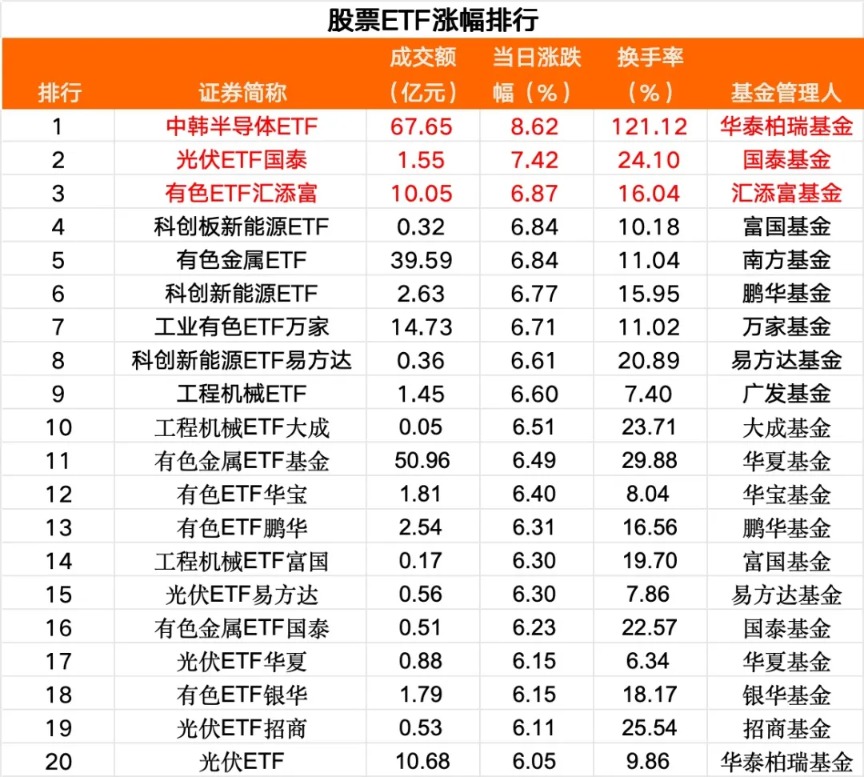
Core Viewpoint - The A-share market experienced a broad increase, but there was a significant outflow of funds from stock ETFs, totaling over 717 billion yuan on January 23, indicating a trend of profit-taking among investors [2][7][8]. Group 1: Market Performance - On January 23, the A-share market saw all three major indices rise, with total trading volume exceeding 30 trillion yuan [2]. - The total scale of stock ETFs in the market reached 4.58 trillion yuan as of January 23, 2026 [4]. - The trading volume of stock ETFs on that day was 368.61 billion yuan, an increase of over 68 billion yuan compared to the previous trading day [4]. Group 2: Fund Flows - Stock ETFs experienced a cumulative net outflow of nearly 450 billion yuan over the past five trading days, with 26 ETFs seeing outflows exceeding 1 billion yuan on January 23 [8][10]. - The largest net outflows were observed in broad-based ETFs, with four ETFs experiencing single-day outflows exceeding 100 billion yuan, and one ETF exceeding 200 billion yuan [8][10]. Group 3: Sector Performance - The solar and satellite sectors led the gains among stock ETFs, with four solar ETFs and six satellite ETFs among the top ten performers [5]. - On January 23, 21 stock ETFs had an increase of over 8%, with the top performers being the Sci-Tech Innovation Board New Energy ETF and various satellite ETFs, each rising by 10% [5][6]. Group 4: Fund Inflows - Despite the overall outflow, 58 stock ETFs saw inflows exceeding 100 million yuan, with the CSI 500 ETF, Sci-Tech Chip ETF, and Chemical ETF leading the inflows [8][9]. - Notable inflows were recorded for ETFs managed by leading fund companies, such as E Fund and Huaxia Fund, indicating continued interest in specific sectors [12].

新能源ETF(516160)强势拉升涨超3%,政策+资本双轮驱动,新能源全产业链迎发展新机遇
Xin Lang Cai Jing· 2026-01-23 02:03
Core Viewpoint - The renewable energy sector is experiencing positive momentum driven by supportive government policies and increasing demand in electric vehicles and energy storage [1][2][3] Group 1: Market Performance - The New Energy ETF (516160) rose by 3.02%, with a trading volume of 906.94 million yuan [1] - Key stocks in the index, such as Maiwei Co., Ltd. and Laplace, saw significant gains of 20.00% and 19.62% respectively [1] Group 2: Government Policies - On January 20, the Ministry of Finance released five documents outlining a package of favorable policies to support small and medium enterprises, private investment, and equipment upgrades [1] - Key focus areas for support include energy power, new energy vehicles, energy conservation, and small hydropower [1] Group 3: Industry Trends - The electric vehicle and energy storage sectors are entering a new growth cycle, with several automakers announcing ambitious sales targets for 2026 [2] - Global lithium battery production is projected to reach 2,297 GWh by 2025, marking a 48.5% year-on-year increase, with power batteries being the main growth driver [2] - CATL and Changan Automobile signed a five-year strategic cooperation memorandum focusing on advanced fields such as battery swapping and smart vehicles [2] Group 4: Supply Chain Dynamics - The supply and demand for lithium carbonate are expected to remain favorable, with China's production projected to reach 976,300 tons by 2025, a 49% increase [2] - A recent investment of 3.688 billion yuan by a major mining company aims to produce approximately 80,000 tons of lithium carbonate annually [2] Group 5: Technological Advancements - The solid-state battery sector is entering a critical phase of engineering and industrialization, with recent tests being conducted in extreme cold conditions [2] - The State Grid announced a fixed asset investment of 4 trillion yuan for the 14th Five-Year Plan period (2026-2030), a 40% increase from the previous period, aimed at achieving carbon peak by 2030 [3] - The integration of AI in manufacturing is being promoted to enhance productivity and support new industrialization [3] Group 6: Index Composition - The New Energy Index includes companies involved in renewable energy production, application, storage, and interaction devices, with the top ten weighted stocks accounting for 43.23% of the index [3]





中信证券:建议关注创业板50、创业板指、双创50、中证1000等ETF
Xin Hua Cai Jing· 2026-01-20 01:29
Core Insights - The ETF market has recently experienced record outflows, with broad-based ETFs seeing over 200 billion yuan in outflows in a single week, while sector and thematic ETFs in technology and cyclical sectors continue to attract inflows [1] Group 1: Market Trends - The outflow of funds from broad-based ETFs indicates a significant market adjustment, which may help temper market sentiment and promote rationality in capital market operations [1] - Small-cap stocks have been less impacted by the outflows, while sectors such as banking, food and beverage, coal, and non-bank financials have faced greater challenges [1] Group 2: Investment Recommendations - The current investment strategy suggests focusing on broad-based products like the ChiNext 50, ChiNext Index, Double Innovation 50, and CSI 1000 ETFs, as well as thematic products in new energy, non-ferrous metals, agriculture, pharmaceuticals, and medical devices [1]

中信证券:当前建议关注宽基产品中的创业板50、创业板指、双创50、中证1000等ETF
Jin Rong Jie· 2026-01-20 00:40
Core Insights - The ETF market has recently experienced record outflows, with broad-based ETFs seeing over 200 billion yuan in outflows in a single week, while sector and thematic ETFs in technology and cyclical sectors continue to attract inflows [1] Group 1: Market Trends - The outflow of funds from broad-based ETFs indicates a significant market adjustment, which may help temper market sentiment and promote rationality in capital markets [1] - Small-cap stocks have been less impacted by the outflows, while sectors such as banking, food and beverage, coal, and non-bank financials have faced greater challenges [1] Group 2: Investment Recommendations - The report suggests focusing on broad-based products like the ChiNext 50, ChiNext Index, Double Innovation 50, and CSI 1000 ETFs, as well as thematic products in new energy, non-ferrous metals, agriculture, pharmaceuticals, and medical devices [1]
新能源ETF(516160)盘中涨超1%,阳光电源涨超3%,国内电网投资进入“十五五”高景气周期
Xin Lang Cai Jing· 2026-01-16 03:50
Group 1 - The core viewpoint of the news highlights significant investments in the energy sector, particularly by the State Grid Corporation, which is expected to reach a historical high of 4 trillion yuan during the 14th Five-Year Plan, representing a 40% increase compared to the previous plan [1] - The investment focus will be on promoting green and low-carbon energy transition, constructing a new power system, and deepening technological innovation [1] - The expected fixed asset investments for the State Grid and Southern Grid during the 14th Five-Year Plan are approximately 4 trillion yuan and 1 trillion yuan, respectively, with a projected annual grid investment of 889 billion yuan in 2026, reflecting a year-on-year growth of over 7% [1] Group 2 - The meeting of the inter-ministerial joint conference on energy-saving and new energy vehicles noted that the market size of China's new energy vehicles increased by 3.6 times during the 14th Five-Year Plan, with battery costs reduced by 30%, lifespan increased by 40%, and charging speeds improved by over three times [2] - There is a pressing need to establish a power capacity market mechanism to ensure the recovery of installation costs for various power generation entities in the context of high renewable energy penetration [2] - The top ten weighted stocks in the CSI New Energy Index, which the New Energy ETF closely tracks, account for 43.23% of the index, including major companies like CATL, Sungrow Power, and Longi Green Energy [2]




资金大举布局,超100亿加仓ETF(名单)
Zhong Guo Ji Jin Bao· 2025-12-29 06:30
Group 1 - On December 26, the A-share market saw a collective rise in the three major stock indices, with the Shanghai Composite Index achieving an eight-day consecutive increase, and the total trading volume significantly increased, leading to a net inflow of 10.371 billion yuan into stock ETFs [2][3] - The total scale of 1,284 stock ETFs in the market reached 4.79 trillion yuan, with broad-based ETFs receiving the most significant net inflow of 12.306 billion yuan on the same day [3] - The net inflow for the CSI 1000 Index ETF was the highest at 3.05 billion yuan, with notable contributions from Southern Fund and Huaxia Fund [3] Group 2 - Over the past five days, the net inflow into the CSI A500 Index ETF exceeded 49.3 billion yuan, while the CSI 500 Index ETF saw a net inflow of over 4.1 billion yuan [4] - The top five ETFs by net inflow on December 26 included the CSI 500 ETF, CSI 1000 ETF, and the ChiNext 50 ETF, with inflows of 2.356 billion yuan, 1.692 billion yuan, and 1.576 billion yuan respectively [5] - Conversely, industry-themed ETFs experienced significant outflows, totaling 2.098 billion yuan, with the defense and military sector leading the outflows [7][8] Group 3 - The top outflowing ETFs included the Military Industry ETF and Gold ETF, with outflows of 1.15 billion yuan and 660 million yuan respectively [7][8] - The overall market liquidity remains ample due to a supportive monetary policy and low-interest rates, which continues to foster thematic investment opportunities [7]

金融工程周报:跨年无忧,慢牛继续-20251228
Huaxin Securities· 2025-12-28 15:39
- The report mentions an A-share timing model, specifically a "wave model" that turned bullish mid-week, marking the first shift to a higher position since November 14, 2025. This model is used to determine optimal entry points for A-share investments based on market signals [1][29] - A short-term timing model for A-shares also turned bullish on major broad-based indices on Friday, indicating a positive outlook for traditional sectors such as consumption, infrastructure, real estate, and manufacturing [1][29] - The report highlights a "position timing strategy" for the A-share market, which is used to adjust equity exposure based on market conditions. This strategy is supported by historical net value data and performance metrics [11][12] - A "multi-long-short timing strategy" for the A-share market is also discussed, which involves leveraging long and short positions in futures to optimize returns. This strategy is visualized through net value curves and position recommendations [13][14] - The report includes a "dividend growth timing strategy" for A-shares, focusing on stocks with high dividend yields and growth potential. This strategy is designed to capture returns from dividend-paying stocks while managing risk [21] - A "small and micro-cap timing strategy" for A-shares is mentioned, targeting smaller market capitalization stocks for potential higher returns. This strategy is based on specific timing signals for small-cap stocks [17][18] - The report also discusses a "Hong Kong stock position timing strategy," which adjusts exposure to Hong Kong equities based on macroeconomic and market signals. This strategy emphasizes resilience and flexibility in sectors like central enterprises and internet companies [15] - A "gold timing strategy" is included, which maintains a medium position in gold while avoiding silver due to uncertain market conditions. This strategy is based on the U.S. dollar index and other macroeconomic factors [22] - The report outlines "ETF portfolio strategies," including equity-biased and bond-biased portfolios. These strategies are designed to optimize returns through diversified ETF investments, with performance tracked through net value curves [24][26]