半导体制造

Search documents
东微半导: 苏州东微半导体股份有限公司关于取消监事会、调整董事会人数、修订《公司章程》并办理工商变更登记及制定和修订部分治理制度的公告
Zheng Quan Zhi Xing· 2025-07-16 14:13
Group 1 - The company has decided to abolish the supervisory board and adjust the number of board members from 9 to 8 to enhance operational efficiency and governance structure [2][3] - The supervisory board's powers will be transferred to the audit committee of the board, and related internal regulations will be abolished [2] - The company aims to revise its articles of association to align with the latest regulations and improve its governance structure [3] Group 2 - The company will amend specific clauses in its articles of association to better protect the rights of shareholders and creditors [3][4] - The registered capital of the company is reported to be RMB 12,253.1446 million [4] - The company will ensure that all shares issued have equal rights and obligations, adhering to principles of fairness and transparency [5][6]

东微半导: 苏州东微半导体股份有限公司股东会议事规则
Zheng Quan Zhi Xing· 2025-07-16 14:13
General Principles - The rules are established to regulate the behavior of Suzhou Dongwei Semiconductor Co., Ltd. and ensure shareholders can exercise their rights according to the Company Law and relevant regulations [1][2] - The company must strictly follow legal and regulatory requirements when convening shareholder meetings [1][2] Types of Shareholder Meetings - Shareholder meetings are categorized into annual and temporary meetings, with annual meetings held within six months after the end of the previous fiscal year [1] - Temporary meetings must be convened within two months under specific circumstances, such as insufficient board members or significant losses [1] Legal Opinions and Procedures - The company must hire a lawyer to provide legal opinions on the legality of the meeting's procedures, participant qualifications, and voting results [2] - The board of directors is responsible for convening meetings within the stipulated time frames [2][3] Rights of Shareholders - Shareholders holding 10% or more of the company's shares can request a temporary meeting, and the board must respond within ten days [3][4] - Independent directors can also propose temporary meetings, requiring a majority agreement from the independent directors [4] Notification and Proposals - Shareholder meeting notifications must be sent out 20 days prior for annual meetings and 15 days for temporary meetings, including all proposal details [6][7] - Proposals must be within the scope of the shareholder meeting's authority and comply with legal requirements [12] Voting and Decision-Making - Shareholders can vote in person or by proxy, and each share carries one vote [19] - Decisions require a simple majority for ordinary resolutions and a two-thirds majority for special resolutions [14][15] Meeting Records and Announcements - Meeting records must be maintained for at least ten years, detailing the meeting's proceedings, attendance, and voting results [41][42] - Resolutions must be announced promptly, including details of attendance and voting outcomes [39][40] Compliance and Legal Recourse - Shareholders can request the court to annul resolutions that violate laws or regulations within 60 days of the decision [18] - The company must comply with court rulings and fulfill disclosure obligations regarding any legal disputes [18]
台积电(TSM.N):公司购买了价值1940万美元的固定收益证券。
news flash· 2025-07-16 09:10
Core Insights - TSMC has purchased fixed-income securities worth $19.4 million [1] Group 1 - The company is actively investing in fixed-income securities, indicating a strategy to diversify its investment portfolio [1]
客户需求下滑,台积电暂缓建厂
半导体行业观察· 2025-07-16 00:53
Core Viewpoint - TSMC's construction timeline for its Kumamoto second factory in Japan has been delayed primarily due to a decline in market demand from major clients, alongside transportation issues [3][4]. Group 1: TSMC's Kumamoto Factory - The Kumamoto second factory is crucial for Japan's semiconductor industry revival, with partners including Sony and Toyota's Denso [3]. - The first Kumamoto factory began mass production at the end of last year, utilizing 22/28 and 12/16 nm processes, with a maximum monthly capacity of 55,000 wafers [3]. - The construction of the second factory was initially scheduled for Q1 this year but has been postponed to later this year, with production expected to start in 2027 using a 6 nm process, which is Japan's most advanced technology [3][4]. Group 2: Market Conditions - TSMC's chairman noted that the delay is influenced by local traffic issues and a soft market for consumer and automotive products, particularly impacting demand for image sensors [3]. - The company is adjusting its capacity expansion based on market and customer demand, indicating that even if construction begins this year, the timeline for production will depend on client needs [3]. Group 3: Financial Projections - TSMC's Japanese subsidiary president stated that the company expects to generate over $4 billion (approximately 580 billion yen) in revenue from the Japanese market in 2024, accounting for about 4% of TSMC's total revenue [4]. - The projected wafer shipment volume (converted to 12-inch equivalents) is expected to exceed 1.49 million wafers, representing around 10% of the overall shipments [4].


7300亿南下资金重构港股生态:2025上半年高股息与硬科技双主线深度解析
智通财经网· 2025-07-15 13:18
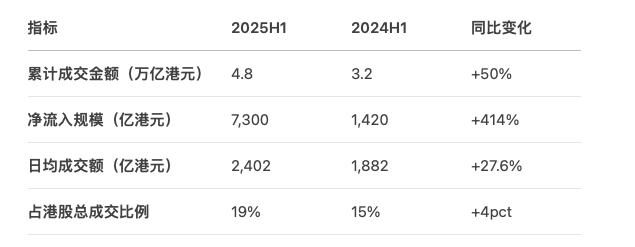
Core Insights - The Hong Kong stock market experienced a significant rebound in the first half of 2025, with the Hang Seng Index rising by 20%, leading among major global indices [1] - The primary driver of this rebound was the substantial inflow of mainland funds through the "Hong Kong Stock Connect" channel, coupled with a global reassessment of the value of "cheap Chinese assets" [1] - The net inflow of southbound funds reached over 730 billion HKD, marking a 414% increase year-on-year and setting a historical record for the same period [3][5] Market Dynamics - The total trading volume through the Hong Kong Stock Connect reached 4.8 trillion HKD, a 50% increase compared to the previous year, accounting for 19% of the total trading volume in the Hong Kong market [2][3] - Southbound funds have significantly reshaped the investor structure in the Hong Kong market, with their proportion of total trading volume rising from less than 10% in 2020 to nearly 20% [4] - The inflow of southbound funds has enhanced the correlation between the Hong Kong and A-share markets, while also increasing the independence of the Hong Kong market from global trends [4] Sector Preferences - The southbound funds showed a clear preference for high-dividend and innovative pharmaceutical sectors, with energy, telecommunications, and banking being the top three sectors for net buying [6][7] - The energy sector attracted a net buying of 620 million HKD, while telecommunications and banking received 410 million HKD and 380 million HKD, respectively [6][7] - The innovative pharmaceutical index saw significant gains, with some stocks experiencing over 60% increases, reflecting a strong recovery after a prolonged downturn [6][8] Investment Trends - The current market environment is characterized by a "barbell strategy," where investors are seeking both stable cash flow from high-dividend assets and growth potential from innovative sectors [10][16] - The anticipated interest rate cuts by the Federal Reserve are expected to further highlight the defensive value of high-dividend sectors, while the commercialization capabilities of innovative pharmaceutical companies will be crucial for growth stocks [16] - The semiconductor, innovative pharmaceuticals, and energy security sectors are expected to benefit from policy support and sustained inflows from mainland funds [17] Notable Stocks - The top-performing stocks in the Hong Kong Stock Connect included Lao Pu Gold, which saw a staggering increase of 330.18%, followed by Sangfor Technologies and Rongchang Biopharmaceuticals with increases of 288.98% and 278.12%, respectively [11][12] - The presence of diverse sectors among the top gainers indicates a broad market interest, with biotechnology leading the way [11][12] - Stocks like Rongchang Biopharmaceuticals have gained significant institutional recognition, with over 50% of holdings through the Hong Kong Stock Connect [13]
日本功率半导体代工厂,申请破产
半导体芯闻· 2025-07-15 10:04
Core Viewpoint - JS Foundry, a Japanese wafer foundry, filed for bankruptcy after failed negotiations for SiC technology collaboration, despite initial government support and a brief operational history [1][2][3]. Group 1: Company Background - JS Foundry was established in 2022 and operates a 41-year-old wafer plant previously owned by Sanyo and later by ON Semiconductor [3]. - The company had a revenue of $68 million in its first operational year, a significant increase from $17.6 million the previous year [3]. - JS Foundry has a debt of $110 million and employed 550 staff members [3][4]. Group 2: Market Context - The power semiconductor market is facing challenges due to a slowdown in electric vehicle sales and increased competition from China [4]. - Notable competitors, such as Wolfspeed, have also filed for bankruptcy, and Renesas Electronics has abandoned plans to start SiC production later this year [4]. Group 3: Government Support and Investment - The Japanese central government and Niigata Prefecture planned to provide subsidies worth billions of yen for equipment investment in JS Foundry [4]. - The company was co-founded by Mercuria Investment and Sangyo Sosei Advisory, backed by the Development Bank of Japan [3][4].
事关氮化镓,三大灵魂拷问
半导体芯闻· 2025-07-15 10:04
Core Viewpoint - The article highlights the rising prominence of Gallium Nitride (GaN) technology in various sectors, particularly in data centers and automotive applications, while Silicon Carbide (SiC) faces challenges. The power GaN market is projected to grow significantly, with a forecasted compound annual growth rate (CAGR) of 41% from 2023 to 2029, reaching over $2 billion [1]. Group 1: GaN Market Dynamics - NVIDIA is leading the transition to 800 V HVDC data center power infrastructure, which will significantly utilize GaN technology [1]. - Yole Group predicts that the power GaN market will grow tenfold from 2023 to 2029, driven by its higher switching frequency and power density, as well as reduced energy loss [1]. Group 2: TSMC's Shift in GaN Production - TSMC announced it will cease GaN foundry production by July 2027, citing low profit margins and a shift in focus towards advanced logic processes [6]. - This decision has forced existing customers to seek new partnerships, indicating a significant shift in the GaN foundry landscape [6]. Group 3: GaN Production Challenges and Opportunities - InnoScience, a leading domestic GaN manufacturer, emphasizes the importance of 8-inch wafer production for cost-effectiveness and scalability, arguing that 6-inch production is not viable for large-scale applications [7]. - The transition to 12-inch GaN production is seen as feasible but requires significant preparation and experience from 8-inch production [10][12]. Group 4: GaN Applications Beyond Consumer Electronics - GaN technology is not limited to consumer electronics; it has potential applications in electric vehicles (EVs) and data centers, with partnerships like that with CATL showcasing its capabilities [15][17]. - The article discusses the potential for GaN in smart and electric vehicles, highlighting its role in energy management and as part of distributed energy systems [16]. Group 5: Strategic Collaborations - InnoScience's collaboration with STMicroelectronics aims to enhance GaN power solutions across various sectors, leveraging each company's strengths to improve supply chain resilience [18]. - The partnership is expected to expand GaN product offerings and market capabilities, indicating a strategic move to solidify positions in the growing GaN market [18].
思特威:上半年净利同比预增140%-180%
news flash· 2025-07-15 08:20
Core Viewpoint - The company, Sitaiwei (688213.SH), expects to achieve a net profit attributable to shareholders of the parent company between 360 million to 420 million yuan for the first half of 2025, representing a year-on-year growth of 140% to 180% [1] Group 1: Business Performance - The company has deepened collaborations with multiple clients in the smartphone sector, leading to a significant increase in the shipment volume of high-end and cost-effective products [1] - In the smart security field, the performance of iterative products has improved, resulting in notable sales growth [1] - The automotive electronics sector has seen a substantial year-on-year increase in the shipment volume of new generation products applied in intelligent driving and cabin systems [1] Group 2: Financial Management - The company has effectively controlled expense expenditures while scaling up revenue, leading to an enhancement in profitability and a significant increase in net profit [1]

不服就干!日韩被特朗普“逼反”了,第一步就斩断美国的军事枷锁
Sou Hu Cai Jing· 2025-07-15 03:33
Group 1 - The core issue is the unexpected imposition of a 25% tariff on all goods exported from Japan and South Korea to the US, which has led to a significant deterioration in relations between these countries and the US [2][4][13] - Japan and South Korea are seeking to reduce their military dependence on the US and are taking steps towards greater autonomy in security matters, marking a shift in their long-standing alliance with the US [1][9][11] - The tariffs have caused immediate economic repercussions, with stock markets in Tokyo and Seoul dropping sharply, and major companies like Toyota and Hyundai experiencing significant losses in market value [2][4] Group 2 - Japan's government is considering selling US Treasury bonds as a countermeasure against the tariffs, indicating a potential shift in financial relations [6] - South Korea is accelerating the development of its domestic defense systems and has signed agreements to acquire advanced military technology from Russia, showcasing a move away from reliance on US military support [11][15] - The military cooperation between the US, Japan, and South Korea is under strain, with joint exercises being scaled back and Japan asserting more control over its defense budget and strategies [13][15][17] Group 3 - The crisis triggered by the tariffs is seen as a turning point in US-Japan-South Korea relations, with both countries taking significant steps to assert their independence from US influence [17] - The potential for an "Asian version of NATO" is being questioned as Japan and South Korea explore new military partnerships and defense strategies outside of the US framework [15][17]

A股盘前市场要闻速递(2025-07-15)
Jin Shi Shu Ju· 2025-07-15 02:14
Monetary Policy and Economic Indicators - The People's Bank of China will conduct a buyout reverse repurchase operation of 1.4 trillion yuan on July 15, 2025 [1] - As of the end of June, M2 (broad money) increased by 8.3% year-on-year, reaching 330.29 trillion yuan, while M1 (narrow money) grew by 4.6% to 113.95 trillion yuan [2] - The cash in circulation (M0) reached 13.18 trillion yuan, with a year-on-year growth of 12% [2] Green Finance Initiatives - The People's Bank of China, along with financial regulatory authorities, issued the "Green Finance Support Project Directory (2025 Edition)" to enhance liquidity in the green finance market and improve asset management efficiency [2] Corporate Earnings Forecasts - Vanke A expects a net loss of 10 billion to 12 billion yuan for the first half of 2025, with a basic loss per share of 0.8433 to 1.01 yuan [4] - Yonghui Supermarket anticipates a net loss of 240 million yuan for the first half of 2025, impacted by the closure of 227 underperforming stores [5] - Longi Green Energy forecasts a net loss of 2.4 billion to 2.8 billion yuan, although it expects to reduce losses compared to the previous year [6] - Hengsheng Electronics projects a net profit of approximately 251 million yuan, a 741% increase year-on-year [7] - Wintime Technology expects a net profit of 390 million to 585 million yuan, representing a growth of 178% to 317% [8] - ST Huatuo anticipates a net profit of 2.4 billion to 3 billion yuan, a year-on-year increase of 107.2% to 159% [9] - Tianqi Lithium expects a net profit of 0 to 1.55 billion yuan, recovering from a loss of 5.206 billion yuan in the previous year [10] - Ganfeng Lithium forecasts a net loss of 300 million to 550 million yuan, compared to a loss of 760 million yuan in the same period last year [11] - Liyi Intelligent Manufacturing expects a net profit of 900 million to 1.14 billion yuan, a growth of 31.57% to 66.66% [12] - CICC anticipates a net profit of 3.453 billion to 3.966 billion yuan, a year-on-year increase of 55% to 78% [13] - Shenwan Hongyuan projects a net profit of 4.1 billion to 4.5 billion yuan, a growth of 92.66% to 111.46% [14] - Shandong Gold expects a net profit of 2.55 billion to 3.05 billion yuan, an increase of 84.3% to 120.5% year-on-year [15] - Huahong Technology anticipates a net profit of 70 million to 85 million yuan, a significant increase from 2.224 million yuan in the previous year [16] Corporate Actions and Legal Matters - Suzhou Planning intends to acquire 100% of Beijing Dongjin Aviation Technology Co., Ltd., with stock resuming trading on July 15, 2025 [17] - BOE Technology Group plans to appeal the preliminary ruling from the US International Trade Commission regarding trade secrets and has initiated a patent lawsuit against Samsung Display [18]