
服装

Search documents
2025世界服装大会在中国东莞虎门举行
Zhong Guo Xin Wen Wang· 2025-11-17 06:02
2025世界服装大会在中国东莞虎门举行 中新网东莞11月17日电 (记者 阮煜琳)11月16日,2025世界服装大会在中国东莞虎门正式拉开帷幕。 本届大会以"时尚变革多元共生"为主题,由中国纺织工业联合会主办,广东虎门富民集团有限公司联合 主办,中国服装协会、中国纺织信息中心承办,吸引了来自25个国家和地区的行业协会负责人、海外组 织代表、专家学者、设计师及企业家,共同探索全球时尚产业融合发展新路径。 中国纺织工业联合会会长孙瑞哲指出,全球服装产业作为世界繁荣与文明共生的基石,是关联民生、驱 动经济、促进文明互鉴的重要力量。当前行业面临环境深刻变化:格局之变中地缘冲突与贸易壁垒加 剧,区域化与多元化趋势显著;范式之变下人工智能等新技术正重塑产业逻辑,但也带来数字鸿沟与治 理挑战;价值之变体现为可持续发展成为核心,绿色转型进入深水区;市场之变表现为消费动能受抑, 而新兴市场与个性化需求带来新机遇。 来源:中国新闻网 编辑:徐世明 广告等商务合作,请点击这里 本文为转载内容,授权事宜请联系原著作权人 中新经纬版权所有,未经书面授权,任何单位及个人不得转载、摘编或以其它方式使用。 关注中新经纬微信公众号(微信搜索" ...


“已经不投老登了”
3 6 Ke· 2025-11-17 05:58
Core Viewpoint - The traditional consumer sectors, referred to as "old industries," are losing their appeal for investment, as evidenced by declining valuations and performance metrics in sectors like liquor, dining, and retail [1][4][8]. Summary by Sections Old Industries Overview - "Old industries" include traditional sectors such as clothing, dining, home appliances, regional supermarkets, and low-value manufacturing, which were once considered stable investments due to demographic dividends and consumption upgrades [1][4]. - These sectors accounted for a significant portion of RMB fund allocations between 2016 and 2021, often viewed as "cash cows" for investment [4][8]. Market Performance - The liquor sector, a representative of high-end consumption, has seen a significant decline, with the total market capitalization of 20 major liquor companies dropping by over 500 billion RMB from previous highs [4][5]. - The white liquor index has experienced a 51% retracement since its peak in February 2021, indicating a severe market correction [5][6]. Financial Metrics - In 2025, the first three quarters showed a 5.83% decline in total revenue and a 6.76% drop in net profit for the liquor sector, with the third quarter witnessing an alarming 18.42% revenue drop [7][8]. - The overall price-to-earnings (PE) ratio for the liquor sector has fallen to approximately 18.7, significantly below the long-term average of 27.6 [5][6]. Shift in Investment Focus - Investment capital is shifting away from "old industries" towards "new productive forces," such as artificial intelligence, semiconductors, and advanced manufacturing, reflecting a broader trend in venture capital [9][10]. - Despite a 32% decline in overall VC financing in 2024, significant funding is still directed towards high-potential sectors, indicating a concentration of capital in fewer, more promising areas [9][10]. Government and Institutional Support - The Chinese government has emphasized the importance of "new productive forces" in its economic policies, encouraging investment in strategic emerging industries [10][11]. - Various funds, including national AI and technology innovation funds, are being established to support these new sectors, further driving the shift in investment focus [11][12]. Evolution of Traditional Industries - Traditional industries are not disappearing; rather, they are evolving. Companies that embrace digital transformation and new technologies are beginning to attract investment again [14][15]. - Examples include traditional clothing brands that have successfully integrated digital supply chains and advanced manufacturing techniques to enhance efficiency and profitability [15][16]. Conclusion - The phrase "no longer investing in old industries" reflects a strategic pivot rather than a complete abandonment of traditional sectors, as new players and innovative approaches emerge within these markets [18][19].

刚刚,全线大跌!日本,利空突袭!
券商中国· 2025-11-17 04:52
Core Viewpoint - Japanese retail stocks have faced significant declines due to a warning from China's Ministry of Culture and Tourism advising Chinese tourists to avoid traveling to Japan, coupled with negative economic data indicating a contraction in Japan's GDP [1][4][6]. Group 1: Stock Market Impact - The Japanese stock market experienced a broad decline, with the Nikkei 225 index falling by 0.7% and the Tokyo Stock Exchange index dropping by 0.8% [3]. - Notable retail and tourism-related stocks saw substantial drops, including Shiseido, which fell over 11%, and Mitsukoshi Isetan, which plummeted more than 12% [3][4]. - Fast Retailing, the parent company of Uniqlo, saw its stock price decrease by nearly 7% [4]. Group 2: Economic Data - Japan's Cabinet Office reported a 1.8% year-on-year decline in real GDP for the third quarter, marking a return to negative growth since the first quarter of 2024 [6][7]. - The GDP decreased by 0.4% quarter-on-quarter, with exports of goods and services falling by 1.2% due to the impact of U.S. tariffs [7]. - Domestic consumption, which constitutes over half of Japan's economy, showed only a slight increase of 0.1% in the same period, indicating weak internal demand [7]. Group 3: Tourism and Economic Forecast - The decline in Chinese tourists, who account for approximately 25% of foreign visitors to Japan, is expected to significantly impact the tourism sector [5]. - Analysts estimate that a substantial drop in Chinese visitors could reduce Japan's GDP by 0.36%, leading to an economic loss of approximately 2.2 trillion yen (about 101.16 billion RMB) [5]. - The Japanese government has revised its economic growth forecast for the fiscal year 2025 from 1.2% to 0.7% due to ongoing economic pressures [7]. Group 4: Government Response - The Japanese government is considering a stimulus plan worth approximately 17 trillion yen (around 110 billion USD) to counteract economic downturns [8].

王缉慈|中国中小企业的地方集群面面观
Xin Lang Cai Jing· 2025-11-17 03:27
Core Insights - The importance of small and medium-sized enterprises (SMEs) in economic growth and job creation is emphasized, highlighting that isolated enterprises struggle to survive [3][6][8] - The concept of industrial clusters, particularly in the context of SMEs, is discussed, noting that these clusters can enhance innovation and competitiveness against larger firms [2][3][6] - The evolution of SME clusters in China is traced, indicating that many of these clusters are rooted in specific localities and have emerged due to globalization and international outsourcing [6][8][10] Group 1 - SMEs are crucial for economic growth and job creation, but isolated firms face significant challenges [3][6] - The concept of industrial clusters, where SMEs can both compete and collaborate, is vital for enhancing innovation capabilities [2][3][6] - The rise of digital platforms and the establishment of a nurturing ecosystem for SMEs are essential for their development in the current technological landscape [8][10] Group 2 - Historical examples of successful SME clusters in China, such as the cashmere industry in Hebei and the sock industry in Zhejiang, illustrate the potential for growth and innovation [11][12] - The role of community building and local government support is highlighted as critical for the sustainable development of SME clusters [11][12] - The need for a structured approach to fostering these clusters, including the establishment of dedicated organizations and leveraging non-profit resources, is emphasized [11][12]
优衣库母公司迅销(06288.HK)早盘跌超6%
Mei Ri Jing Ji Xin Wen· 2025-11-17 03:09
Group 1 - The company Fast Retailing (06288.HK) experienced a decline of over 6%, specifically a drop of 6.52%, bringing its stock price to 26.4 HKD [1] - The trading volume for Fast Retailing reached 159,000 HKD at the time of reporting [1]

港股异动 | 日本股市多只消费股大跌 优衣库母公司迅销(06288)早盘跌超6%
Zhi Tong Cai Jing· 2025-11-17 03:05
Group 1 - Fast Retailing (06288) shares fell over 6%, currently down 6.52% at HKD 26.4, with a trading volume of HKD 159,000 [1] - The Japanese stock market saw significant declines in several consumer stocks, with Shiseido dropping over 9% and Fast Retailing experiencing a decline of over 6% [1] - The Ministry of Culture and Tourism in China issued a travel advisory, citing a deterioration in the safety environment for Chinese citizens in Japan due to rising crime rates and several unresolved cases involving Chinese nationals [1] Group 2 - Recent provocative remarks by Japanese leaders regarding Taiwan have further strained the atmosphere for exchanges between China and Japan, posing significant risks to the personal safety of Chinese citizens in Japan [1]
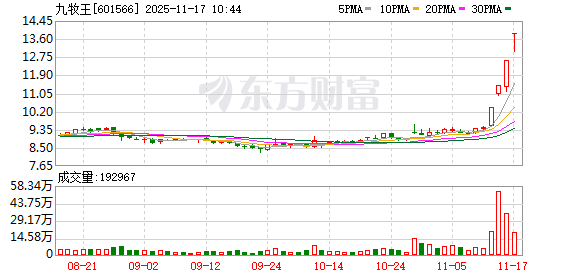
九牧王连收4个涨停板
Zheng Quan Shi Bao Wang· 2025-11-17 02:45
Core Viewpoint - Jiumuwang Co., Ltd. has experienced a significant stock price increase, achieving a total rise of 46.46% over the past four trading days, with the stock reaching a price of 13.84 yuan as of 9:25 AM on November 14, 2025 [2] Group 1: Stock Performance - The stock has hit the daily limit up for four consecutive trading days, with a trading volume of 1.5645 million shares and a total transaction amount of 21.6527 million yuan on November 14, 2025 [2] - The stock's total market capitalization has reached 7.953 billion yuan [2] - The stock's turnover rate during the consecutive limit-up period was 19.39% [2] Group 2: Margin Trading Data - As of November 14, 2025, the margin trading balance for the stock is 168 million yuan, with a financing balance of 168 million yuan, reflecting an increase of 35.0026 million yuan or 26.37% from the previous trading day [2] - Over the past four days, the margin trading balance has increased by 52.116 million yuan, representing a growth of 45.07% [2] Group 3: Institutional Trading Activity - The stock has appeared on the Dragon and Tiger List due to a cumulative price deviation of 20% over three trading days and a daily price deviation of 7% [2] - Institutional investors have net sold 15.6 million yuan, while the Shanghai Stock Connect has seen a cumulative net sell of 25.1284 million yuan [2] - Total net buying from brokerage seats amounted to 11.7294 million yuan [2] Group 4: Financial Performance - For the first three quarters, the company reported a total operating income of 2.130 billion yuan, a year-on-year decrease of 6.02% [2] - The net profit for the same period was 310 million yuan, showing a year-on-year increase of 129.63% [2] - The basic earnings per share were 0.5400 yuan, with a weighted average return on equity of 7.71% [2]

日股,开盘重挫!旅游股暴跌!
Zheng Quan Shi Bao· 2025-11-17 02:24
Group 1 - Japanese stock market saw a significant drop in tourism-related stocks, with multiple stocks falling over 10% [3] - Major retail and airline stocks in Japan also experienced substantial declines, with Shiseido's stock price dropping by 11% and Isetan Mitsukoshi's stock falling by over 12% [3][4] - Fast Retailing's stock fell by more than 6%, while Japan Airlines also saw a decline of nearly 6% [4] Group 2 - The Chinese Ministry of Culture and Tourism issued a travel warning for Japan, citing deteriorating safety conditions for Chinese citizens, including multiple incidents of violence against them [4] - The warning has led to a significant impact on the perception of safety in Japan, affecting the willingness of Chinese tourists to visit [4]
A股开盘:沪指跌0.05%、创业板指跌0.46%
Jin Rong Jie· 2025-11-17 02:09
11月17日,A股三大股指集体低开,沪指跌0.05%,报3988.56点,深成指跌0.12%,报13200.54点,创业板指跌0.46%,报 3097.34点,科创50指数涨0.17%,报1363.48点。军工装备板块竞价活跃,江龙船艇高开超10%,长城军工、北方长龙均一字涨 停,晟楠科技涨超8%。 盘面上,市场焦点股安泰集团(22天13板)高开0.64%,福建本地股平潭发展(21天13板)竞价涨停、三木集团(10天7 板)低开0.50%,并购重组的盈新发展(20天12板)高开3.74%,锂电池板块孚日股份(7板)竞价涨停、石大胜华(3板)高开 2.05%,大消费板块东百集团(8天6板)高开3.27%、九牧王(3板)竞价涨停,医药股人民同泰(5板)竞价涨停、金迪克(科 创板5天3板)高开4.96%,钙钛矿电池概念股国晟科技(10天6板)低开7.18%。 ...

深度观察丨贴息“红包”撬动消费潜能
Ren Min Ri Bao· 2025-11-17 01:56
Core Insights - The implementation of the personal consumption loan interest subsidy policy aims to stimulate consumer spending and support economic growth by reducing the cost of consumer credit [1][2][3] - The policy has been positively received by consumers and financial institutions, leading to increased loan applications and consumer spending in sectors like home appliances and furniture [3][6][7] Group 1: Policy Implementation and Impact - The personal consumption loan interest subsidy policy began in September, providing financial incentives to consumers to encourage spending [1][2] - As of the end of October, nearly 1 million customers had signed subsidy agreements, with over 1.8 million transactions recognized as eligible for the subsidy [3][10] - The policy has led to a noticeable increase in consumer purchases, particularly in home appliances and home renovations, with significant savings on interest payments [3][8] Group 2: Consumer Experience - Consumers report a seamless experience when applying for loans and receiving subsidies, with many banks offering automated systems for recognizing eligible transactions [2][9] - The convenience of online applications and automatic recognition of eligible purchases has enhanced consumer satisfaction [2][9] - The subsidy has allowed consumers to make larger purchases without the burden of high interest, leading to increased spending on essential and luxury items [5][11] Group 3: Financial Institutions' Response - Financial institutions have adapted quickly to the new policy, streamlining processes to ensure consumers can easily access the benefits [3][10] - Banks have established dedicated teams to manage the implementation of the subsidy policy, ensuring compliance and efficiency [3][10] - The collaboration between banks and e-commerce platforms has resulted in additional incentives for consumers, further driving sales during promotional events like "Double 11" [6][14] Group 4: Market Trends - The subsidy policy has led to a significant increase in the proportion of products available for interest-free installment payments, with some retailers reporting a rise from under 5% to over 50% [7][14] - E-commerce platforms have seen a nearly 40% increase in transaction volume for products covered by the subsidy since its implementation [14] - The combination of government subsidies, financial support, and retailer discounts has created a robust environment for consumer spending, positioning it as a long-term growth driver for the economy [7][10]