水泥

Search documents
建材行业多部门稳增长方案解读
2025-09-26 02:29
Summary of Key Points from the Conference Call Industry Overview - The conference call primarily discusses the **building materials industry**, focusing on **cement**, **glass**, and **photovoltaic glass** sectors, along with emerging materials and government policies impacting these areas [1][2][3]. Core Insights and Arguments Cement Industry - The Ministry of Industry and Information Technology (MIIT) aims to increase the cement industry's capacity utilization rate from approximately **45% to 70%** by December 31, 2025, through restrictions on overproduction and encouraging off-peak production [1][3][6]. - Challenges include effective supervision and enforcement of these policies, as well as the potential revival of "zombie" capacities that could undermine profitability improvements [6][22]. - Companies like **Sankeshu**, **Hankow Group**, and **Dongfang Yuhong** show significant fundamental improvements, making them noteworthy [3][18]. - The outlook for export-oriented building material companies is optimistic, particularly for leaders like **China Jushi** [3][19]. Glass Industry - The glass sector, particularly float and architectural glass, has reacted positively to the new policies, with significant movements in both futures and stock markets indicating expectations of price increases [5][9]. - The main driver of stock price fluctuations is attributed to pricing strategies of small and medium enterprises during peak seasons, rather than the new growth stabilization policies [9]. - The glass industry faces limited new policy increments, focusing instead on capacity replacement, with market performance influenced by window guidance [15][23]. Photovoltaic Glass Industry - The photovoltaic glass sector has implemented measures to reduce production capacity by approximately **15%**, leading to improved profitability, transitioning from losses to a **10% net profit** for leading companies [10]. - However, the industry faces risks from potential declines in export tax rebates, which may lead to short-term export surges [10][15]. Emerging Materials - New materials such as advanced glass, artificial crystals, and high-performance fibers are gaining attention, with some receiving policy support [11][16]. - The introduction of quality traceability mechanisms is expected to enhance standards in the building materials sector, particularly for non-standard products [17]. Other Important Insights - Government subsidies for building materials have been marginally improved, with categories like tiles and energy-efficient windows included in new subsidy programs, although the overall subsidy intensity has decreased compared to the previous year [12][14]. - Urban renewal projects continue to support demand for building materials, with ongoing high activity levels in renovation and upgrading of old properties [13][14]. - The building materials industry is expected to see structural growth through strict supply controls, demand stimulation, and quality improvements, although execution details and potential risks remain to be clarified [8][14]. Company Performance and Recommendations - Companies with strong fundamentals, such as **Sankeshu**, **Hankow Group**, and **Dongfang Yuhong**, are recommended for their positive performance outlook [18][20]. - Export-oriented companies like **China Jushi** are highlighted for their growth potential, especially in a favorable global demand environment post-Federal Reserve interest rate cuts [19]. - The cement sector's main players, including **Huaxin Cement**, **Keda Manufacturing**, and **Puyang Nanfang**, are expected to show long-term upward trends despite short-term volatility [20]. Conclusion - The building materials industry is undergoing significant changes driven by government policies aimed at stabilizing growth and improving quality standards. Key sectors like cement, glass, and photovoltaic glass are adapting to these changes, presenting both challenges and opportunities for investors and companies alike [1][8][14].

天山股份20250925
2025-09-26 02:28
Summary of Tianshan Cement Conference Call Company Overview - Tianshan Cement is a leading national cement company in China, benefiting from the industry's anti-competition trend and supply-side reform policies, particularly the requirement to address overproduction by the end of 2025 [2][3][12]. Key Points and Arguments Industry Dynamics - The cement industry has entered a downward phase since the peak in 2020-2021, with cumulative demand expected to decline by 23% by the end of 2024 [9]. - The demand structure is shifting, with infrastructure becoming the main driver of cement demand, replacing real estate [10][11]. - The industry faces challenges such as internal competition and the need for capacity reduction, with policies in place to enforce production limits [13][14][15]. Company Performance - Tianshan Cement's clinker sales have declined in line with the industry, with a compound annual growth rate of -10.8% from 2021 to 2024 [18]. - Despite a drop in sales price from 360 RMB to approximately 250 RMB, the company maintained a competitive average price of 247 RMB per ton, second only to Huaxin Cement [18]. - In 2025, the company achieved a significant turnaround in Q2, reporting a profit of 572 million RMB, a year-on-year increase of nearly 140% [19]. Financial Health - The company has a stable financial position, with a decreasing debt-to-asset ratio and low financing costs, averaging 2.61% in 2024 [22]. - Tianshan Cement has committed to a dividend payout ratio of no less than 50% from 2025 to 2027, ensuring shareholder returns [23]. Cost Management and Efficiency - The company is implementing cost reduction measures, including increasing self-sufficiency in limestone and optimizing management, resulting in a decrease in unit costs [21]. - The average unit cost decreased by 23 RMB in 2024, while the average price per ton increased by 13 RMB in the first half of 2025 [20]. Growth Strategies - Tianshan Cement is expanding its non-clinker business, which has increased from 12% in 2020 to 37% in the first half of 2025, enhancing the overall stability of its operations [8]. - The company is also developing its overseas business, with a compound annual growth rate of nearly 21% from 2021 to 2024, and a significant increase in revenue in 2025 due to new projects [27]. Additional Important Insights - The company’s valuation is currently at a historical low, with a price-to-book (PB) ratio of 0.5, compared to the industry average of 0.74 [3][28]. - The market perception is cautious, with concerns about continued demand decline and high costs, but the company’s management believes in the potential for recovery through cost control and policy execution [29][30]. - The company’s strong shareholder structure, with nearly 90% held by the top ten shareholders, provides it with valuation flexibility [6]. Conclusion - Tianshan Cement is positioned to benefit from industry reforms and has demonstrated resilience through effective cost management and strategic expansion. The company’s financial health and commitment to shareholder returns further enhance its attractiveness as an investment opportunity.
建材行业稳增长方案对水泥影响几何?
2025-09-26 02:28
Summary of Cement Industry Conference Call Industry Overview - The conference call focused on the cement industry and its response to government policies aimed at stabilizing growth and addressing overproduction issues [1][2][3]. Key Points and Arguments 1. **Government Support for Growth**: The new policies aim to support the cement industry by promoting self-discipline and staggered production, which is expected to boost confidence among local associations and companies [1][2]. 2. **Overproduction Management**: By the end of 2025, cement companies are required to develop capacity replacement plans to align actual production capacity with registered capacity. As of September 24, 55 million tons of capacity have been cleared, with more expected in Q4 [1][4][3]. 3. **Carbon Emission Trading Changes**: The carbon emission trading market will shift from linking quotas to production volume to linking them to capacity, leading to stricter management and encouraging companies to focus on carbon emission control during production [5][12]. 4. **Expected Capacity Reduction**: After completing overproduction management, the total clinker capacity is expected to decrease to around 1.5 billion tons, improving overall industry utilization to approximately 70%, with some provinces potentially reaching over 80% [6][12]. 5. **Green Low-Carbon Transition Fund**: A regional approach will be taken to establish a green low-carbon transition fund, starting in areas with excess capacity, such as Yunnan and Guizhou. This fund will be financed by surviving companies compensating those exiting the market [8][9]. 6. **Future Regulatory Environment**: By 2027, the industry will enter a phase of strict capacity control, limiting behaviors that exceed approved capacity and promoting the exit of inefficient production [10][11]. Additional Important Insights 1. **Impact of Carbon Control Policies**: The initial phase of carbon control policies in 2025 will not significantly differentiate costs between large and small enterprises. However, as quotas tighten, larger companies that have invested in carbon reduction will gain a cost advantage [2][12]. 2. **Challenges in Overproduction Governance**: The first year of strict overproduction governance in 2026 may face challenges due to inconsistent regulatory enforcement across regions, potentially leading to confusion and varied compliance levels [14]. 3. **Monitoring Mechanisms**: A monitoring system for clinker production has been established to prevent overproduction, with a pilot program in Chongqing to ensure accurate reporting of production data [17]. 4. **Price and Profitability Outlook**: Prices are expected to rise in Q4 2025, with regional variations. The southwest region is likely to see significant price increases due to effective staggered production, while the Yangtze River Delta may struggle with price recovery [18][19]. This summary encapsulates the key discussions and insights from the conference call regarding the cement industry, highlighting the impact of government policies, overproduction management strategies, and future regulatory changes.
2025年中国碳市场大会 全国碳市场累计成交额突破490亿元
Yang Shi Xin Wen· 2025-09-26 01:11
Core Insights - The national carbon market in China has become the largest carbon trading market globally, covering a significant portion of greenhouse gas emissions [1][4] - The cumulative transaction volume of the carbon market has exceeded 49 billion yuan, with nearly 720 million tons of carbon allowances traded [2] - The market has expanded its coverage to include industries such as steel, cement, and aluminum, effectively managing over 60% of the country's carbon dioxide emissions [2] Group 1: Market Performance - The carbon market's trading scale reached a historical high since 2024, indicating increased market vitality [2] - The "waste-to-energy" system implemented in the cement industry can consume over 150,000 tons of solid waste annually, reducing carbon emissions by approximately 300,000 tons [2] Group 2: Policy and Strategic Development - A central document was issued in August to accelerate the construction of a unified national carbon market, outlining key tasks and action plans [3] - The national carbon market conference serves as a platform to share China's experiences with emerging economies, promoting the adoption of carbon market mechanisms for green development [3] Group 3: International Recognition - The achievements of China's carbon market have been recognized by international guests, highlighting its role in optimizing resource allocation and guiding industry emissions reductions [4] - The European Union has expressed admiration for China's leadership in green transformation and renewable energy deployment [5] - International organizations acknowledge China's positive experiences in green development, which inspire confidence in global emission reduction efforts [6]
谁最挣钱?谁熟料卖的最多?22家水泥上市公司排名来了
Xin Lang Cai Jing· 2025-09-25 17:02
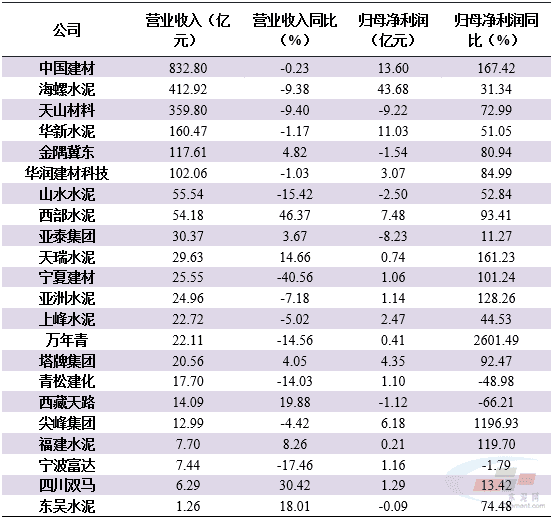
Core Insights - In the first half of 2025, China's GDP grew by 5.3% year-on-year, with infrastructure investment increasing by 4.6% while real estate investment declined by 11.2%, leading to weak demand in the cement industry [1] - National cement production reached 815 million tons, a decrease of 4.3% year-on-year, exacerbating the oversupply situation and intensifying market competition [1] - Despite the decline in demand, the cement industry's profitability improved due to lower coal costs and previously low prices, resulting in significant profit recovery for many companies [1] Company Performance - Among 22 listed cement companies, 9 reported revenue growth while 13 experienced declines; 5 companies had revenue growth exceeding 10% [3] - Western Cement led the industry with a revenue increase of 46.37%, driven by overseas business expansion, with overseas sales of cement and clinker reaching 2.027 billion yuan, up 82.83% year-on-year [3] - In terms of net profit, 16 companies were profitable while 6 reported losses; Conch Cement maintained strong profitability with a net profit of 4.368 billion yuan, up 31.34% year-on-year [5] Sales and Pricing Trends - Among 13 companies reporting cement and clinker sales, 3 saw increases while 10 experienced declines; Western Cement's overseas sales volume surged by 178.0%, compensating for domestic market declines [7] - The average selling price of cement increased for 10 companies, with Huaxin Cement's average price reaching 330 yuan, an 8.5% increase year-on-year, driven by rising prices in both domestic and international markets [7]

山东省地矿局鲁南院推动“矿保姆”服务走深走实 助力矿山企业绿色高质量发展
Zhong Guo Fa Zhan Wang· 2025-09-25 15:38
Core Viewpoint - The successful completion and expert acceptance of the self-assessment for the construction of a national-level green mine in the Zhujiashan-Wangshan limestone mining area, commissioned by Lunan Zhonglian Cement Co., Ltd, highlights the company's commitment to sustainable mining practices and environmental responsibility [1] Group 1: Project Achievements - The self-assessment for the green mine construction received a score of 97.8, ranking first among its peers and being included in the provincial recommendation list [1] - The geological environmental monitoring and balance plan preparation for Lunan Zhonglian Cement's mining operations are progressing smoothly [1] Group 2: Service Model Development - Lunan Institute is shifting from a single mineral exploration focus to providing comprehensive geological services, including resource assurance, green mine construction, administrative management, and environmental governance [1] - The "mining nanny" service model has been implemented, with over 10 mining enterprises receiving geological environmental monitoring and ecological restoration plan services since 2025 [1] Group 3: Future Plans - The Lunan Institute aims to deepen various geological service expansions, leveraging the proactive, foundational, public, and strategic roles of geological work [1] - The company plans to actively engage with local government departments and mining enterprises to provide high-quality technical services that support the green and high-quality development of mining enterprises [1]
我国宣布新一轮温室气体减排目标
Shang Hai Zheng Quan Bao· 2025-09-25 14:23
Core Points - China announced new national contribution targets at the UN Climate Change Summit, aiming for a 7%-10% reduction in greenhouse gas emissions by 2035, with non-fossil energy consumption exceeding 30% of total energy consumption [1] - The total installed capacity for wind and solar power is targeted to exceed 360 million kilowatts, which is more than six times the capacity in 2020 [1] - The new targets reflect China's commitment to global climate governance and are a strategic continuation of its domestic "dual carbon" process [1] Group 1 - As of August 2023, China's total installed capacity for wind and solar power surpassed 1.69 billion kilowatts, contributing 80% of new power installations since the start of the 14th Five-Year Plan [2] - To meet the new targets, nearly 2 billion kilowatts of new capacity must be added over the next decade, requiring an average annual increase of around 200 million kilowatts [2] - The development of wind and solar power is crucial for China to achieve its emission reduction goals and is supported by advancements in photovoltaic and wind power technology [2] Group 2 - The new targets are a scientific response to China's energy transition strategy, with expectations of continued economic growth and rising energy demands in various sectors [3] - By 2024, China's energy consumption per unit of GDP is expected to decrease by 11.6%, making it one of the fastest countries in terms of energy intensity reduction [3] - The new national contribution targets represent a revolutionary upgrade, covering all greenhouse gases and not just carbon dioxide emissions [3] Group 3 - The new targets provide a clear policy signal for the next decade, indicating a decoupling of economic growth from carbon emissions [4] - China's carbon market is expanding, with major industries like steel, cement, and aluminum already included, and plans to extend to petrochemical, chemical, and aviation sectors [4] - By 2027, the national carbon market is expected to cover the main emission industries in the industrial sector [4]
每日投行/机构观点梳理(2025-09-25)
Jin Shi Shu Ju· 2025-09-25 10:56
Group 1: Currency and Economic Outlook - Barclays reports that despite recent negative events, the US dollar has remained resilient, with no significant decline observed since May, even amid weak economic data and challenges to the Federal Reserve's credibility [1] - Goldman Sachs predicts that the US economy will recover in the coming months, which may support the dollar's continued strength [1] Group 2: Oil and Emerging Markets - Goldman Sachs states that a complete ban on Russian oil imports by the EU is unlikely due to reliance from certain member states like Hungary and Slovakia, and any potential ban would only redistribute oil flows rather than reduce global supply [2] - Goldman Sachs expects emerging market stocks and currencies to rise by the end of the year, raising the MSCI Emerging Markets Index target from 1,370 to 1,480 points, indicating a potential 10% upside [2] Group 3: Domestic Market Insights - Dongfang Jincheng forecasts stable and ample market liquidity by year-end, with potential for a new round of reserve requirement ratio cuts and government bond purchases [4] - CITIC Securities highlights the long video industry benefiting from favorable policies, which may enhance production capacity and efficiency for content creators [6][10] - CITIC Securities notes a recovery in the restaurant industry, with August seeing a year-on-year increase in dining revenue, suggesting structural opportunities for leading companies with strong compliance and quality [8] Group 4: Sector-Specific Developments - CITIC Securities indicates that the carbon fiber industry is in a recovery phase, with strong demand in wind energy and aerospace sectors, recommending attention to high-quality companies with international exposure [9] - China Galaxy Securities observes a slight increase in cement prices due to seasonal demand, with expectations for further price support from rising coal prices [11][12] - China Galaxy Securities also reports positive signals in panel procurement ahead of the overseas promotional season, indicating a potential peak in TV demand [13] Group 5: Electronic Materials - Huatai Securities emphasizes the importance of electronic cloth in the PCB-CCL supply chain, predicting a supply shortage for various specialty electronic cloth products until 2026, and recommends companies with rapid capacity expansion [14][15]
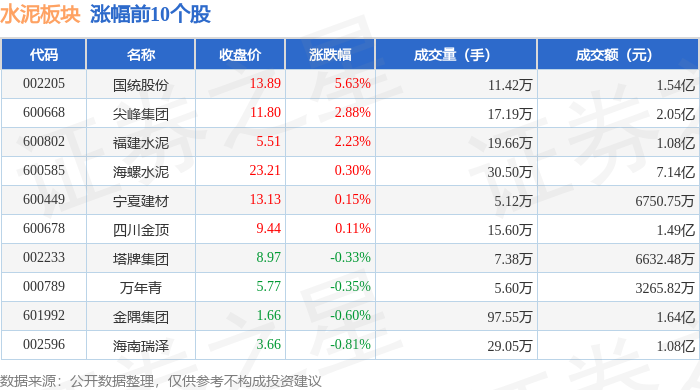
水泥板块9月25日跌0.79%,三和管桩领跌,主力资金净流出2.38亿元
Zheng Xing Xing Ye Ri Bao· 2025-09-25 08:45
Market Overview - The cement sector experienced a decline of 0.79% on September 25, with Sanhe Pile leading the drop [1] - The Shanghai Composite Index closed at 3853.3, down 0.01%, while the Shenzhen Component Index closed at 13445.9, up 0.67% [1] Individual Stock Performance - Notable gainers included Guotong Co. (5.63% increase), Jianfeng Group (2.88% increase), and Fujian Cement (2.23% increase) [1] - Major decliners included Sanhe Pile (4.50% decrease), Shangfeng Cement (3.75% decrease), and Huaxin Cement (2.23% decrease) [2] Trading Volume and Value - Guotong Co. had a trading volume of 114,200 shares and a transaction value of 154 million yuan [1] - Sanhe Pile recorded a trading volume of 231,800 shares with a transaction value of 193 million yuan [2] Capital Flow Analysis - The cement sector saw a net outflow of 238 million yuan from institutional investors, while retail investors contributed a net inflow of 278 million yuan [2][3] - Key stocks with significant net inflows from retail investors included Fujian Cement and Sanhe Pile, while Guotong Co. and Jianfeng Group saw net outflows from institutional investors [3]


《建材行业稳增长工作方案(2025—2026年)》点评:水泥玻璃去产能确定性进一步增强,盈利底部向上可期
Shenwan Hongyuan Securities· 2025-09-25 07:29
Investment Rating - The report maintains a positive outlook on the cement and glass industries, indicating a potential for recovery and profitability improvement in the coming years [2][3]. Core Insights - The newly released "Building Materials Industry Stabilization and Growth Work Plan (2025-2026)" emphasizes enhancing profitability as a primary goal, shifting focus from revenue growth to profit quality [2]. - Key initiatives include promoting technological innovation, industry transformation, demand expansion, and open cooperation, with a focus on stabilizing growth and addressing internal competition [2]. - Cement production capacity is expected to significantly shrink, with a target to reduce actual annual production capacity from 2.2 billion tons to below 1.8 billion tons by the end of 2025, leading to an increase in capacity utilization rates by over 10% [2][3]. - The glass industry will focus on phasing out outdated production capacity, particularly in flat glass, to improve profitability amid declining demand due to reduced real estate completions [2][3]. Summary by Sections Policy Changes - The new plan introduces stricter capacity control measures for cement and glass industries, including prohibiting new capacity and requiring capacity replacement plans for existing projects [4][5]. - The emphasis has shifted from merely maintaining stable growth to enhancing profitability and technological capabilities within the industry [3]. Industry Performance - The report forecasts that the cement industry will see a capacity reduction of over 40 million tons, with a significant portion of this reduction expected to occur in the fourth quarter of 2024 [2][6]. - The glass sector is anticipated to undergo further improvements in profitability as outdated and high-pollution production lines are phased out [2]. Investment Opportunities - The report highlights key companies in the cement sector, such as Conch Cement, Huaxin Cement, and Tianshan Cement, as potential investment opportunities due to their competitive advantages [2]. - In the glass industry, companies like Xinyi Glass and China Southern Glass are noted for their potential to benefit from the elimination of outdated capacity [2]. - The report also identifies opportunities in advanced materials, particularly in fiberglass composites and low-dielectric fiberglass, with companies like China Jushi and Zhongcai Technology being of interest [2].