农产品加工

Search documents
农产品加工板块9月30日跌0.18%,中粮糖业领跌,主力资金净流出1.61亿元
Zheng Xing Xing Ye Ri Bao· 2025-09-30 08:42
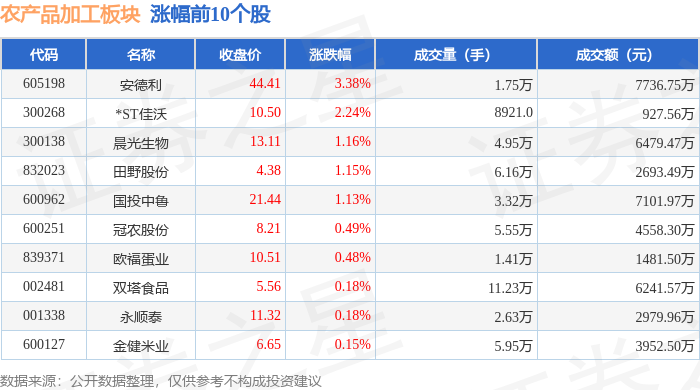
Core Viewpoint - The agricultural processing sector experienced a slight decline of 0.18% on September 30, with COFCO Sugar leading the losses, while the overall Shanghai Composite Index rose by 0.52% [1][2]. Agricultural Processing Sector Performance - The closing prices and performance of key stocks in the agricultural processing sector are as follows: - Andeli: 44.41, +3.38% - ST Jiawo: 10.50, +2.24% - Chenguang Biological: 13.11, +1.16% - Tianye Co.: 4.38, +1.15% - Guotou Zhonglu: 21.44, +1.13% - Others showed minor fluctuations [1][2]. Capital Flow Analysis - The agricultural processing sector saw a net outflow of 161 million yuan from institutional investors, while retail investors contributed a net inflow of 92.86 million yuan [2][3]. - The detailed capital flow for selected stocks indicates varying levels of institutional and retail participation, with some stocks experiencing significant outflows from institutional investors [3].


Amspec:马来西亚9月1日-30日的棕榈油出口量为1439845吨
Xin Hua Cai Jing· 2025-09-30 06:56
Group 1 - The core point of the article is that Malaysia's palm oil exports increased in September 2023 compared to the previous month, indicating a positive trend in the industry [1] Group 2 - Malaysia's palm oil export volume for the period from September 1 to September 30 was 1,439,845 tons, up from 1,341,990 tons in the same period last year, reflecting a month-on-month increase of 7.3% [1]
2019-2025年9月中旬豆粕(粗蛋白含量≥43%)市场价格变动统计分析
Chan Ye Xin Xi Wang· 2025-09-30 03:43
Core Insights - The report by Zhiyan Consulting highlights the market trends and strategic outlook for the soybean meal industry in China from 2025 to 2031 [1] Price Trends - As of mid-September 2025, the market price for soybean meal (with crude protein content ≥43%) is 3015.7 yuan per ton, reflecting a year-on-year decrease of 2.27% and a month-on-month decrease of 0.97% [1] - The highest recorded price in the past five years was in mid-September 2022, reaching 4910.4 yuan per ton [1]

美豆油价格低位震荡 9月29日阿根廷豆油(10月船期)C&F价格上调12美元/吨
Jin Tou Wang· 2025-09-30 03:16
Group 1 - The core viewpoint of the news is the fluctuation of soybean oil futures prices on the Chicago Board of Trade (CBOT), with a slight decline observed recently [1][2] Group 2 - On September 30, CBOT soybean oil futures opened at 49.59 cents per pound and currently stand at 49.52 cents per pound, reflecting a decrease of 0.12% [1] - The highest price during the trading session reached 49.67 cents per pound, while the lowest dipped to 49.44 cents per pound [1] Group 3 - On September 29, the opening price for soybean oil futures was 50.25 cents per pound, with a closing price of 49.69 cents per pound, marking a decline of 1.06% [2] - The C&F price for Argentine soybean oil for October shipment increased by $12 to $1,113 per ton, while the December shipment rose by $11 to $1,111 per ton [2] Group 4 - As of September 26, 2025, the commercial inventory of soybean oil in key regions of the country was 1.2487 million tons, which is an increase of 12,800 tons (1.04%) from the previous week and a year-on-year increase of 92,900 tons (8.04%) [2] - On September 29, the Dalian Commodity Exchange had 25,534 soybean oil futures warehouse receipts, remaining stable compared to the previous trading day [2]
综合晨报-20250930
Guo Tou Qi Huo· 2025-09-30 03:10
1. Report Industry Investment Ratings No relevant content provided. 2. Core Views of the Report - The overall market shows a complex situation with various commodities having different trends. Some commodities are facing supply - demand imbalances, while others are affected by geopolitical factors, seasonal changes, and policy expectations. Investors need to pay attention to different influencing factors for each commodity and adjust their investment strategies accordingly, especially during the National Day holiday to control risks [2][3][44] 3. Summary by Commodity Categories Energy - **Crude Oil**: Overnight international oil prices dropped significantly. The supply side is in a multi - empty intertwined state. The oil inventory accumulation process is clear, with a 2.4% increase in the third quarter. It's recommended to hold a protective strategy combining futures shorts and call options [2] - **Fuel Oil & Low - sulfur Fuel Oil**: Iraq's crude oil export recovery and OPEC +'s increasing production expectations put pressure on oil prices. High - sulfur fuel oil supply may tighten due to geopolitical factors, while low - sulfur fuel oil has a weaker fundamental situation [20] - **Asphalt**: Market pre - holiday stocking enthusiasm increased. The overall inventory level decreased. The 10 - month production plan was in line with expectations, and the BU trend is temporarily oscillating strongly [21] - **Liquefied Petroleum Gas**: Due to typhoon weather in South China, the import volume decreased. Supply - demand improved marginally, and the LPG price rebounded slightly from the bottom [22] Metals - **Precious Metals**: Overnight precious metals continued to be strong. The medium - term upward trend remains, but there is high volatility risk during the National Day holiday, so it's recommended to stay on the sidelines [3] - **Base Metals** - **Copper**: Overnight copper prices rose. The market is digesting the supply impact. Technically, LME copper shows potential for a trend breakthrough, and SHFE copper enters the high - price area. However, there are negative demand expectations [4] - **Aluminum**: Overnight non - ferrous metals were strong, but SHFE aluminum was relatively stable. The consumption in September was lower than expected, and it faces resistance at the March high. Pay attention to the peak - season feedback after the holiday [5] - **Zinc**: As the National Day holiday approaches, the zinc fundamentals weakened. Shorts increased positions significantly. Pay attention to the support at 21,500 yuan/ton, and be vigilant against potential short squeezes in the outer market [8] - **Lead**: The supply of lead exceeded demand in the short term, and the price dropped significantly. Pay attention to the cost support at around 16,500 yuan/ton [9] - **Nickel & Stainless Steel**: SHFE nickel is in a weak state. The inventory of pure nickel and nickel iron decreased, while the stainless - steel inventory increased. Wait for the external copper price to drive the market [10] - **Tin**: Overnight tin prices rose rapidly. Pay attention to the impact of Indonesia's policy and the changes in refined tin production rate and inventory after the holiday [11] - **Manganese Silicon & Silicon Iron**: With the "Three - Carbon" concept, there is an upward driving force for prices. The demand from molten iron production is rising, and it's recommended to go long at low prices [18][19] Chemicals - **Urea**: Agricultural and industrial demand is weak, and the supply exceeds demand. The inventory of production enterprises continues to accumulate. Pay attention to policy adjustments [23] - **Methanol**: The methanol market is expected to be weak. Pay attention to macro - sentiment and overseas device changes [24] - **Pure Benzene**: The real - world fundamental situation is okay, but the oil - price collapse and future demand decline expectations drag down the market [24] - **Styrene**: The cost - side support from oil prices is strengthening, but high inventory suppresses prices [25] - **Polypropylene, Plastic & Propylene**: The supply of polypropylene is under pressure, and the price is always under pressure. For polyethylene, the downstream has stocking demand before the holiday, but there is de - stocking pressure after the holiday [26] - **PVC & Caustic Soda**: PVC is in a weak and oscillating state due to high supply and inventory. Caustic soda may oscillate due to weak current situation and strong future expectations [27] - **PX & PTA**: The strong expectations of PX are weakened, and the supply - demand situation of PTA is still under pressure after the holiday [28] - **Ethylene Glycol**: The supply pressure is not large in the short term, but the supply - demand may be weak in the fourth quarter [29] - **Short Fibre & Bottle Chip**: Short - fiber demand is boosted during the peak season, and bottle - chip prices are affected by short - term factors [30] Building Materials - **Glass**: Pay attention to the downstream restocking sentiment. If capacity reduction does not occur, the market may return to a weak state [31] Agricultural Products - **Soybean - related Products**: U.S. soybeans face seasonal and export pressures. Palm oil is in a seasonal production - reduction cycle. Mid - term, soybean and palm oil are expected to trade in a range. Consider protective call strategies [34] - **Rapeseed Meal & Rapeseed Oil**: Due to the holiday, market sentiment is cautious. Rapeseed meal demand is suppressed, while rapeseed oil inventory is expected to continue to decline. It's recommended to stay on the sidelines before the holiday [35] - **Domestic Soybeans**: Domestic soybeans are performing better than imported ones in the short term. Pay attention to the performance after the listing of domestic soybeans [36] - **Eggs**: Egg futures have significantly reduced positions. After the National Day, demand will weaken. Consider long positions in far - month contracts next year [38] - **Cotton**: U.S. and Chinese cotton prices are falling. Xinjiang cotton may have a bumper harvest, and domestic demand is weak. Temporarily stay on the sidelines [39] - **Sugar**: Brazilian sugar production may remain high, and the market focuses on the next - crop - season yield estimate in China [40] - **Apples**: Although the spot market is good, the cold - storage inventory may be higher than expected, so maintain a short - selling mindset [41] - **Timber**: The supply - demand situation has improved, and the spot price is relatively low. Maintain a long - buying mindset [42] - **Pulp**: Pulp prices hit a new low. The inventory in Chinese ports is relatively high, and the demand is average. Stay on the sidelines [43] Financial Products - **Stock Index**: The stock index showed strength. The external liquidity environment for the Greater China stock index is positive. Mid - term, increase the allocation of technology - growth sectors, and moderately increase the allocation of cyclical sectors in the short term [44] - **Treasury Bonds**: Treasury futures closed down. The economic operation faces challenges, and the yield - curve steepening probability increases [45] Livestock - **Hogs**: Hog futures dropped. The supply is abundant, and the government has carried out small - scale purchases. The industry is in a loss state. Pay attention to the impact of re - entry in the fourth quarter [37] - **Eggs**: Egg futures reduced positions significantly. The demand will weaken after the National Day. Consider long positions in far - month contracts for next year [38]
529家A股公司参与!期货市场最新公布!
券商中国· 2025-09-30 02:07
Core Viewpoint - The article highlights the increasing participation of A-share listed companies in China's futures and options markets, indicating a growing trend in risk management through hedging strategies. Group 1: Market Participation - As of the end of 2024, 529 out of 5383 A-share listed companies participated in futures and options trading, representing 9.8% of all listed companies and 35.8% of market capitalization [2] - The number of companies involved in commodity futures and options reached 509, accounting for 9.5% of all listed companies, with a market cap exceeding 30% [2] - The average market capitalization of companies participating in commodity futures and options was 666.9 million, a 22.1% increase from 2023, significantly higher than the overall market average of 183.6 million [3] Group 2: Risk Management Strategies - Over 50% of the total cumulative positions held by non-financial listed companies in 2024 were for hedging purposes, marking a 15 percentage point increase from 2023 [3] - The number of listed companies using derivatives for hedging has surged, with 440 companies publishing 713 hedging-related announcements by August 2025, a 167% increase from the same period in 2024 [4] Group 3: Sector-Specific Insights - State-owned listed companies showed strong influence in the commodity futures and options market, with nearly 40% of such companies participating and accounting for nearly 80% of total positions [3] - The participation in commodity futures included 116 different products, with high engagement in copper, aluminum, silver, gold, lithium carbonate, rebar, and hot-rolled coil [3] Group 4: Market Trends - The options market has seen record high positions, with a peak of 13.48 million contracts in August 2025, reflecting a 207% increase in average daily positions compared to 2022 [6] - The number of listed options has expanded, with 62 products currently available, covering major categories such as energy and agricultural products [6]

农业策略:节日驱动不足,猪价下跌
Zhong Xin Qi Huo· 2025-09-30 01:39
Report Industry Investment Rating Not mentioned in the provided content. Core Viewpoints of the Report The report analyzes various agricultural and related commodity markets, providing short - and long - term outlooks and investment suggestions for each commodity. Overall, the market shows a mixed trend with some commodities expected to be weak, some to be in a range - bound state, and others with potential for short - term rebounds [1][6][8]. Summary by Commodity 1. Livestock - **Pig**: In the short term, the planned pig出栏量 in September increased by 4% month - on - month, and the completion rate was 64.6%. There is still significant pressure at the end of the month. In the medium term, the number of pigs for sale is expected to increase in Q4. In the long term, if the "anti - involution" policy of reducing 1 million sows is implemented, the supply pressure will ease in the second half of 2026. The outlook is weak - side oscillation, and attention should be paid to reverse arbitrage strategies [1][8]. 2. Oils and Fats - **Oils**: The outlook is that soybean oil and palm oil will oscillate, while rapeseed oil will oscillate with a stronger bias. The US soybean harvest is normal, but the good - quality rate is decreasing. The domestic soybean import volume will seasonally decline, and the soybean oil inventory will peak. The palm oil inventory accumulation in September may be limited, and the rapeseed oil inventory will decline. Attention should be paid to trade relations, supply in producing areas, and overseas biodiesel demand [6]. 3. Protein Meals - **Protein Meals**: The outlook is that both soybean meal and rapeseed meal will oscillate. Internationally, the US crop harvest is progressing well, and Brazil's sowing has a record - fast start. Domestically, there is support from pre - holiday stocking, but the inventory pressure is large. The supply of soybean meal is expected to increase in Q4 2025 and Q1 2026. Attention should be paid to the impact of pig "anti - involution" on sentiment [6][7]. 4. Grains - **Corn/Starch**: New grain is gradually coming onto the market. In the short term, there is pressure from the concentrated listing of new grain, but there may be a small rebound before the holiday. In the long term, the market is expected to be short - term bearish and long - term bullish. Attention should be paid to short - selling opportunities [7][8]. 5. Rubbers - **Natural Rubber**: The short - term fundamentals are supportive, and the market is expected to maintain a range - bound state. The market has a strong spot, is de - stocking, and the basis is narrowing. However, there is an expectation of increased supply in Q4. Attention should be paid to raw material prices and domestic social inventory changes [10][11]. - **Synthetic Rubber**: The market will continue to oscillate within a range. There are many device overhauls expected from September to November, and the price is at a low level, so the bearish sentiment has cooled, but there is no continuous upward driving force [12]. 6. Fibers - **Cotton**: The medium - term outlook is weak - side oscillation. The expected increase in Xinjiang's cotton production in the 25/26 season will bring supply pressure. Before the holiday, the price fluctuation will narrow. After the holiday, as new cotton is listed, the downward driving force will increase. Attention should be paid to the seed cotton purchase price and trade negotiations [12]. 7. Sweeteners - **Sugar**: In the short term (around National Day), it will oscillate, and the decline may slow down with a potential for a rebound. In Q4, as new sugar is listed in the Northern Hemisphere, the supply pressure will increase, and the price is expected to be weak - side oscillating. Attention should be paid to production data in Brazil's central - southern region [13][14]. 8. Pulps and Papers - **Pulp**: The market is weak - side oscillating. The downstream paper production peak is coming to an end, and the supply is in an oversupply situation. Although there is support from the delivery price, there is no clear upward logic [16]. - **Double - Glued Paper**: The market is weak - side oscillating. The supply is relatively abundant, the demand is not strong, and there is no clear upward or downward driving force in the short term. The long - term outlook is weak [17]. 9. Logs - **Logs**: The market will oscillate around 800 before the holiday. The spot price is stable, the inventory is being de - stocked, and the fundamentals are marginally improving. However, the delivery situation has a negative impact on the market, and the selling hedging pressure is large [19][20].
邮储银行河南省分行:“三项机制”助民营企业高质量发展
Sou Hu Cai Jing· 2025-09-29 23:13
Core Insights - Private enterprises play a vital role in the market economy, contributing significantly to employment, improving livelihoods, and driving economic growth [1] - In Henan Province, the number of private economic entities has exceeded 10 million, accounting for over 95% of all operating entities, making them a crucial support for regional economic development [1] - Postal Savings Bank of China in Henan Province actively responds to national policy directions, focusing on "two highs and four efforts," and continuously promotes three mechanisms to provide robust financial support for private enterprises [1] Group 1: Financial Support Mechanisms - The "re-lending" mechanism effectively aids enterprise transformation and upgrading, as demonstrated by a company specializing in engine camshafts and new energy motor shafts, which received a credit of 46 million yuan and a loan of 28.05 million yuan, including 16.4 million yuan from the technology transformation re-lending fund [2] - The "financing coordination" mechanism efficiently empowers small and micro enterprises, with a company in the grain trade receiving a 3 million yuan working capital loan and a 5 million yuan low-risk bill discounting limit [3][4] - The "investment-loan linkage" mechanism promotes private investment vitality, with the bank implementing a "three priorities" strategy for key projects, ensuring efficient funding allocation [5][6] Group 2: Policy Implementation and Impact - The technology innovation and technology transformation re-lending policy aims to guide financial institutions to increase support for technology-based SMEs and key areas of technological transformation [2] - The financing coordination mechanism, established by national financial regulatory authorities, aims to quickly direct credit funds to grassroots small and micro enterprises, addressing financing difficulties [4] - The investment-loan linkage mechanism enhances the participation of private capital in effective investment, providing a comprehensive financial service ecosystem covering the entire lifecycle of enterprises [5][6]

全国“一盘棋”凝聚发展合力
Jing Ji Ri Bao· 2025-09-29 22:16
Core Viewpoint - The article emphasizes the importance of high-quality development in China, addressing issues of imbalance and insufficiency in development, and outlines the strategic direction set by the government for the "14th Five-Year Plan" [1] Group 1: Regional Development - Significant progress has been made in regional coordination, with major cities like Shanghai, Hefei, Hangzhou, and Suzhou enhancing cross-regional collaboration in technology and industry [4] - The Beijing-Tianjin-Hebei, Yangtze River Delta, and Guangdong-Hong Kong-Macau Greater Bay Area are becoming key drivers of high-quality national development, projected to account for over 40% of the national economy by 2024 [5] - The integration of industries and resources across regions is increasing, with 40% of energy in eastern regions sourced from western areas through major energy transmission projects [6] Group 2: Infrastructure and Public Services - The construction of strategic transportation networks is accelerating, connecting over 80% of county-level administrative regions and serving approximately 90% of the national economy and population [7] - By the end of 2024, rural road mileage is expected to reach 4.64 million kilometers, achieving nearly universal access to paved roads in villages [11] Group 3: Urban-Rural Integration - The integration of urban and rural areas is progressing, with a focus on breaking down the dual structure and facilitating smoother flow of resources and people [10] - The income gap between urban and rural residents is narrowing, with the income ratio decreasing from 2.56:1 in 2020 to 2.34:1 by 2024 [12] Group 4: Cultural Development - The demand for cultural and spiritual enrichment is rising alongside material wealth, with a record 304 million visitors to museums this year [14] - China's economic strength has significantly increased, with GDP projected to reach around 140 trillion yuan this year, maintaining its status as a global leader in various sectors [15]
双节“赶大集”,一站式淘遍临朐好物!
Sou Hu Cai Jing· 2025-09-29 18:50
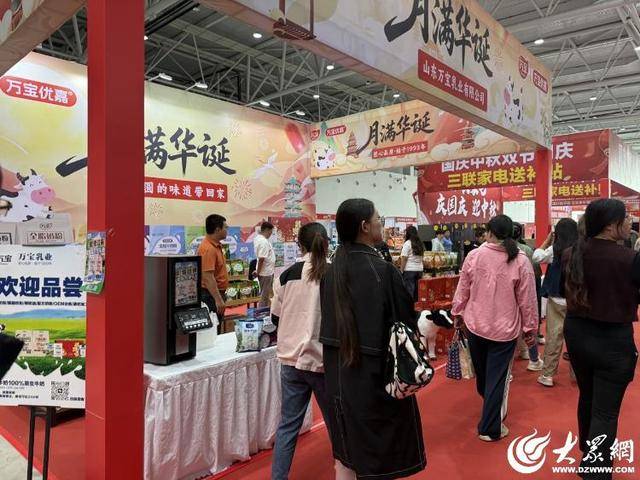
Core Viewpoint - The "Celebrating National Day and Welcoming Mid-Autumn Festival" promotional event for local agricultural products in Linyi has become a popular destination for holiday shopping, showcasing the region's diverse agricultural offerings and reflecting the ongoing transformation in its agricultural industry [1][11]. Group 1: Event Overview - The event took place from September 28 to October 4 at the Linyi International Convention and Exhibition Center, attracting a large number of visitors [1]. - Various stalls featured local specialties, including meat products, gourmet items, and traditional snacks, creating a vibrant atmosphere for holiday shopping [3][5]. Group 2: Product Highlights - The event showcased a range of products, such as bacon, chicken fillets, and innovative goose liver products, which drew significant customer interest [3]. - Local specialties like hawthorn strips, chestnuts, and pickled vegetables were popular among attendees, emphasizing the region's agricultural diversity [5][8]. Group 3: Agricultural Development - Linyi's agricultural strategy focuses on "one village, one product" and "one town, one industry," leading to a rich variety of local products [8]. - The region has evolved from simple agricultural practices to advanced processing and branding, indicating a shift from traditional to modern agricultural practices [10]. - The event serves as a microcosm of the broader changes in Linyi's agricultural sector, which is poised for new opportunities under the rural revitalization strategy [11].