
航空航天

Search documents
中直股份(600038.SH):控股股东中航科工已增持约5002.52万元股份
Ge Long Hui A P P· 2025-11-24 12:27
Group 1 - The core point of the article is that the controlling shareholder, AVIC Science and Technology, has increased its stake in AVIC Helicopter by purchasing 1,391,700 shares through the Shanghai Stock Exchange, amounting to approximately 50.0252 million yuan including transaction fees [1] Group 2 - The share purchase indicates a strong commitment from the controlling shareholder towards the company, potentially signaling confidence in its future performance [1] - The transaction was executed on November 24, 2025, highlighting the recent activity in the company's stock [1] - The increase in shareholding may influence market perception and investor sentiment regarding AVIC Helicopter's growth prospects [1]

资金“抄底”了,大举净流入
Zhong Guo Zheng Quan Bao· 2025-11-24 12:12
Group 1: ETF Performance - Aerospace and satellite-themed ETFs showed strong gains, with multiple products rising over 4% on November 24 [4] - The Satellite ETF (563230) surged by 3.79%, with its share increasing nearly 50% since the end of September, making it the top performer among similar ETFs [4] - The technology-focused Nasdaq ETF (159509) experienced a significant premium of 19.23% after resuming trading following a one-hour suspension [3][10] Group 2: Market Trends - The market saw a significant adjustment last week, but there was a "bottom-fishing" trend with substantial net inflows into several broad-based ETFs [2][7] - The lithium carbonate futures contract hit a limit down, negatively impacting market expectations for related companies, leading to a decline in rare metals and energy-related ETFs [5] - Despite recent adjustments, the long-term development logic of the new energy sector remains solid, supported by policy, market demand, and performance recovery [5] Group 3: Fund Flows - Notable net inflows were recorded for several broad-based ETFs, including the CSI 500 ETF, which saw a net inflow of 57.78 billion [9] - The Hang Seng Technology and CSI 50 ETFs also ranked high in net inflows for November, indicating investor interest in these sectors [9] - Active trading was observed in various currency and bond ETFs, with the Silver Day ETF (511880) achieving a transaction volume exceeding 20 billion [7][8]

零重力启用低空超级工厂 eVTOL企业摸索场景端建设
Zheng Quan Shi Bao Wang· 2025-11-24 12:09
Group 1 - The core concept of the news is the launch of the ZG-ONE Qiao Fei low-altitude super factory and offline flagship showroom by Zero Gravity Aircraft Industry, which aims to extend the company's operations from manufacturing to scenario-based applications through an innovative "five-in-one" model [1] - The "five-in-one" model integrates five key functions: R&D center, flagship showroom, delivery base, educational park, and aviation camp, creating a comprehensive ecosystem covering technology development, product display, manufacturing delivery, education, and operational scenarios [1] - The delivery base, once completed, is expected to achieve an annual production capacity of 100 eVTOL aircraft [1] Group 2 - Zero Gravity Aircraft Industry has developed a product matrix in the field of new energy manned aircraft, featuring two parallel technical paths: eCTOL and eVTOL, with four models including eCTOL RX1E-A, RX1E-S, multi-rotor eVTOL ZG-ONE Qiao Fei, and tilt-rotor eVTOL ZG-T6 [1] - The ZG-ONE Qiao Fei is projected to obtain its TC certification and begin market operations by 2026, with over 1,000 intention orders already received [1] - The company views the cultural tourism sector as a "golden entry point" for the low-altitude economy, planning to use controlled and closed cultural tourism scenarios as a testing ground before expanding into open urban airspace [2] Group 3 - The green aviation camp strategy was announced, which aims to connect products and markets by leveraging urban resources to create a network that integrates aviation parks, cultural tourism, aviation technology, education, training, sports, and infrastructure [2] - The first demonstration camp is planned around the Shenzhen Shekou low-altitude super factory, which will serve as a model for low-altitude flight networks in South China and gradually expand nationwide [2] - The company anticipates that over the next decade, more than 2,000 green aviation flight camps will emerge across the country, generating market demand for new energy aircraft [2] Group 4 - Shenzhen is positioned as a pioneering demonstration area for low-altitude economic development, with a goal to establish over 1,500 takeoff and landing points by 2035 [3] - Zero Gravity Aircraft Industry aims to use Shenzhen as a starting point to build a low-altitude economic framework that radiates Southeast Asia, connects nationwide, and links globally [3]
中直股份:控股股东中航科工已增持约5002.52万元股份
Ge Long Hui· 2025-11-24 11:59
格隆汇11月24日丨中直股份(600038.SH)公布,2025年11月24日,公司收到控股股东中航科工《关于增 持中航直升机股份有限公司股份的告知函》,中航科工已通过上海证券交易所集中竞价平台增持公司 1,391,700股股份,增持股份金额约5,002.52万元(含交易费用)。 ...
海外策略周报:美联储分歧加剧,降息预期显著波动-20251124
Ping An Securities· 2025-11-24 11:35
Core Insights - The Federal Reserve's interest rate cut expectations have fluctuated significantly, leading to a decline in risk assets and a slight strengthening of the US dollar. The MSCI global index fell by 2.5%, with major developed market indices also declining, particularly the Dow, S&P, Nasdaq, and Hang Seng [2][33] - The US labor market showed improvement in September, with non-farm payrolls increasing by 119,000, but the unemployment rate unexpectedly rose to 4.4% due to a higher labor participation rate. The government announced that October's non-farm data would not be released, with some data to be combined with November's figures in December [3][4][6] - The internal divisions within the Federal Reserve have intensified, causing significant volatility in interest rate cut expectations. The minutes from the October FOMC meeting indicated that many officials preferred to maintain rates, leading to a 20 percentage point drop in market expectations for a rate cut to 30%. However, comments from New York Fed President Williams suggested potential adjustments, causing expectations to rise to 71% [7][9] Economic Outlook - The US economy is expected to experience moderate growth in 2026, supported by resilient technology investments and stable consumer spending. AI investments are projected to remain strong, driven by commitments from countries like Japan and South Korea to invest in US AI infrastructure [12][17] - The labor market is anticipated to maintain a balance between supply and demand, with the unemployment rate expected to hover around 4.5% throughout 2026. The impact of tariffs on inflation is expected to diminish in the second half of the year, contributing to a more favorable economic outlook [17][16] Market Performance - The US stock market is currently in a phase of consolidation following previous high valuations, with limited further downside potential. Sectors with low valuations and solid earnings support, such as healthcare and utilities, are expected to show resilience [2][33] - The S&P 500 index's price-to-earnings ratio (TTM) stands at 28.09, slightly below the past ten-year average plus one standard deviation, indicating a relatively high valuation level. The index's equity-to-bond ratio is at 0.87, above the historical average minus one standard deviation [43][39] Sector Analysis - The technology sector is likely to continue driving growth, with major tech companies expected to maintain high capital expenditure growth rates. This is supported by favorable policies and a stable economic environment [12][28] - The healthcare and consumer sectors are projected to remain resilient amid changing market conditions, with potential for growth driven by stable consumer spending and investment in technology [2][12]
多只航天ETF涨超4%;ETF新老赛道建仓策略分化丨ETF晚报
2 1 Shi Ji Jing Ji Bao Dao· 2025-11-24 11:29
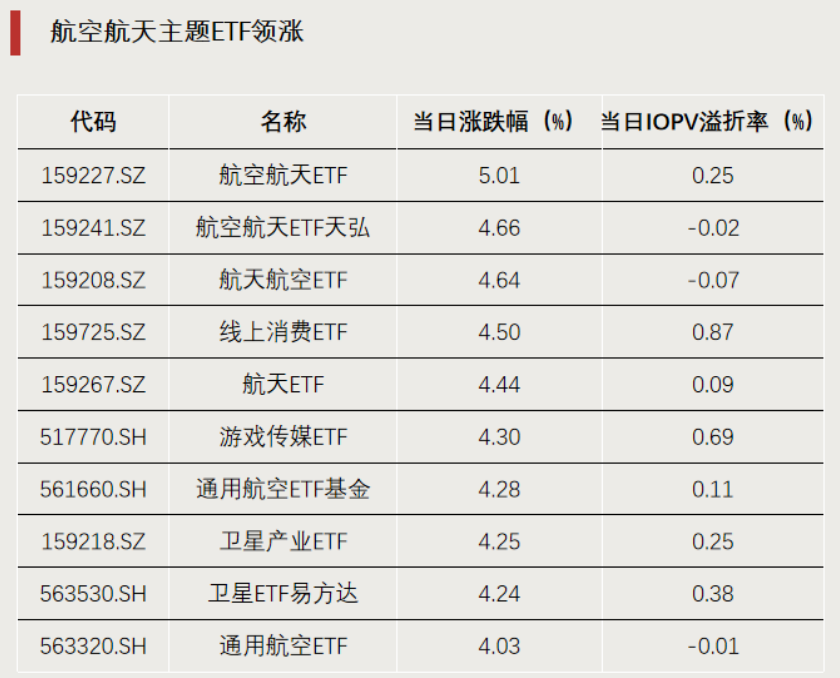
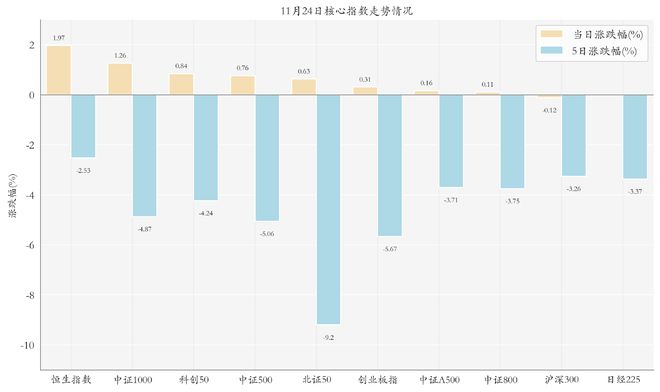
Group 1: ETF Market Overview - The three major indices collectively rose, with the Shanghai Composite Index up 0.05%, Shenzhen Component Index up 0.37%, and ChiNext Index up 0.31% [1][5] - Aerospace ETFs showed significant gains, with the Aerospace ETF (159227.SZ) rising by 5.01%, Aerospace ETF Tianhong (159241.SZ) up 4.66%, and Aerospace ETF (159208.SZ) up 4.64% [1][12] - The overall performance of ETFs varied, with cross-border ETFs showing the best average increase of 1.30%, while stock strategy index ETFs had the worst average performance at -0.36% [10] Group 2: Regulatory Changes - New regulations for public ETF naming have been introduced, requiring ETFs to include the core elements of the investment target and the fund manager's abbreviation in their names [2][3] - Existing ETFs must complete their name changes by March 31, 2026, to comply with the new guidelines [2] Group 3: Investor Behavior and Strategy - There is a noticeable divergence in the investment strategies between new and old ETFs, with traditional ETFs having a higher proportion of institutional investors compared to newer, popular ETFs that are more heavily held by retail investors [4] - The performance of ETFs with high retail participation has been poor, while those with significant institutional backing have shown better returns [4]
少走弯路,少犯错的两个办法
创业家· 2025-11-24 10:12
每日金句 想要少走弯路,少犯错有两个办法:第一就是小步快跑,快速试错,不要做一 个特别宏大的产品研发计划,先做一个最简单的版本,不停地迭代。第二,多 找这个行业里面的高手,走过坑的那些人,去跟他们交流。 吴世春 | 梅花创投创始合伙人 吴世春黑马实验室,2019.4 这里认真推荐你: 报名 「吴世春·西安出行活动」 1月23日-25日 , 吴世春将亲自带队 100家企业家 , 去陕西西安线下游学 , 走进科技制造 产业,打开万亿赛道蓝海。 你 在 创业路上遇到的问题和想法 , 都可以找吴老师聊聊 。 如果你是 优质的项目,吴老师也会果断投 你 。 希望所有支持吴老师的人 , 一如既往的相信他、支持他,大家 一起 加油! 活动详情如下 ↓↓↓ 吴世春导师亲自带队 走进科技制造产业 升级数字文旅体验 探索产业生态协同 打开万亿赛道蓝海 机器人、航空航天、高端装备、新材料、新能源、 科技演费、Al+产生的创出者看过来! 你将收获 1场 产业重做的深度链接之旅 与独角虎企业、梅花投资人深度交流,占据产业链关键 卡位,共建协同生态 3天 深度沉浸式学习与认知共振 从技术创新到商业化实现,从破局战略到破局战术,从 理论到 ...

光启技术:2025年初至今公司共披露了27.89亿元的超材料产品批产合同
Zheng Quan Ri Bao· 2025-11-24 09:44
Core Viewpoint - The company, Guangqi Technology, announced on November 24 that it has disclosed contracts worth 2.789 billion yuan for the mass production of metamaterial products since early 2025, indicating strong demand for its main business [2] Group 1 - The company has reported a total of 2.789 billion yuan in contracts for metamaterial products [2] - The main products, complex functional components of metamaterials, are crucial for the latest generation of aerospace advanced equipment [2] - The performance parameters of these metamaterials significantly outperform other solutions [2]


工业和信息化部启动创建国家新兴产业发展示范基地
Xin Hua She· 2025-11-24 09:38
Core Points - The Ministry of Industry and Information Technology has initiated the creation of national emerging industry development demonstration bases, aiming to establish around 100 park-type and 1,000 enterprise-type bases by 2035 [1] Group 1: Development Strategy - The demonstration bases will focus on key emerging industries such as next-generation information technology, new energy, new materials, biotechnology, high-end equipment, intelligent connected new energy vehicles, green environmental protection, low-altitude equipment, and aerospace [1] - The work plan emphasizes the need for park-type bases to promote the clustering, scaling, and high-end development of leading industries, enhance the supply capacity of key common technologies, and improve the transformation and industrialization of scientific and technological achievements [1] Group 2: Enterprise Focus - Enterprise-type bases will concentrate on strengthening product development, tackling key core technology challenges, achieving major original technological breakthroughs, and fostering new business models and innovative application scenarios [1] - The creation period for these demonstration bases is set for two years, after which the Ministry will conduct evaluations to assess the completion of key tasks and performance indicators outlined in the creation work plan [1]
航空航天ETF天弘(159241):收盘涨4.75%,回调期净流入1.28亿
Sou Hu Cai Jing· 2025-11-24 09:31
本文由 AI 算法生成,仅作参考,不涉投资建议,使用风险自担 【11月24日军工板块涨停潮,航空航天ETF天弘大涨4.75%】11月24日,军工板块掀起涨停潮,航空股 强势领涨。航空航天ETF天弘(159241)跟踪指数收盘大涨4.75%,年初至今累计上涨12%。该ETF标的指 数是全市场军工含量、"含航量"最高的军工指数,"航空装备+航天装备"权重超67%,与热门主题契 合,权重股含航发动力等央企龙头。催化剂方面,2025年亚洲通用航空展11月27 - 30日将在珠海举行, 主题聚焦"通用航空与低空互促发展"。工信部启动卫星物联网商用试验,中国可回收火箭"朱雀三号"11 月中下旬首飞。行情走势上,9月1日 - 11月21日该指数回调13%,回调时空充足,且ETF回调期获资金 净流入1.28亿元。东北证券称,2025年前三季度申万国防军工板块营收和利润增长好。十五五规划将 至,地缘政治紧张,关注军贸市场拓展与企业业绩改善。 ...