
芯片

Search documents
北斗星通:2025年预亏2.3亿元—2.9亿元 同比减亏
Zheng Quan Shi Bao Wang· 2026-01-22 09:17
Core Viewpoint - Beidou Xingtong (002151) expects a net profit loss of 230 million to 290 million yuan for the fiscal year 2025, which represents a reduction in losses compared to the previous year's loss of 350 million yuan [1] Financial Performance - The company anticipates a year-on-year reduction in losses, improving from a loss of 350 million yuan in the previous year to a projected loss of 230 million to 290 million yuan [1] Revenue Growth Drivers - The rapid expansion of demand in emerging sectors such as lawn mowers, intelligent driving, and consumer electronics has significantly boosted revenue from the company's core product lines, including chip modules and antennas [1] - Strategic acquisition of Shenzhen Tianli has enabled the company to advance its antenna business in automotive applications, contributing to increased revenue and profit [1]

北斗星通:预计2025年净亏损2.3亿元-2.9亿元 同比减亏
Xin Lang Cai Jing· 2026-01-22 09:08
Core Viewpoint - Beidou Xingtong (002151.SZ) forecasts a net profit attributable to shareholders for the year 2025 to be between -290 million and -230 million yuan, an improvement from -349.74 million yuan in the same period last year [1] Group 1: Financial Performance - The company is focusing on its core businesses of intelligent positioning digital base and ceramic components, aiming to build a "cloud-core integration" model to seize market opportunities [1] - The reduction in net loss is primarily due to increased demand in sectors such as lawn mowers, intelligent driving, and consumer electronics, leading to revenue growth in chip modules and antenna product lines [1] - Strategic acquisition of Shenzhen Tianli has boosted the antenna business in automotive applications [1] Group 2: Challenges - The overall profit remains in loss due to approximately 150 million yuan in goodwill impairment, increased R&D investment, and contraction in the special equipment business [1]
AI狂热烧向CPU,明晨大考来临
财联社· 2026-01-22 09:08
Core Viewpoint - The demand for AI hardware is shifting from storage chips to CPUs, making Intel and AMD's performance a focal point in the current earnings season for US stocks. Both companies are experiencing significant stock price increases due to optimistic market sentiment regarding their AI server CPU businesses [2][5]. Group 1: Intel's Performance - Intel's stock rose by 11.7% before its earnings report, reaching a closing price of $54.25, the highest since January 18, 2022, driven by strong growth expectations for its CPU business and signs of recovery in its manufacturing operations [5]. - Analysts expect Intel's Q4 adjusted earnings to be $0.08 per share, with revenues projected at $13.4 billion, including $8.4 billion from its client computing segment and $4.4 billion from its data center and AI segment [10]. - HSBC recently raised Intel's target price from $26 to $50 and upgraded its rating from "underweight" to "hold," citing increased demand for general computing capabilities as AI evolves [9]. Group 2: AMD's Performance - AMD's stock has seen a nearly 8% increase, marking its longest winning streak since February 19, 2025, driven by strong demand for its server CPUs, particularly the latest Turin data center CPUs [4][12]. - Analysts predict that AMD's server CPU inventory will soon be sold out, with average prices expected to rise by 10% to 15% due to high demand from large-scale enterprises [11]. - Bernstein analysts have raised their revenue expectations for AMD's Q4, driven by optimism regarding the company's server business momentum, with projected sales growth of 30% for its EPYC series products [12].

港股收盘 | 恒指收涨0.17% 商业航天概念走强 泡泡玛特午后升近6%
Zhi Tong Cai Jing· 2026-01-22 09:05
Market Overview - The Hong Kong stock market showed mixed performance, with the Hang Seng Index rising by 0.17% to close at 26,629.96 points, while the Hang Seng China Enterprises Index fell by 0.09% to 9,114.3 points, and the Hang Seng Tech Index increased by 0.28% to 5,762.44 points. The total trading volume was HKD 234.86 billion [1] Blue Chip Performance - Pop Mart (09992) led the blue-chip stocks, rising by 5.97% to HKD 206, contributing 13.8 points to the Hang Seng Index. The company has been in the spotlight due to its new product launch and share buybacks totaling nearly HKD 350 million [2] - Other notable blue-chip performers included Wharf Real Estate (01997) up 4.81%, Li Auto-W (02015) up 4.13%, while China Life (02628) fell by 3.82%, dragging the index down by 15.13 points [2] Sector Highlights - Large tech stocks had mixed results, with Baidu rising over 4% and Alibaba nearly 1%, while Tencent fell by 0.83%. The construction and cement sectors performed well, with China Liansu up over 8% and China National Building Material up nearly 7% [3] - Oil and gas stocks were active, with Shanghai Petrochemical (00338) up 3.45% and Sinopec (00386) up 3.41%. The International Energy Agency (IEA) raised its global oil demand growth forecast for 2026 to 930,000 barrels per day, up from a previous estimate of 860,000 barrels per day [3][4] Commercial Aerospace - The commercial aerospace sector saw renewed interest, with JunDa Co. (02865) rising nearly 16% and other related companies also showing significant gains. Reports indicate that Elon Musk is pushing for a SpaceX IPO, which could further stimulate the sector [4] Real Estate Sector - Hong Kong real estate stocks showed positive performance, with Wharf Real Estate (01997) and Sun Hung Kai Properties (00016) both rising significantly. Analysts predict a continued upward trend in property prices, although the growth rate may moderate due to resilient mortgage rates [5][6] Gold Stocks - Gold stocks experienced a decline, with Lingbao Gold (03330) down 3.16% and Zijin Mining (02899) down 2.3%. This drop is attributed to easing risk aversion, leading to a decrease in gold prices from historical highs [6] Notable Stock Movements - Minth Group (00425) saw a significant increase of 13.94% following a positive report from Citigroup, which initiated a 90-day upward catalyst observation [7] - ASMPT (00522) continued its upward trend, rising 6.29% as it evaluates options for its surface mount technology business [8] - Baidu (09888) was active, rising 4.1% after the release of its new AI model, which supports various forms of information processing [9] - Longqi Technology (09611) debuted with a 3.55% increase, raising approximately HKD 1.52 billion from its IPO [10] - Nanshan Aluminum (02610) faced a decline of 6.89% after announcing a share placement at a discount to its previous closing price [11]

5张图看懂“2026年全球视野·下注中国”十大核心ETF
Ge Long Hui· 2026-01-22 08:54
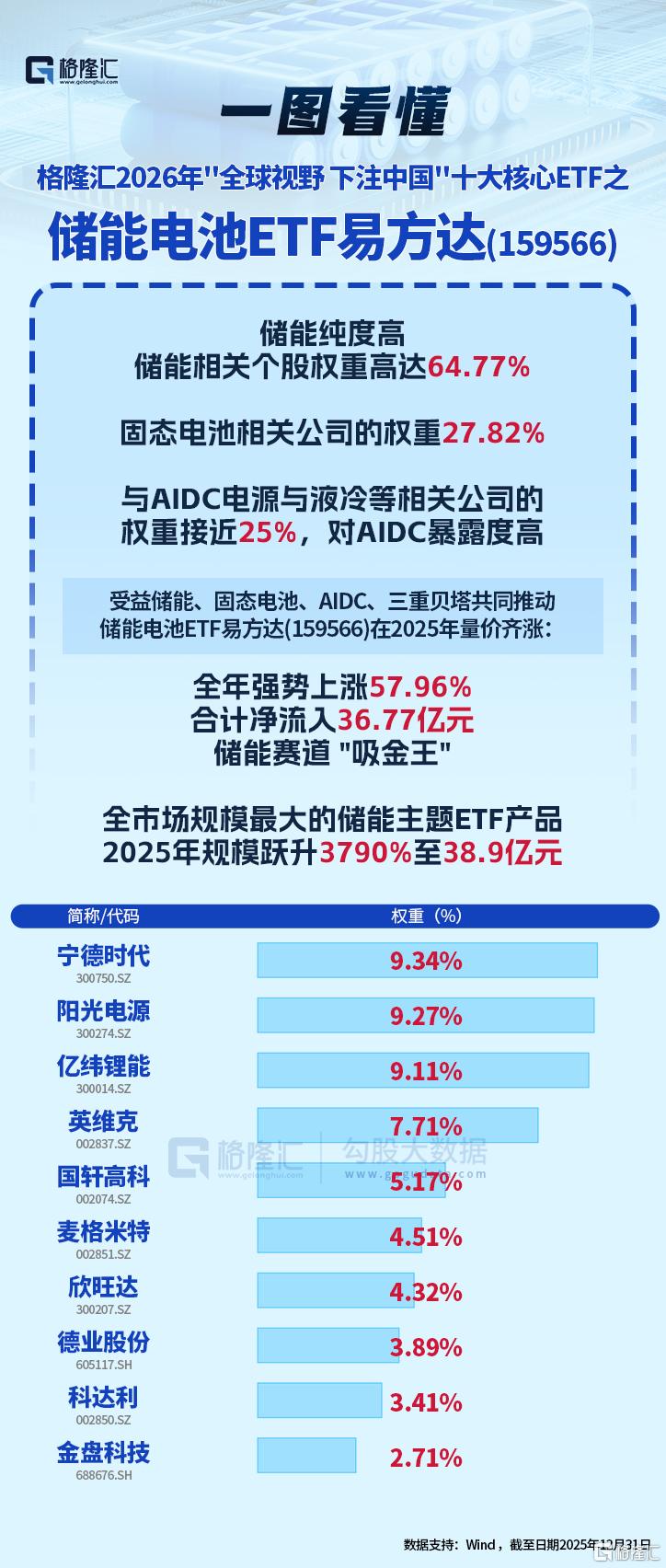
Group 1: Energy Storage Battery ETF - The Energy Storage Battery ETF by E Fund (159566) achieved a strong annual increase of 57.96% in 2025, with its scale rising from 100 million to 3.89 billion, marking a 3790% growth, making it the largest energy storage-related ETF in the market [1] - The ETF tracks the National Securities New Energy Battery Index, focusing on core stocks related to the energy storage battery industry, including leading companies like CATL, Sungrow, EVE Energy, and Inovance [1] - Key characteristics include a high purity of energy storage with 64.77% weight in energy storage-related stocks, benefiting from increased demand for energy storage due to rising data center electricity consumption [1] Group 2: Sci-Tech Chip ETF - The Sci-Tech Chip ETF (588200) tracks the Shanghai Stock Exchange Sci-Tech Board Chip Index, covering the entire chip industry chain, focusing on critical segments, with the top ten holdings accounting for 57% [3][4] - The index consists entirely of companies from the Sci-Tech Board, emphasizing R&D capabilities and technological innovation, representing the "elite force" of the chip industry [4] - The index shows significant growth indicators, with a 39% year-on-year revenue increase and a 94% net profit growth in the first three quarters of 2025 [4] Group 3: Aerospace ETF - The Aerospace ETF (159227) aligns closely with the "space and sky integration" strategy, focusing on military aerospace power, with a high weight of 98.2% in defense and military industries, making it the purest military index in the market [6][7] - The ETF has a significant overlap with commercial aerospace concepts, with a 70.19% correlation, and focuses on key national strategic areas such as military aircraft replacement and satellite internet [6][7] - It recorded a net inflow of 1.329 billion in the period, becoming the leading fund in the aerospace sector [7] Group 4: Hang Seng Technology ETF - The Hang Seng Technology ETF (513010) tracks the Hang Seng Technology Index, selecting 30 leading Hong Kong tech companies, covering sectors like internet platforms, semiconductors, and new energy vehicles [10] - The top ten holdings include major players like Meituan, SMIC, Tencent, and Alibaba, with AI-related companies making up over 60% of the portfolio [10] - The ETF saw a net inflow of 19.047 billion in 2025, with a low comprehensive fee rate of 0.25% per year [10] Group 5: Robotics ETF - The Robotics ETF (562500) focuses on the most competitive leading companies in the industry, with the top ten holdings accounting for 52% of the portfolio, showcasing significant leader effects [12][14] - It includes key component companies like Harmonic Drive and Mingzhi Electric, as well as system integrators like Inovance Technology and iFlytek, providing a balanced exposure to both industrial and humanoid robotics [12][14] - The ETF's latest scale is 26.169 billion, making it the only robotics-themed ETF in the market exceeding 20 billion [12]
计算机行业月报:AI应用全面加速,DeepSeekV4有望深刻改变全球AI的竞争格局-20260122
Zhongyuan Securities· 2026-01-22 08:53
Investment Rating - The report maintains an "Outperform" rating for the computer industry, indicating a positive outlook compared to the market [1]. Core Insights - The acceleration of AI applications is expected to significantly alter the global AI competitive landscape, particularly with the anticipated release of DeepSeek's V4 model [7]. - The Chinese AI cloud market is projected to reach 51.8 billion yuan by 2025 and 193 billion yuan by 2030, with Alibaba aiming to capture 80% of the market's incremental growth in 2026 [7]. - The report highlights the ongoing trend of domestic chip manufacturers gaining market share due to restrictions on foreign competitors like NVIDIA [7]. Summary by Sections Industry Data - From January to November 2025, the software industry revenue reached 13.98 trillion yuan, growing by 13.3% year-on-year, marking a continuous recovery over nine months [13]. - The IC design sector showed a robust growth of 16.5% during the same period, outperforming the overall software industry growth [18]. AI Developments - Major AI models such as OpenAI's GPT-5 and DeepSeek's V3.2 are leading the market, with DeepSeek's models expected to challenge established players significantly [39][44]. - The report notes that the trend of using domestic chips for training large models is anticipated to grow in 2026, with DeepSeek already optimizing its models for compatibility with local hardware [63]. Domestic Market Trends - The report emphasizes the increasing importance of domestic chip manufacturers, as restrictions on foreign technology create opportunities for local firms [7]. - The number of devices running Huawei's HarmonyOS has surpassed 36 million, indicating strong growth in the domestic software ecosystem [7]. Investment Opportunities - The report suggests focusing on companies like Runze Technology, Sugon, and Huada Jiutian, which are positioned well within the AI and chip sectors [7]. - The ongoing IPOs of companies like Changxin Technology and Chipone Semiconductor are highlighted as potential investment opportunities in the semiconductor space [7].





消息称阿里旗下芯片公司平头哥拟独立上市
Xin Lang Cai Jing· 2026-01-22 08:52
Core Viewpoint - Alibaba Group has decided to support its subsidiary chip company, Pingtouge, for an independent IPO, marking a significant step in the company's strategy to unveil its chip capabilities [1]. Group 1: Company Developments - Pingtouge, established in 2018, has been a low-profile entity within Alibaba, described as a "nuclear weapon" that has now come to the forefront with its chip offerings [1]. - The first generation of Pingtouge's PPU chip matches the performance of NVIDIA's popular H20, while the upgraded version surpasses the NVIDIA A100 [2]. - Pingtouge has launched several chips in the computing sector, including the AI inference chip Lingang 800, CPU Yitian 710, and the PPU AI chip, as well as SSD controller chip Zhenyue 510, indicating a comprehensive strategy in data center chips [2]. Group 2: Industry Positioning - Industry experts believe that Alibaba and Google will lead AI development in China and the U.S., as both companies have a full-stack layout from AI chips to applications [3]. - The unveiling of Pingtouge's capabilities is seen as the final piece in Alibaba's AI full-stack strategy, showcasing its long-term investment in foundational chip technology [3].

中国政府只在特殊情况下批准购买H200芯片?商务部回应
第一财经· 2026-01-22 08:48
编辑 | 钉钉 1月22日,商务部举行例行新闻发布会。有媒体提问:有报道称,知情人士透露中国政府告知一些科技 公司,只有在特殊情况下才会批准他们购买H200芯片,请问是否属实?是否正在进行相应措施? 商务部新闻发言人何咏前表示,我不了解你所说的情况。 来源|澎湃新闻 ...
186.68%!业绩爆表!聚焦芯片产业最锋利的“矛”
Ge Long Hui· 2026-01-22 08:06
Group 1 - The semiconductor industry is experiencing a significant surge, with South Korea's semiconductor exports reaching $10.73 billion in the first 20 days of the year, marking a year-on-year increase of over 70% [1] - The Philadelphia Semiconductor Index rose by 3.18%, reaching a historical high, indicating strong market performance in the semiconductor sector [1] - The current chip market is undergoing an unprecedented price surge driven by the wave of generative AI, indicating a structural change rather than a traditional cyclical recovery [2][3] Group 2 - The price of DDR5 memory chips has increased by over 300%, with some server memory prices exceeding 40,000 yuan, highlighting the unprecedented bargaining power of storage giants [4] - The chip design segment, characterized by high margins and flexibility, is becoming a hot investment area, as evidenced by the 20.58% increase in the Tianhong ETF tracking the Sci-Tech Innovation Board Chip Design Index over 13 trading days [4][8] - The domestic market is experiencing a similar structural change, with increasing importance placed on independent chip design capabilities amid rising external challenges and internal demand for computing power [7] Group 3 - The Tianhong ETF tracking the Sci-Tech Innovation Board Chip Design Index shows a remarkable net profit growth of 186.68% year-on-year for the first three quarters of last year, indicating strong fundamentals in chip design companies [8] - The index is expected to see revenue growth rates of 38.48% and 31.33% in 2025 and 2026, respectively, with net profit growth rates projected at 247.70% and 75.42%, outperforming many similar chip indices [12] - The focus on chip design is not just an industry-level discussion but is tied to national security, technological pathways, and long-term competitiveness in the context of China's evolving chip industry [14][15] Group 4 - The Tianhong ETF, launched on January 23, tracks the Sci-Tech Innovation Board Chip Design Index, reflecting the connection between industry evolution and market mechanisms [16] - The external environment, including ongoing trade tensions, is increasing the difficulty of obtaining high-end chips, accelerating the push for self-sufficiency in the semiconductor supply chain [16] - The Chinese cloud AI chip market is projected to reach $4 billion by 2027, with the domestic GPU market share expected to rise significantly, alleviating key supply issues in AI training and inference [16]
1400万出货量,中国车规芯片实现从量产到标准引领
Jing Ji Wang· 2026-01-22 08:03
Core Insights - The article highlights the transition of Chinese chip companies, particularly Gateron, from technology followers to standard setters in the UWB (Ultra-Wideband) joint ranging solution based on the IEEE 802.15.4ab standard [1] - This development reflects a structural upgrade in China's smart automotive industry, moving from reliance on imports to self-innovation in the automotive chip sector [1] Industry Trends - The demand for high-precision perception chips is continuously rising as the automotive intelligence process advances [1] - Third-party data indicates that global UWB device shipments are expected to exceed 1 billion units by 2029, with a compound annual growth rate (CAGR) of 34% in the automotive sector [1] - The millimeter-wave radar market is also experiencing growth, with estimates suggesting that the Chinese automotive radar chip market will surpass 40 million units by 2025, increasing the domestic production rate from 20% in 2024 to 33% [1] Company Developments - Gateron has achieved a milestone of shipping 14 million millimeter-wave radar chips in 2025, accounting for approximately one-third of the domestic market, with a cumulative total exceeding 20 million units [2] - The company has validated its technical capabilities in the European market, with the first luxury model equipped with the Alps-Pro chip entering mass production and delivery in 2025 [2] - In the UWB sector, Gateron has launched next-generation standard-compliant chip products and is advancing the industrialization process through joint testing, enabling Chinese companies to participate in defining technology standards [2] - Automotive chip companies are emphasizing quality system construction, including certifications such as ISO 26262 ASIL B for functional safety, TMMi 4 for software testing maturity, and TISAX AL3 for information security, facilitating entry into international markets [2]