通信设备

Search documents
行业研究|行业周报|通信设备Ⅲ:通信行业周观点:软银兑现OpenAI投资,Meta加码AI Agent-20260107
Changjiang Securities· 2026-01-07 10:46
Investment Rating - The report maintains a "Positive" investment rating for the communication industry [10]. Core Insights - In the 53rd week of 2025, the communication sector experienced a decline of 1.26%, ranking 24th among primary industries in the Yangtze River region. However, since the beginning of 2025, the sector has risen by 84.79%, ranking 1st among primary industries [2][5]. - SoftBank Group has made an additional investment of $22.5 billion in OpenAI, fulfilling its $40 billion investment commitment, increasing its stake to approximately 11%, making it the second-largest shareholder. This funding will primarily support the expansion of OpenAI's large model training and inference capabilities [6][8]. - Meta Platforms has announced the acquisition of AI Agent startup Manus for over $2 billion, marking its third-largest acquisition in history. Manus has processed over 147 trillion tokens and created more than 80 million virtual computer instances, with a revenue run rate exceeding $125 million as of mid-December 2025 [7][8]. Summary by Sections Market Performance - The communication sector's performance in the 53rd week of 2025 showed a decline of 1.26%, while it has increased by 84.79% since the start of the year, leading the primary industries [2][5]. Company Developments - SoftBank's total investment in OpenAI has reached $41 billion, with a focus on enhancing AI capabilities and infrastructure [6]. - Meta's acquisition of Manus is aimed at leveraging AI technology to enhance user engagement across its platforms [7]. Investment Recommendations - The report recommends several companies within the communication sector, including: - Telecom Operators: China Mobile, China Telecom, China Unicom - Optical Modules: Zhongji Xuchuang, Xinyi Sheng, Tianfu Communication - Liquid Cooling: Invec - AI Applications: Boshi Jie, Heertai, Tuobang Co., Yiyuan Communication - Satellite Applications: Huace Navigation, Haige Communication [8].

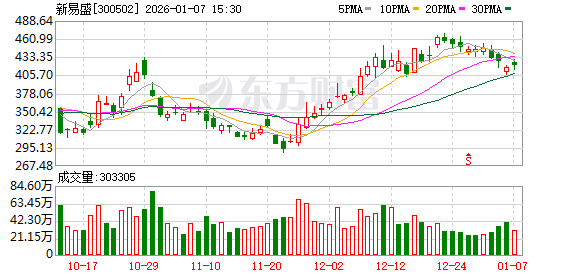
新易盛大宗交易成交2.50万股 成交额1050.75万元
Zheng Quan Shi Bao Wang· 2026-01-07 09:51
两融数据显示,该股最新融资余额为200.27亿元,近5日减少7.09亿元,降幅为3.42%。(数据宝) 1月7日新易盛大宗交易一览 | 成交量(万 | 成交金额(万 | 成交价格 | 相对当日收盘折溢价 | 买方营业 | 卖方营业 | | --- | --- | --- | --- | --- | --- | | 股) | 元) | (元) | (%) | 部 | 部 | | 2.50 | 1050.75 | 420.30 | 0.00 | 机构专用 | 机构专用 | 新易盛1月7日大宗交易平台出现一笔成交,成交量2.50万股,成交金额1050.75万元,大宗交易成交价为 420.30元。该笔交易的买卖双方均为机构专用席位。 (文章来源:证券时报网) 进一步统计,近3个月内该股累计发生14笔大宗交易,合计成交金额为1.13亿元。 证券时报·数据宝统计显示,新易盛今日收盘价为420.30元,上涨0.66%,日换手率为3.43%,成交额为 127.89亿元,全天主力资金净流入6.13亿元,近5日该股累计下跌5.44%,近5日资金合计净流出32.78亿 元。 ...


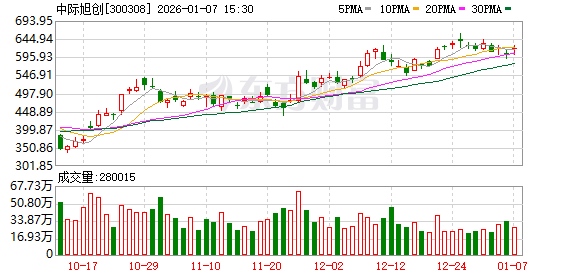
中际旭创现2笔大宗交易 合计成交2.20万股
Zheng Quan Shi Bao Wang· 2026-01-07 09:48
证券时报·数据宝统计显示,中际旭创今日收盘价为619.60元,上涨2.37%,日换手率为2.53%,成交额 为172.81亿元,全天主力资金净流入3.60亿元,近5日该股累计上涨0.26%,近5日资金合计净流出35.78 亿元。 两融数据显示,该股最新融资余额为215.75亿元,近5日增加5.21亿元,增幅为2.47%。(数据宝) 1月7日中际旭创大宗交易一览 | 成交量(万 | 成交金额(万 | | 成交价格 | 相对当日收盘折溢价 | 买方营业部 | 卖方营 | | --- | --- | --- | --- | --- | --- | --- | | 股) | | 元) | (元) | (%) | | 业部 | | 1.80 | 1115.28 | | 619.60 | 0.00 | 机构专用 | 机构专 | | | | | | | | 用 | | 0.40 | 247.84 | | 619.60 | 0.00 | 华泰证券股份有限公司盐 | 机构专 | | | | | | | 城分公司 | 用 | 中际旭创1月7日大宗交易平台共发生2笔成交,合计成交量2.20万股,成交金额1363.12万元。成交价格 ...

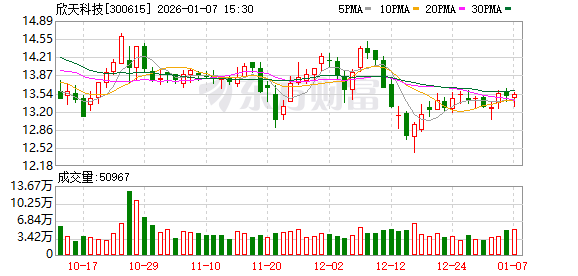
欣天科技:截至2025年12月31日股东总户数为13994户
Zheng Quan Ri Bao· 2026-01-07 09:39
Group 1 - The core point of the article is that Xintian Technology has disclosed its total number of shareholders, which is 13,994 as of December 31, 2025 [2]

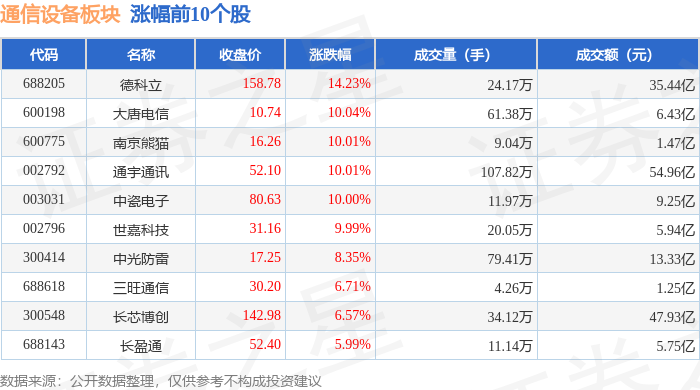
通信设备板块1月7日涨1.6%,德科立领涨,主力资金净流入42.06亿元
Zheng Xing Xing Ye Ri Bao· 2026-01-07 08:59
证券之星消息,1月7日通信设备板块较上一交易日上涨1.6%,德科立领涨。当日上证指数报收于 4085.77,上涨0.05%。深证成指报收于14030.56,上涨0.06%。通信设备板块个股涨跌见下表: 从资金流向上来看,当日通信设备板块主力资金净流入42.06亿元,游资资金净流出27.56亿元,散户资金 净流出14.5亿元。通信设备板块个股资金流向见下表: | 代码 | 名称 | 主力净流入(元) | 主力净占比 游资净流入 (元) | | 游资净占比 散户净流入 (元) | | 散户净占比 | | --- | --- | --- | --- | --- | --- | --- | --- | | 002792 通宇通讯 | | 11.54 Z | 21.00% | -7.11 亿 | -12.94% | -4.43 Z | -8.05% | | 600105 | 永鼎股份 | 5.69 Z | 8.22% | -1.86亿 | -2.69% | -3.83 Z | -5.54% | | 300502 | 新易盛 | 5.63 亿 | 4.40% | -5.62 Z | -4.39% | -84.76万 | ...

上市公司回购、增持、分红月度跟踪(2025年12月):AH股回购金额大幅增长,关注新发布分红承诺公司-20260107
Shenwan Hongyuan Securities· 2026-01-07 08:40
Group 1 - The report highlights a significant increase in stock buybacks and dividend commitments among listed companies, with A-share buyback amounts rising by 97% and buyback proposals increasing by 50% in December 2025 compared to November 2025 [5][10]. - In December 2025, the total amount of buyback transactions in A-shares reached approximately 232.6 billion, with 88 transactions recorded, marking a substantial increase from the previous month [10][11]. - The report identifies the top three companies with the largest proposed buyback amounts: China Metallurgical Group, ZTE Corporation, and Zhongju Hi-Tech, with proposed amounts of 10-20 billion, 10-12 billion, and 3-6 billion respectively [10][11]. Group 2 - The report notes that the total amount of buyback and increase loans applied for in December 2025 was approximately 1604.5 billion, with 788 transactions recorded, indicating a structural preference for buybacks over increases [8][9]. - The A-share market saw a 58% increase in actual buybacks by controlling shareholders in December 2025, with a total of 38.9 billion in buybacks, although the number of new buyback proposals dropped significantly by 82% [17]. - The report also provides insights into the Hong Kong stock market, where buyback amounts reached approximately 219.3 billion HKD in December 2025, a rise of 87% from the previous month, driven by stock price corrections [23][24]. Group 3 - The report emphasizes the importance of dividend commitments as a key component of shareholder returns, tracking new dividend commitments from listed companies, with notable companies listed for December 2025 [30][31]. - The report suggests a focus on companies with significant buyback and increase announcements, providing a list of companies for investor reference based on their fundamentals and current valuations [27][28].




华为申请注册“赛道传奇”商标
Zheng Quan Ri Bao· 2026-01-07 08:11
本报讯天眼查知识产权信息显示,近日,华为技术有限公司申请注册"赛道传奇"商标,国际分类为科学 仪器、珠宝钟表,当前商标状态均为等待实质审查。 (文章来源:证券日报) ...
科创板收盘播报:科创50指数涨0.99% 元器件股表现强势
Xin Hua Cai Jing· 2026-01-07 07:45
Group 1 - The Sci-Tech Innovation 50 Index opened high on January 7, fluctuated within a narrow range, turned negative in the afternoon, and then rose significantly, closing at 1443.39 points with an increase of 0.99% and a total trading volume of approximately 871.3 billion yuan [1] - The Sci-Tech Innovation Composite Index rose by 1.53% on January 7, closing at 1746.72 points with a total trading volume of about 3094 billion yuan. The average increase for the 600 stocks in the Sci-Tech Innovation Board was 1.73% with an average turnover rate of 4.27% [2] - High-priced stocks generally rose while low-priced stocks showed mixed performance. Notably, component stocks and electrical equipment stocks performed strongly, while healthcare and communication equipment stocks had the largest declines [2] Group 2 - The stock with the highest trading volume was Cambrian with 94.2 billion yuan, while ST Pava had the lowest trading volume at 482.2 million yuan [3] - The stock with the highest turnover rate was Hengkang New Materials at 41.79%, while Longteng Optoelectronics had the lowest turnover rate at 0.26% [4]


上市公司回购、增持、分红月度跟踪(2025年12月):AH股回购金额大幅增长,关注新发布分红承诺公司-20260107
Shenwan Hongyuan Securities· 2026-01-07 07:41
Group 1 - The report highlights a significant increase in stock repurchase amounts in December 2025, with a 97% month-on-month growth in implemented repurchases, totaling approximately 232.6 billion CNY [11][23] - The report notes that the total amount of repurchase plans announced in December reached 88.3 billion CNY, marking a 50% increase from November [11][23] - The majority of the funds used for repurchases, about 95%, came from self-owned or raised funds, with only 5% from special loans [11][23] Group 2 - In December 2025, the amount of stock repurchases in the Hong Kong market was approximately 219.3 billion HKD, reflecting an 87% increase compared to November, primarily due to stock price corrections [23] - The top three companies in terms of repurchase amounts in the Hong Kong market were Tencent Holdings, Xiaomi Group-W, and China COSCO Holdings, with repurchase amounts of 133.5 billion HKD, 32.5 billion HKD, and 9.2 billion HKD respectively [23] Group 3 - The report identifies key companies for potential investment based on their recent repurchase and increase announcements, considering their fundamentals, current valuations, and the proportion of repurchase/increase amounts [27][30] - Notable companies for repurchase in December include China Metallurgical Group, ZTE Corporation, and Zhongju High-tech, with planned repurchase amounts of 10-20 billion CNY, 10-12 billion CNY, and 3-6 billion CNY respectively [28] - For the A-share market, the report lists companies with significant dividend commitments, such as Gigabit and Weixing New Materials, emphasizing their commitment to shareholder returns [31]
南方周末:中国企业科创力研究报告(2025)
Sou Hu Cai Jing· 2026-01-07 06:10
Core Insights - The "2025 China Enterprise Innovation Capability Research Report" covers 7,065 enterprises, showcasing the development trends in technological innovation within Chinese companies, focusing on R&D investment, output, and enterprise growth [1][2]. R&D Investment - R&D investment among enterprises continues to grow, reaching a total of 2.71 trillion yuan in 2025, with Huawei leading at 179.7 billion yuan, the only company surpassing the 100 billion yuan mark [1][2]. - Private enterprises constitute 56% of the top 100 in innovation capability, while non-state-owned enterprises account for 60%, indicating their dominance in technological innovation [1][2]. - The information transmission, software, and IT services sectors lead in R&D investment, with the automotive manufacturing sector showing significant growth [1][2]. R&D Output - The quality of innovation is steadily improving, with the proportion of invention patent applications reaching 61.38%, a notable increase from previous years [2]. - A total of 878 enterprises contributed to 43.27% of the national PCT patent applications, with Xiaomi entering the global top 10 for the first time [2]. - 2,039 enterprises participated in 74.89% of national standard-setting activities, particularly in the electronic information and communication sectors [2]. Enterprise Development - The 7,048 enterprises that disclosed revenue achieved a combined total of 94.36 trillion yuan, showing a positive correlation between revenue and R&D investment, with nearly half of the billion-yuan enterprises achieving "double growth" [2]. - Despite operational pressures, 934 enterprises increased their R&D investment, with significant contributions from companies listed on the Sci-Tech Innovation Board and the Growth Enterprise Market [2]. - Over five years, the number of enterprises disclosing R&D investment and personnel has increased by 34.07% and 36.30%, respectively, indicating a rise in transparency regarding innovation capabilities [2]. Overall Trends - Chinese enterprises are transitioning from cost leadership to technology leadership, moving from technological catch-up to original innovation [2]. - Emerging fields such as artificial intelligence, biomedicine, and semiconductors are becoming hotspots for innovation, while traditional industries are revitalizing through technological upgrades [2]. - The continuous improvement of the innovation ecosystem is expected to further enhance the innovation capabilities of enterprises, providing sustained momentum for high-quality economic development [2].