自动驾驶

Search documents
轻舟智航:计划2026上半年在宁波投放数百台无人物流车
Zheng Quan Shi Bao Wang· 2025-11-21 00:41
Core Viewpoint - The strategic partnership between Lightyear Zhihang and Zhejiang Jinpost Supply Chain Technology Service Co., Ltd. aims to promote the large-scale commercial use of L4 autonomous logistics vehicles on open roads in Ningbo by 2025 [1] Group 1 - The agreement was signed on November 20, indicating a formal collaboration between the two companies [1] - The plan includes the establishment of multiple benchmark routes for autonomous logistics operations in Ningbo by 2025, focusing on the delivery and transfer of goods between distribution points and stations [1] - The companies intend to deploy hundreds of autonomous logistics vehicles in the first half of 2026 [1]
工业界算法专家带队!面向落地的端到端自动驾驶小班课
自动驾驶之心· 2025-11-21 00:04
Core Insights - The article emphasizes the importance of end-to-end production in the automotive industry, highlighting the scarcity of qualified talent in this area [1][3] - A newly designed advanced course on end-to-end production has been developed to address the industry's needs, focusing on practical applications and real-world scenarios [3][5] Course Overview - The course covers essential algorithms such as one-stage and two-stage end-to-end frameworks, reinforcement learning applications, and trajectory optimization techniques [5][10] - It aims to provide hands-on experience and insights into production challenges, making it suitable for individuals looking to advance or transition in their careers [5][18] Course Structure - Chapter 1 introduces the overview of end-to-end tasks, focusing on the integration of perception and control algorithms [10] - Chapter 2 discusses the two-stage end-to-end algorithm framework, including its modeling and information transfer methods [11] - Chapter 3 covers the one-stage end-to-end algorithm framework, emphasizing its advantages in information transmission [12] - Chapter 4 focuses on the application of navigation information in autonomous driving, detailing map formats and encoding methods [13] - Chapter 5 introduces reinforcement learning algorithms, highlighting their necessity alongside imitation learning [14] - Chapter 6 provides practical experience in trajectory output optimization, combining imitation and reinforcement learning [15] - Chapter 7 discusses fallback strategies for trajectory smoothing and reliability in production [16] - Chapter 8 shares production experiences from various perspectives, including data and model optimization [17] Target Audience - The course is designed for advanced learners with a foundational understanding of autonomous driving algorithms, reinforcement learning, and programming skills [18][19] Course Logistics - The course starts on November 30 and spans three months, featuring offline video lectures and online Q&A sessions [20]

驭势科技 | 规划算法工程师招聘(可直推)
自动驾驶之心· 2025-11-21 00:04
Core Insights - The article discusses the advancements in autonomous driving technology, particularly focusing on the development and implementation of VLA (Vehicle-Language Architecture) by Xiaopeng Motors, highlighting its significance in the industry [14]. Group 1: Company Developments - Xiaopeng Motors has announced the launch of VLA 2.0, which represents a significant step in the evolution of autonomous driving technology, transitioning from perception-based systems to more integrated approaches [14]. - The article reflects on a year of research and development in VLA, indicating a shift in focus from traditional perception methods to VLA, which aims to enhance the vehicle's decision-making capabilities [14]. Group 2: Industry Trends - The article notes a growing trend in the industry towards end-to-end autonomous driving solutions, with VLA being positioned as a potential game-changer in how vehicles interact with their environment [14]. - There is a discussion on the competitive landscape, particularly the debate between world models and VLA routes, suggesting that the industry is at a crossroads in terms of technological direction [14]. Group 3: Research and Academic Contributions - The article mentions recent academic contributions, such as the paper from The Chinese University of Hong Kong (Shenzhen) and Didi, which proposes a new method for dynamic driving scene reconstruction, indicating ongoing research efforts in the field [14].
NeurIPS'25 | 博世最新D2GS:无需LiDAR的自驾场景重建方案
自动驾驶之心· 2025-11-21 00:04
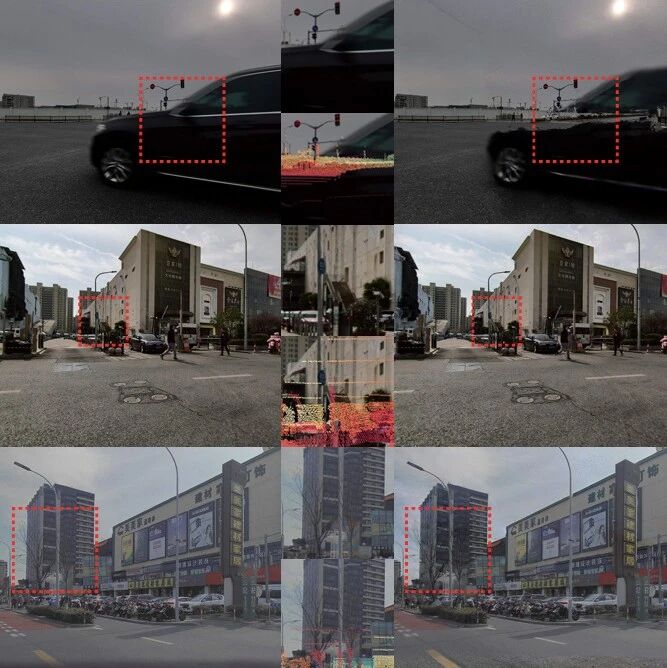
Core Viewpoint - The article discusses the potential of D²GS, a framework for urban scene reconstruction in autonomous driving that does not rely on LiDAR, addressing challenges associated with traditional methods that depend on multi-modal sensor inputs [3][6]. Group 1: D²GS Framework - D²GS offers a solution for urban scene reconstruction without the need for LiDAR, achieving comparable geometric priors that are denser and more accurate [3][6]. - Traditional methods face challenges such as precise spatial-temporal calibration between LiDAR and other sensors, and projection errors when sensors are misaligned [3]. Group 2: Technical Insights - The framework utilizes multi-view depth initialization of Gaussian point clouds and alternates optimization of 3DGS scenes and depth estimation during training [6]. - The approach aims to overcome calibration errors and depth projection issues commonly encountered in LiDAR-based systems [6]. Group 3: Expert Insights - Zhang Youjian, an expert in 3D reconstruction algorithms from Bosch Innovation Software Center, is featured to provide detailed analysis of the D²GS work [8].
自动驾驶三大技术路线:端到端、VLA、世界模型
自动驾驶之心· 2025-11-21 00:04
Overview - The article discusses the ongoing technological competition in the autonomous driving industry, focusing on different approaches to solving corner cases and enhancing safety and efficiency in driving systems [1][3]. Technological Approaches - There is a debate between two main technological routes: single-vehicle intelligence (VLA) and intelligent networking (VLM) [1]. - Major companies like Waymo utilize VLM, which allows AI to handle environmental understanding and reasoning, while traditional modules maintain decision-making control for safety [1]. - Companies such as Tesla, Geely, and XPeng are exploring VLA, aiming for AI to learn all driving skills through extensive data training for end-to-end decision-making [1]. Sensor and Algorithm Developments - The article highlights the evolution of perception technologies, with BEV (Bird's Eye View) perception becoming mainstream by 2022, and OCC (Occupancy) perception gaining traction in 2023 [3][5]. - BEV integrates various sensor data into a unified spatial representation, facilitating better path planning and dynamic information fusion [8][14]. - OCC perception provides detailed occupancy data, clarifying the probability of space being occupied over time, which enhances dynamic interaction modeling [6][14]. Modular and End-to-End Systems - Prior to the advent of multimodal large models and end-to-end autonomous driving technologies, perception and prediction tasks were typically handled by separate modules [5]. - The article outlines a phased approach to modularization, where perception, prediction, decision-making, and control are distinct yet interconnected [4][31]. - End-to-end systems aim to streamline the process by allowing direct mapping from raw sensor inputs to actionable outputs, enhancing efficiency and reducing bottlenecks [20][25]. VLA and VLM Frameworks - VLA (Visual-Language-Action) and VLM (Visual-Language Model) frameworks are discussed, with VLA focusing on understanding complex scenes and making autonomous decisions based on visual and language inputs [32][39]. - The article emphasizes the importance of language models in enhancing the interpretability and safety of autonomous driving systems, allowing for better cross-scenario knowledge transfer and decision-making [57]. Future Directions - The competition between VLA and WA (World Action) architectures is highlighted, with WA emphasizing direct visual-to-action mapping without language mediation [55][56]. - The article suggests that the future of autonomous driving will involve integrating world models that understand physical laws and temporal dynamics, addressing the limitations of current language models [34][54].
小马智行-W(02026.HK)获The Goldman Sachs Group增持118.28万股
Ge Long Hui· 2025-11-20 23:53
Group 1 - The Goldman Sachs Group, Inc. increased its stake in 小马智行-W (02026.HK) by purchasing 1,182,800 shares at an average price of HKD 96.5407 per share, totaling approximately HKD 114 million [1] - Following this transaction, The Goldman Sachs Group, Inc.'s total holdings in 小马智行-W rose to 25,090,336 shares, increasing its ownership percentage from 6.78% to 7.12% [1]

轻舟智航李栋:现在我们处在一个高阶辅助驾驶全面落地的阶段 我们相信未来会有L4大规模量产
2 1 Shi Ji Jing Ji Bao Dao· 2025-11-20 15:48
Core Insights - The CTO of Qingsong Zhihang, Li Dong, announced that their technology has been integrated into over 20 vehicle models, with total software deployment expected to exceed 1 million units [1] - Li Dong emphasized that the industry is currently at a stage where advanced driver assistance systems (ADAS) are being fully implemented, and large-scale production of Level 4 (L4) autonomous driving is anticipated in the future [1] - Qingsong Zhihang's technology is characterized by the use of a unified technology stack that supports both Level 2 (L2) and L4 operations, allowing for shared operational experience and safety redundancies to enhance both levels [1]
美股异动 | 文远知行(WRD.US)涨逾7% 旗下Robotaxi获瑞士纯无人牌照
智通财经网· 2025-11-20 15:18
Core Viewpoint - WeRide has received a fully autonomous license for its Robotaxi service in Switzerland, marking a significant milestone in the autonomous driving industry and enhancing its global presence in the market [1] Company Summary - WeRide's Robotaxi has officially obtained a fully autonomous license from the Swiss Federal Roads Office, allowing it to operate without a driver on public roads in the Zurich area [1] - This license is the first of its kind issued in Switzerland for a fully autonomous Robotaxi [1] - WeRide is now the only technology company globally that holds autonomous driving licenses in eight countries, including Switzerland, China, UAE, Saudi Arabia, Singapore, France, Belgium, and the United States [1] Market Reaction - Following the announcement, WeRide's stock price increased by over 7%, reaching $7.68 [1]

文远知行(WRD.US)涨逾7% 旗下Robotaxi获瑞士纯无人牌照
Zhi Tong Cai Jing· 2025-11-20 15:17
Core Viewpoint - WeRide has received the first fully autonomous Robotaxi license in Switzerland, allowing it to operate on public roads in Zurich, marking a significant milestone in the autonomous driving industry [1] Company Summary - WeRide's stock increased by over 7%, reaching $7.68 following the announcement of its new license [1] - The company is now the only technology firm globally to hold autonomous driving licenses in eight countries, including Switzerland, China, UAE, Saudi Arabia, Singapore, France, Belgium, and the United States [1]
基于准确的原始材料对比小鹏理想VLA
理想TOP2· 2025-11-20 10:42
Core Viewpoint - The article discusses the advancements in autonomous driving technology, particularly focusing on the VLA (Vision-Language-Action) architecture developed by Li Auto and the insights shared by Xiaopeng's autonomous driving head, Liu Xianming, during a podcast. Liu emphasizes the removal of the intermediate language component (L) to enhance scalability and efficiency in data usage [1][4][5]. Summary by Sections VLA Architecture and Training Process - The VLA architecture involves a pre-training phase using a 32 billion parameter (32B) vision-language model that incorporates 3D vision and high-definition 2D vision, improving clarity by 3-5 times compared to open-source models. It also includes driving-related language data and key VL joint data [10][11]. - The model is distilled into a 3.2 billion parameter (3.2B) MoE model to ensure fast inference on vehicle hardware, followed by a post-training phase that integrates action to form the VLA, increasing the parameter count to nearly 4 billion [13][12]. - The reinforcement learning phase consists of two parts: human feedback reinforcement learning (RLHF) and pure reinforcement learning using world model-generated data, focusing on comfort, collision avoidance, and adherence to traffic regulations [15][16]. Data Utilization and Efficiency - Liu argues that using language as a supervisory signal can introduce human biases, reducing data efficiency and scalability. The most challenging data to collect are corner cases, which are crucial for training [4][6]. - The architecture aims to achieve a high level of generalization, with plans to implement L4 robotaxi services in Guangzhou based on the current framework [4][5]. Future Directions and Challenges - Liu acknowledges the uncertainties in scaling the technology and ensuring safety, questioning how to maintain safety standards and align the model with human behavior [5][18]. - The conversation highlights that the VLA, VLM, and world model are fundamentally end-to-end architectures, with various companies working on similar concepts in the realm of Physical AI [5][18]. Human-Agent Interaction - The driver agent is designed to process short commands directly, while complex instructions are sent to the cloud for processing before execution. This approach allows the system to understand and interact with the physical world like a human driver [17][18]. - The article concludes that the traffic domain is a suitable environment for VLA implementation due to its defined rules and the ability to model human driving behavior effectively [19][20].