Funds

Search documents
创新药、黄金股票相关ETF上周领涨丨ETF基金周报
2 1 Shi Ji Jing Ji Bao Dao· 2025-06-16 03:31
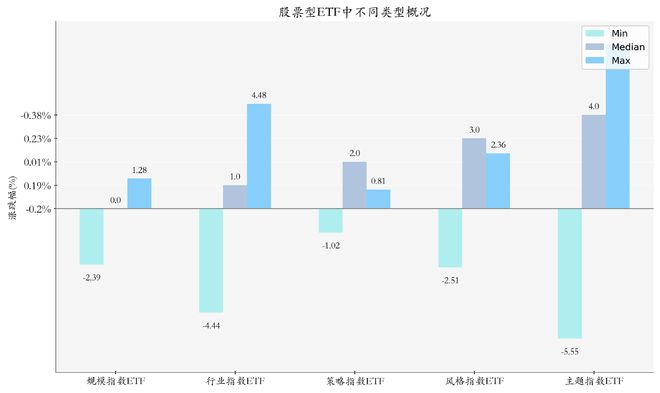
Market Overview - The Shanghai Composite Index fell by 0.25% to 3377.0 points, with a weekly high of 3413.51 points [1] - The Shenzhen Component Index decreased by 0.6% to 10122.11 points, reaching a high of 10295.4 points [1] - The ChiNext Index rose by 0.22% to 2043.82 points, with a peak of 2076.91 points [1] - In global markets, the Nasdaq Composite dropped by 0.63%, the Dow Jones Industrial Average fell by 1.32%, and the S&P 500 decreased by 0.39% [1] - In the Asia-Pacific region, the Hang Seng Index increased by 0.42%, and the Nikkei 225 rose by 0.25% [1] ETF Market Performance - The median weekly return for stock ETFs was -0.19% [2] - The highest weekly return among scale index ETFs was 1.28% for the China Asset Management CSI 500 Enhanced Strategy ETF [2] - The highest weekly return in industry index ETFs was 4.48% for the Penghua National Oil and Gas ETF [2] - The highest weekly return in thematic index ETFs was 6.99% for the Fuguo CSI Hong Kong-Shanghai Innovation Drug Industry ETF [2] ETF Liquidity - Average daily trading volume for stock ETFs increased by 19.9%, while average daily turnover rose by 14.1% [6] ETF Fund Flows - The top five stock ETFs by fund inflow were: - Jiashi CSI 500 ETF with an inflow of 340 million yuan - Penghua National Wine ETF with 339 million yuan - Huaxia SSE STAR 50 ETF with 271 million yuan - Guotai National Military Industry ETF with 225 million yuan - Fuguo National Military Industry Leader ETF with 221 million yuan [9] - The top five stock ETFs by fund outflow were: - Huaxia SSE 50 ETF with an outflow of 635 million yuan - Huatai-PineBridge CSI Dividend Low Volatility ETF with 369 million yuan - Invesco CSI A500 ETF with 297 million yuan - Jiashi CSI 300 Dividend Low Volatility ETF with 279 million yuan - Huaxia CSI A500 ETF with 262 million yuan [10] ETF Financing and Margin Trading - The financing balance for stock ETFs decreased from 40.7357 billion yuan to 40.2446 billion yuan [11] - The highest financing buy amount was 470 million yuan for the Huaxia SSE STAR 50 ETF [11] ETF Market Size - The total market size for ETFs reached 41,626.28 billion yuan, a decrease of 17.23 billion yuan from the previous week [14] - The stock ETF market accounted for 71.1% of the total ETF market size [16] ETF Issuance and Establishment - No new ETFs were issued last week, but two new ETFs were established: Huabao CSI Pharmaceutical ETF and Fuguo National Consumption Theme ETF [17] Institutional Views - Founder Securities noted that the systematic valuation increase in the innovative drug sector is the biggest catalyst for industry allocation recovery, driven by leading companies entering profitability and R&D pipelines generating regular income [17] - Huaxin Securities expressed a bullish outlook on gold prices due to rising geopolitical risks in the Middle East, suggesting that while short-term spikes may occur, long-term factors like real interest rates and global uncertainty will dominate gold price trends [17]

两市ETF两融余额较前一交易日减少2.19亿元丨ETF融资融券日报
Sou Hu Cai Jing· 2025-06-16 03:06
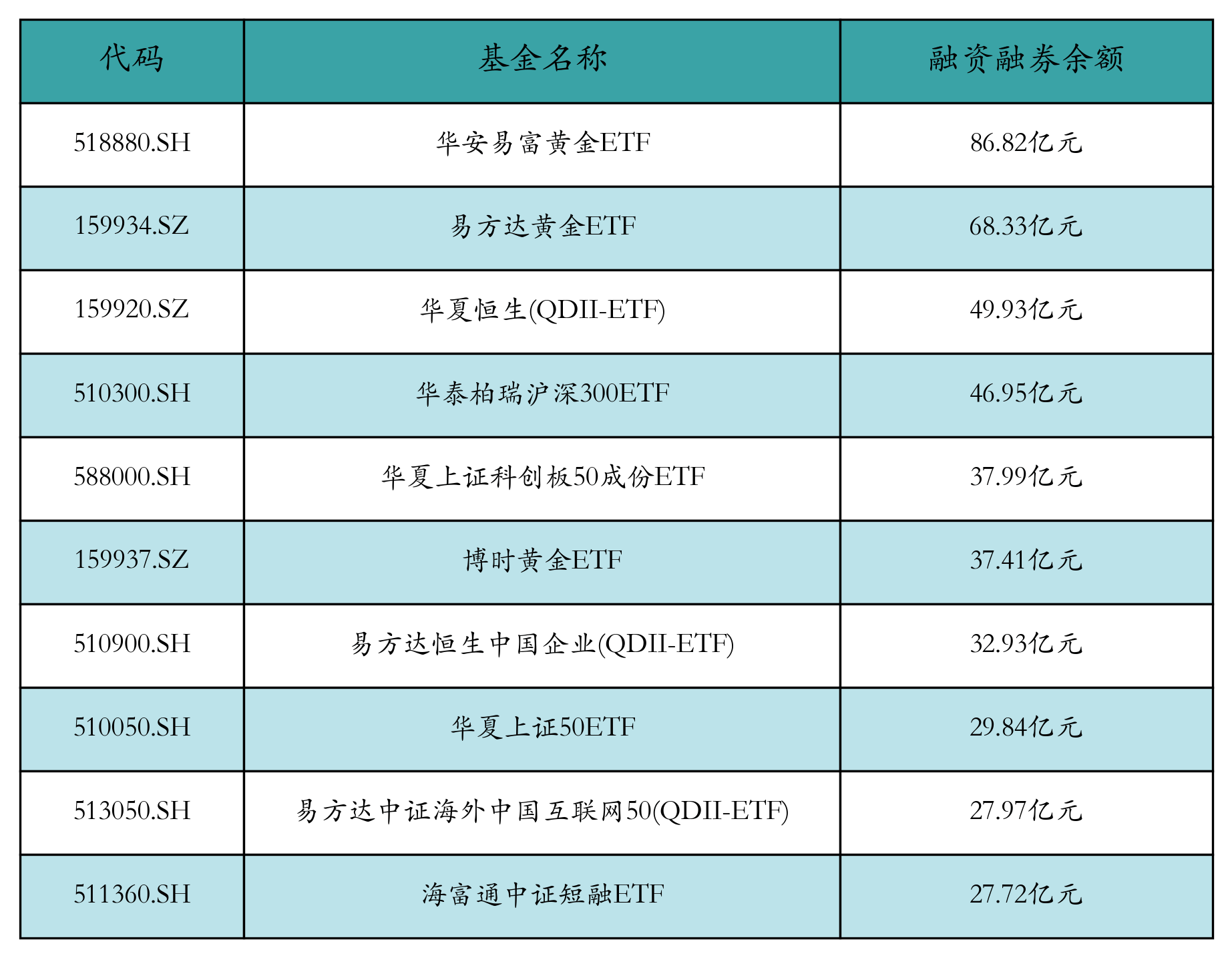
Market Overview - On June 13, the total ETF margin balance in the two markets was 99.534 billion yuan, a decrease of 0.219 billion yuan from the previous trading day [1] - The financing balance was 93.888 billion yuan, down by 0.244 billion yuan, while the securities lending balance increased by 24.5126 million yuan to 5.646 billion yuan [1] - In the Shanghai market, the ETF margin balance was 66.162 billion yuan, a decrease of 0.33 billion yuan, with a financing balance of 61.252 billion yuan, down by 0.348 billion yuan [1] - In the Shenzhen market, the ETF margin balance was 33.372 billion yuan, an increase of 0.111 billion yuan, with a financing balance of 32.636 billion yuan, up by 0.105 billion yuan [1] ETF Margin Balance - The top three ETFs by margin balance on June 13 were: - Huaan Yifu Gold ETF (8.682 billion yuan) - E Fund Gold ETF (6.833 billion yuan) - Huaxia Hang Seng (QDII-ETF) (4.993 billion yuan) [2] ETF Financing Buy Amount - The top three ETFs by financing buy amount on June 13 were: - Hai Futu Zhong Zheng Short Bond ETF (1.004 billion yuan) - GF Zhong Zheng Hong Kong Innovative Medicine (QDII-ETF) (946 million yuan) - Huatai Bairui Southern Dongying Hang Seng Technology Index (QDII-ETF) (798 million yuan) [4] ETF Financing Net Buy Amount - The top three ETFs by financing net buy amount on June 13 were: - Huitianfu Guozheng Hong Kong Stock Connect Innovative Medicine ETF (65.859 million yuan) - Huaxia Hang Seng Internet Technology Industry (QDII-ETF) (53.976 million yuan) - Huaan Yifu Gold ETF (44.137 million yuan) [6] ETF Securities Lending Sell Amount - The top three ETFs by securities lending sell amount on June 13 were: - Southern Zhong Zheng 1000 ETF (86.8632 million yuan) - Huatai Bairui Hu and Shen 300 ETF (24.9355 million yuan) - Huaxia Zhong Zheng 1000 ETF (19.2102 million yuan) [8]
嘉实基金旗下22只指数产品集体更名
Sou Hu Cai Jing· 2025-06-16 02:28
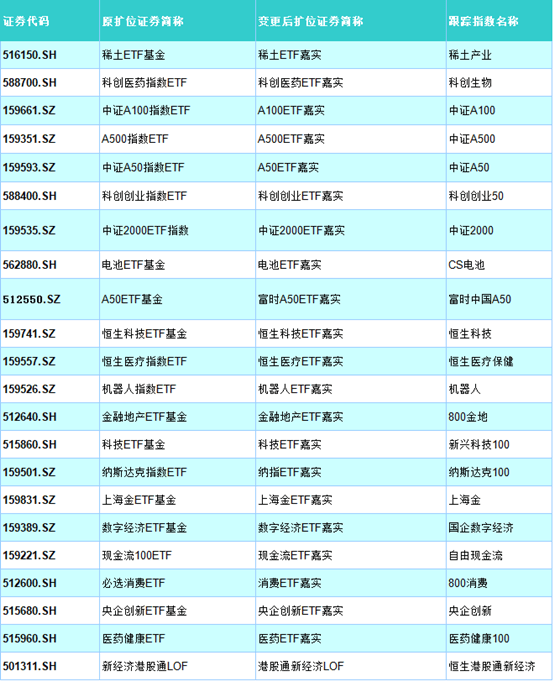
Core Viewpoint - On June 16, 2023, Jiashi Fund announced a collective renaming of 22 of its products starting June 17, aimed at enhancing investor recognition and convenience in ETF investments [1][3] Group 1: Product Renaming Details - The renaming involves several core broad-based and thematic ETFs under Jiashi Fund, including changes such as "稀土ETF基金" to "稀土ETF嘉实" (516150), "A500指数ETF" to "A500ETF嘉实" (159351), and "纳斯达克指数ETF" to "纳指ETF嘉实" (159501) [1][2] - The new naming convention follows a format of "Index Name + ETF + Manager Name," which aims to provide clear and direct information about the fund's characteristics [3] Group 2: Market Context and Impact - The ETF market in China has seen rapid growth, with over 21 million investors and a total of 1,186 ETF products, reaching a scale of 4.17 trillion yuan [4] - Jiashi Fund emphasizes that the renaming will not affect product codes, fees, or investment strategies, ensuring that existing holder rights remain intact [4] - The company aims to focus on investor needs and enhance service innovation, reflecting a shift towards high-quality development in the public fund industry [4]
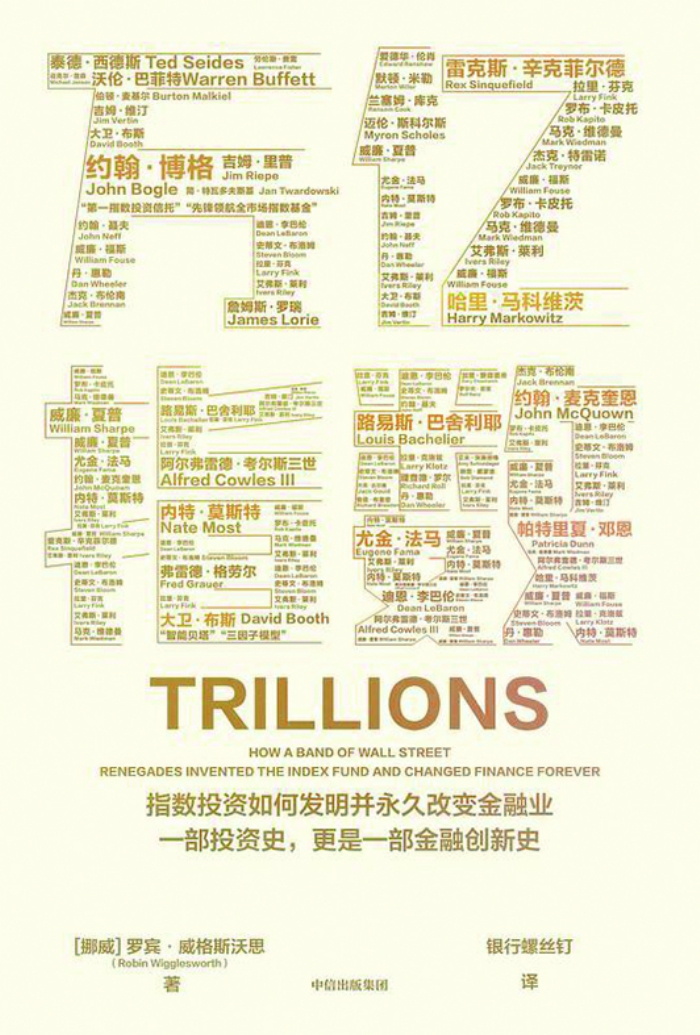
指数基金:被动投资的智慧与力量——读《万亿指数》
Shang Hai Zheng Quan Bao· 2025-06-15 17:59
好捷加·修州 ·西德斯 Ted Seides 800 空亮相所得 "完斯· 沃伦 · 巴菲特Warren Buffett 默頓 · 米蘭 拉里 · 芬克 Rex Sinquefield 倫頓 · 慶福宗 Burton Malkie Larry Fi 合演出 · 旋式 罗布 · 卡皮托 直姆 · 维汀 26 IC (40) 11 迈伦 · 斯科尔斯 马克·维德 大卫·布局 Myron Scholes 成绩 · 夏卡 查见 ·特雷诺 格 信號 · 里 EF 成區·提斯 John Boqle # #ESANE Jan Twardo William Four 曲线 · 国图 布·卡皮杆 投资信托""先锋领航全市场指 的脸 · 精美 马克 · 维德 於10.18 脏癌 · 福斯 艾弗斯·莱利 丹· 原因 William F 兵 · 周公 旋幕 · 堪斯 艾麦图 · 湖北 Gan Whee 艾弗瑟·斯科 Villiam Fouse 品 · 高校园 中国:东1 图 转 e 微 · 罗 · 罗 · 罗 · 罗 · · 罗 · · 罗 · · 罗 试用·其實 表演 · 傲门 Harry Markowitz James Lori ...
中央汇金金融版图扩容“全链条”优势凸显 旗下券商整合预期升温
Zhong Guo Jing Ying Bao· 2025-06-15 06:34
Core Viewpoint - Central Huijin Investment Co., Ltd. has been approved to become the actual controller of eight financial institutions under the three major Asset Management Companies (AMCs), marking a continuation of its business integration efforts after taking over the control from the Ministry of Finance in February 2023 [1][2]. Group 1: Central Huijin's Financial Institutions - The eight newly controlled financial institutions include Changcheng Guorui Securities, Dongxing Securities, Xinda Securities, Dongxing Fund Management, Xinda Australia Fund Management, Changcheng Futures, Dongxing Futures, and Xinda Futures, completing Central Huijin's full license layout in the securities, fund, and futures sectors [2][3]. - Following the approval, Central Huijin will directly or indirectly control over 20 financial institutions across banking, insurance, and securities sectors, enhancing its operational scale and influence [3]. Group 2: Market Implications and Opportunities - The integration of these institutions is expected to create a "full-chain" advantage, allowing for better collaboration in areas such as distressed asset disposal, investment banking services, and asset management product innovation [3][4]. - Analysts predict that the consolidation of brokerages under Central Huijin will lead to a new wave of mergers and acquisitions in the securities industry, driven by regulatory support for supply-side reforms and the creation of leading investment banks [5][6]. Group 3: Future Outlook - The total assets of Central Huijin's brokerages have reached 3.2 trillion yuan, with expectations for increased market competition and potential mergers among leading brokerages, such as a possible integration of China International Capital Corporation (CICC) and Galaxy Securities [6][7]. - The ongoing regulatory push for the securities industry to consolidate and strengthen is anticipated to accelerate the pace of mergers and acquisitions, with a focus on creating "carrier-level" leading brokerages [6][7].


一周快讯丨四川成果转化引导基金启动;无为福城股权投资母基金招GP;服贸二期基金来了
FOFWEEKLY· 2025-06-15 04:19
Core Viewpoint - The article highlights the recent establishment and optimization of various mother funds across multiple regions in China, focusing on strategic industries such as new energy, new materials, semiconductors, information technology, biomedicine, and low-altitude economy. It emphasizes the supportive policies aimed at enhancing long-term capital investment in these sectors [1][29]. Group 1: Fund Establishments and Adjustments - Tianjin has adjusted its Haihe Industrial Fund rules, allowing a maximum investment of 70% in broker-led acquisition mother funds and extending the fund's duration to 2040 [2][3]. - Jiangsu's Lianyungang has launched a 1 billion yuan mother fund specifically for the new materials industry, targeting high-performance fibers, advanced inorganic non-metallic materials, and other related sectors [4]. - Hubei has established a 100 billion yuan highway development fund, with 80% allocated for highway project construction, aiming to leverage 400 billion yuan in infrastructure investment [7]. - A 20 billion yuan industrial guidance mother fund has been set up in Jingzhou to support modern industrial system construction, focusing on intelligent equipment, new materials, and other strategic sectors [8][9]. - The establishment of a 5 billion yuan talent science and technology investment fund in Huzhou aims to support projects in new energy vehicles, semiconductors, and green energy [10][11]. Group 2: Policy Innovations and Support Mechanisms - Wuhan's new policy allows for a maximum loss tolerance of 100% for seed and angel funds, with a provision for 10% of new funds to support exiting projects [29][30]. - The government investment funds are encouraged to participate in seed and angel funds with a contribution ratio of over 50%, and the maximum duration for these funds can extend up to 15 years [29]. - The article notes that the government will enhance the evaluation mechanism for investment funds, focusing on overall fund performance rather than individual project outcomes [29]. Group 3: Sector-Specific Focus - The article mentions the establishment of various funds targeting specific sectors, including a 50 billion yuan results transformation guidance fund in Sichuan focusing on AI, healthcare, and low-altitude economy [12]. - Guangdong has initiated a 100 billion yuan smart industry fund to support technological innovation and industrial upgrades, particularly in AI and robotics [18][19]. - The establishment of a QFLP fund in Guangxi aims to attract international capital for health, advanced manufacturing, and AI sectors [26]. Group 4: Collaborative Efforts and Strategic Goals - The article discusses the collaboration between financial institutions and local governments to create a supportive ecosystem for emerging industries, such as the establishment of a national first pension science and technology industry fund [31][32]. - The focus on integrating government, banking, and enterprise resources aims to foster innovation and address the challenges posed by an aging population [31][32].

四类公募基金新宠今年狂吸3700亿
Huan Qiu Wang· 2025-06-15 01:20
Core Insights - The public fund market is experiencing significant changes, with previously "non-mainstream" products leading the growth in scale, particularly bond ETFs, gold ETFs, fixed income plus funds, and public REITs, which are projected to collectively grow over 370 billion yuan by 2025 [1][3] Group 1: Bond ETFs - The total scale of bond ETFs has surpassed 320 billion yuan as of June 13, 2025, marking an increase of 146 billion yuan from the end of 2024, representing a growth rate of 84% [1] - The emergence of large-scale bond ETFs, such as the Hai Fu Tong Zhong Zheng Short-term Bond ETF, which has exceeded 48 billion yuan, is attributed to policy support, market demand, and product innovation [1] Group 2: Gold ETFs - Gold ETFs have seen a strong inflow, with their scale doubling to 156.67 billion yuan this year, reflecting a growth rate of 122% [1] - The rise in demand for gold ETFs is linked to increasing risk aversion among investors, as these products have lowered investment thresholds and become essential tools [1] Group 3: Fixed Income Plus Products - Fixed income plus products have regained momentum in volatile markets, with a scale increase of over 100 billion yuan in the first quarter [3] - Several fund companies have reported significant growth in their fixed income plus products, with China Europe Fund achieving an increase of 17.7 billion yuan in the first quarter [3] Group 4: Public REITs - The public REITs market remains active, with a total market value exceeding 200 billion yuan and seven new funds established this year [3] - The expansion of new types of products, such as housing REITs, is accelerating, with successful fundraising for the Huaxia Beijing Affordable Housing REIT and an upcoming offering for the Bank of China’s logistics REIT [3] Group 5: Industry Trends - The rise of these products contrasts with the stagnation faced by stock ETFs, indicating a shift in the public fund industry from homogeneous competition to differentiated specialization [3] - Fund companies are focusing on their strengths to break through, with Hai Fu Tong emphasizing bond ETFs, Hua An focusing on gold ETFs, and China Europe deepening its fixed income plus strategy [3] - Looking ahead, the public fund industry is exploring more differentiated layout directions, with niche or innovative tracks such as commodities, overseas investments, active ETFs, multi-asset FOFs, and cross-border allocations expected to drive future growth [3]
百亿元债券ETF再掀降费潮!年内规模暴增82%,机构抢筹“低波资产”
Hua Xia Shi Bao· 2025-06-14 02:12
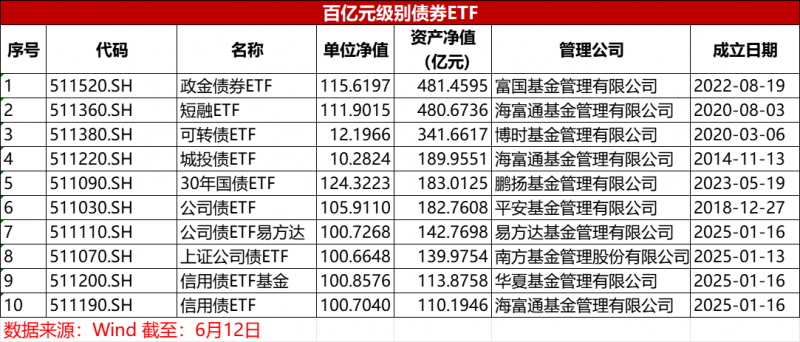
Core Viewpoint - The recent trend of lowering management and custody fees for bond ETFs reflects the competitive landscape and changing investor preferences in the bond market, particularly among institutional investors [3][5][6]. Group 1: Fee Reductions - On June 12, Haitong Fund announced a reduction in management and custody fees for its Shanghai Urban Investment Bond ETF, effective June 16, with management fees decreasing from 0.30% to 0.15% and custody fees from 0.1% to 0.07% [4]. - This ETF currently has a size of 149.11 billion yuan, marking it as one of the significant bond ETFs in the market [4]. - The fee reduction strategy aligns with a broader trend in the industry, as seen with Ping An Fund's similar actions earlier in the year [4][5]. Group 2: Market Growth and Trends - As of June 12, the total size of all bond ETFs in the market reached 3178.99 billion yuan, surpassing the 3000 billion yuan mark for the first time, with a year-to-date growth of 82.73% [7][8]. - The number of bond ETFs has increased significantly, with eight new ETFs launched this year, contributing to the emergence of ten bond ETFs with over 100 billion yuan in size [7][8]. - The growth in bond ETFs is attributed to the rising popularity of passive investment strategies, favorable market conditions, and increasing demand from institutional investors [8][9]. Group 3: Competitive Landscape - The bond ETF market is becoming increasingly competitive, with fee reductions signaling a potential price war among fund companies, which may lead to industry consolidation and improved management standards [6][5]. - Institutional investors, who hold a significant portion of bond ETFs, are particularly sensitive to fee changes, making fee reductions a crucial strategy for attracting and retaining these investors [5][6]. - The current low-interest-rate environment and the appeal of bond ETFs as a stable investment option are driving funds into this asset class, reinforcing its position as a key component of investment portfolios [9].
公募千亿元“分红盛宴”:债基、QDII领衔,这只产品豪掷83亿元破纪录
Hua Xia Shi Bao· 2025-06-13 14:06
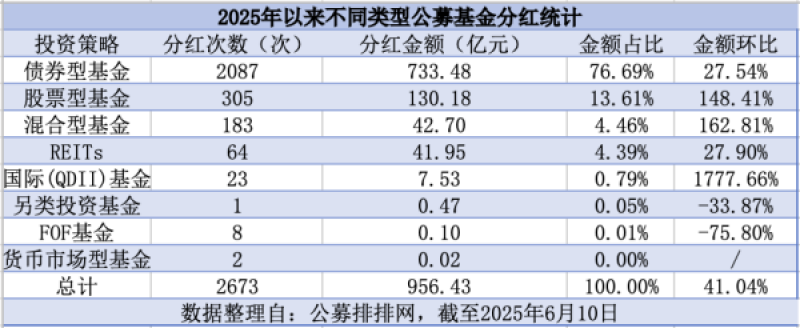
Core Viewpoint - The announcement of Huatai-PineBridge's flagship product, Huatai-PineBridge CSI 300 ETF, plans to distribute over 8.3 billion yuan in dividends, setting a new record for single dividend distribution in domestic ETFs, surpassing the previous record of 5.322 billion yuan held by E Fund's CSI 300 ETF [3][4] Fund Distribution Summary - As of June 10, the total dividend distribution of public funds in the year approached 100 billion yuan, with bond funds leading at 73.348 billion yuan, accounting for 76.69% of the total [2][4] - The bond funds had 2,087 distributions, showing a year-on-year increase of 27.54% [4] - QDII funds exhibited a remarkable growth rate of 1,777.66% in dividend distribution, becoming the biggest surprise of the year [2][4] Individual Fund Performance - Huatai-PineBridge CSI 300 ETF has a market size of 378.292 billion yuan and has distributed dividends 13 times since its inception in May 2012 [3] - The bond funds are recognized for their ability to provide stable cash flow, especially favored by institutional investors [4] - Stock funds distributed 13.018 billion yuan, with a significant increase of 148.41% in distribution frequency [4] - Mixed funds also saw a 162.81% increase, distributing 4.270 billion yuan [4] Management Company Performance - In terms of distribution frequency, Bosera Fund led with 148 distributions, followed by GF Fund with 129 distributions [5] - E Fund ranked third with 125 distributions, while the total amount distributed by E Fund reached 6.363 billion yuan [6][7] - Notably, Zhongyin Securities achieved 23.98 billion yuan in dividends with only 13 distributions, showcasing high efficiency [7] ETF and Bond Fund Insights - Broad-based ETFs and medium to long-term pure bond funds dominate the high dividend rankings, with Huatai-PineBridge CSI 300 ETF leading the way [8] - Among bond funds, 27 products distributed over 500 million yuan, with 21 being bond funds, highlighting their role as "cash cows" [8] - QDII funds are also gaining attention, with Guotai Nasdaq 100 Fund distributing 5.87 billion yuan, marking it as the only QDII product in the top 20 [9]

全球掀起“购金热”,市场资金大幅涌入,年内多只黄金ETF规模大增
Hua Xia Shi Bao· 2025-06-13 06:56
Core Insights - The ETF market is experiencing unprecedented growth due to increasing investor demand for asset allocation, with approximately 1,200 ETF products and a net inflow of about 250 billion yuan this year, with nearly 40% of products showing positive net inflows [2][3] - Gold ETFs have emerged as a new favorite in the capital market, driven by their unique hedging properties and investment value, amidst a global surge in gold purchases by central banks [2][5] ETF Market Expansion - The ETF market has seen a significant influx of funds, with a total net inflow of approximately 250 billion yuan as of June 12, 2023, and nearly 40% of products recording positive net inflows [3] - There are 92 ETF products with net inflows exceeding 1 billion yuan this year, with over 40 products attracting more than 3 billion yuan and 30 products over 5 billion yuan [3] - Notably, 14 ETF products have raised over 10 billion yuan within a year, indicating strong capital attraction among leading products [3] Leading ETF Products - The top-performing ETF is the Huaxia CSI 300 ETF, which has seen a net inflow exceeding 30 billion yuan this year, with its total scale growing from 37.7 billion yuan at the end of 2023 to over 160 billion yuan by the end of 2024 [4] - Other notable ETFs include Huatai-PB CSI 300 ETF and Haitong CSI Short Bond ETF, both with net inflows exceeding 17 billion yuan this year [4] Gold ETF Performance - Gold ETFs, particularly the Huaan Gold ETF, have shown remarkable performance, with a net inflow of approximately 23 billion yuan this year and a return exceeding 25% [5] - The total scale of Huaan Gold ETF has surpassed 60 billion yuan, reflecting a steady growth trend from 9.7 billion yuan at the end of 2022 to 28.7 billion yuan by the end of 2024 [5] - Other gold ETFs, such as Bosera Gold ETF and E Fund Gold ETF, have also performed well, with net inflows of 9.5 billion yuan, 9.4 billion yuan, and 9.1 billion yuan respectively this year [5] Central Bank Gold Purchases - A global "gold buying spree" has emerged, with central banks purchasing a net total of 1,045 tons of gold in 2024, marking the third consecutive year exceeding 1,000 tons [7] - China's central bank has increased its gold reserves for seven consecutive months, reaching 7.383 million ounces by the end of May [7] - Analysts suggest that central bank demand for gold may become a long-term trend, particularly in the context of weakening dollar credit and rising risks of de-globalization [7]