外卖

Search documents
美团、淘宝闪购、饿了么、京东同一日发文:抵制无序竞争
Bei Ke Cai Jing· 2025-08-01 13:51
Core Viewpoint - Major food delivery platforms including Meituan, Taobao Flash Sale, Ele.me, and JD.com have called for a halt to disorderly competition and pledged to establish a fair and orderly industry environment to promote mutual benefits and sustainable development in the food service sector [1][7]. Group 1: Meituan's Initiatives - Meituan has proposed five measures to regulate subsidy activities, including strict compliance with various laws such as the Anti-Monopoly Law and the E-Commerce Law, and avoiding selling goods below cost to prevent market disruption [2]. - The company will publicly disclose subsidy information to merchants and consumers without exaggerating the total amount of subsidies [3]. - Meituan will not force or indirectly compel merchants to participate in subsidy activities, ensuring merchants' autonomy in pricing [4]. - The company emphasizes non-discriminatory practices to ensure fairness in promotional activities, protecting the interests of small and medium-sized merchants [4]. - Meituan aims to create a win-win ecosystem involving consumers, merchants, delivery riders, and platform enterprises, advocating for a shift from price competition to quality and service competition [4]. Group 2: Other Platforms' Commitments - Taobao Flash Sale and Ele.me have committed to rationally planning subsidies based on consumer and merchant needs, ensuring merchants' rights to information, choice, and pricing [5]. - Both platforms will actively resist malicious competition and respect market operation rules, avoiding irrational promotional activities like "0 yuan purchase" [5]. - They will enhance service quality by providing diverse consumption scenarios and improving delivery efficiency, while promoting green consumption [5]. - JD.com has also pledged to standardize subsidy behaviors and resist "0 yuan purchase" promotions, focusing on quality and service rather than subsidies [6]. - JD.com will promote mutual benefits by providing various support services to merchants and improving the welfare of delivery riders [7]. Group 3: Regulatory Context - The State Administration for Market Regulation has recently interviewed Meituan, Ele.me, and JD.com, urging them to comply with relevant laws and regulations, and to rationally participate in competition to foster a healthy and sustainable development in the food service industry [7].



美团、饿了么、京东集体发声 业内称外卖行业竞争将回归理性
Zheng Quan Shi Bao Wang· 2025-08-01 13:46
近期,外卖平台的补贴大战持续引发市场关注。继 7 月 18 日被市场监管总局约谈后,三大平台于今日 集体表态,承诺开展良性竞争。 8月1日上午,美团、饿了么、京东等先后在官方渠道发布声明,承诺将"规范促销",同时提出多项限制 补贴行为的举措,包括规范促销行为、合理规划发放补贴、不做非理性促销活动、不以显著低于成本的 价格销售商品和服务等。 消息公布后,美团与阿里巴巴股价盘中均涨超 3%,京东集团股价盘中涨近 2%。不过,截至港股当日 收盘,三家公司股价均有所回落。 从行业趋势来看,曹磊认为,未来即时零售市场向三个方向发展:一是技术驱动替代资本消耗,平台将 加大AI算法、智能调度等技术投入,提升履约效率;二是供应链能力成为核心竞争力,平台将通过数 据共享、资源协同等方式,优化供应链管理;三是监管框架下的行业进化,平台将在保障消费者权益、 提升商家利润、完善骑手福利等方面寻求平衡。 具体来看,8月1日,美团官微发布《繁荣行业生态 抵制无序竞争》的声明称,外卖平台补贴近日引发 社会高度关注,美团对此高度重视,将坚决规范促销行为,杜绝不正当竞争行为,推动建立公平有序行 业秩序,促进各方互利共赢。美团承诺从自身做起,并 ...
外卖大战“停火”?三大平台集体发声
2 1 Shi Ji Jing Ji Bao Dao· 2025-08-01 13:31
Core Viewpoint - The competition in the food delivery industry is shifting from price wars to a focus on service, quality, and efficiency, with major platforms calling for a halt to disorderly competition and emphasizing the protection of riders and merchants' interests [1][2][6]. Group 1: Industry Competition Dynamics - Major platforms including Meituan, Taobao Ele.me, and JD have publicly committed to resisting disorderly competition, indicating a collective effort to foster a healthier industry ecosystem [1][2]. - The "delivery war" intensified with JD's entry into the market in Q2 2025, leading to aggressive competition among the three platforms, particularly around rider welfare and merchant commissions [3][5]. - The recent "subsidy war" initiated by Taobao Flash Sale, which involved a 500 billion yuan subsidy plan, has significantly increased order volumes, but many merchants report that their profits have not improved despite higher order counts [3][4]. Group 2: Regulatory and Market Responses - Regulatory bodies have been urging the cessation of disorderly competition across various industries, emphasizing that while competition can benefit consumers, it must adhere to certain rules to avoid negative consequences [2][6]. - Following government pressure, the platforms have increased their efforts to improve rider benefits and support merchants, indicating a shift in focus from aggressive pricing strategies to enhancing service quality [7][8]. Group 3: Future Directions in Competition - The industry is moving towards a model that prioritizes rider welfare and food safety, with initiatives such as Meituan's "Raccoon Canteen" and JD's investment in rider benefits and food safety measures [8][9][10]. - Companies are expected to invest significantly in improving the overall ecosystem, with Meituan planning to invest 100 billion yuan over three years to enhance food safety and transparency in the delivery process [8][9].
抵制恶性竞争 美团、京东、淘宝闪购、饿了么同日发声
Guang Zhou Ri Bao· 2025-08-01 13:19
Core Viewpoint - Major Chinese e-commerce platforms, including Meituan, JD.com, Taobao Flash Sale, and Ele.me, have collectively announced their commitment to resist malicious competition and promote fair industry practices, aiming for a healthy and sustainable development of the food delivery sector [1][2][3]. Group 1: Company Commitments - Meituan has pledged to adhere strictly to various laws, including the Anti-Monopoly Law and the Anti-Unfair Competition Law, ensuring that subsidy activities do not distort market prices or harm small merchants [1]. - JD.com emphasizes the importance of a transparent subsidy mechanism and aims to eliminate harmful practices like "0 yuan purchase" promotions, focusing instead on quality and service differentiation [2]. - Taobao Flash Sale and Ele.me have committed to rationally planning subsidies based on consumer and merchant needs, ensuring merchants' rights to participate and set prices are respected [3]. Group 2: Industry Trends - The industry is moving away from capital-intensive competition towards a model driven by technology and supply chain optimization, with a focus on enhancing consumer experience and merchant profitability [4][5]. - Regulatory frameworks are expected to evolve, balancing consumer rights, merchant profits, and rider welfare, promoting a sustainable ecosystem [4][5]. Group 3: Regulatory Context - The State Administration for Market Regulation has urged major platforms to comply with relevant laws and to rationally engage in competition, fostering a win-win ecosystem for consumers, merchants, and delivery riders [5].
智通港股解盘 | 关税落地破坏全球供应链 观察非农数据是否有惊喜
Zhi Tong Cai Jing· 2025-08-01 13:04
Market Overview - The market sentiment for August is pessimistic, with the Hang Seng Index closing down 1.07% [1] - The U.S. has finalized tariffs on various countries, with rates ranging from 10% to 41%, impacting global trade dynamics [1][2] - Canada faces a tariff increase to 35% on certain goods, leading to potential retaliatory measures [1] Economic Impact - The average tariff rate in the U.S. is expected to rise to 15.2%, significantly higher than previous levels, which may disrupt global supply chains [2] - Japan and Thailand are experiencing substantial impacts on their agricultural sectors due to U.S. tariffs on rice [2] Pharmaceutical Sector - U.S. President Trump has threatened 17 pharmaceutical companies with price reductions by September 29, causing significant stock declines in major firms [2] - Hong Kong-listed pharmaceutical companies also faced declines, reflecting the broader market impact [2] Industry Developments - The Hong Kong stablecoin initiative has seen limited licensing, affecting related stocks negatively [3] - The Chinese government is promoting consumption and service sectors, with companies like Xirui and Legend Holdings benefiting from this trend [5] Regulatory Changes - New regulations in the Chinese traditional medicine sector require all herbal products to have clear expiration dates, promoting safer practices [8] - The establishment of a unified national market in China is progressing, with logistics companies like Zhongtong Express seeing stock increases [6] Company Highlights - Goldwind Technology has secured significant contracts, indicating strong market competitiveness and a robust order backlog [10] - The company reported a 35.72% increase in revenue and a 70.84% increase in net profit for Q1 2025, driven by international expansion [10][11] - Goldwind's international business has grown, with a substantial share of orders coming from overseas markets [11]
南财快评|鼓励良性竞争,让平台成为拉动消费的新动能
2 1 Shi Ji Jing Ji Bao Dao· 2025-08-01 12:56
Core Viewpoint - The recent statements from multiple food delivery platforms advocate for healthy competition and responsible business practices in response to regulatory guidance aimed at promoting fair competition and sustainable market practices [1][2]. Group 1: Industry Response and Regulation - The market regulatory authorities have previously engaged with major platforms like JD, Meituan, and Ele.me to encourage legal and fair business operations [1]. - The emphasis on avoiding unsustainable competitive practices, such as "zero-yuan purchases" and selling below cost to gain market dominance, reflects the industry's commitment to social responsibility [1][2]. Group 2: Market Dynamics and Consumer Behavior - In the platform economy, merchants face market pressures not only from direct competition but also from the platforms themselves, which leverage data and scale to respond to market changes [2]. - The potential for service consumption growth is significant, as increasing frequency of service usage can lead to substantial consumption increases, aligning with national policies to boost domestic demand [2]. Group 3: Economic Impact of Subsidies - A study from Peking University indicates that effective subsidy strategies can stimulate platform consumption and generate significant spillover effects, with every 1 yuan of effective flash purchase subsidy leading to an additional 6.76 yuan in consumer spending [3]. - The estimated total consumption increase from platform subsidies could reach 676 billion yuan, representing 1.4% of the projected total retail sales of consumer goods in 2024 [3]. Group 4: Balancing Efficiency and Diversity - The harsh realities of market competition can lead to the closure of small businesses that provide unique value, highlighting the need for platforms to balance efficiency with the preservation of market diversity [3]. - Platforms are encouraged to utilize data analytics to identify and support unique merchants, ensuring their survival during challenging market conditions [3]. Group 5: Sustainable Development and Social Responsibility - The food delivery market is becoming a crucial driver of consumption upgrade, employment, and public service, necessitating a focus on service quality and the balanced interests of platforms, merchants, delivery personnel, and consumers [4]. - Achieving sustainable industry development requires a multi-faceted approach that considers both economic and social benefits [4].
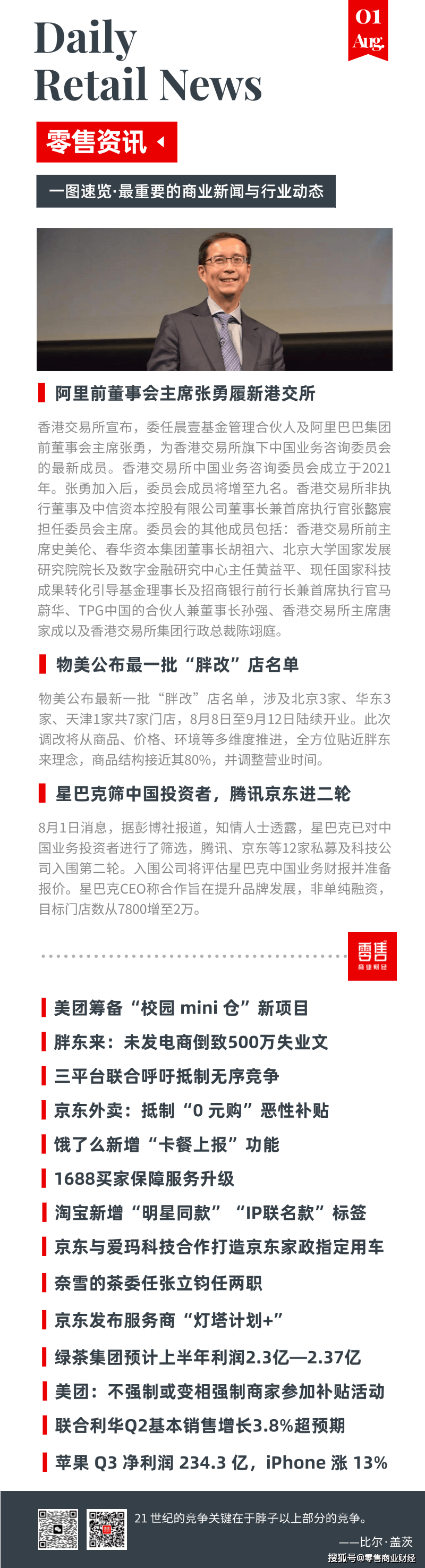
阿里前董事会主席张勇履新港交所;物美公布最一批“胖改”店名单
Sou Hu Cai Jing· 2025-08-01 12:25
Group 1 - Alibaba's former chairman Zhang Yong has been appointed as a new member of the Hong Kong Stock Exchange's China Business Advisory Committee, increasing the committee's membership to nine [6] - The committee was established in 2021 and is chaired by Zhang Jianchen, the non-executive director of the Hong Kong Stock Exchange [6][7] Group 2 - Wumart has announced the latest batch of "Fat Transformation" stores, involving seven locations across Beijing, East China, and Tianjin, set to open between August 8 and September 12 [8] - The transformation will focus on multiple dimensions including product offerings, pricing, and store environment, aiming to align closely with the Fat Donglai concept [8] Group 3 - Starbucks is reportedly screening investors for its China business, with Tencent and JD.com among the twelve companies advancing to the second round [10] - The collaboration aims to enhance brand development rather than merely seeking financing, with a target to increase store count from 7,800 to 20,000 [10] Group 4 - Meituan is preparing a new instant retail project called "Campus Mini Warehouse," targeting university campuses with small warehouses for high-frequency items [11] - The project will adopt a platform model, recruiting partners for warehouse and delivery services, prioritizing those with campus experience [11] Group 5 - The Green Tea Group expects a profit of approximately 230 million to 237 million yuan for the first half of 2025, a year-on-year increase of about 32% to 36% [22] - Adjusted net profit is anticipated to be around 247 million to 254 million yuan, reflecting a growth of 38% to 42% compared to the previous year [22] Group 6 - Unilever reported a 3.8% increase in underlying sales growth for Q2, exceeding expectations, with a slight decline in sales in the Chinese market [25] - The company is undergoing multiple transformations, including the planned spin-off of its ice cream business in November [25] Group 7 - Apple reported a net profit of $23.43 billion for Q3 2025, a 9% year-on-year increase, with revenue reaching $94.04 billion, up 9.6% [27] - iPhone revenue grew by 13% to $44.58 billion, and service revenue also increased by 13% to $27.42 billion, both exceeding market expectations [27]

美团、淘宝、饿了么集体发声!
Jin Rong Shi Bao· 2025-08-01 11:52
Core Viewpoint - Major food delivery platforms such as Meituan, Taobao, and Ele.me have collectively committed to regulating promotions and limiting subsidy behaviors to foster healthy competition in the industry [1][2][4] Group 1: Industry Response and Actions - On August 1, Meituan, Taobao, and Ele.me issued statements promising to "regulate promotions" and introduced measures to limit subsidies, including avoiding irrational promotional activities and not selling goods and services at prices significantly below cost [1] - The State Administration for Market Regulation had previously conducted talks with these platforms, urging them to further regulate promotional activities and participate in rational competition [2] - Following the talks, marketing activities across the platforms showed varying degrees of contraction, although large subsidies like zero-yuan purchases and significant discounts continued, with merchants bearing about 70% of the subsidy costs [2] Group 2: Market Trends and Observations - Recent commentary from Xinhua Daily and People's Daily highlighted the ongoing price wars in the food delivery sector, indicating that such competition has not generated consumer growth and has led to profit challenges for platforms and merchants [3] - The upcoming "Autumn First Cup of Milk Tea" event on August 7 is expected to be a significant marketing period, with Taobao already launching promotions featuring celebrity endorsements [3][4] - Industry analysts suggest that the "Autumn Battle" could evolve into a new milk tea delivery war, with the collective statements from the platforms serving as a preemptive reminder of anti-involution policies [4]
多家外卖平台表态:抵制无序竞争,承诺不强制商家参与补贴
Nan Fang Du Shi Bao· 2025-08-01 10:59
Core Viewpoint - Major food delivery platforms including Meituan, JD, Taobao Flash Sale, and Ele.me collectively called for a halt to disorderly competition in the industry, emphasizing the need for fair promotional practices and sustainable business practices [1][2][3] Group 1: Company Commitments - Meituan pledged to strictly regulate promotional activities, avoid selling below cost, and ensure fair treatment of merchants and consumers [1] - JD committed to resisting unhealthy competition practices such as "0 yuan purchase" and emphasized transparency in marketing activities for merchants and consumers [2] - Taobao Flash Sale and Ele.me promised to rationally plan subsidies, respect merchants' rights, and ensure clear promotional information for consumers [2] Group 2: Industry Context - The recent "food delivery war" has led to concerns over unsustainable practices, including low merchant profits and declining food quality due to excessive order volumes [3] - The State Administration for Market Regulation has previously summoned these platforms to enforce compliance with laws and promote fair competition [3]
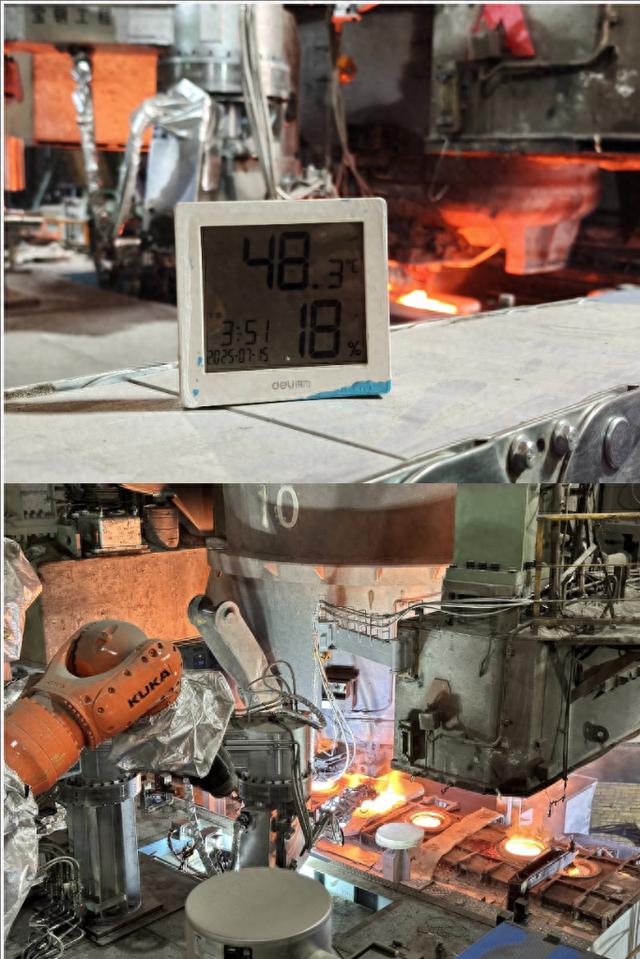
新华视点丨高温炙烤来了,如何应对?
Xin Hua Wang· 2025-08-01 10:50
Group 1: Impact of High Temperatures on Labor - High temperatures have led to the implementation of robots in outdoor labor roles, significantly improving working conditions and reducing the need for human labor in extreme heat [1][4] - "Human-machine collaboration" is being utilized in sanitation work, where autonomous cleaning machines operate during peak heat hours to lessen the burden on sanitation workers [2] - Workers are now equipped with smart cooling gear, such as cooling vests and special materials for seating, which help reduce sweat and improve comfort during high temperatures [4][5] Group 2: Consumer Trends in Response to Heat - Sales of cooling appliances like air conditioners and fans have surged, with air conditioner sales on JD.com increasing over 123% year-on-year in July [5][7] - Social media has seen a rise in discussions around "cooling gadgets," with related topics garnering 460 million views, indicating a strong consumer interest in heat relief products [7] - The demand for seasonal cooling products has led to significant increases in sales for items like ice-making machines and summer foods, with some categories seeing growth rates of nearly 400% [7][8] Group 3: Enhanced Weather Forecasting and Public Health Measures - The introduction of more precise "meteorological+" warnings reflects a shift towards understanding the health impacts of high temperatures, with new health risk alerts being issued based on temperature-related disease risks [11][12] - Local governments are now providing detailed temperature forecasts and health advisories tailored to specific populations, such as the elderly and outdoor workers, to mitigate health risks associated with extreme heat [11][13] - The focus on personalized public service in response to high temperatures demonstrates a growing awareness of the need for targeted health protection measures [13]