
电力设备

Search documents
创业板系列指数小幅回踩,关注创业板ETF(159915)、创业板200ETF易方达(159572)等产品投资机遇
Sou Hu Cai Jing· 2025-12-26 05:06
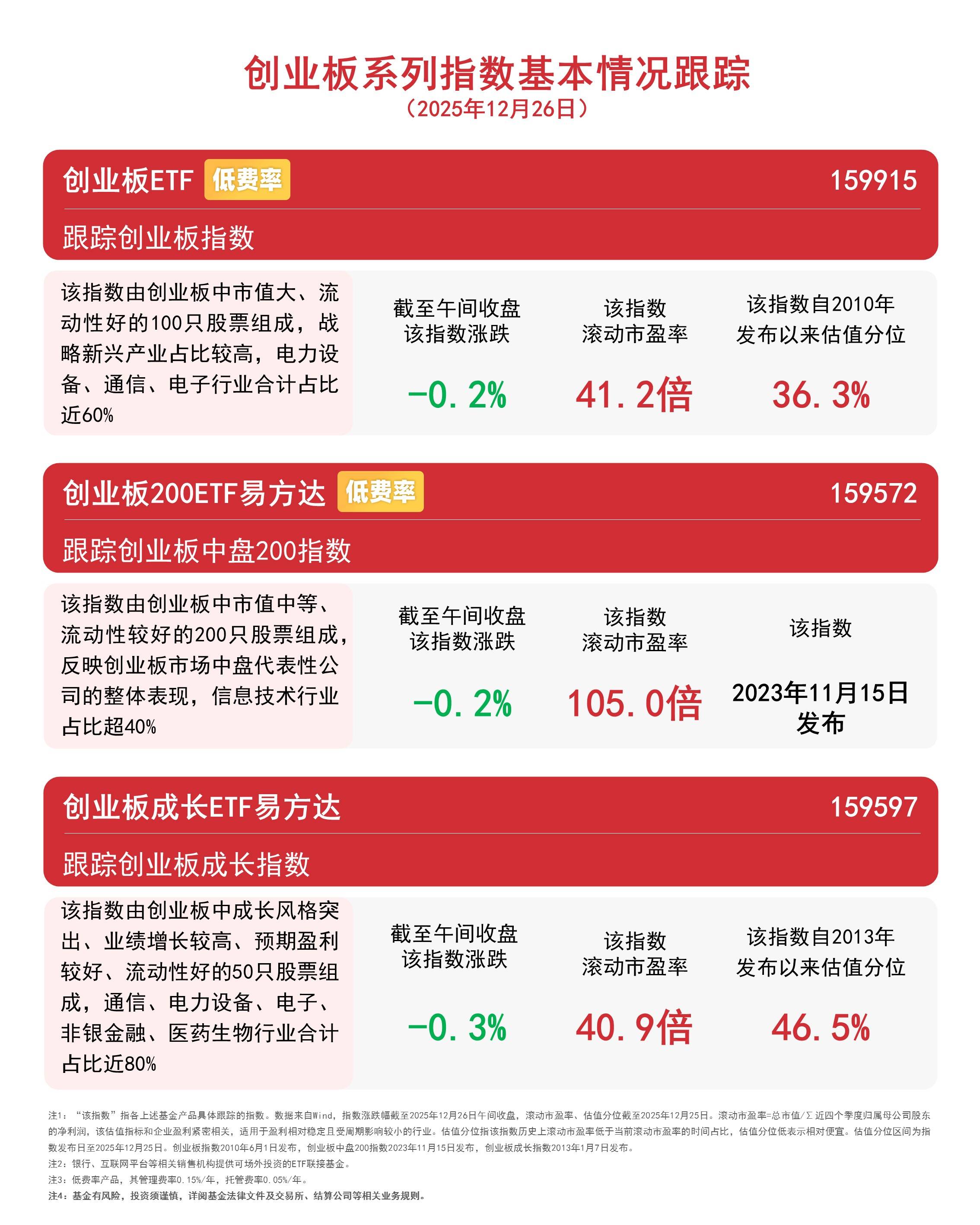
Group 1 - The ChiNext Index and ChiNext Mid-Cap 200 Index both declined by 0.2%, while the ChiNext Growth Index fell by 0.3% as of the midday close [1] - Huazhong Securities' report indicates that price improvements will boost nominal GDP, leading to a continuous recovery in corporate profits, which will serve as a strong fundamental support for the market [1] - It is estimated that the overall profit growth rate for the A-share market will increase from 8.2% in 2025 to 10.3% in 2026, with the profit growth rate excluding financials reaching 7.7% [1] Group 2 - The ChiNext is expected to benefit from a new round of industrial cycles, with a projected profit growth rate of 31.7% in 2026 [1] - The ChiNext Growth ETF tracks the ChiNext Growth Index, which consists of 50 stocks characterized by growth style, high performance, good profit expectations, and strong liquidity, with the information technology sector accounting for over 40% [3] - The communication, power equipment, electronics, non-bank financials, and pharmaceutical sectors collectively account for nearly 80% of the ChiNext Growth Index [3]


新能源ETF涨2.31%,阳光电源涨8.11%
Cai Jing Wang· 2025-12-26 05:05
Core Viewpoint - The Chinese stock market showed positive momentum with significant gains in the new energy sector, indicating a favorable outlook for related industries [1][2]. Group 1: Market Performance - On December 26, the Shanghai and Shenzhen stock markets experienced upward movement, with the Shanghai Composite Index rising by 0.33% and the Shenzhen Component Index increasing by 0.6% [1]. - The new energy sector saw a rise of 0.93%, while the blade battery sector increased by 1.66%, and the Huawei automotive sector grew by 0.2% [1]. - As of 10:30 AM, the New Energy ETF (516160.SH) rose by 2.31%, and Sunshine Power surged by 8.11% [1]. Group 2: Industry Insights - The energy storage sector is benefiting from a significant global demand increase, with a price turning point and expanding demand scale expected to reverse profitability in battery and material segments [2]. - The photovoltaic industry is optimizing supply-demand dynamics through capacity regulation, which is expected to enhance price recovery and corporate profitability [2]. - The wind power sector is experiencing multiple benefits, including stabilized domestic turbine prices and expanded growth opportunities through international strategies [2]. - The electric equipment sector is driven by the development of global AI data centers and investments in grid construction, maintaining demand stability [2]. - The gas power industry is witnessing high demand for gas turbines, supported by favorable market conditions [2]. - Policy guidance is enhancing the industry by promoting non-electric utilization of new energy to address consumption issues, leading manufacturers to shift towards a full-chain operational model [2]. - The New Energy ETF (516160.SH) tracks the CSI New Energy Index, which comprehensively covers the entire industry chain, making its cost-effectiveness noteworthy [2].

2026年权益市场展望:结构性机遇凸显,多主线值得关注
Zheng Quan Shi Bao Wang· 2025-12-26 04:42
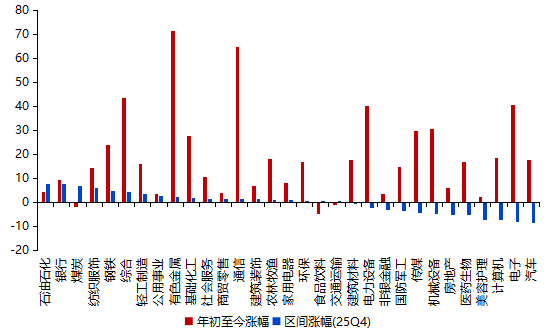
Core Viewpoint - The market is increasingly focused on investment opportunities for 2026 as the A-share market approaches the end of 2025, with sectors like metals, TMT, and power equipment performing well, while dividend stocks and real estate are under pressure [1] Group 1: Global Economic Environment - The global macroeconomic landscape is expected to show positive changes in 2026, with the U.S. likely to adopt more accommodative fiscal and monetary policies, potentially increasing the federal deficit by approximately $3.4 trillion over the next decade [4] - The anticipated fiscal expansion in the U.S. may require a low-interest-rate environment, which could improve global liquidity and stabilize the external environment for the A-share market [4] Group 2: Domestic Economic Policies - The Central Economic Work Conference at the end of 2025 has set a policy direction of "seeking progress while maintaining stability," indicating a focus on quality and efficiency improvements [5] - Industrial enterprises are at the bottom of the inventory cycle, with a narrowing decline in PPI suggesting an approaching recovery phase for corporate profits, as evidenced by a 3.2% year-on-year growth in net profit for all A-shares in Q3 2025 [5] Group 3: Investment Opportunities for 2026 - The A-share market is expected to remain structurally driven, with five key areas for investors to focus on: 1. AI Super Cycle: Continued growth in domestic and international computing power chains, with a focus on new technology iterations and the gaming industry [9] 2. High-end Manufacturing Overseas: Attention on sectors like energy storage and lithium batteries, as well as heavy-duty vehicles and engineering machinery that offer growth potential [11] 3. Strategic Resource Revaluation: Long-term focus on precious and industrial metals, with particular attention to energy and lithium carbonate showing signs of stabilization [11] 4. Frontier Technology Breakthroughs: Ongoing interest in industries such as robotics, solid-state batteries, and quantum computing [11] 5. New Consumption and Innovative Pharmaceuticals: Focus on sectors with solid fundamentals in consumer and technology spending, as well as innovative medical devices [11] Group 4: Market Liquidity - The degree of asset allocation migration towards equity markets is still in its early stages, with significant room for growth as indicators remain at historical lows [10] - Institutional investors, including insurance funds and bank wealth management products, are expected to become important sources of marginal capital in 2026, further enhancing market liquidity [10]
【盘中播报】沪指涨0.28% 有色金属行业涨幅最大
Zheng Quan Shi Bao Wang· 2025-12-26 04:27
| 申万行业 | 行业涨跌(%) | 成交额(亿元) | 比上日(%) | 领涨(跌)股 | 涨跌幅(%) | | --- | --- | --- | --- | --- | --- | | 有色金属 | 2.68 | 641.88 | 25.16 | 深圳新星 | 9.99 | | 电力设备 | 1.25 | 1234.90 | 24.87 | 东方日升 | 13.00 | | 商贸零售 | 1.21 | 212.29 | -6.89 | 银座股份 | 10.03 | | 钢铁 | 1.17 | 47.91 | 9.25 | 海南矿业 | 10.02 | | 国防军工 | 1.04 | 766.64 | 2.85 | 西测测试 | 19.03 | | 汽车 | 0.94 | 565.03 | 16.37 | 标榜股份 | 20.01 | | 计算机 | 0.88 | 527.93 | 4.98 | 佳缘科技 | 20.00 | | 非银金融 | 0.84 | 255.66 | 4.67 | 中银证券 | 7.68 | | 房地产 | 0.71 | 105.70 | -12.39 | 华联控股 | 10.00 ...
证券代码:603577 证券简称:汇金通 公告编号:2025-059
Zhong Guo Zheng Quan Bao - Zhong Zheng Wang· 2025-12-26 03:43
Core Viewpoint - The company has signed a maximum guarantee contract with Industrial Bank Co., Ltd. Nanning Branch to provide a guarantee of RMB 50 million for its subsidiary Guangxi Huadian Intelligent Equipment Co., Ltd. [1][2] Group 1: Guarantee Details - The guarantee provided is a joint liability guarantee for Guangxi Huadian's bank credit application [1][2] - The maximum principal amount of the guarantee is RMB 50 million, with a guarantee period of three years from the debt performance deadline [2][4] - The guarantee covers all debts arising from loans, financing, and other financial services provided to the debtor [2] Group 2: Internal Decision-Making Process - The company’s board approved the guarantee limit for 2025, allowing a total of up to RMB 1.1 billion for guarantees among subsidiaries [1] - The approval was made during the board meeting on March 24, 2025, and the annual shareholders' meeting on April 14, 2025 [1] Group 3: Cumulative Guarantee Situation - As of the announcement date, the total amount of guarantees provided by the company and its subsidiaries is RMB 1.1 billion, which is 58.27% of the company's audited net assets for the last year [4] - The actual guarantee balance is RMB 87.5 million, accounting for 46.35% of the company's audited net assets, with no overdue guarantees reported [4]

玄元投资2026年市场展望及投资策略:跃龙在渊 进无咎 重点关注的三大方向
Xin Lang Cai Jing· 2025-12-26 03:07
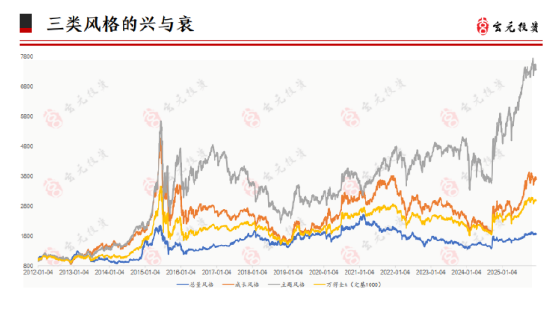
Core Viewpoint - The market is currently in a position where it can either advance or retreat, with the emphasis on the need for economic fundamentals to improve for sustained growth [1][4]. Investment Framework and Style Tracking - The investment framework is based on the equation "Stock Price = EPS × PE," highlighting that valuation (PE) fluctuations are typically larger than earnings (EPS) changes in the A-share market [2][20]. - The market opportunities can be categorized into three styles: macro style, growth style, and thematic style, with macro style being influenced by the China-US interest rate differential [2][21]. Judgments for 2026 - The market is still in a bull phase, but the rhythm of growth will differ from the past, with the current A-share market capitalization to household savings ratio at approximately 0.65, indicating that the bull market is not over yet [7][25]. - The current market is driven by liquidity and risk appetite, but this type of market has a clear "ceiling," as seen in historical liquidity-driven markets [8][26]. - Economic fundamentals are expected to gradually improve in the second half of next year, which may trigger a style switch from growth and thematic to value and cyclical stocks [9][27]. - Bull markets may experience more severe pullbacks, with historical data showing that pullbacks in bull markets are typically around 10% at the index level, but certain broad indices may see declines exceeding 20% [9][28]. Key Areas for Fundamental Improvement - Exports have been growing, but the "price for volume" model is unsustainable, with China's export price index down approximately 20% compared to developed countries, which may suppress long-term profit margins [11][28]. - Fixed asset investment has seen a decline for the first time in 36 years, influenced by various factors including a significant drop in land revenue [11][28]. - The real estate market shows high inventory levels, particularly in second-tier cities, indicating a need for stronger demand-side policies [11][29]. - There is a shift towards service consumption, with a focus on sectors such as cultural tourism, elderly care, and emotional consumption [11][29]. Policy Perspective - The current policy focus includes addressing "involution" competition, promoting technological innovation, and expanding domestic demand, with expectations for substantial policy implementation around mid-next year [14][33]. - Historical patterns suggest that policy effects are gradual and may take time to manifest, as seen in past housing reform policies [12][31]. Style Switching Considerations - A sustainable style switch from growth and thematic to value requires solid fundamental data support, as historical trends indicate a strong correlation between total style relative returns and revenue growth rates [15][34]. - Short-term style switches may occur due to trading factors, but these are often less sustainable without fundamental backing [16][34]. Focus Areas for 2026 - Key investment opportunities will revolve around three main themes: addressing involution competition, fostering new productive forces, and expanding domestic demand, with a particular emphasis on service consumption [17][35][36].
宜春清理存量矿权,锂资源“供给侧改革”启幕
Zhong Guo Neng Yuan Wang· 2025-12-26 03:05
Core Insights - Yichun City Natural Resources Bureau announced the cancellation of 27 mining rights, primarily affecting ceramic clay and limestone, signaling stricter regulations and potential long-term upgrades in the lithium resource sector [1][2]. Group 1: Industry Overview - The cancellation of mining licenses is expected to have a limited short-term impact on lithium carbonate supply, as the licenses had already expired [1][2]. - The Yichun region is a significant source of lithium resources, as lithium-bearing minerals often accompany the listed mining types, indicating that any changes in mining rights could affect supply expectations [2]. Group 2: Regulatory Environment - Existing mining operations, especially those classified under "ceramic clay," will face stricter compliance reviews, potentially interrupting production due to procedural flaws [2]. - The approval process for new mining projects is likely to be delayed due to environmental regulations and changes in mining rights [2]. Group 3: Cost Implications - The move towards regulated development will increase costs related to environmental protection and technological upgrades, raising the production cost baseline for lithium [2][4]. Group 4: Market Dynamics - The elimination of non-compliant projects may accelerate industry consolidation, allowing compliant leading companies to increase their market share [3]. - The scarcity of resources is expected to strengthen price support, leading to an upward adjustment in lithium price baselines [4]. Group 5: Investment Strategy - Companies with complete mining rights and environmental compliance, as well as those with integrated "resource + smelting" operations, are recommended for investment consideration, such as Yongxing Materials, Tianqi Lithium, and Ganfeng Lithium [7].



新型断路器破解配电网绿色化智能化难题
Ke Ji Ri Bao· 2025-12-26 02:55
Core Viewpoint - The ZW68 vacuum circuit breaker developed by China Electric Power Research Institute has won the 2025 Power Innovation Award for its technological breakthroughs in green and intelligent power distribution equipment, marking it as a benchmark technology for the construction of new power systems [1][2]. Group 1: Product Features and Innovations - The ZW68 circuit breaker features complete independent intellectual property rights and utilizes vacuum arc extinguishing and dry air insulation technology, offering significant green and low-carbon environmental advantages compared to traditional SF6 insulated circuit breakers [1]. - The product is globally innovative, incorporating an integrated isolation switch within the box-type vacuum circuit breaker housing, along with electronic voltage sensors, low-power current transformers, and zero-sequence current transformers, meeting the requirements for integrated technology while being compatible with traditional usage standards [1]. Group 2: Industry Impact and Applications - Since its trial operation began in July 2021, the ZW68 has been tested in 19 provinces, with 253 units successfully operating under various climatic conditions, demonstrating good operational status [2]. - From 2022 onwards, the product has achieved large-scale procurement applications in regions such as Hunan, Shandong, Fujian, and Tibet, with a total exceeding 6,800 units, effectively promoting technological upgrades in the power distribution equipment industry and enhancing the reliability and intelligence of power distribution networks [2].
光伏50ETF(159864)涨超2%,技术迭代与海外需求成焦点
Mei Ri Jing Ji Xin Wen· 2025-12-26 02:51
Group 1 - The photovoltaic equipment industry should pay close attention to the "space photovoltaic" theme, as the fundamental catalysts in this field may accelerate significantly compared to emerging industries like nuclear fusion and robotics, driven by Sino-US strategic competition and low-orbit resource contention [1] - Space photovoltaics are irreplaceable in providing power for low-orbit satellite constellations, space data centers, and lunar bases, with the silicon-perovskite tandem technology expected to accelerate verification in commercial satellite energy systems [1] - In the wind power equipment sector, European offshore wind demand continues to rise, with an average annual grid connection scale expected to exceed 14 GW from 2031 to 2032, leading to accelerated release of orders for piles, submarine cables, and wind turbines [1] Group 2 - The power equipment sector is experiencing a high degree of certainty in overseas grid upgrade cycles, with domestic companies transitioning from product exports to a comprehensive approach of "capital + capacity + services" in international markets [1] - After a supply-side clearing in the photovoltaic industry, demand-side expectations are anticipated to recover by 2026, with global AI computing power construction and manufacturing recovery potentially driving demand beyond expectations [1] - The photovoltaic 50 ETF (159864) tracks the photovoltaic industry index (931151), which selects listed companies involved in silicon materials, wafers, battery cells, modules, and photovoltaic equipment to reflect the overall performance of the photovoltaic industry [1]
创业板公司融资余额七连增 其间累计增加179.90亿元
Zheng Quan Shi Bao Wang· 2025-12-26 02:43
Core Insights - The total margin financing balance of the ChiNext market reached 554.14 billion yuan as of December 25, 2025, marking an increase of 50.44 billion yuan from the previous trading day, and has risen for seven consecutive trading days, accumulating an increase of 179.90 billion yuan during this period [1][2]. Margin Financing Balance Changes - As of December 25, 2025, the margin financing balance was 552.30 billion yuan, which increased by 50.59 billion yuan from the previous day [2]. - The margin financing balance has seen increases across 509 stocks, with 66 stocks experiencing an increase of over 20% [2]. - The stock with the highest increase in margin financing balance was Jiangxin Home, which saw a 123.76% increase, bringing its latest balance to 39.73 million yuan [2][3]. Stocks with Significant Margin Financing Changes - The stocks with the largest increases in margin financing included: - Jiangxin Home: 39.73 million yuan, +123.76% - Kema Technology: 97.47 million yuan, +118.89% - Yidong Electronics: 44.34 million yuan, +116.06% [3][4]. - Conversely, the stocks with the largest decreases included: - Green Island Wind: 10.27 million yuan, -29.55% - Kaichuang Electric: 11.48 million yuan, -25.91% - Jiayuan Technology: 19.87 million yuan, -23.72% [3][4]. Market Performance - Stocks with margin financing increases of over 20% averaged a rise of 16.41%, outperforming the ChiNext index [5]. - Notable performers included: - Yidong Electronics: +79.99% - Kaige Precision Machinery: +45.63% - Hongda Electronics: +38.89% [5]. - The stock with the highest total margin financing increase was Zhongji Xuchuang, with a balance of 22.02 billion yuan, increasing by 2.51 billion yuan [5]. Summary of Margin Financing Changes - The stocks with the most significant increases in margin financing included: - Zhongji Xuchuang: 22.02 billion yuan, +2.51 billion yuan - Yangguang Electric: 15.10 billion yuan, +2.06 billion yuan - Xinyi Sheng: 21.42 billion yuan, +1.30 billion yuan [5][6]. - The stocks with the largest decreases in margin financing included: - Dongfang Caifu: 26.89 billion yuan, -0.54 billion yuan - Tonghuashun: 5.43 billion yuan, -0.30 billion yuan - Kunlun Wanwei: 3.10 billion yuan, -0.21 billion yuan [5][6].



