
自动驾驶

Search documents
用好优势抓住机遇,促进广东制造业与服务业协同发展
2 1 Shi Ji Jing Ji Bao Dao· 2026-02-24 22:40
Group 1 - The core theme of the Guangdong conference is the collaborative development of manufacturing and service industries to explore new paths for high-quality development [1] - Guangdong's manufacturing sector accounts for 1/8 of the national manufacturing value added and approximately 1/3 of the province's GDP, establishing it as a global manufacturing hub [1] - The manufacturing industry in Guangdong is transitioning towards intelligent, green, and integrated development, aiming to move from low-value assembly to high-value design and sales [1] Group 2 - The historical evolution of developed economies shows that manufacturing and service industries have always evolved dynamically and collaboratively, leading to deeper industrial division and tighter integration [2] - The rapid development of information technology since the 1990s has empowered manufacturing through service-oriented manufacturing and the integration of digital and physical economies [2] - The current technological revolution and industrial transformation necessitate a strong collaboration between manufacturing and services, leveraging advancements in AI, bio-manufacturing, and quantum communication [2] Group 3 - Guangdong has unique advantages in the global technological revolution, with the Guangdong-Hong Kong-Macao Greater Bay Area being a leading region in both mechanical and AI technologies [3] - The manufacturing sector in Guangdong includes leading industries such as home appliances, mobile phones, and automobiles, which need to collaborate with intelligent technologies to enhance their competitive edge [3] - A supportive market environment is essential for the collaborative innovation of manufacturing and services, requiring regulatory frameworks that facilitate new products, business models, and technological innovations [3]
全球媒体聚焦 | 美媒:中国正朝着实现能源主导权的方向迈进
Sou Hu Cai Jing· 2026-02-24 14:48
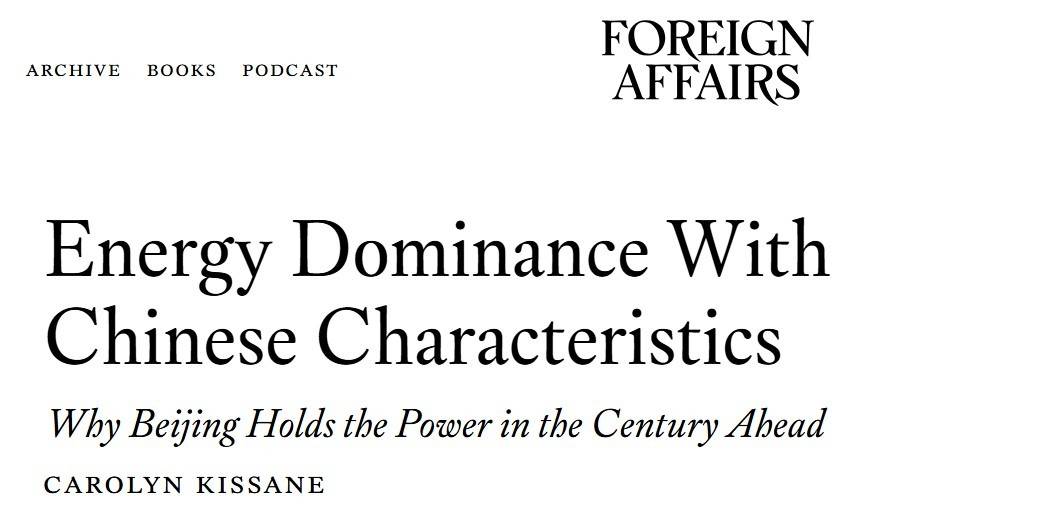
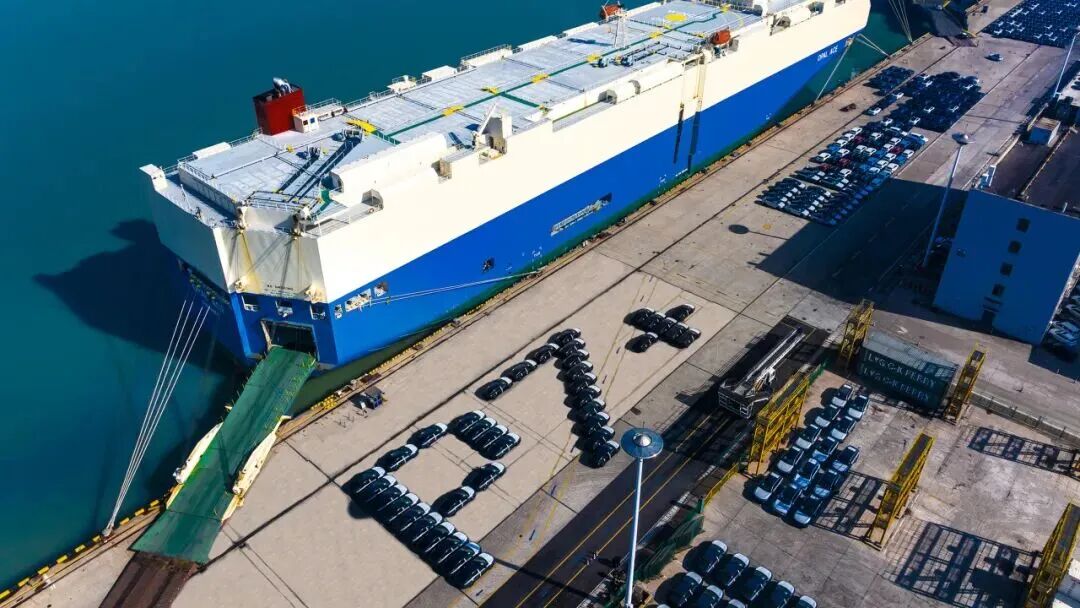
Core Insights - The article emphasizes that China is advancing towards energy dominance, transitioning from a reliance on oil and gas imports to becoming a global leader in clean energy [1][2]. Group 1: China's Energy Transition - Over the past two decades, China has transformed from an energy-dependent nation to a leader in clean energy, integrating energy and electrification as core components of national strength [2][3]. - China's strategic approach combines manufacturing, technological innovation, and national security, reducing external dependencies while enhancing domestic capabilities [2][3]. Group 2: Supply Chain and Innovation - China's energy sector has developed a tightly coordinated ecosystem capable of setting global standards, with manufacturing of raw materials, intermediate components, and finished products located in close proximity [3][4]. - The supply chain clustering effect has led to reduced costs and accelerated production, giving Chinese companies a competitive edge in speed and pricing [3][4]. Group 3: Global Market Influence - China's large-scale domestic construction has lowered local costs, while its export capabilities ensure that its technologies reach markets with high demand and limited capital [4]. - The country has shifted from supplying single components to offering complete energy systems, including generation, transmission, storage, and grid modernization, often accompanied by financing and long-term maintenance services [4]. Group 4: Strategic Framework - China's energy strategy is encapsulated in the Energy Law, which integrates energy security, industrial development, technological innovation, and market structure into a unified legal and policy framework [4]. - The organizational principle of this new system is "expansion" rather than "replacement," allowing China to build a resilient energy system that supports industrial growth and leverages influence over other nations [4]. Group 5: Future Directions - In the next five years, China plans to extend its national industrial strategy for clean energy manufacturing into emerging fields such as autonomous driving, artificial intelligence, and robotics [4]. - The goal is not merely participation but to root next-generation technologies in domestic supply chains and achieve scale before global competitors catch up, thereby securing a leading position [4].

特斯拉(TSLA.US)起诉加州DMV,力求在Robotaxi落地前洗清FSD“虚假宣传”污点
Zhi Tong Cai Jing· 2026-02-24 13:17
Core Viewpoint - Tesla has officially filed a lawsuit against the California Department of Motor Vehicles (DMV) to overturn an administrative ruling regarding alleged "false advertising" related to its autonomous driving systems [1][2] Group 1: Legal Proceedings - Tesla claims that the DMV's conclusion regarding misleading statements in marketing "Autopilot" and "Full Self-Driving" (FSD) features lacks factual basis [1] - The lawsuit follows a history of regulatory scrutiny that began in 2021, focusing on whether Tesla's product naming could mislead consumers into believing the vehicles are fully autonomous [1] - A preliminary ruling by the California Office of Administrative Hearings (OAH) in late 2025 categorized Tesla's terminology as misleading, posing a risk of suspension of the company's vehicle sales license in the state [1] Group 2: Regulatory Compliance and Adjustments - In December, a court ruled in favor of the DMV, recognizing the misleading nature of the terms and suggesting license suspension, although the penalties were later mitigated, allowing Tesla time to rectify the situation [2] - In early 2026, Tesla modified its official descriptions, adding the "Supervised" suffix, and passed the DMV's compliance review on February 17, temporarily alleviating the threat of license suspension [2] - Tesla argues that it has provided adequate risk warnings in user manuals and activation interfaces, aiming to eliminate potential legal risks and protect its brand reputation [2] Group 3: Industry Implications - The outcome of this legal battle is expected to have significant implications for the global autonomous driving industry, particularly in setting compliance standards [2] - If Tesla fails to clear the "misleading consumers" allegations, it could lead to larger-scale consumer class-action lawsuits, potentially impacting the valuation logic tied to AI-driven premiums [3]

何小鹏定调 2026:今年将量产机器人与飞行汽车
Xin Lang Cai Jing· 2026-02-24 11:11
Core Insights - The CEO of XPeng Motors, He Xiaopeng, announced a strategic plan titled "Steady Progress and Breaking the Game, 2026 Towards a New Decade of Physical AI," marking 2026 as a pivotal year for the company's transition from "capable" to "mass production" in embodied intelligence [1][4] - The company plans to launch three cutting-edge AI businesses this year: humanoid robots, flying cars, and Robotaxi services, with a focus on large-scale production and delivery [1][4] Flying Cars - The flying car, referred to as "land aircraft carrier," has completed its trial production line and has undergone extreme cold testing at -35 degrees Celsius [5] - XPeng has received over 7,000 global orders for the flying car, with 600 orders from the Middle East, and its manufacturing facility in Guangzhou has an annual production capacity of "tens of thousands" [6] - The company aims to initiate commercial exploration of personal low-altitude travel this year [7] Humanoid Robots - The next-generation IRON robot is set to begin mass production by the end of 2026, targeting the title of "the world's first mass-produced advanced humanoid robot" [8] - This robot will meet automotive-grade standards and will initially be used in guiding and shopping scenarios, with an open SDK available for global developers to build an ecosystem [8] Robotaxi Services - The Robotaxi initiative will accelerate this year, with pilot operations for ride-hailing services starting, utilizing models built on the GX platform equipped with four self-developed Turing AI chips, providing 3000 TOPS of computing power for a pure vision solution [8] - He Xiaopeng predicts that the Robotaxi segment will enter a rapid growth phase between 2027 and 2028, significantly boosting revenue and market value for the company [2][8] Global Strategy and Product Expansion - 2026 is projected to be an unprecedented product year for XPeng, with three super-range products launching in Q1 and at least four new vehicles entering overseas markets throughout the year, aiming to double overseas sales [10] - By 2030, XPeng plans to achieve overseas sales of 1 million vehicles, contributing over 70% of profits, focusing on key markets such as Germany and Thailand [3][10] Talent Acquisition - To support its ambitious plans, XPeng intends to hire 8,000 people globally in 2026, including 5,000 campus recruits, to strengthen its talent pool [11] - He Xiaopeng emphasized that 2026 will be a critical turning point for fully autonomous driving, as the company aims to transition from an automotive manufacturer to a comprehensive player in the physical AI sector [11]


自动驾驶行业更新报告:L3强标征求意见,国内智驾政策持续推进
CAITONG SECURITIES· 2026-02-24 11:09
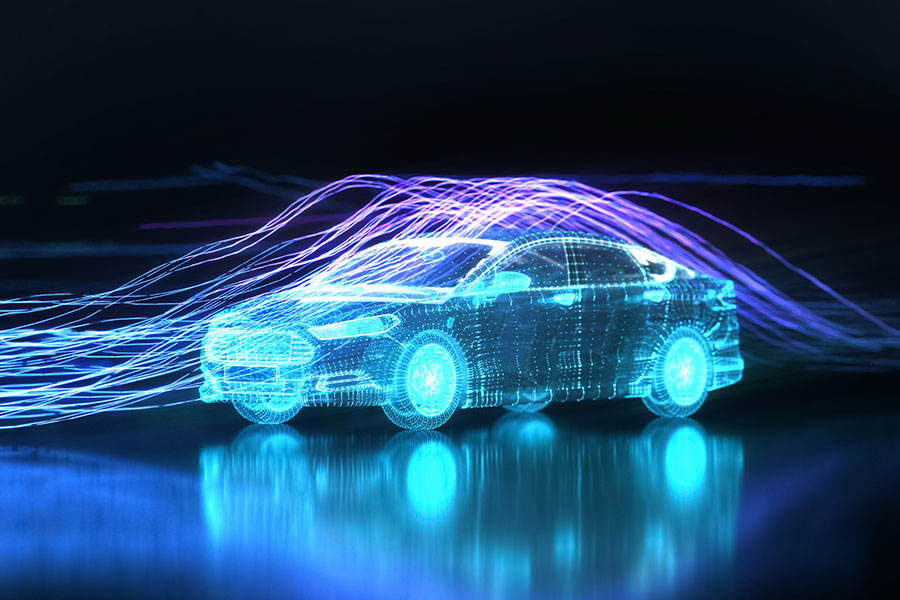
Investment Rating - The investment rating for the automotive industry is "Positive" (maintained) [1] Core Insights - In February 2026, China began soliciting public opinions on the L3 strong standards, completing the draft of "Safety Requirements for Autonomous Driving Systems of Intelligent Connected Vehicles" on February 5, 2026. The public consultation for this and four other mandatory national standards started on February 12, 2026, and will end on April 13, 2026. This strong standard primarily targets L3 and L4 levels of autonomous driving, replacing the recommended standard GB/T 44721-2024 [4] - The proposed implementation date for the L3 strong standard is July 1, 2027. The standard includes mandatory (GB) and recommended (GB/T) classifications, with violations of the mandatory standard leading to legal consequences. The L3 strong standard has completed the drafting phase and is currently in the public consultation stage, followed by review, approval, and publication [4] - Earlier, China approved L3 vehicles for road testing, with two models from Changan and BAIC Blue Valley receiving approval for road access trials on December 15, 2025. These models will undergo the next phase of road testing, with specific requirements set by the Ministry of Industry and Information Technology [4] - Investment recommendations include: 1) Vehicle manufacturers: Jianghuai Automobile, Xpeng Motors-W; 2) Component suppliers: Bertley, Coboda, Nexperia, Horizon Robotics-W, among others. Attention is also recommended for Huayi Technology [4] Summary by Sections - **L3 Strong Standards**: The draft for L3 strong standards has been completed and is open for public consultation, with a focus on safety requirements for autonomous driving systems [4] - **Implementation Timeline**: The strong standard is set to be implemented by July 1, 2027, following a series of approval processes [4] - **Road Testing Approvals**: Two L3 models have been approved for road testing, indicating progress in the industry [4] - **Investment Opportunities**: Specific companies are recommended for investment based on the ongoing developments in autonomous driving policies [4]
运达科技:公司参股企业扬斯科技的L4级自动驾驶物流机器人的研发与量产工作正按既定规划推进
Zheng Quan Ri Bao Zhi Sheng· 2026-02-24 10:17
Core Viewpoint - The company is progressing with the research and mass production of L4 autonomous driving logistics robots through its affiliated enterprise, Yangsi Technology, according to responses to investor inquiries on February 24 [1] Group 1 - The development of the new business is influenced by multiple factors including technology, market conditions, suppliers, and customers [1] - There is uncertainty regarding the business progress, and it is stated that there will be no direct impact on the company's performance in the short term [1] - Investors are advised to pay attention to risks and refer to publicly disclosed information for specific updates [1]

共赴智能经济新形态:两业协同下的广东高质量发展探索样本
Nan Fang Du Shi Bao· 2026-02-24 05:24
Group 1: Manufacturing and Automation - The manufacturing process is increasingly automated, with companies like Guangdong Yida Textile achieving a 75% automation coverage in shirt production, resulting in a threefold increase in efficiency [3] - Guangdong's home appliance industry is also embracing automation, with major companies implementing automated production lines and AI technology to enhance product quality and functionality [3][4] - The integration of AI and automation in manufacturing is leading to significant improvements in production efficiency and a reduction in labor costs, exemplified by the 80% automation in certain garment production processes [3][4] Group 2: Intelligent Services and Robotics - Companies like Kuku Intelligent Robot Co. are deploying coffee robots that can prepare a cup of coffee in about one minute, showcasing the application of AI in everyday services [10] - The humanoid robots from Shenzhen Yuejiang Technology are gaining traction in global markets, with over 50% of their revenue coming from international sales [8] - The use of AI-powered robots in service industries is breaking traditional boundaries between manufacturing and services, as seen in various applications across Guangdong [10] Group 3: Autonomous Vehicles and Transportation - WeRide's Robotaxi service has commenced 24-hour operations in Guangzhou, highlighting the advancements in autonomous driving technology and its integration into urban transportation [11] - The company has developed a comprehensive autonomous driving platform that significantly reduces data collection costs, showcasing the technological capabilities of Guangdong's automotive sector [12] - The presence of a complete automotive supply chain in Guangdong is facilitating rapid growth and innovation in the autonomous vehicle industry [12] Group 4: Agricultural Technology - Guangzhou XAG Technology is pioneering smart agriculture solutions, utilizing drones and AI for crop management across various countries, enhancing agricultural efficiency [7] - The company has established an IoT platform for agriculture, enabling comprehensive monitoring and management of farming activities [7] - The integration of technology in agriculture is contributing to the overall high-quality development of Guangdong's economy [6]
佑驾创新(02431)与地上铁、壁虎科技达成战略合作,开启无人物流规模化新阶段
智通财经网· 2026-02-24 02:54
Core Viewpoint - The strategic partnership between Youjia Innovation, Di Shang Tie Green Technology, and Shenzhen Wall Gecko New Energy Vehicle Technology aims to advance the design, production, and delivery of vehicle-grade unmanned logistics vehicles, addressing market gaps and enhancing market share in the unmanned logistics sector [1][2]. Group 1: Strategic Partnership Details - The three companies will integrate their resources to create a collaborative system that spans from technology research and development to mass production and market implementation [1]. - Youjia Innovation will focus on meeting national and industry vehicle-grade certification standards, ensuring the core technology for unmanned logistics vehicles is robust and reliable [1]. - Wall Gecko Technology will lead the development of the chassis system for unmanned logistics vehicles, providing essential hardware support for overall vehicle performance [1]. Group 2: Market Context and Opportunities - The logistics industry increasingly demands efficiency improvements and cost control, with unmanned logistics vehicles offering continuous operation and reduced labor costs as key solutions [2]. - Currently, there is a lack of mature, scalable, vehicle-grade products in the market, and this partnership aims to fill that gap, creating significant scale effects [2]. - The Xiaozhu unmanned vehicle has successfully completed practical application verification in various complex scenarios, demonstrating its reliability and adaptability [2]. Group 3: Expected Outcomes - The collaboration is expected to lower logistics costs and provide a replicable model for cost reduction and efficiency enhancement in the industry [2]. - The partnership marks a significant breakthrough for Youjia Innovation in the large-scale application of unmanned logistics, further expanding its market influence [2].
佑驾创新携手地上铁、壁虎科技,签署无人物流车领域战略合作协议
Ju Chao Zi Xun· 2026-02-24 02:53
Group 1 - The core viewpoint of the news is the strategic partnership formed between Youjia Innovation, Dizhantian Green Technology, and Bihuo Technology to develop and deliver 3,000 autonomous logistics vehicles that meet automotive-grade standards [2][3] - The collaboration aims to leverage each company's strengths in operational management, research and development, and L4 autonomous driving technology to enhance the efficiency and cost-effectiveness of logistics operations [2][3] - Youjia Innovation will lead the integration of the intelligent driving system and chassis system, ensuring compliance with national and industry certification standards for the autonomous logistics vehicles [2][3] Group 2 - Dizhantian will contribute its deep understanding of logistics scenarios to define the product, providing insights on functionality, performance metrics, design, and cost control [3] - Bihuo Technology will focus on the development of the chassis system, managing the entire process from component selection to performance validation and production [2][3] - The partnership aims for large-scale deployment of autonomous logistics vehicles across various scenarios, enhancing logistics efficiency and creating a replicable model for cost reduction and efficiency improvement in the industry [3]
佑驾创新(2431.HK)与地上铁、壁虎科技达成3000台无人物流车战略合作
Ge Long Hui· 2026-02-24 02:04
Core Viewpoint - The strategic partnership between Youjia Innovation, Di Shang Tie Green Technology, and Bihu Technology aims to develop and deliver 3,000 vehicle-grade unmanned logistics vehicles, addressing market gaps and enhancing market share in the unmanned logistics sector [1][2]. Group 1: Strategic Partnership Details - The collaboration focuses on resource integration to meet core demands in the unmanned logistics market, establishing a comprehensive collaborative system from technology R&D to mass production and market implementation [1]. - Youjia Innovation will ensure compliance with national and industry vehicle-grade certification standards, taking responsibility for the core technology of unmanned logistics vehicles [1]. - Bihu Technology will lead the development of the chassis system for unmanned logistics vehicles, providing essential hardware support for vehicle performance [1]. - Di Shang Tie will leverage its market resources and operational experience to contribute to product definition, offering practical suggestions on functionality, performance, appearance, and cost control [1]. Group 2: Market Context and Impact - The logistics industry increasingly demands efficiency improvements and cost control, with unmanned logistics vehicles offering continuous operation and labor cost savings as key solutions [2]. - The current market lacks mature, scalable, vehicle-grade products, and this partnership aims to fill that gap, creating significant scale effects [2]. - The Xiaozhu unmanned vehicle has successfully completed practical application verification in various complex scenarios, demonstrating its versatility and reliability [2]. - Xiaozhu unmanned vehicles have secured multiple bulk orders, including 500 units from Master and 800 units from New Ji'ao, indicating rising market recognition [2]. - This strategic collaboration marks a significant breakthrough for Youjia Innovation in the large-scale application of unmanned logistics, further enhancing its market influence in the sector [2].