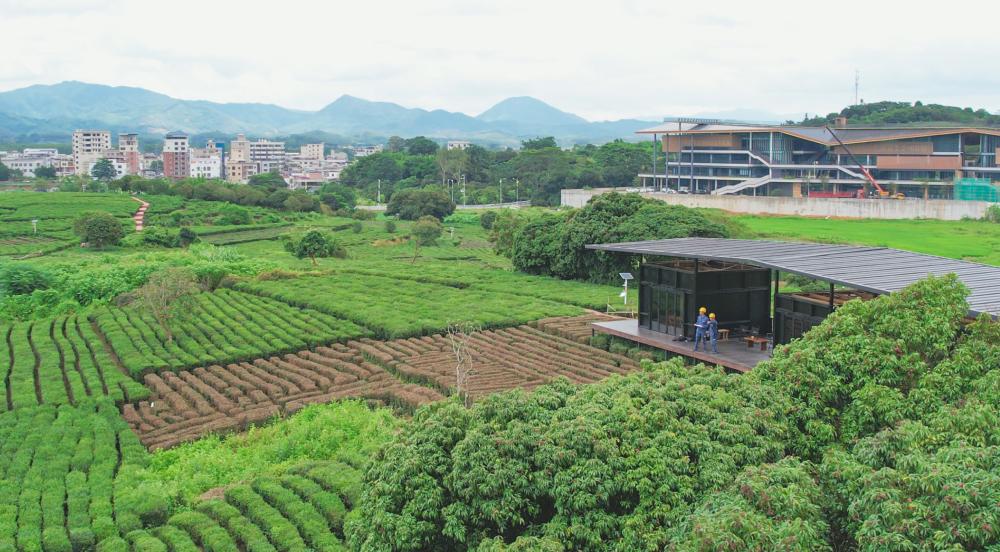
茶产业

Search documents
夏日里,听一首乡村振兴“奋进曲”
Xin Hua She· 2025-07-26 01:18
Bamboo Industry in Chishui City - Chishui City, known as one of the first ten bamboo towns in China, has 1.328 million acres of bamboo forests, creating a green ecological barrier and a thriving bamboo industry chain [1] - The bamboo industry in Chishui has seen continuous growth due to the "replace plastic with bamboo" policy, attracting high-quality enterprises and leading to the establishment of companies like Guizhou Xingchangmei Bamboo Industry Development Co., which produces bamboo chopsticks and containers [5][10] - The bamboo industry is transitioning towards deep processing and high value-added products, including bamboo pulp paper, eco-friendly tableware, and biomass materials [7] Economic Impact - The bamboo industry has provided stable employment opportunities for local residents, allowing them to earn a living without migrating [8] - The development of the bamboo industry has been recognized by the China Forestry Industry Federation, awarding Chishui the title of "Bamboo Capital of China" in 2023 [10] Tea Industry in Meitan County - Meitan County, a major tea-producing area in Guizhou, has over 300,000 tea farmers benefiting from the tea industry [12] - The tea gardens in Meitan have expanded to 600,000 acres, contributing significantly to rural revitalization [13] - Guizhou Yangchun Baiyue Tea Co., a key agricultural enterprise, connects over 20,000 acres of tea gardens and supports more than 30,000 tea farmers through a cooperative model [16] Agricultural Development in Sanjia Village - Sanjia Village, led by a young village party secretary, has initiated agricultural projects, including the cultivation of millet on over 100 acres of land [15][18] - The village has successfully sold over 30,000 pounds of millet through online sales, generating over 400,000 yuan in revenue [20] - Efforts are being made to create a complete industrial chain that integrates agricultural production, processing, and sales [20]

南农晨读丨铁岗红了
Nan Fang Nong Cun Bao· 2025-07-25 02:35
Group 1 - The People's Bank of China and the Ministry of Agriculture and Rural Affairs jointly issued an opinion to enhance financial services for rural reform and promote comprehensive rural revitalization [7][8][5] - The initiative aims to improve the rural financial service system and enhance the efficiency of financial resource allocation, aligning with the directives from the Party's 20th National Congress [6][5] - The document emphasizes learning from the "Ten Million Project" experience to drive reform thinking within the financial system [6][8] Group 2 - Zhang Guofu, chairman of Xianchi Tea Industry, is focusing on promoting oil tea globally, leveraging the Greater Bay Area as a strategic point [31][32] - Zhang has over 30 years of experience in the oil tea and tea industry and has received multiple honors for his contributions to rural revitalization [35][36] - The company is currently working on a new deep processing plant for oil tea [32] Group 3 - Yu Minghai, a technical expert in aquaculture, is utilizing technology to support fish farming and enhance the livelihoods of farmers [38][40] - He has been recognized for his role in agricultural technology promotion and connects farmers through the internet for better resource sharing [42][43] - His efforts have made him a trusted figure among local farmers, contributing to their economic success [44] Group 4 - The Ministry of Human Resources and Social Security has officially recognized "substitute tea processing worker" as a new independent profession, reflecting the evolving job market [46][47] - This new classification highlights the growing importance of alternative tea products in the industry [47]

普洱“碳”寻绿色发展密码
Zhong Guo Huan Jing Bao· 2025-07-24 02:09
Group 1: Carbon Management Initiatives - Yunnan Province's Pu'er City has established itself as a national forestry carbon sink pilot county, emphasizing ecological and green development [1] - The city has implemented a comprehensive carbon peak action plan, focusing on nine major actions including energy transition, urban construction, and green technology innovation [2][3] - A carbon account platform has been initiated, facilitating over 5,300 tons of carbon trading through a collaborative mechanism involving companies, counties, and farmers [2] Group 2: Green Economic Development - Pu'er City achieved a 100% green electricity supply rate during the 14th Five-Year Plan period, with significant growth in organic product certifications and green food brands [4] - The city is developing a circular economy, integrating agriculture, forestry, and tourism into a diversified industrial structure, with a focus on clean production and resource efficiency [4] - Traditional industries are undergoing green upgrades, exemplified by a salt company's energy-saving project that reduced energy consumption by 65% and carbon emissions by over 35,000 tons [5] Group 3: Sustainable Agricultural Practices - The city is promoting the green transformation of traditional agriculture, leveraging highland specialty products like tea and coffee to create a sustainable agricultural cycle [6] - Initiatives include the establishment of ecological demonstration gardens and the development of a circular industry chain that enhances agricultural productivity [6] - The city has successfully integrated carbon management into its agricultural practices, contributing to high-quality green development [6]
满足聆讯条件!八马茶业已获证监会备案,或很快在港上市
Nan Fang Du Shi Bao· 2025-07-22 10:26
Group 1 - The core point of the article is that Baima Tea has received a备案通知书 from the China Securities Regulatory Commission (CSRC), allowing it to proceed with its listing on the Hong Kong Stock Exchange [2][3] - Baima Tea plans to issue no more than 29,133,400 overseas listed ordinary shares and convert 43,986,875 shares held by 106 shareholders from domestic unlisted shares to overseas listed shares [2] - The company has shown steady revenue growth from 2021 to 2023, with revenues of 1.744 billion, 1.818 billion, and 2.122 billion yuan, and net profits of 163 million, 166 million, and 206 million yuan respectively [3] Group 2 - Baima Tea's journey to listing has been complicated, having previously attempted to list on the Shenzhen Stock Exchange in 2013 and later on the New Third Board in 2015, but faced multiple setbacks including withdrawal of applications [4] - The company is characterized as a family business, with significant shareholdings held by family members, including Wang Wenbin and Wang Wenli [5] - The new regulations for overseas listing management, effective from March 2023, have simplified the process for domestic companies seeking to list in Hong Kong [3]

3家企业完成境外上市备案 附名单(截至2025年7月17日)
Sou Hu Cai Jing· 2025-07-18 06:21
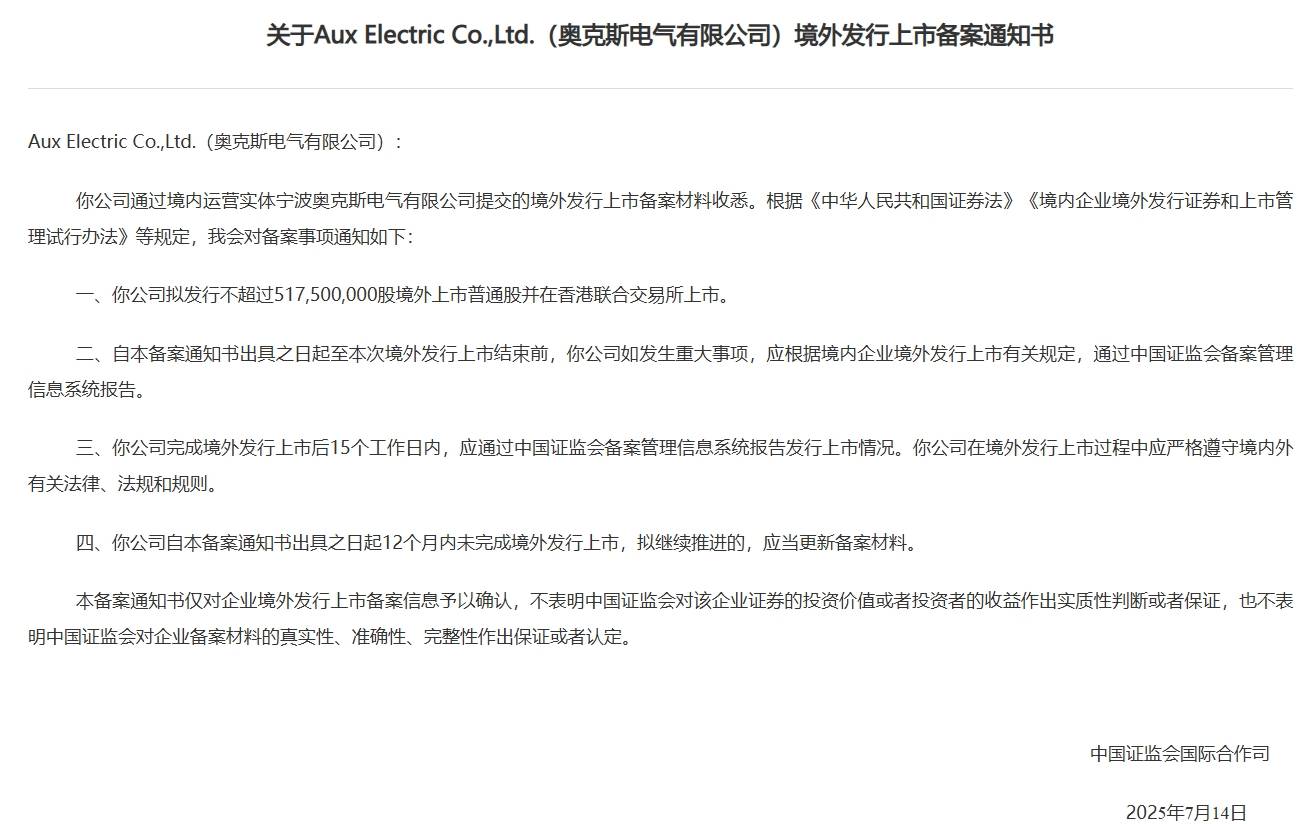
Core Viewpoint - The China Securities Regulatory Commission has confirmed the overseas listing applications for three companies: Aux, Bama Tea, and Dahang Technology, all of which are set to list in Hong Kong, bringing the total number of companies that have completed the filing for Hong Kong listings to 174 [1][3]. Group 1: Aux - Aux plans to issue no more than 517,500,000 shares of overseas listed common stock and list on the Hong Kong Stock Exchange [1]. - Aux Electric is one of the top five air conditioning providers globally, focusing on the design, research and development, production, sales, and service of household and central air conditioning, with operations in over 150 countries and regions [3]. - Financial performance for Aux shows revenues of 19.528 billion yuan, 24.832 billion yuan, and 24.278 billion yuan for the years 2022, 2023, and the first nine months of 2024, respectively, with corresponding net profits of 1.442 billion yuan, 2.487 billion yuan, and 2.716 billion yuan [3]. Group 2: Bama Tea - Bama Tea plans to issue no more than 29,133,400 shares of overseas listed common stock and list on the Hong Kong Stock Exchange [1]. - The company focuses on the high-end tea market, offering a full range of tea products including Oolong, black, red, green, white, and yellow teas, as well as tea utensils and food [6]. - As of September 30, 2024, Bama Tea operates 3,498 stores in China, including 274 direct-operated stores and 3,224 franchised stores [6]. - Financial performance for Bama Tea shows revenues of 1.818 billion yuan, 2.122 billion yuan, and 1.647 billion yuan for the years 2022, 2023, and the first nine months of 2024, respectively, with corresponding net profits of 166 million yuan, 206 million yuan, and 208 million yuan [6]. Group 3: Dahang Technology - Dahang Technology plans to issue no more than 9,100,000 shares of overseas listed common stock and list on the Hong Kong Stock Exchange [1]. - The company is a global leader in folding bicycles, offering over 70 models and holding 108 patents in mainland China, along with 22 patents in the United States, Europe, and Japan [7]. - Financial performance for Dahang Technology shows revenues of 254 million yuan, 300 million yuan, and 352 million yuan for the years 2022, 2023, and the first nine months of 2024, respectively, with corresponding net profits of 31.43 million yuan, 34.85 million yuan, and 45.84 million yuan [7].
连南茶产业智慧化转型遇瓶颈 高校调研厘清三方诉求
Zhong Guo Fa Zhan Wang· 2025-07-17 13:22
Group 1 - The core viewpoint of the news highlights the challenges faced by the tea industry in Lian Nan, Guangdong, particularly in the context of smart transformation and modernization of agriculture in hilly areas [1][2] - The research team identified three main challenges for smart management of tea gardens: terrain constraints affecting efficiency, insufficient technology adaptation, and high costs that are difficult for small and medium-sized enterprises to bear [2][3] - The government is also facing innovation bottlenecks, with less than 5% of the 30,000 acres of tea gardens in the county covered by smart technology, indicating a need for economically viable and replicable solutions [2][4] Group 2 - The research team proposed an exploratory research framework focusing on three dimensions: evaluating the effectiveness of drone patrols in mountainous areas, testing low-power sensor devices in weak network environments, and calculating the cost threshold for lightweight systems [3] - A collaborative mechanism between government, academia, and enterprises has been established to address the issues, with the county's agricultural bureau creating a dynamic feedback mechanism for industry pain points [4] - The collaboration aims to clarify the essence of the problems faced in the tea industry and hopes to construct a scientific theoretical framework to aid in the transformation of agriculture in mountainous regions [4]
第十四届财经峰会启幕 行业标杆大益茶斩获双奖
Sou Hu Cai Jing· 2025-07-17 10:19
Core Insights - The CFS2025 summit, themed "Navigating the Waves of Change, Building Economic Resilience," gathered over 1,200 elites from business, government, and academia to discuss topics like technological innovation, digital economy, and green development [1][3] - Yunnan Dali Tea Group's Chairman Zhang Yafeng received the "2025 Most Socially Responsible Entrepreneur Award," and Dali Tea was awarded the "2025 (Industry) Influential Brand Award," marking its unique recognition in the tea industry [3][6] Industry Focus - Dali Tea, as a leading company in the Chinese tea industry, emphasizes the importance of developing new productive forces amidst global economic adjustments and domestic economic transformations [5] - The company aims to address traditional industry upgrade bottlenecks and explore growth paths for emerging industries, providing strategic references for enterprises [5] Social Responsibility - Under Zhang Yafeng's leadership, Dali Group integrates the philosophy of "achieving through society, contributing to society" into its products and services, with the Dali Charity Foundation donating over 100 million yuan to various causes since its establishment in 2007 [8][10] - The "Dali Rural Revitalization Action," initiated in 2022, plans to invest no less than 50 million yuan over four to five years to support tea farmers in improving their living conditions, with over 24.68 million yuan already invested [12] Brand Influence - Dali Tea's recognition as an influential brand reflects its strength in brand value creation, technological innovation, and global expansion [14][17] - The company operates the world's largest single tea factory and has developed innovative tea-making techniques, contributing to the high-quality tea products it offers [15][17] - Dali Tea has established a global sales network and actively promotes tea culture, with its brand ranking first in the "Hurun China Tea Industry Exemplary Enterprises List" for its comprehensive strength [17][19]

【金融一线调研】从“看行业”到“看转型”:银行重构农企信贷逻辑
Jing Ji Guan Cha Wang· 2025-07-14 15:52
Group 1: Industry Overview - The eel farming industry is becoming a new growth engine for Tianma Technology, which has expanded its operations from feed production to a comprehensive modern aquaculture group, including health food, safe feed, smart farming, quality seed sources, and international trade [3] - Tianma Technology has established a strategic positioning centered on the eel industry, with a focus on food as a new blue ocean and feed as a foundational pillar, operating large-scale industrial bases in Fujian and Guangdong [3] - The company has developed domestically produced eel feed, breaking the foreign technology monopoly previously held by Japan [3] Group 2: Financial Support and Growth - Agricultural Bank of China (ABC) has increased its credit support for Tianma Technology, signing a strategic cooperation agreement for a credit line of 1 billion yuan in 2024, with a total credit of 417 million yuan currently provided [4] - The financial support aims to promote the company's strategic layout, which includes the core eel industry and four strategic sectors: special aquatic products, livestock, integrated industries, and food [4] - Spring Lun Group, a tea industry player, has also received tailored financial support from Guangfa Bank, which provided a "technology loan" of 10 million yuan to facilitate its transformation and modernization efforts [6] Group 3: Technological Innovation - Spring Lun Group is leveraging technology and digital transformation to modernize the traditional jasmine tea industry, establishing a national tea processing technology research center and holding 12 national patents [5] - The company has implemented automated production lines and IoT technologies to enhance production efficiency, achieving over a 30% increase in capacity through optimized fertilization and irrigation [5] - Spring Lun Group is also developing a comprehensive project integrating research, e-commerce, and cultural tourism, with an expected annual increase in output value of 1.5 billion yuan by 2025 [6]

新业态强势崛起 生产结构愈发清晰 我国茶产业逐步恢复稳健发展
Zhong Guo Chan Ye Jing Ji Xin Xi Wang· 2025-07-12 23:19
Core Insights - The tea industry in China is focusing on high-quality development, maintaining stable tea garden areas, and enhancing production technology to adapt to climate change and promote green transformation [1][2] - Despite the growth in tea garden area and total tea production, the domestic sales value of tea has decreased due to a decline in premium tea sales, indicating a need for innovation in the supply chain [2][5] - New tea beverages and innovative products are gaining popularity among younger consumers, driving growth in the tea market [2][5] Group 1: Industry Performance - The total area of tea gardens in China reached 3.4952 million hectares, an increase of 62,100 hectares year-on-year [2] - The total production of dry tea was 3.4991 million tons, reflecting a year-on-year growth of 4.78% [2] - Domestic tea sales value was 325.755 billion yuan, a decrease of 2.66% year-on-year [2] Group 2: Market Trends - The new tea beverage sector is driving rapid growth in bagged tea, with jasmine tea and herbal teas becoming new highlights [2] - Brand specialty stores are performing well, with sales increasing by over 15%, while traditional markets face challenges [3] - E-commerce continues to grow, with online tea sales reaching approximately 37 billion yuan, a year-on-year increase of 6% [3] Group 3: Technological Innovations - The tea industry is undergoing digital transformation, with provinces implementing 5G and IoT technologies for better monitoring and management of tea production [4] - Innovations in breeding and cultivation techniques are being developed, such as space-grown tea seeds and precision harvesting robots [4] - Blockchain technology is being utilized to enhance trust in the tea supply chain by recording production and sales data [4] Group 4: Sustainable Practices - Sustainable practices are being adopted, including green pest control and soil management to protect tea garden ecosystems [5] - New agricultural social services like "shared tea factories" and "tea caretakers" are emerging to support the industry [6] - Capital operations are being enhanced through initiatives like land transfer and attracting social capital for tea garden development [6]
36个精品新时代电气化村 “电”亮环“两山”引领区县域产业
2 1 Shi Ji Jing Ji Bao Dao· 2025-07-11 23:13
Core Viewpoint - The integration of power infrastructure development and ecological protection is a key initiative by the Southern Power Grid Guangdong Electric Power Company to support high-quality rural development in the "Two Mountains" leading area [1][2]. Group 1: Infrastructure Development - The Southern Power Grid has optimized the layout of power lines in tourist areas, such as the tea gardens in Huizhou, to enhance the aesthetic appeal and maintain ecological integrity [2]. - The company has implemented a comprehensive upgrade of power supply facilities in response to the increasing electricity demand from the local tea industry, ensuring reliable power supply for modernized tea production [4][5]. - A total of 72 charging stations and 369 charging piles have been established across the county, achieving full coverage in 17 towns, which supports the development of the tourism industry [6]. Group 2: Ecological and Economic Impact - The "All-Electric Homestay" project in Xuetian Village exemplifies the integration of renewable energy solutions, reducing carbon emissions by approximately 34 tons annually [6]. - The company has signed cooperation agreements with over 50 local governments to invest approximately 1.3 billion yuan in building 362 new electrified villages in 2024, promoting sustainable rural development [6]. - The establishment of 36 boutique electrified villages in the "Two Mountains" leading area is part of a broader strategy to enhance local industries and promote economic growth [7].