
农产品加工

Search documents
综合晨报-20250917
Guo Tou Qi Huo· 2025-09-17 02:46
隔夜国际油价上行,布伦特11合约涨1.51%。近期俄乌博弈再次加码,乌克兰频繁袭击俄罗斯炼厂 及出口港口,上周末遇袭的Kirishi地区炼厂炼能40万桶/天在全国占比6.4%,总体受损炼厂开工或 在10万桶/天之内;出口能力100万桶/天的西北部Primorsk港口亦因遇袭影响9月装船计划。 此外, 市场预期周三结束的联储议息会议将至少降息25bp,对商品市场情绪构成短期支撑。原油价格中期 偏空趋势不变,短期地缘因素或对供应有阶段性犹动,但反弹空间愈发受限,继续关注高位空单与 看涨期权相结合的策略组合。 gtaxinstitute@essence.com.cn 综合晨报 2025年09月17日 【原油】 (责金属) 隔夜贵金属震荡,美国公布8月零售销售月率录得0.6%,高于预测的0.2%和前值0.50%。市场定价美 联储年内将连续降息三次,特朗普称需要更快速的降息,聚焦明日凌晨美联储会议降息幅度以及鲍 威尔讲话对未来路径的指引。 【铜】 隔夜铜价阴线走低,短线仓量获利了结,市场静待联储会议。国内现铜上调到81120元,换月后沪 粤升水75、40元。铜价突破再涨,需重点关注资金兴趣,目前仓量一般。多单择机止盈观 ...
油脂油料早报-20250917
Yong An Qi Huo· 2025-09-17 01:00
Report Summary 1. Industry Investment Rating No industry investment rating is provided in the report. 2. Core Viewpoints - Abiove adjusted its forecasts for Brazil's 2024/25 soybean - related products, maintaining the soybean production and export volume forecasts, while increasing the forecasts for soybean crushing volume, bean - meal production, and soybean oil production [1]. - The NOPA monthly report showed that the U.S. soybean crushing volume in August decreased but was still higher than expected, and the soybean oil inventory at the end of August reached an eight - month low [1]. - Ukraine's rapeseed trade has been stagnant for two consecutive weeks due to export chaos, and there may be short - term price fluctuations [1]. 3. Summary by Related Catalogs Overnight Market Information - **Brazil**: Abiove kept the forecast of Brazil's 2024/25 soybean production at 170.3 million tons and the 2025 soybean export volume at 109.5 million tons. It raised the 2025 soybean crushing volume forecast to 58.5 million tons from 58.1 million tons, the 2024/25 bean - meal production forecast to 45.1 million tons from 44.8 million tons, and the 2024/25 soybean oil production forecast to 11.7 million tons from 11.65 million tons. The forecasts for 2024/25 bean - meal and soybean oil export volumes were unchanged at 23.6 million tons and 1.35 million tons respectively [1]. - **USA**: NOPA reported that U.S. member units crushed 189.81 million bushels of soybeans in August, 3.0% less than in July and 20.1% more than in August 2024. The average daily crushing volume was 6.123 million bushels, the lowest since last September. The soybean oil inventory at the end of August dropped to 1.245 billion pounds, 9.7% lower than at the end of July but 9.4% higher than the same period last year. The U.S. produced 4,512,904 short tons of bean - meal and 2.272749 billion pounds of soybean oil in August [1]. - **Ukraine**: Ukraine's rapeseed export has been blocked for two consecutive weeks due to disputes over customs documents after a 10% export tariff on rapeseed and soybeans. The Black Sea rapeseed CPT price dropped by $10 to $525 per ton last week. The rapeseed oil export volume from September 5 - 11 was 9,300 tons, down from 129,000 tons the previous week. Ukrainian agricultural enterprises may postpone rapeseed sales until November or December [1]. Spot Prices - The spot prices of soybean meal in Jiangsu, rapeseed meal in Guangdong, soybean oil in Jiangsu, palm oil in Guangzhou, and rapeseed oil in Jiangsu from September 10 - 16, 2025, showed certain fluctuations [4].
黄金刷新历史高位-20250917
申银万国期货研究· 2025-09-17 00:47
Core Viewpoint - The article highlights the strong performance of the U.S. retail sales in August, which increased by 0.6% month-on-month, marking the 11th consecutive month of growth, suggesting robust consumer spending despite economic challenges. This may influence the Federal Reserve's decision on interest rate cuts [1][2][15]. Group 1: Key Economic Indicators - U.S. retail sales showed a month-on-month increase of 0.6% in August, surpassing the expected 0.2%, and a year-on-year growth of 2.1% [2][15]. - The Consumer Price Index (CPI) for August rose by 2.9% year-on-year, while the core inflation rate was at 3.1% [2][15]. - The Producer Price Index (PPI) unexpectedly decreased by 0.1% month-on-month, with a year-on-year increase of 2.6%, which was below the market expectation of 3.3% [2][15]. Group 2: Commodity Insights - Gold prices are expected to remain strong due to the anticipation of multiple interest rate cuts by the Federal Reserve, with a neutral expectation of three cuts within the year [2][16]. - Copper prices are likely to fluctuate within a range due to mixed factors, including tight supply and varying demand from sectors like electricity and automotive [3][17]. - Oil prices increased by 1.56% as OPEC+ countries decided to adjust their production levels, indicating a stable outlook for global economic growth [3][10]. Group 3: Policy and Regulatory Developments - The Chinese government, through the Ministry of Commerce and other departments, announced measures to expand service consumption, including optimizing student holiday arrangements and enhancing service supply [1][4]. - The ongoing trade negotiations between the U.S. and China are expected to influence market conditions, particularly regarding tariffs and inflation [2][15]. Group 4: Market Performance - The U.S. stock market showed volatility, with major indices experiencing fluctuations, indicating a period of consolidation after a prolonged uptrend [8][9]. - The bond market saw a decrease in yields, with the 10-year Treasury yield falling to 1.784%, reflecting increased expectations for interest rate cuts [9]. Group 5: Industry-Specific Developments - The real estate sector in China is facing challenges, with the launch of a direct sales platform by the China Real Estate Association aimed at improving market efficiency [6]. - The agricultural sector is experiencing mixed signals, with soybean planting area adjustments and expectations for supply improvements affecting market dynamics [20][24].


苏霍同心 共赴“疆”来
Su Zhou Ri Bao· 2025-09-17 00:21
Group 1: Core Insights - The article highlights the significant progress made in the Xinjiang Uygur Autonomous Region over the past 70 years, particularly focusing on the collaboration between Suzhou and Horgos, which has been ongoing for 15 years [1] - The Suzhou-Horgos partnership emphasizes a comprehensive approach to aid, focusing on industry development, livelihood improvement, and cultural exchange [1] Group 2: Economic Development Initiatives - The Jiangsu Aid to Xinjiang Suzhou Working Group has invested nearly 3 million yuan to establish a Horgos agricultural product exhibition center, facilitating the sale of 1.3 billion yuan worth of Xinjiang agricultural products [2] - The group aims to transition from "blood transfusion" to "blood production," enhancing local agricultural technology and establishing a full industrial chain for products like persimmons and honey [2][4] - A financing lease of 24 million yuan was introduced to support local enterprises, marking a significant step in providing accessible financing options [3] Group 3: Education and Workforce Development - The construction of a vocational education park in Horgos, with a total investment of approximately 850 million yuan, aims to address the local shortage of skilled labor by providing training for 7,500 students [5] - The Horgos Technical School has established partnerships with Suzhou technical colleges to offer various vocational training programs, achieving a high employment rate for graduates [5] Group 4: Healthcare and Social Support - The Jiangsu Aid to Xinjiang Suzhou Working Group has facilitated the introduction of medical experts to improve healthcare services in Horgos, treating over 3,121 patients and performing 48 surgeries [6] - Significant donations from various organizations have been made to support education and social welfare in Horgos, totaling 6.09 million yuan [6] Group 5: Cultural Exchange and Community Building - Regular cultural exchanges between Suzhou and Horgos have fostered community ties, with numerous events promoting mutual understanding and appreciation of each other's heritage [7][8] - The "Su-Yun Yi-Qing" cultural exchange year series has seen extensive participation, with over 1,000 individuals engaging in various activities, enhancing cultural integration [8]
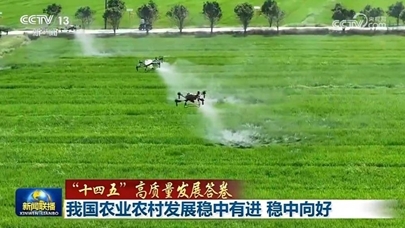
我国农业农村发展稳中有进 稳中向好
Yang Shi Wang· 2025-09-16 14:14
Core Viewpoint - During the "14th Five-Year Plan" period, China's agricultural and rural development has shown a steady and positive trend, with significant advancements in grain production and rural industries [2] Agricultural Production - Grain production in China reached a new high, surpassing 1.4 trillion jin last year, an increase of 74 billion jin compared to 2020 [2] - The per capita grain availability has reached 500 kg, ensuring basic self-sufficiency in grains and absolute safety in staple food [2] Technological Advancements - Over 100 million acres of high-standard farmland have been established, with the contribution rate of agricultural technology progress reaching 63.2% by the end of last year [2] - The comprehensive mechanization rate for crop planting and harvesting exceeds 75%, and the coverage rate of quality seeds for crops is over 96% [2] Poverty Alleviation Efforts - Following the successful poverty alleviation campaign, over 6 million monitoring subjects have been identified and supported, effectively eliminating the risk of returning to poverty [2] - The employment scale of the poverty alleviation population has remained stable at over 30 million in recent years, maintaining a baseline to prevent large-scale return to poverty [2] Rural Industry Development - The rural industry has flourished during the "14th Five-Year Plan" period, with revenue from large-scale agricultural product processing enterprises reaching approximately 1.8 trillion yuan last year [2] - There have been significant improvements in rural living environments, and public services in education, healthcare, and elderly care have continuously enhanced [2]
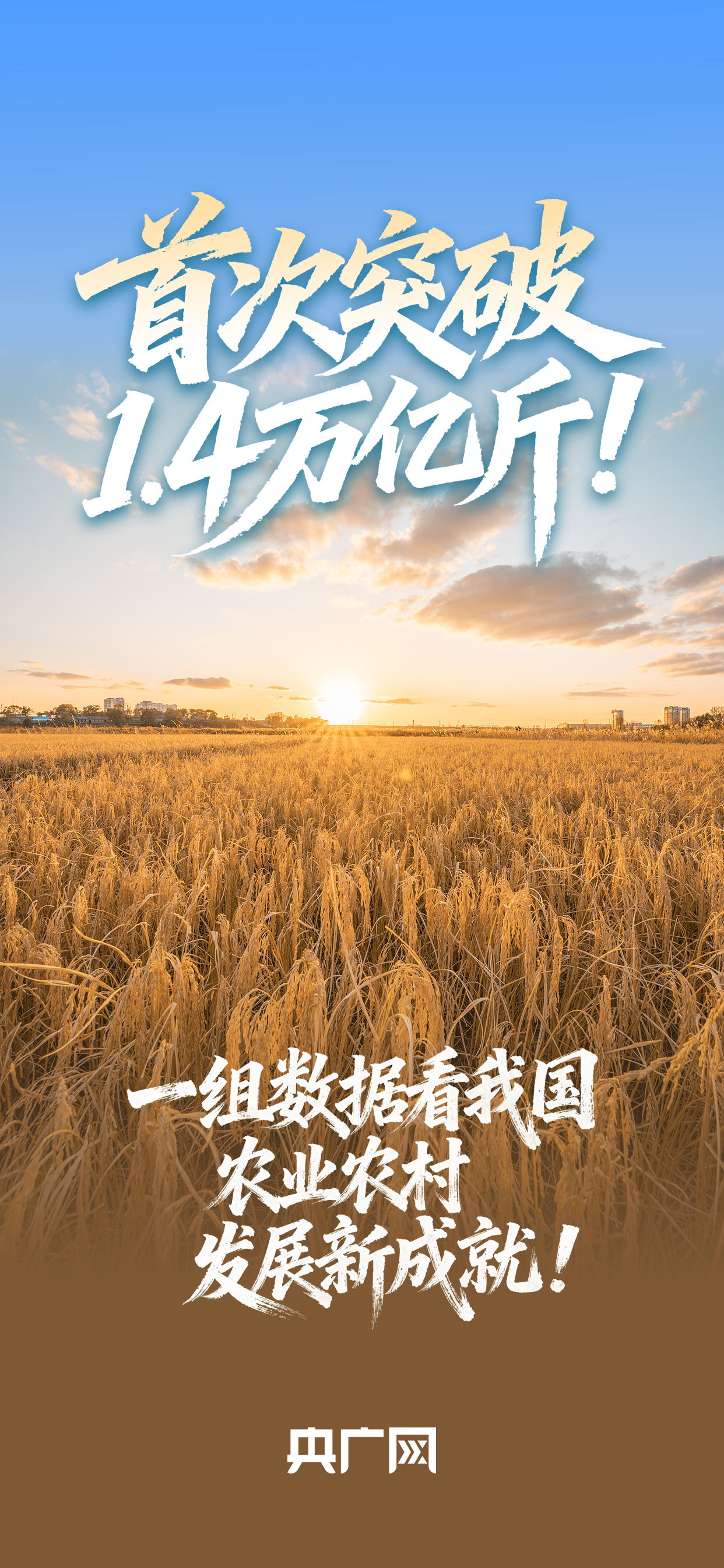
数读“十四五”答卷丨首次突破1.4万亿斤!一组数据看我国农业农村发展新成就!
Yang Guang Wang· 2025-09-16 14:05
Core Points - The press conference highlighted the achievements in agricultural and rural development during the 14th Five-Year Plan period, with a focus on food security and agricultural productivity [1] Group 1: Agricultural Production - In 2024, China's grain output is expected to exceed 1.4 trillion jin (approximately 700 million tons), marking a significant increase of 74 billion jin compared to 2020 [4][5] - The national grain planting area reached 1.79 billion mu (approximately 119 million hectares), an increase of over 3.8 million mu since 2020 [8] - The contribution rate of agricultural technological progress is projected to reach 63.2% by the end of 2024 [9] Group 2: Food Security - The per capita grain availability in China is set to reach 500 kg, ensuring basic self-sufficiency and absolute safety in staple food [6][7] - The coverage rate of improved crop varieties is expected to exceed 96% [9] Group 3: Agricultural Industry - The revenue of large-scale agricultural product processing enterprises is projected to reach around 1.8 trillion yuan (approximately 18 trillion yuan) in 2024 [13] - The comprehensive mechanization rate for crop farming is anticipated to exceed 50% [9] Group 4: Poverty Alleviation and Employment - The scale of employment for the population lifted out of poverty has remained stable at over 30 million in recent years [16]
14亿中国人的饭碗端得更牢 农业农村部:现在人均粮食占有量已达500公斤
Mei Ri Jing Ji Xin Wen· 2025-09-16 13:21
Core Viewpoint - The "14th Five-Year Plan" period has seen significant achievements in agricultural and rural development in China, ensuring food security and improving the quality of life for rural residents [1][2][3]. Group 1: Agricultural Production and Food Security - National grain production exceeded 1.4 trillion jin for the first time, an increase of 74 billion jin compared to 2020, with per capita grain availability reaching 500 kg [1][2]. - The country has achieved basic self-sufficiency in grains and absolute safety in staple food supply, ensuring national food security [2]. Group 2: Poverty Alleviation and Rural Revitalization - The success of poverty alleviation efforts has been solidified, with over 6 million monitoring subjects identified and supported to eliminate risks of returning to poverty [2][3]. - The income gap between urban and rural residents has narrowed, with the urban-rural income ratio decreasing from 2.56:1 in 2020 to 2.34:1 [3]. Group 3: Agricultural Modernization - Over 100 million acres of high-standard farmland have been established, with agricultural technology contribution rates reaching 63.2% and mechanization rates exceeding 75% [2]. - The coverage rate of quality seeds in crops has surpassed 96% [2]. Group 4: Food Safety and Quality Assurance - The national agricultural product quality safety monitoring pass rate has remained stable at over 97.5% during the "14th Five-Year Plan" [4]. - A total of 3,782 new or revised agricultural and veterinary drug residue standards have been established, increasing by nearly 40% compared to the end of the "13th Five-Year Plan" [4]. Group 5: Regulatory and Monitoring Framework - A comprehensive regulatory framework has been implemented, including the elimination of high-toxicity pesticides from agricultural production and a decrease in the use of veterinary antibiotics [4][5]. - Risk monitoring is conducted annually, covering a wide range of food products, with a focus on traceability and rapid detection of pesticide residues [4][6].
新华社权威速览丨势头良好!数据展现“十四五”农业农村发展新图景
Xin Hua She· 2025-09-16 12:12
Core Insights - The article highlights the achievements in agricultural and rural development during the "14th Five-Year Plan" period in China, emphasizing food security and poverty alleviation efforts [2][3]. Agricultural Production and Food Security - The annual grain production for 2024 is projected to exceed 1.4 trillion yuan, an increase of 740 billion yuan compared to 2020, with per capita grain availability reaching 500 kg, ensuring basic self-sufficiency and absolute food security [4]. - The supply of oil, sugar, fruits, vegetables, meat, eggs, milk, and aquatic products is abundant and diverse, enhancing the quality of life for the public [6]. Poverty Alleviation and Rural Revitalization - Over 6 million monitoring subjects have been identified for assistance, effectively eliminating risks of returning to poverty, with stable employment for over 30 million people from the poverty alleviation population [7]. - The "three guarantees" (compulsory education, basic medical care, and housing safety) and drinking water safety levels for the poverty alleviation population have continuously improved [7]. Agricultural Modernization - More than 100 million acres of high-standard farmland have been established, with significant advancements in agricultural modernization [7]. - The contribution rate of agricultural technology progress is reported at 62%, with a comprehensive mechanization rate of 75% for crop farming [8][9]. Rural Infrastructure and Public Services - By 2024, the revenue of large-scale agricultural processing enterprises is expected to reach 18 trillion yuan, with significant improvements in rural living conditions, including a sanitation toilet coverage rate of approximately 76% [12]. - Public service levels in rural education, healthcare, and elderly care are continuously improving, with various cultural and sports activities enhancing community engagement [13]. Income and Economic Disparity - The per capita disposable income of rural residents is projected to reach 23,119 yuan by 2024, with the urban-rural income ratio decreasing from 2.56:1 in 2020 to 2.34:1 [14]. Rural Development Initiatives - The second round of land contracts has been extended for another 30 years, with steady progress in the management of rural homesteads and collective land use [16]. - The cultivation of new agricultural business entities has been emphasized, with over 2 million farmer cooperatives and nearly 4 million family farms established [16].

湖北多举措护航“荆楚粮仓”硕果丰盈
Zhong Guo Xin Wen Wang· 2025-09-16 10:13
Core Insights - Hubei province has enhanced its grain and important agricultural product supply capacity through various measures since the beginning of the 14th Five-Year Plan, ensuring a bountiful harvest in the "Jingchu Granary" [1][2] Group 1: Agricultural Production - Hubei has built 11.84 million acres of high-standard farmland and implemented large-scale yield improvement actions in 55 major grain-producing counties, leading to a stable annual grain production of over 55 billion pounds for the past four years [1] - The total grain production in Hubei is projected to reach 55.7 billion pounds in 2024, indicating a strong agricultural output [1] Group 2: Agricultural Industry Development - Hubei is developing a trillion-yuan modern agricultural product processing industry, with the comprehensive output value of ten key agricultural industry chains expected to reach 1.09 trillion yuan in 2024 [1] - Four industry chains, including high-quality rice, live pigs, freshwater products, and vegetables, are projected to exceed 100 billion yuan in output value [1] - The province has added 1,181 new regulated agricultural product processing enterprises, bringing the total to 5,922, and established 36 new national key leading enterprises, totaling 98 [1] Group 3: Water Resource Management - Hubei has implemented 191 large and medium-sized irrigation projects during the 14th Five-Year Plan, increasing the irrigated area by over 17 million acres [2] - The province has improved drainage capabilities by constructing and renovating 55 drainage pump stations in flood-prone areas, significantly enhancing irrigation and drainage capacity [2] - Digital twin irrigation pilot projects have been launched in areas like Zhanghe and Wuling, optimizing irrigation water scheduling and achieving precise irrigation [2]
2024年湖北十大重点农业产业链综合产值达1.09万亿元
Zheng Quan Shi Bao Wang· 2025-09-16 10:00
Core Insights - In 2024, the comprehensive output value of the top ten key agricultural industry chains in Hubei Province is expected to reach 1.09 trillion yuan, with four industry chains including high-quality rice, live pigs, freshwater products, and vegetables exceeding 100 billion yuan each [1] Industry Development - Since the 14th Five-Year Plan, Hubei Province has added 1,181 new large-scale agricultural product processing enterprises, bringing the total to 5,922 [1] - The province has established 36 new national-level key leading enterprises, totaling 98 [1] - Three agricultural enterprises have gone public, increasing the total to 14 [1] - Hubei has built nine national-level advantageous characteristic industry clusters, 13 modern agricultural industrial parks, and 86 strong agricultural towns [1]