智能手机

Search documents
Omdia:三季度中国大陆智能手机市场出货量同比下降3%
智通财经网· 2025-10-16 02:07
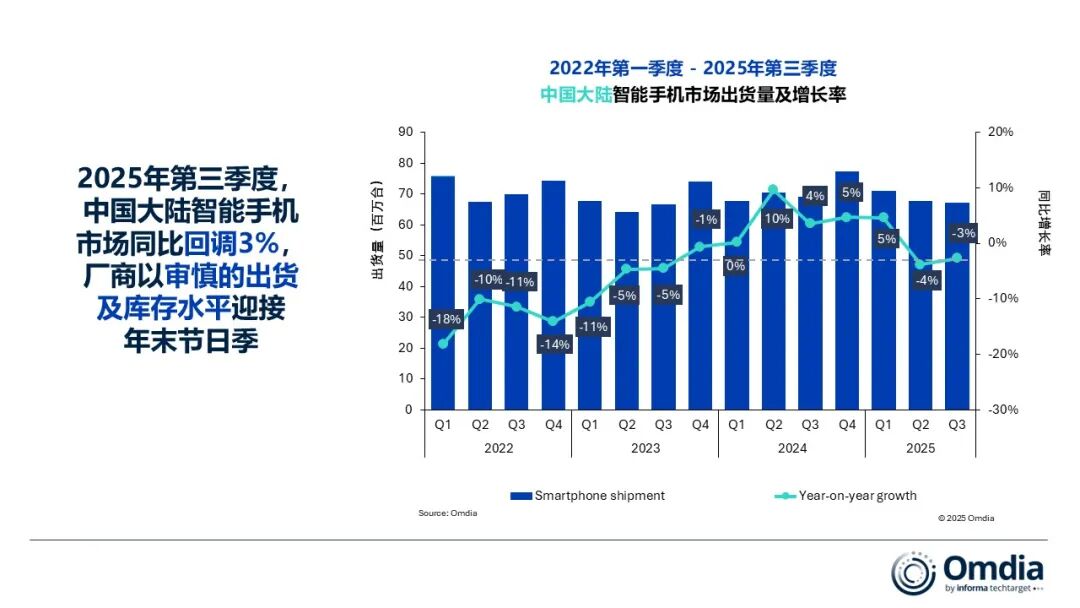
Core Insights - The Chinese smartphone market is experiencing a year-on-year decline of 3% in Q3 2025, indicating an ongoing adjustment phase with increasing competition among leading manufacturers [1][3] - Vivo regained the top position with a shipment of 11.8 million units, capturing an 18% market share, followed closely by Huawei with 10.5 million units (16% market share) and Apple with 10.1 million units (15% market share) [1][5] - The overall shipment volume for the Chinese smartphone market in Q3 2025 is 67.2 million units, down from 69.1 million units in the same period of 2024 [5] Market Dynamics - The market is gradually returning to normalcy after a period of fluctuations caused by national subsidy programs, with a more cautious shipment pace allowing manufacturers to maintain healthy inventory levels [3] - Major manufacturers are strategically updating their mid-range product lines, focusing on durability and reliability to meet consumer demands, with new models featuring large batteries and enhanced protection [3][5] Future Outlook - Despite the current decline, Omdia forecasts a moderate growth in smartphone shipments for the entire year of 2025, supported by national subsidies [5] - Local brands are differentiating their products through design, battery life, camera capabilities, and enhanced AI features to attract Chinese consumers, who are noted for their strong inclination towards AI [5]



信息图:2025年Q2 | 智能手机 | 移动市场监测
Counterpoint Research· 2025-10-16 02:02
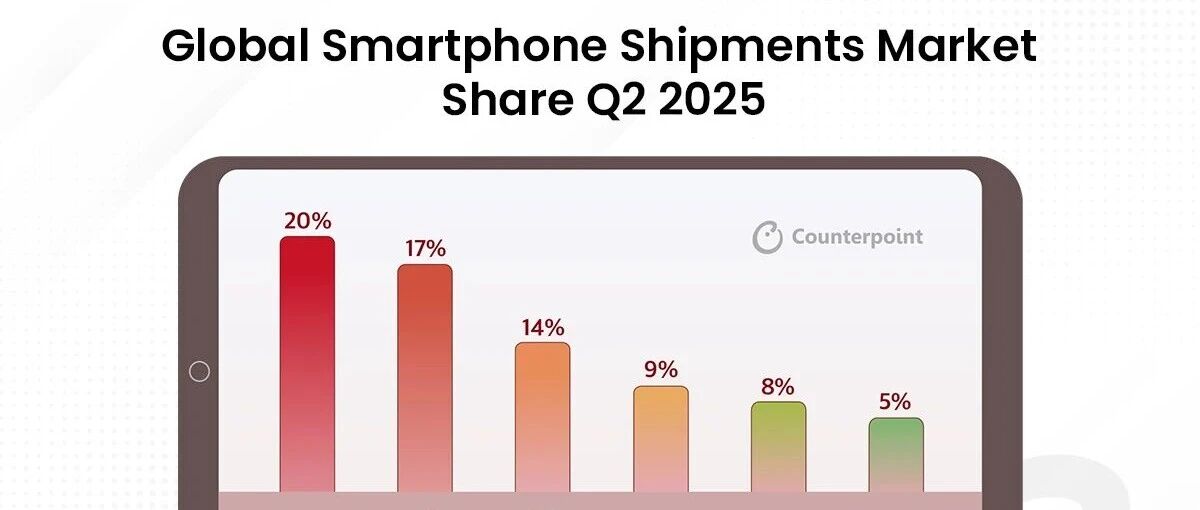
Group 1 - The global smartphone shipments increased by 3% year-on-year in Q2 2025, marking the second consecutive quarter of growth, driven by emerging markets like India, Latin America, and the Middle East and Africa, as well as stable high-end demand in mature markets such as Japan, Europe, and North America [7] - Global smartphone revenue reached $103.04 billion in Q2 2025, showing a strong year-on-year growth of 10% [7] - Samsung maintained its position as the global leader in smartphone shipments, with a 7% year-on-year increase, supported by the Galaxy S25 series and an upgraded Galaxy A series [7] Group 2 - Xiaomi ranked third in global shipments, with performance remaining flat year-on-year in Q2 2025, benefiting from stable demand in China and competitive pricing in Central Europe and Latin America [7] - Vivo and OPPO ranked fourth and fifth in global shipments, respectively, facing a slowdown in their core Chinese market but experiencing stable demand in Southeast Asia and parts of the Middle East [7] - The Asia-Pacific region continued to lead in shipments, accounting for over half of global shipments with a 2% year-on-year growth, while China's growth rate declined by 2% due to slowing demand, and India saw a strong rebound with a 9% year-on-year increase driven by rapid 5G adoption and active channel promotion [7]
由饱和迈向增长:全球二手智能手机市场正在转型
Counterpoint Research· 2025-10-16 02:02
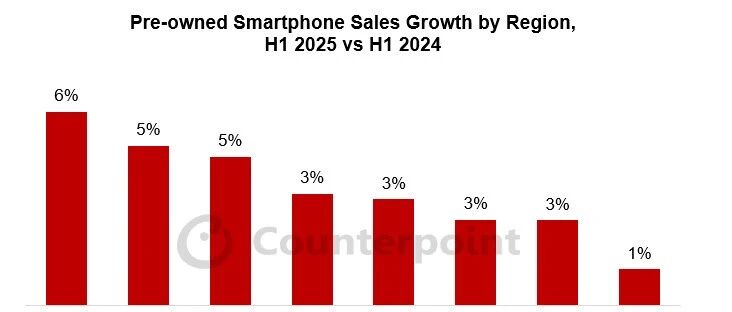
Core Insights - The article discusses the growth trends in the second-hand smartphone market, highlighting the contrasting performances between mature and emerging markets. Emerging markets like Africa, India, and Southeast Asia are driving growth, while mature markets are experiencing stagnation due to saturation and extended upgrade cycles [4][5][8]. Market Performance - In the first half of 2025, the second-hand smartphone market in mature regions such as Europe, the US, and Japan is expected to show a modest year-on-year growth of approximately 1%. Factors such as market fragmentation, rising costs, and prolonged upgrade cycles are impacting supply and demand [5][10]. - Conversely, emerging markets like Africa, India, Southeast Asia, and Latin America are projected to grow at an average year-on-year rate of about 4%, significantly outpacing the global average [5]. Regional Growth Drivers - **Africa**: The second-hand smartphone market is anticipated to grow by 6% year-on-year, driven by the increasing involvement of authorized retailers and government initiatives like "Bridge by Digital Africa," which support local refurbishment ecosystems [8][9]. - **India**: The market is expected to grow by 5% year-on-year, with a focus on high-end refurbished devices. Factors include enhanced consumer awareness, improved supply chain systems, and a rising demand for premium refurbished products [10][11]. - **Southeast Asia**: The market is projected to grow by 5% year-on-year, supported by a robust informal channel and stable inflow of second-hand devices from China. The rise of C2C transactions facilitated by online platforms is also a significant growth driver [12]. Brand Performance - Apple leads the refurbished smartphone market with a 7% year-on-year growth, primarily due to partnerships with high-end retailers and consumer preference for newer models like the iPhone 13 and above [11]. - Samsung follows with a 4% year-on-year growth, benefiting from aggressive trade-in promotions for its Galaxy S and Z series [11][14]. - In Indonesia and other Southeast Asian countries, Apple achieved a 15% year-on-year growth, capturing about half of the market share, while Samsung experienced a 3% decline overall [15]. Market Challenges - Mature markets are facing challenges such as declining exports, rising costs, and regulatory uncertainties, which are stabilizing overall sales but limiting growth potential [10][15]. - The competitive landscape in Europe is intensifying, with increased frequency of trade-in activities and pressure on profitability due to rising operational costs and regulatory changes [15].
2025年Q3全球智能手机出货量同比增长4%,三星、苹果领跑,亚太地区拉动增长
Counterpoint Research· 2025-10-16 02:02
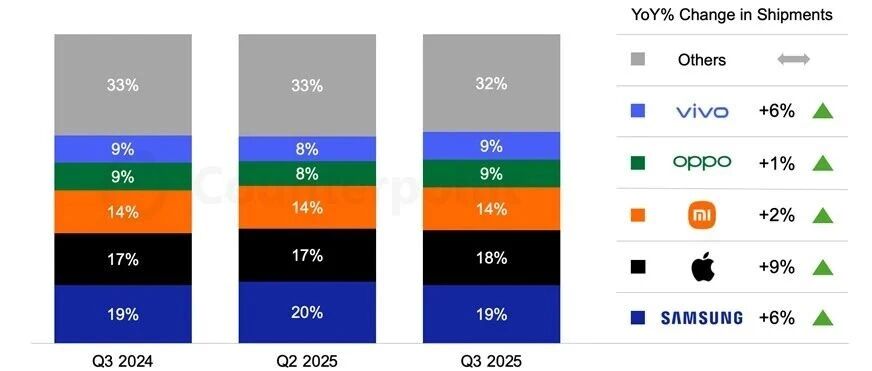
Core Insights - The global smartphone market experienced a 4% year-on-year growth in Q3 2025, driven by strong performances in the APAC and MEA regions despite declines in mature markets like North America and Europe [4][5]. Market Performance - Strong demand for high-end models persists in developed markets, while affordable 5G devices are gaining traction in growth markets such as India, APAC, and MEA. However, inventory reduction strategies have slowed down the Chinese market, and consumer confidence remains weak in Latin America [7]. - Japan's smartphone market saw a 15% year-on-year growth, fueled by the continued popularity of the iPhone 16 and iPhone 16e, alongside strong performance from Samsung's high-end Galaxy S25 series [7]. - The MEA region's smartphone shipments grew by 14% year-on-year, primarily driven by strong performances from Samsung and Xiaomi, with Apple leading the high-end segment [7]. - India's smartphone shipments increased by 9% year-on-year, benefiting from early festive season demand and government relief measures that improved consumer sentiment [7]. Brand Performance - Samsung led the global market with a 19% shipment share and a 6% year-on-year growth, driven by the strong performance of the Galaxy A series and the newly launched Galaxy Z Fold7 [11]. - Apple recorded a 9% year-on-year growth in global shipments, making it the fastest-growing brand among the top five, with significant growth in Japan, China, Western Europe, and APAC [11]. - Xiaomi maintained a 14% shipment share with a 2% year-on-year growth, particularly strong in Southeast Asia, MEA, and Latin America [12]. - Google saw an 18% year-on-year growth in shipments, driven by the popularity of the Pixel 9 series and the integration of AI features [12]. - OPPO and vivo ranked fourth and fifth in the global market, with OPPO achieving growth through affordable 5G models and vivo maintaining steady growth in India and Southeast Asia [12].
智能早报丨新凯来高端示波器亮相新闻联播,已在华为商用多年
Guan Cha Zhe Wang· 2025-10-16 01:55
Group 1: New Product Launches - New Kai's subsidiary, Shenzhen Wanlian Technology Co., Ltd., launched a self-developed 90GHz ultra-high-speed real-time oscilloscope, marking a significant breakthrough in high-end electronic measurement instruments in China [1] - Tsinghua University's team developed the world's first sub-angstrom snapshot spectral imaging chip "Yuheng," achieving a new height in high-precision imaging measurement technology [4] Group 2: Market Position and Performance - IDC reported that Vivo holds the top position in the Chinese smartphone market with a 17.3% market share in Q3 2025, followed by Apple and Huawei [5][6] - AliExpress has seen over ten brands with annual sales exceeding one million dollars surpassing Amazon in global sales since the launch of its "Super Brand Going Global Plan" [8] Group 3: Strategic Partnerships and Collaborations - UCloud and Haiguang Information have officially established an important ecological partnership, optimizing compatibility with Haiguang's deep computing processors for AI training and inference [7] Group 4: Corporate Developments - Ke Yang, head of AI-driven web search at Apple, is leaving to join Meta, indicating a continuing trend of departures from Apple's AI department [10] - Meta is investing over $1.5 billion in a new 1 GW data center in Texas to support its AI initiatives, with total capital expenditures for the year projected to reach $72 billion [11]

小米入局短剧赛道
第一财经· 2025-10-16 01:53
Core Viewpoint - Xiaomi has launched a new app called "Weiguan Short Drama" on its application store, which claims to offer a large number of short dramas for free without advertisements, achieving a download count of 20,000 so far [3]. Group 1 - The app "Weiguan Short Drama" is developed by Chengdu Share Information Dissemination Co., Ltd., which has a registered capital of 10 million yuan [5]. - The legal representative of Chengdu Share Information Dissemination Co., Ltd. is Wang Chuan, who is a co-founder and senior vice president of Xiaomi Technology [5]. - Chengdu Share Information Dissemination Co., Ltd. is fully owned by Beijing Juai Liao Network Technology Co., Ltd., which in turn is wholly owned by Xiaomi Technology Co., Ltd. [5][9]. Group 2 - The app is currently not available on the Apple App Store or other Android application stores [9]. - In July 2023, Xiaomi's subsidiary REDMI collaborated with Douyin and Wanhe Tianyi to produce a short drama titled "Time and Space Collaborator," with participation from some Xiaomi and REDMI employees [9].

苹果iPhone Air拆解:值得买吗?
半导体行业观察· 2025-10-16 01:00
Core Viewpoint - The article discusses the launch of Apple's new iPhone Air, highlighting its design choices aimed at achieving a balance between thinness and battery life, while also noting the trade-offs made in terms of features and increased production costs [2][10][20]. Design and Specifications - The iPhone Air is the thinnest iPhone to date at 5.6 mm, with a 7% reduction in area, 28% reduction in thickness, and 17% reduction in weight compared to the iPhone 16 Plus, while maintaining similar battery life [4][10]. - The battery design has changed to an irregular shape to maximize surface area, and it uses silicon for the anode instead of traditional graphite, allowing for efficient power supply in a smaller size [8][10]. Battery and Cost Analysis - The battery cost for the iPhone Air is estimated at $22, which is 2.8 times higher than that of the iPhone 16 Plus, reflecting the increased complexity of its design [10][16]. - The estimated cost of the base model (256GB) of the iPhone Air is approximately $539, with a cost ratio of 54%, similar to the iPhone 16 Plus [16]. Feature Reductions and Integration - To accommodate the larger battery and reduce power consumption, several features were removed, including reducing the rear camera from two to one and eliminating the physical SIM card slot [12][14]. - The layout of components has been altered, with electronic parts consolidated to the top of the device, and improvements made to Apple's semiconductor designs to reduce overall power consumption [14][16]. Market Strategy - Apple has increased the base storage of the iPhone Air to 256GB, priced at $999, effectively discontinuing the lower-margin 128GB model to secure higher profits [17]. - The article notes that while the iPhone's performance has improved, the physical size has generally increased over the past five years, with the new Air model catering to consumer demand for a lighter and thinner device [20]. Technological Innovation - The article suggests that the iPhone Air represents limited technological innovation in hardware, with Apple lagging in software advancements, particularly in the integration of generative AI [20].

9月核心CPI回到1%,央行开展6000亿逆回购 | 财经日日评
吴晓波频道· 2025-10-16 00:30
Economic Indicators - In September, China's CPI showed a slight year-on-year increase of -0.3%, with the core CPI rising to 1.0%, marking the first time in 19 months it has reached this level [2] - The PPI decreased by 2.3% year-on-year, but the decline was less severe than in previous months, indicating a potential stabilization in industrial prices [3] Monetary Policy - The central bank conducted a 600 billion yuan reverse repurchase operation to maintain liquidity in the banking system, with a total of 4 trillion yuan in reverse repos planned for October [4] - The need for fiscal stimulus is increasing as macroeconomic recovery shows signs of slowing, with expectations for potential interest rate cuts or reserve requirement ratio reductions in the fourth quarter [5] Global Economic Outlook - The IMF has raised its global economic growth forecast to 3.2% for 2025, citing reduced trade uncertainties due to new agreements, particularly between the US and other countries [6] - Global inflation is expected to decline, with the IMF projecting a drop to 4.2% by 2025, although disparities exist between different regions [7] Smartphone Market - Global smartphone shipments grew by 3% in Q3 2025, driven primarily by leading manufacturers like Samsung and Apple, with Apple achieving a 4% increase in iPhone sales [8] - The demand for smartphones is being supported by new product launches, although overall market recovery remains limited [9] Manufacturing Sector - The Chinese government has implemented tax reductions and refunds totaling approximately 1.3 trillion yuan to support the manufacturing sector, which has seen a 4.7% increase in sales revenue year-on-year [10] - Despite short-term impacts on tax revenue, these measures are expected to enhance the resilience and vitality of economic growth in the long run [11] Automotive Industry - JD.com is set to launch a new car in collaboration with GAC Group and CATL, with a price range of 100,000 to 120,000 yuan, aiming to leverage its e-commerce platform for sales [12] - The automotive market remains challenging for online sales, as previous attempts by JD.com have not yielded significant success [13] Retail Innovations - Walmart is partnering with OpenAI to allow customers to shop directly through ChatGPT, indicating a shift towards integrating AI in retail [14] - This collaboration may pave the way for broader applications of AI across various sectors, although the effectiveness of this model remains to be validated [15] Stock Market Performance - On October 15, the Shanghai Composite Index rose by 1.22%, reflecting a recovery in the market driven by policies aimed at boosting domestic demand [16] - The automotive sector has shown significant growth, with various economic indicators indicating a positive trend in the industry [16]




财信证券晨会纪要-20251016
Caixin Securities· 2025-10-15 23:30
Group 1: Market Overview - The Shanghai Composite Index closed at 3912.21, up 1.22%, while the Shenzhen Component Index rose 1.73% to 13118.75, and the ChiNext Index increased by 2.36% to 3025.87, indicating a positive market trend [1][7] - The overall market saw a reduction in trading volume, with a total turnover of 20903.87 billion, down by 5061.99 billion from the previous trading day, reflecting a cautious sentiment among investors [7][10] Group 2: Economic Indicators - In the first three quarters, RMB loans increased by 14.75 trillion, with M2 growing by 8.4% year-on-year as of the end of September [15][16] - The Consumer Price Index (CPI) fell by 0.3% year-on-year in September, while the Producer Price Index (PPI) decreased by 2.3%, indicating deflationary pressures in the economy [19][21] Group 3: Industry Dynamics - ASML reported a net sales of 7.5 billion euros in Q3 2025, with a gross margin of 51.6%, driven by strong demand for extreme ultraviolet (EUV) lithography equipment [27][28] - IDC reported that global smartphone shipments reached 322.7 million units in Q3 2025, a year-on-year increase of 2.6%, driven by high-end market demand [29][30] Group 4: Company Updates - Mindray Medical (300760.SZ) plans to issue H shares and list on the Hong Kong Stock Exchange to enhance its international strategy and capital strength [31] - Haiguang Information (688041.SH) reported a revenue of 9.49 billion for the first three quarters of 2025, a year-on-year increase of 54.65% [33] - Tailin Microelectronics (688591.SH) expects a revenue of 766 million for the first three quarters of 2025, representing a 30% year-on-year growth [36]
苹果CEO库克这趟中国行 为何先去LABUBU展“充电”?
Mei Ri Jing Ji Xin Wen· 2025-10-15 13:56
Core Insights - Apple's CEO Tim Cook's visit to China highlights the company's strategic focus on the Chinese market, particularly in the context of cultural engagement and new product launches [3][4][6] - The collaboration with LABUBU, a popular Chinese IP, signifies Apple's intent to connect with younger consumers and enhance its brand's emotional resonance in a saturated smartphone market [4][6][7] Group 1: Tim Cook's Visit and Activities - Tim Cook's visit included interactions with LABUBU creator Long Jiasheng and Pop Mart founder Wang Ning, showcasing Apple's commitment to cultural engagement [3][4] - Cook's presence at the LABUBU exhibition as the first stop of his China trip indicates a strategic move to tap into the growing trend of cultural and emotional branding [4][6] Group 2: Market Context and Implications - The launch of eSIM services by major Chinese telecom operators coincided with Cook's visit, reflecting a significant shift in the domestic communication landscape [2] - Apple's announcement of the iPhone Air pre-sale aligns with its efforts to maintain relevance in a competitive market, emphasizing the importance of cultural connections [2][3] Group 3: LABUBU and Pop Mart's Market Impact - LABUBU has emerged as a leading IP for Pop Mart, contributing significantly to the company's revenue, with a reported income of approximately 48.14 billion yuan in the first half of 2023 [6] - The cultural appeal of LABUBU, combining elements of Nordic mythology and emotional design, enhances its marketability and aligns with current consumer trends [6][7] Group 4: Broader Cultural Significance - The collaboration between Apple and LABUBU reflects a growing trend of cross-industry partnerships that leverage cultural IP to enhance brand identity and consumer engagement [5][8] - LABUBU's popularity among younger consumers illustrates a shift towards accessible luxury and emotional connection, breaking down traditional barriers in consumer branding [7][8]