
创新药

Search documents
超1.27万亿!南向资金加仓再创历史新高 非银、创新药、科技持续“吸金”
Zhong Guo Ji Jin Bao· 2025-11-06 07:37
Core Insights - Southbound capital has been a significant source of inflow into the Hong Kong stock market, with a cumulative net inflow exceeding 1.27 trillion HKD this year, marking a historical high for annual net inflows [1] - The innovative drug, technology, and non-bank sectors have seen substantial gains, with respective year-to-date increases of 79%, 53%, and 34%, compared to a 26% rise in the Hang Seng Index [1] - The largest Hong Kong innovative drug ETF (513120) received a net inflow of 585 million HKD in a single day, bringing its total size to 23.7 billion HKD [1] Fund Flows - The total net inflow for all ETFs in the market exceeded 3.777 billion HKD, with significant inflows into non-bank financials, innovative drugs, and technology sectors [1] - GF Fund Management led all public institutions with a total net inflow of 1.997 billion HKD across its ETFs, including those focused on A-shares and other sectors [2] - Notable ETFs under GF Fund Management include the innovative drug ETF (515120), low-fee创业板 ETF (159952), and the largest media ETF (512980), each receiving over 100 million HKD in net inflows [2] Market Outlook - Market volatility has increased entering November, with industry experts suggesting that fundamental improvements in 2026 may drive further gains in the Hong Kong stock market [2] - The AI industry is expected to catalyze improvements in net asset return rates (ROE) for sectors represented by the Hang Seng Technology Index, potentially leading to higher market valuations [2] - In terms of asset allocation, while the technology sector remains favorable, innovative drugs, non-bank financials, and certain cyclical assets are also worth attention [2]
市场风格切换,关注创新药国际化、上游资源品涨价
Tebon Securities· 2025-11-06 06:11
Market Review - The A-share market experienced a style switch with a mixed index performance, as technology stocks led the decline while small-cap stocks showed active performance. The Shanghai Composite Index broke through 4000 points before retreating, with an average daily trading volume of 2.33 trillion yuan, up from 1.80 trillion yuan the previous week [4][5]. Hard Technology - The global semiconductor expansion driven by AI continues, with Q2 2025 global semiconductor equipment sales reaching 33.1 billion USD, a 23% year-on-year increase. In September, Japan's semiconductor equipment sales reached 424.6 billion yen, up 14.9% year-on-year [14][15]. - Domestic semiconductor equipment manufacturers saw significant revenue growth in Q3 2025, with an average year-on-year increase of 35%. This reflects strong order fulfillment from last year's orders and progress in downstream wafer fabs [25][26]. Healthcare - Chinese innovative drug companies showcased significant achievements at the 2025 ESMO conference, with 33 companies presenting research results and 35 studies selected for oral presentations. Chinese companies accounted for 15.3% of the total abstracts presented [28][29]. - The value of patent licensing transactions for Chinese innovative drugs exceeded 100.7 billion USD in the first three quarters of 2025, marking a 170% year-on-year increase, indicating accelerated globalization of Chinese innovative drugs [32][33]. High-end Manufacturing - The tungsten price has significantly increased, reflecting supply-side policy tightening and recovering downstream demand. The average price of domestic black tungsten concentrate reached 299,000 yuan per ton, up 109.8% from the beginning of the year [38][39]. - The excavator industry in China has shown a continuous recovery, with sales reaching 174,000 units in the first nine months of 2025, a year-on-year increase of 18.1%. Both domestic and export markets experienced double-digit growth [42][43]. Consumer Sector - Cross-border e-commerce has emerged as a new highlight in China's foreign trade, with a rich midstream ecosystem involving merchants, platforms, and service providers. The development is driven by domestic "push" factors and overseas "pull" factors, leading to a comprehensive export era for platforms, factories, and sellers [5][6].


“出海+临床+政策”三重利好共振,震荡市场中恒生创新药ETF(520500)或迎布局良机
Xin Lang Ji Jin· 2025-11-06 05:31
Core Insights - The Hong Kong innovative drug sector is experiencing a volatile correction, with previous high gains being released, yet the underlying industry logic and fundamentals remain positive, indicating potential value in the sector [1][3] - The Hang Seng Innovative Drug ETF (520500) has seen a significant increase in trading activity, with an average daily trading volume of 1.304 billion yuan over the last four trading days, a 123% increase from October [1][3] - The total amount of License-out transactions from China reached 92.03 billion USD in the first three quarters of 2025, reflecting a strong trend in the internationalization of Chinese innovative drugs [1][4] Industry Developments - Recent clinical advancements were presented at the 2025 European Society for Medical Oncology (ESMO) conference, with several domestic innovative drug companies reporting promising clinical data that meets or slightly exceeds expectations [2][4] - The policy environment is improving, with the introduction of a commercial insurance innovative drug directory expected to diversify payment systems and open new growth opportunities for high-value innovative drugs [2][4] - The Hang Seng Innovative Drug ETF (520500) tracks the Hang Seng Innovative Drug Index, which focuses on core areas of innovative drugs, including biopharmaceuticals and chemical pharmaceuticals, and has recently been restructured to exclude CXO companies [2][4] Market Outlook - The combination of accelerated business development (BD) overseas, a dense pipeline of drug approvals, and favorable policy conditions suggests that Chinese innovative drugs may be on the verge of a global rise and commercialization [2][4] - The Hang Seng Innovative Drug ETF (520500) is positioned as a viable tool for investors to capitalize on opportunities in the Hong Kong innovative drug market, given its large scale and favorable liquidity [2][4]
刚刚,利好来了!创新药大消息
Zhong Guo Ji Jin Bao· 2025-11-06 04:33
Core Viewpoint - The Chongqing Municipal Government has issued measures to support the high-quality development of innovative drugs, aiming to enhance the local pharmaceutical industry by increasing the number of approved innovative drugs and fostering a comprehensive innovation ecosystem by 2027 [1][8]. Group 1: Overall Goals - By 2027, Chongqing aims to approve 1 to 3 innovative drugs annually, with a total of 10 innovative drugs, 3 industrial innovation complexes, 3 high-level innovation platforms, and 3 innovative drug industry clusters [1][8]. Group 2: Encouragement of R&D - Financial support will be provided for innovative drug projects at various clinical trial stages, with funding up to 20% of total R&D costs, capped at 2 million yuan for preclinical and phase I trials, 3 million yuan for phase II trials, and 10 million yuan for phase III trials [2][9]. - Support for the development of traditional Chinese medicine (TCM) will include a 100,000 yuan reward for each TCM product that completes registration and achieves sales [4][12]. Group 3: Industrialization Support - A reward of 10 million yuan will be given for each approved innovative drug, 5 million yuan for improved new drugs and biosimilars, and 1 million yuan for classic TCM products [2][12]. - Financial support for advanced manufacturing platforms will be capped at 1 million yuan, covering up to 20% of fixed asset investments [2][12]. Group 4: Clinical Research and Trial Enhancements - The establishment of a clinical trial responsibility risk compensation mechanism will encourage insurance companies to develop relevant insurance products, with subsidies for insured companies covering 50% of premiums [3][11]. - The measures will streamline the ethical review process for clinical trials, aiming to reduce the overall time for trial initiation to within 25 weeks [11][12]. Group 5: Market Access and Insurance Support - The measures will facilitate faster market access for innovative drugs, with a commitment to complete the listing process within 15 working days for products on the application list [12][13]. - The government will enhance communication channels between insurance departments and innovative drug companies to support the inclusion of innovative drugs in medical insurance [13][14]. Group 6: Talent and Ecosystem Development - The initiative emphasizes the importance of talent cultivation and attracting skilled professionals in the biopharmaceutical sector, aiming to build a robust ecosystem for innovative drug development [14][15]. - The establishment of specialized industrial parks and innovation platforms is planned to foster collaboration among enterprises, research institutions, and universities [14][15].
科创创新药ETF(589720)延续回调,资金逢低买入,连续4日净流入
Mei Ri Jing Ji Xin Wen· 2025-11-06 03:21
Group 1 - The core viewpoint of the article highlights a recent pullback in the innovative drug sector, with the Science and Technology Innovation Drug ETF (589720) declining nearly 1%, while funds have seen a net inflow of over 170 million yuan for four consecutive days, indicating a buying opportunity [1] - According to Zhongan International, the recent slight pullback in the pharmaceutical sector presents a bottom-fishing opportunity, driven by a recovery in capital market financing and an increase in overseas trading scale for innovative drugs [1] - The CXO industry is expected to experience performance recovery due to the combination of a recovering domestic demand for innovative drug research and development and the impact of interest rate cuts in the U.S. [1] Group 2 - Looking ahead, the innovative drug sector is primarily driven by expectations surrounding business development (BD), with the re-establishment of BD anticipated to be a key factor in stimulating sector recovery [1] - Data indicates that BD accounts for approximately 40% of the annual total in the fourth quarter, suggesting significant potential for large product expectations [1] - The Science and Technology Innovation Drug ETF focuses on innovative drug companies listed on the Science and Technology Innovation Board, tracking an index of 30 representative high-quality companies, primarily in the high-growth biotech sector [1]
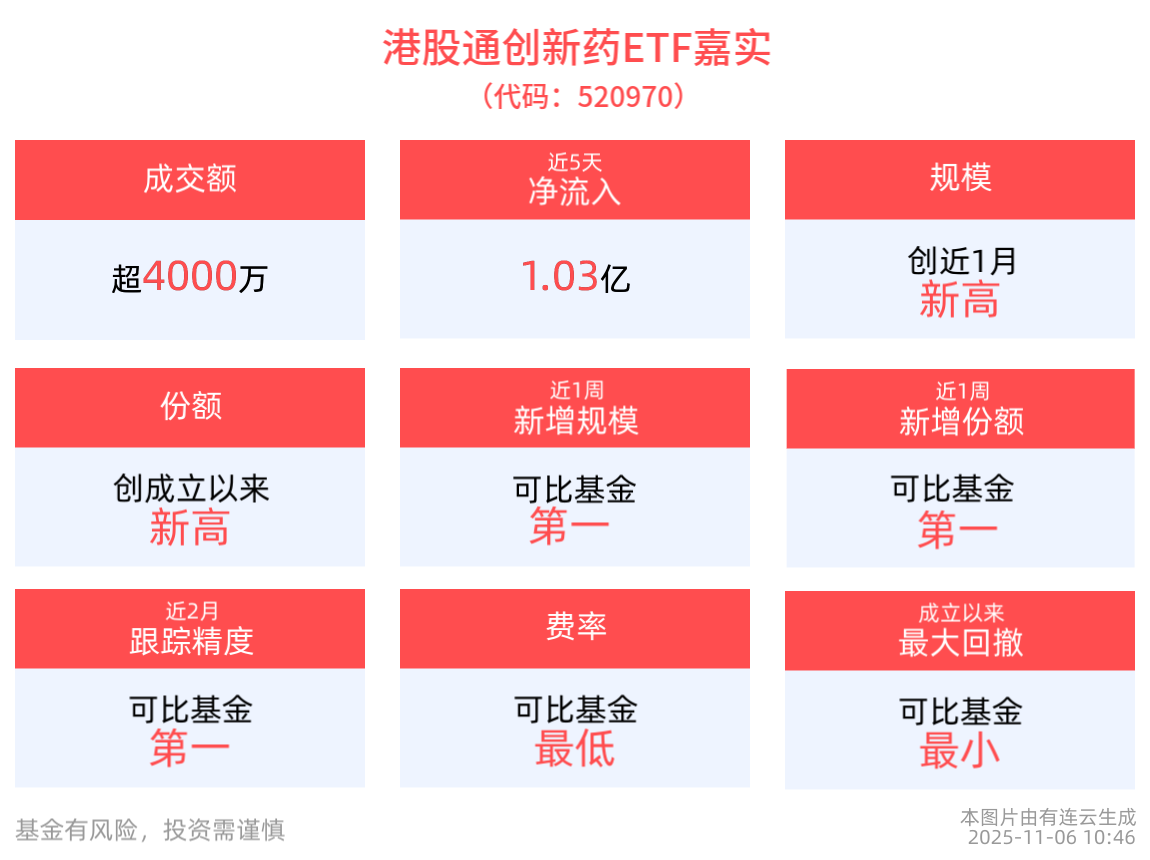
港股通创新药ETF嘉实(520970)最新规模达10.27亿,盘中微涨0.32%,机构:国产创新药正迎来全球性崛起与商业化兑现黄金周期
Xin Lang Cai Jing· 2025-11-06 03:16
Group 1 - The core viewpoint is that the Hong Kong Stock Connect Innovative Drug ETF has shown significant liquidity and growth in scale, with a recent net inflow of 56.08 million yuan and a total scale reaching 1.027 billion yuan [3] - The ETF's average daily trading volume over the past week was 133 million yuan, indicating strong investor interest [3] - The top ten weighted stocks in the CSI Hong Kong Stock Connect Innovative Drug Index account for 71.11% of the index, highlighting concentration in key players like WuXi Biologics and Innovent Biologics [3] Group 2 - Analysts suggest that the recent adjustment in the innovative drug sector from August to October is relatively benign, with no negative changes in the industry fundamentals [4] - The pharmaceutical sector is viewed as being at a relative bottom, providing strong safety margins and potential for upward movement [4] - The 2026 strategy for the pharmaceutical and biotechnology industry emphasizes that innovative drugs will remain a key investment theme due to their growing international status and significant market potential [4]

帮主郑重盘前策略:A股玩起“高低切换”,接下来怎么跟?
Sou Hu Cai Jing· 2025-11-06 03:13
Core Insights - The market is experiencing a shift, with traditional sectors like banking and utilities gaining strength while previously popular sectors such as metals, new energy, and innovative pharmaceuticals are facing declines [1][3] - A significant rebound in the A-share market occurred despite external pressures, indicating resilience among domestic investors and potential policy support [1] Market Trends - High allocation in technology sectors has reached historical highs, prompting institutions to lock in profits, while traditional industries like machinery and chemicals are showing signs of recovery [3] - Public funds are adopting a "barbell strategy," balancing investments between technology growth and stable dividend-paying sectors like coal and electricity, which serve as safe havens in volatile markets [3] - Despite external market challenges, foreign institutions are showing increased interest in Chinese assets, particularly in technology stocks, as noted by reports from JPMorgan and Goldman Sachs [3] Investment Strategies - Investors holding high-position technology stocks are advised to consider gradual profit-taking during rebounds, as historical data suggests an 80% probability of style rotation by year-end [4] - New investments should focus on "double low" opportunities: undervalued recovery sectors (e.g., power grid equipment) and low-profile emerging sectors (e.g., industries benefiting from Hainan's free trade zone) [4] - A recommended portfolio management strategy includes maintaining a 50% base position, 30% flexible allocation, and 20% cash reserves to manage unexpected market events [4] Conclusion - The market presents opportunities, but patience is essential. Understanding the underlying shifts in capital flow is crucial, especially as traditional industries begin to recover amidst a backdrop of high-tech sector volatility [5]
申万宏源证券晨会报告-20251106
Shenwan Hongyuan Securities· 2025-11-06 01:45
Group 1: Market Overview - Recent volatility in the US stock market has raised concerns about a potential new round of corrections globally, with the Nasdaq dropping 2% on November 4 and significant pullbacks in Japanese and Korean markets [2][11] - The tightening of dollar liquidity due to the US government shutdown has been identified as a catalyst for increased market fluctuations, with the Treasury General Account (TGA) rising by $200 billion since October [11] Group 2: North Exchange Quarterly Report - The North Exchange's Q3 2025 report shows a revenue growth of 5.3% year-on-year, while net profit decreased by 5.0%, indicating a recovery in revenue but ongoing challenges in profitability [10][12] - The return on equity (ROE) improved slightly to 6.1%, with asset turnover at 62.0% and a net profit margin of 5.6% [10][12] Group 3: Investment Opportunities in Specific Sectors - The technology and manufacturing sectors are experiencing continued growth, particularly in industries benefiting from anti-involution policies, such as basic chemicals and military equipment [14] - The AI sector remains robust, with companies in this space showing significant revenue growth, although concerns about potential bubbles are emerging [11][21] Group 4: Floating Rate Bond Strategy - Floating rate bonds are gaining traction due to their advantages in terms of duration and yield enhancement, particularly appealing to money market funds [13][18] - The market for floating rate bonds is expected to expand further in a declining interest rate environment, providing a defensive investment option during market downturns [18] Group 5: Weichuang Electric Overview - Weichuang Electric, a key player in the industrial control sector, has shown steady growth and is actively expanding into the humanoid robotics market, leveraging its existing technology [19][20] - The company is projected to achieve revenues of 1.913 billion, 2.234 billion, and 2.612 billion yuan from 2025 to 2027, with a corresponding net profit of 274 million, 318 million, and 376 million yuan [19] Group 6: Pharmaceutical Sector Performance - The pharmaceutical and biotechnology sector reported a revenue of 180.64 billion yuan in Q3 2025, with a slight year-on-year decline of 1.9%, but a positive cash flow trend indicates potential recovery [21][24] - The innovative drug segment has shown remarkable growth, with a 36% increase in revenue in Q3 2025, signaling strong market demand [21][24]

申万宏源研究晨会报告-20251106
Shenwan Hongyuan Securities· 2025-11-06 00:50
Group 1: Market Overview - The recent volatility in the US stock market has raised concerns about a potential new round of market correction, with the Nasdaq dropping by 2% on November 4 and significant declines in Japanese and Korean markets [2][11] - The tightening of dollar liquidity due to the US government shutdown has been identified as a catalyst for increased market fluctuations, with the Treasury General Account (TGA) rising by $200 billion since October [11] Group 2: North Exchange Market Analysis - The North Exchange's Q3 report shows a revenue growth of 5.3% year-on-year, but net profit decreased by 5.0%, indicating ongoing profitability challenges [10][12] - The return on equity (ROE) improved slightly to 6.1%, with asset turnover at 62.0% and net profit margin at 5.6% [10][12] Group 3: Investment Opportunities in Specific Sectors - The industrial automation sector is highlighted as a growth area, with the company achieving market share increases in low-voltage frequency converters and servo systems from 1.80% and 0.55% in 2019 to 3.02% and 2.30% by 2024 [19] - The human-shaped robot industry is also noted for its potential, with the company leveraging its automation technology to reduce R&D cycles and costs [19][20] Group 4: Pharmaceutical Sector Performance - The pharmaceutical sector reported a total revenue of 18,064 billion yuan in the first three quarters of 2025, with a slight year-on-year decline of 1.9% [21][24] - The innovative drug segment showed a significant revenue increase of 36% in Q3, indicating strong growth potential [21][24]
中信建投:三季度创新药产业链表现出色 各板块扣非增速排名有所变动
智通财经网· 2025-11-06 00:00
Core Viewpoint - The pharmaceutical industry has shown a decline in revenue and net profit for the first three quarters of 2025, with a year-on-year decrease of 1.98% in revenue and 11.60% in net profit, although the decline has narrowed compared to the first half of the year [1][2]. Summary by Relevant Sections Overall Industry Performance - The overall revenue and net profit of the pharmaceutical sector continue to decline year-on-year, but the rate of decline has decreased compared to the first half of the year [2]. Subsector Performance - The biopharmaceutical upstream, medical information technology, CRO/CMO, and research reagents sectors have shown strong growth in net profit [1][2]. - The biopharmaceutical upstream, CRO/CMO, medical devices, and home appliances sectors have experienced both revenue and net profit growth [1][2]. Key Sector Insights - **Pharmaceuticals and Innovative Drugs**: The chemical pharmaceutical sector has seen a narrowing of revenue decline, while profits remain under pressure. Innovative drug companies are advancing commercialization and internationalization, leading to significant revenue growth and reduced losses, with leading companies performing steadily [2]. - **CXO**: The industry returned to positive growth in the first half of 2025, with trends continuing into Q3. The CDMO sector shows stable demand, and the CRO sector has seen a notable improvement in order quantity and pricing expectations [2]. - **Upstream Pharmaceutical Chain**: Q3 of 2025 shows signs of recovery with significant profit improvement and gross margin enhancement, benefiting from domestic substitution and demand recovery [3]. - **Medical Devices**: Q3 revenue growth has turned positive, with a noticeable reduction in the year-on-year decline in profits. Several companies are expected to continue improving their performance, with accelerated growth anticipated in 2026 compared to 2025 [3]. - **Medical Services**: Q3 revenue has slightly declined year-on-year, but some consumer medical service companies have stabilized and increased their average transaction value [3]. - **Traditional Chinese Medicine**: Q3 performance has shown a narrowing decline compared to previous quarters, with optimism for demand recovery in the year-end peak season [3]. - **Vaccines**: The sector has experienced a significant year-on-year decline in both revenue and profit for the first three quarters, with future focus on sales improvement and innovation pipeline progress [3]. - **Blood Products**: Revenue has remained stable, but profits are under continued pressure. There is an expectation for a balanced supply-demand situation to recover, with attention on plasma station expansion and industry mergers [3]. - **Pharmaceutical Retail**: Q3 revenue growth has improved quarter-on-quarter, with profits maintaining rapid growth; prior stock price reactions have been sufficient, and attention is on diverse catalysts [3]. - **Pharmaceutical Distribution**: Q3 revenue growth has improved quarter-on-quarter, with impairment provisions affecting profits. Leading companies are stabilizing operations, with future focus on payment recovery and long-term growth expectations from the 14th Five-Year Plan [3]. Investment Outlook for H2 2025 - The company continues to seek new growth and industry consolidation opportunities, with a focus on innovation, global competitiveness, and the assessment of international competitiveness in innovative drugs and medical devices [4][5].
