建材

Search documents
关注下游扩消费活动开展
Hua Tai Qi Huo· 2026-02-13 08:16
Report Summary 1. Report Industry Investment Rating No information provided. 2. Core Viewpoints - The National Development and Reform Commission, the Financial Regulatory Administration, and the Civil Aviation Administration of China have issued an implementation opinion on promoting the high - quality development of low - altitude insurance. By 2027, a preliminary mandatory insurance system for unmanned aerial vehicle liability will be established, and by 2030, the policy framework for low - altitude insurance will basically take shape [1]. - The National Film Administration and the Ministry of Commerce have organized a "Film +" consumption comprehensive pilot program to boost consumption and promote the transformation of the film industry into a diversified consumption ecosystem [1]. 3. Summary by Industry Level Upstream - Black commodities are at low prices [1]. - Egg prices have declined [1]. - Building material prices have dropped [1]. Midstream - The operating rates of PX and urea remain high [2]. - The coal consumption of power plants has increased [2]. - The production of pork products has increased [2]. Downstream - The sales of commercial housing in first - and second - tier cities have seasonally declined [2]. - The number of domestic flights has remained high and stable [2]. 4. Key Industry Price Indicators | Industry | Indicator | Value (as of 2/9) | YoY | | --- | --- | --- | --- | | Agriculture | Spot price of corn | 2271.4 yuan/ton | 0.00% | | | Spot price of eggs | 7.1 yuan/kg | - 12.96% | | | Spot price of palm oil | 8972.0 yuan/ton | - 0.47% | | | Spot price of cotton | 15986.0 yuan/ton | - 0.65% | | | Average wholesale price of pork | 18.3 yuan/kg | - 0.76% | | Non - ferrous metals | Spot price of copper | 101646.7 yuan/ton | 0.79% | | | Spot price of zinc | 24656.0 yuan/ton | - 1.26% | | | Spot price of aluminum | 23406.7 yuan/ton | 1.90% | | | Spot price of nickel | 138650.0 yuan/ton | - 0.20% | | | Spot price of aluminum | 16506.3 yuan/ton | 0.08% | | | Spot price of rebar | 3170.0 yuan/ton | - 0.61% | | Ferrous metals | Spot price of iron ore | 786.9 yuan/ton | - 2.25% | | | Spot price of wire rod | 3367.5 yuan/ton | - 0.96% | | | Spot price of glass | 13.3 yuan/square meter | 0.15% | | Non - metals | Spot price of natural rubber | 16125.0 yuan/ton | 0.62% | | | China Plastic City Price Index | 786.7 | - 0.56% | | | Spot price of WTI crude oil | 63.6 dollars/barrel | - 2.55% | | Energy | Spot price of Brent crude oil | 68.1 dollars/barrel | - 1.83% | | | Spot price of liquefied natural gas | 3620.0 yuan/ton | 0.39% | | | Coal price | 799.0 yuan/ton | - 0.50% | | | Spot price of PTA | 5144.3 yuan/ton | - 0.57% | | Chemical | Spot price of polyethylene | 6800.0 yuan/ton | - 3.20% | | | Spot price of urea | 1765.0 yuan/ton | - 0.70% | | | Spot price of soda ash | 1201.4 yuan/ton | - 0.12% | | Real estate | National cement price index | 131.7 | - 0.79% | | | Building materials composite index | | - 0.43% | | | National concrete price index | 89.8 | - 0.42% | [36]
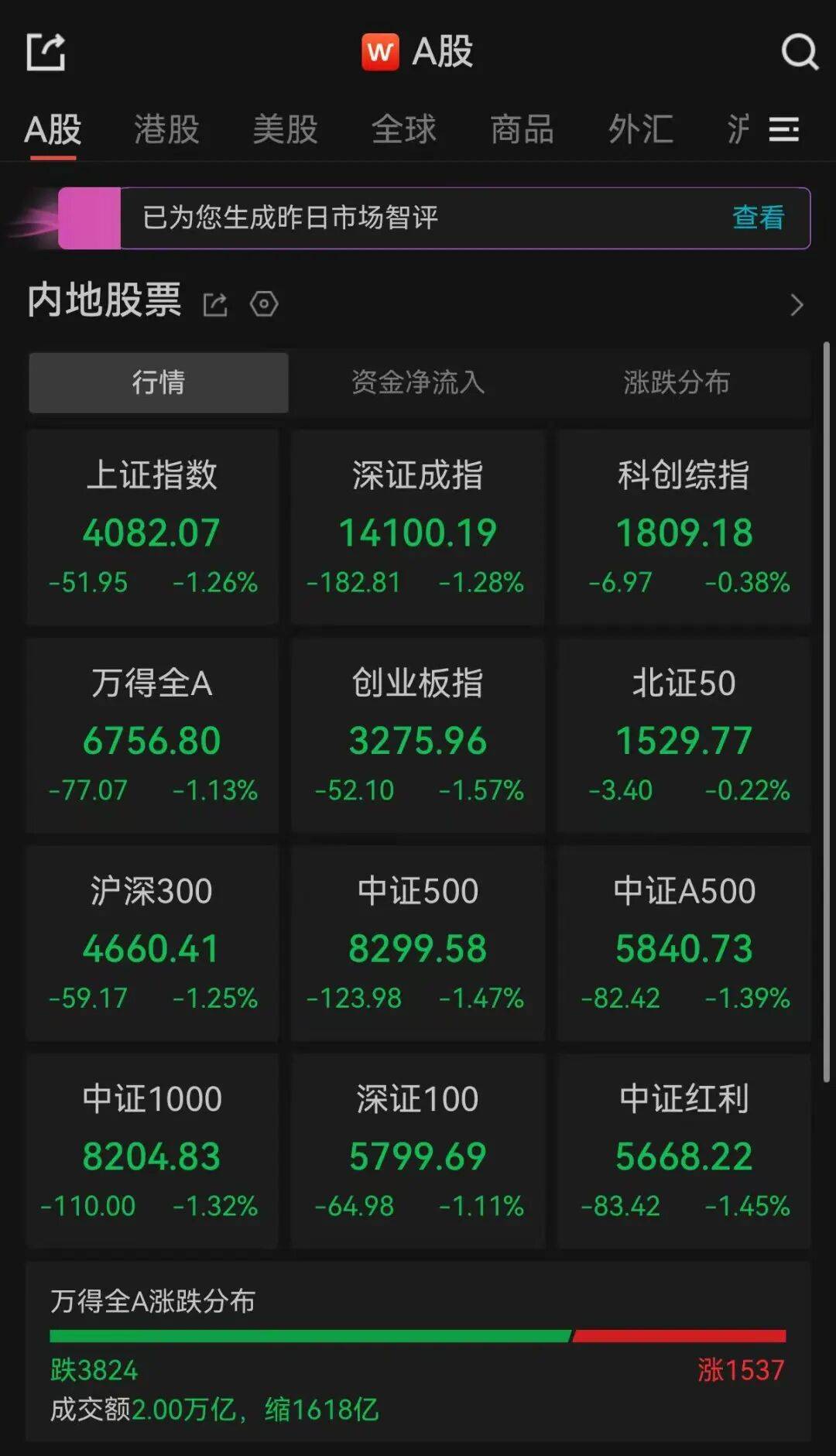
蛇年最后一个交易日:沪指失守4100点,超3800只个股下跌,三大指数集体飘绿
Sou Hu Cai Jing· 2026-02-13 08:02
Market Performance - On the last trading day of the Year of the Snake, the three major indices opened lower and subsequently declined, each falling over 1%. The Shanghai Composite Index dropped by 1.26%, closing below 4100 points, while the Shenzhen Component Index fell by 1.28% and the ChiNext Index decreased by 1.57% [1][2]. Yearly Overview - Throughout the Year of the Snake (from February 5, 2025, to February 13, 2026), all three major indices recorded gains. The Shanghai Composite Index increased by over 25%, the Shenzhen Component Index rose by nearly 39%, and the ChiNext Index surged by over 58% [4]. - The total trading volume for the year reached 20 trillion, with over 3800 stocks experiencing declines [4]. Sector Performance - In terms of sector performance, the non-ferrous metals and oil & gas sectors saw the largest declines, while shipping, steel, and building materials also faced downturns. Conversely, sectors such as commercial aerospace, robotics, and memory storage showed resilience and performed well [4].

短期经济增长
Guoxin Securities Co., Ltd· 2026-02-13 07:25
Economic Growth - The operating rate of blast furnaces in 247 steel mills nationwide was 79.55%, an increase of 0.53 percentage points from the previous week[1] - The capacity utilization rate of steel mills rose to 85.71%, up by 0.26 percentage points week-on-week[1] - The average daily pig iron output reached 2.2864 million tons, an increase of 0.072 million tons from the previous week[1] Inflation - The average wholesale price index for agricultural products was 129.91, up by 0.36% compared to January's average[2] - The average wholesale price index for the "vegetable basket" was 132.80, reflecting a 0.46% increase from January[2] Interest Rates - The average overnight SHIBOR rate was 1.3192%, down by 0.0514 percentage points from the previous week[3] - The average 1-day repo rate was 1.3963%, decreasing by 0.0684 percentage points week-on-week[3] Policy Developments - The State Council approved the "Modern Capital Metropolitan Area Spatial Coordination Plan (2023-2035)" aimed at establishing a world-class metropolitan area centered around the capital[4] - A joint announcement by the People's Bank of China and eight departments clarified that virtual currency-related activities are illegal and strictly prohibited within the country[4] Risk Factors - Potential geopolitical deterioration beyond expectations poses a risk to economic stability[5] - An unexpected recession in Europe and the U.S. could adversely affect market conditions[5]
风险偏好高低切换下,房地产链迎价值机遇,建材ETF(159745)近1周新增规模居同类产品第一
Xin Lang Cai Jing· 2026-02-13 05:12
Group 1 - The core index of the construction materials sector, the CSI All Construction Materials Index, fell by 2.05% as of February 13, 2026, with mixed performance among constituent stocks [1] - The top-performing stocks included Hainan Ruize, which rose by 1.39%, while Jinjing Technology led the decline with a drop of 5.36% [1] - The Construction Materials ETF (159745) decreased by 1.77%, with a latest price of 0.72 yuan, but showed a cumulative increase of 8.24% over the past month [1] Group 2 - The Construction Materials ETF recorded a turnover rate of 2.51% and a transaction volume of 56.7866 million yuan, with an average daily transaction of 183 million yuan over the past week, ranking first among comparable funds [1] - The ETF's scale increased by 12.2 million yuan over the past week, placing it in the top third of comparable funds [1] - The latest net outflow of funds from the ETF was 20.7035 million yuan, but there were net inflows on three out of the last five trading days, totaling 213 million yuan [1] Group 3 - Leverage funds are actively positioning in the market, with the latest margin buying amounting to 3.1003 million yuan and a margin balance of 33.6321 million yuan [1] - According to a report by Guojin Securities, global assets have entered a "Risk-off" mode due to various risk events, leading to a shift from growth to value stocks in the equity market [1] - The report highlights that sectors like industrials, materials, and real estate are gaining favor due to their characteristics that are difficult to replace with AI [1] Group 4 - Zhongyin Securities forecasts two potential turning points in the year: a "policy turning point" around the end of Q1 and a "fundamental turning point" around Q4, focusing on the improvement of demand and narrowing declines in second-hand housing prices [2] - The Construction Materials ETF has seen a net value increase of 28.68% over the past two years, ranking first among comparable funds [2] - The ETF's highest single-month return since inception was 24.25%, with an average monthly return of 6.65% during rising months [2] Group 5 - As of February 6, 2026, the Construction Materials ETF had a Sharpe ratio of 1.29, indicating a favorable risk-adjusted return [3] - The maximum drawdown for the ETF this year was 5.48%, with a relative benchmark drawdown of 0.24%, and it recovered the fastest among comparable funds [3] Group 6 - The management fee for the Construction Materials ETF is 0.50%, and the custody fee is 0.10%, with a tracking error of 0.065% over the past six months, the highest among comparable funds [4] - The ETF closely tracks the CSI All Construction Materials Index, which reflects the overall performance of listed companies in the construction materials sector [4] Group 7 - As of January 30, 2026, the top ten weighted stocks in the CSI All Construction Materials Index accounted for 61.6% of the index, including companies like Conch Cement and Dongfang Yuhong [5]


午评:创业板指跌近1%,石油、电力等板块走低,军工板块上扬
Sou Hu Cai Jing· 2026-02-13 04:14
Market Overview - The three major stock indices experienced a downward trend, with the Shanghai Composite Index testing the 4100-point support level and the ChiNext Index declining nearly 1% [1] - As of the midday close, the Shanghai Composite Index fell by 0.7% to 4105.04 points, the Shenzhen Component Index decreased by 0.67%, and the ChiNext Index dropped by 0.96%, while the Northbound 50 Index rose by 0.86% [1] - The total trading volume across the Shanghai, Shenzhen, and Northbound markets was approximately 1.21 trillion yuan [1] Sector Performance - Sectors such as oil, building materials, steel, insurance, electricity, and non-ferrous metals saw declines, while military, semiconductor sectors, storage chips, photolithography machines, and military trade concepts were active [1] Investor Sentiment - Dongguan Securities noted that with the Spring Festival approaching, investor sentiment is becoming more cautious, leading to a decrease in trading activity and a potential phase of consolidation with reduced volume [1] - Short-term vigilance is advised regarding possible market fluctuations and profit-taking pressures [1] - Investors are encouraged to maintain rationality, avoid blind chasing of highs or panic selling, and manage positions with a balanced allocation strategy [1] - Focus should be on core assets with solid fundamentals and high profit certainty, as well as growth sectors experiencing improved conditions [1]

成本改善叠加渠道红利!借道建材ETF(159745) 把握板块盈利修复双主线
Sou Hu Cai Jing· 2026-02-13 03:55
Core Viewpoint - The construction materials industry is experiencing profit improvement driven by two main paths: cost-side improvements leading to profit elasticity release and a revaluation of channel value in the C-end retail transformation [1][2]. Group 1: Cost-side Improvement - The construction materials industry, being resource-intensive, has over 60% of its production costs attributed to energy and raw materials, making it sensitive to price fluctuations of commodities like coal, natural gas, soda ash, and PVC [2]. - Following the high volatility of global energy prices in 2022-2023, current coal supply policies have stabilized price levels, and international natural gas prices have significantly decreased from historical peaks, providing relief on the cost side for construction material companies [2][4]. - The recent decline in coal prices indicates a potential weakening in market demand, which could further impact profit margins positively [4]. Group 2: C-end Retail Transformation - The real estate sector is transitioning into a stock update era, fundamentally changing the demand structure, with a shift from new housing development to renovation and upgrading of existing properties [4][5]. - This shift compels construction material companies to move from a reliance on B-end bulk procurement to a dual-channel strategy that includes both B and C-end operations, enhancing cash flow quality and brand premium capabilities [4][5]. - C-end retail offers advantages such as stable cash flow, higher profit margins, and strong customer loyalty compared to B-end business, which is characterized by longer payment terms and slower receivables [4][5]. Group 3: Market Sentiment and Investment Trends - Institutional investors are increasingly aligning their portfolios with the construction materials sector, as evidenced by a rising proportion of active equity funds in the industry since Q2 2025, indicating a clear left-side layout for the industry cycle [6][10]. - By late January 2026, there was a significant increase in net inflows for construction materials ETFs, marking a transition from active institutional allocation to passive market resonance, suggesting an improvement in liquidity conditions [7][10]. - The construction materials ETF (159745) tracks the CSI Construction Materials Index, which includes leading companies across the entire industry chain, reflecting the overall performance of the sector [10][12].


中证商品期货指数1月大幅上涨
Qi Huo Ri Bao· 2026-02-13 03:46
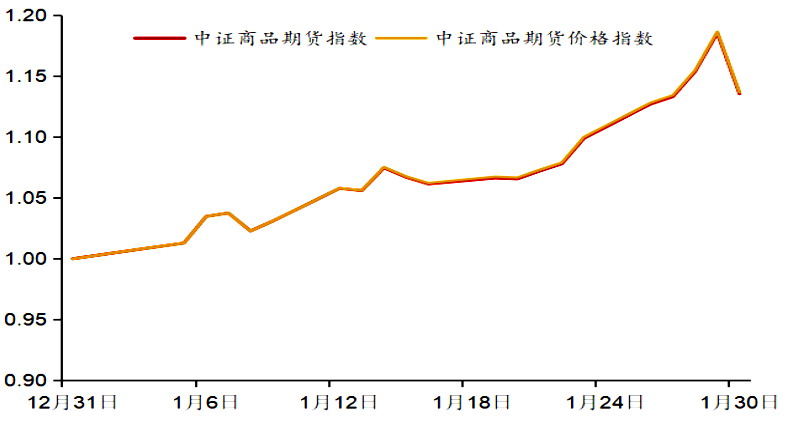
Core Viewpoint - In January, domestic policies aimed at stabilizing demand were implemented intensively, leading to significant support for market demand and a strong performance in the commodity market, as evidenced by the rise in the China Securities Commodity Futures Index and the China Securities Commodity Futures Price Index [1][5]. Index Performance Analysis - In January, the China Securities Commodity Futures Index rose by 13.57%, while the China Securities Commodity Futures Price Index increased by 13.64%, indicating a strong upward trend in the commodity indices with a volatility of 19.71% throughout the month [2]. - The commodity market's strong performance was influenced by international factors, including the Federal Reserve's monetary policy stance and geopolitical risks, which heightened market sentiment towards commodities [4]. Domestic Policy Impact - The implementation of a series of fiscal and financial policies aimed at boosting domestic demand has led to a significant improvement in the commodity market, with a broad-based increase replacing the previous differentiated performance [5]. - The People's Bank of China lowered the re-lending and rediscount rates by 0.25 percentage points, which has positively impacted the industrial sector [5]. Sector-Specific Analysis Energy and Chemical Sector - The energy and chemical sector showed a strong performance in January, with the China Securities Energy Chemical Industry Futures Index rising by 7.54%, driven by improved demand and cost support [8][10]. - The demand for energy products, such as gasoline and diesel, improved due to the implementation of domestic policies and international geopolitical tensions affecting oil prices [10]. Steel Sector - The China Securities Steel Futures Index increased by 0.64%, supported by high demand and inventory reduction, with hot-rolled coil export orders rising by 12% year-on-year [12]. - The supply side faced tightening due to disruptions in Brazilian iron ore shipments, which provided additional cost support for the steel sector [12]. Construction Materials Sector - The China Securities Construction Materials Futures Index rose by 1.87%, reflecting a recovery in demand driven by accelerated infrastructure projects and supply-side adjustments [13]. - The market sentiment improved as the issuance of long-term special government bonds directed funds towards construction material projects [13]. Agricultural Products Sector - The China Securities Agricultural Products Index increased by 1.72%, with notable performance in oilseeds and soft commodities, driven by supply constraints and recovering demand [14]. - Palm oil prices rose due to adverse weather conditions in Malaysia, while cotton prices were supported by rising domestic purchase prices and weakening dollar index [14]. Contribution to Index Returns - The top contributors to the China Securities Commodity Futures Index in January were silver (4.09%), gold (1.47%), and crude oil (1.01%), while the only negative contributor was soda ash (-0.01%) [15][17]. - The strong performance of precious metals was attributed to increased safe-haven buying amid Federal Reserve policy uncertainties and geopolitical tensions [17].
华商基金崔志鹏:布局正当时 消费行业今年或迎来拐点
Zhong Guo Jing Ji Wang· 2026-02-13 02:01
Group 1 - The core viewpoint is that traditional consumption is expected to reach a turning point in 2026, with a comprehensive recovery in fundamentals, making the investment value in the consumption sector promising [1][2] - The investment strategy emphasizes maintaining industry sensitivity, overcoming market noise, and conducting thorough research on the upstream and downstream of the industry to create excess returns for investors [2] - The current expectations and valuations in the consumption industry are at historical lows, with valuations reaching new lows in the past five to ten years, indicating significant undervaluation from a DCF perspective and compared to overseas assets [2] Group 2 - The focus on traditional consumption sectors, particularly food and beverage, has led to increased allocations in the investment portfolio, anticipating a recovery in 2026 [2] - There is a significant potential for the service consumption sector to increase its share in the economy, with expectations that it could become a key driver for consumption and employment in the medium term [2] - The investment approach is characterized by a balanced investment style that emphasizes stock price positioning, industry logic, and marginal changes in both industries and companies [1][2]
智能工厂建设初具规模,江苏山东浙江卓越级数量居前三
Di Yi Cai Jing· 2026-02-12 13:03
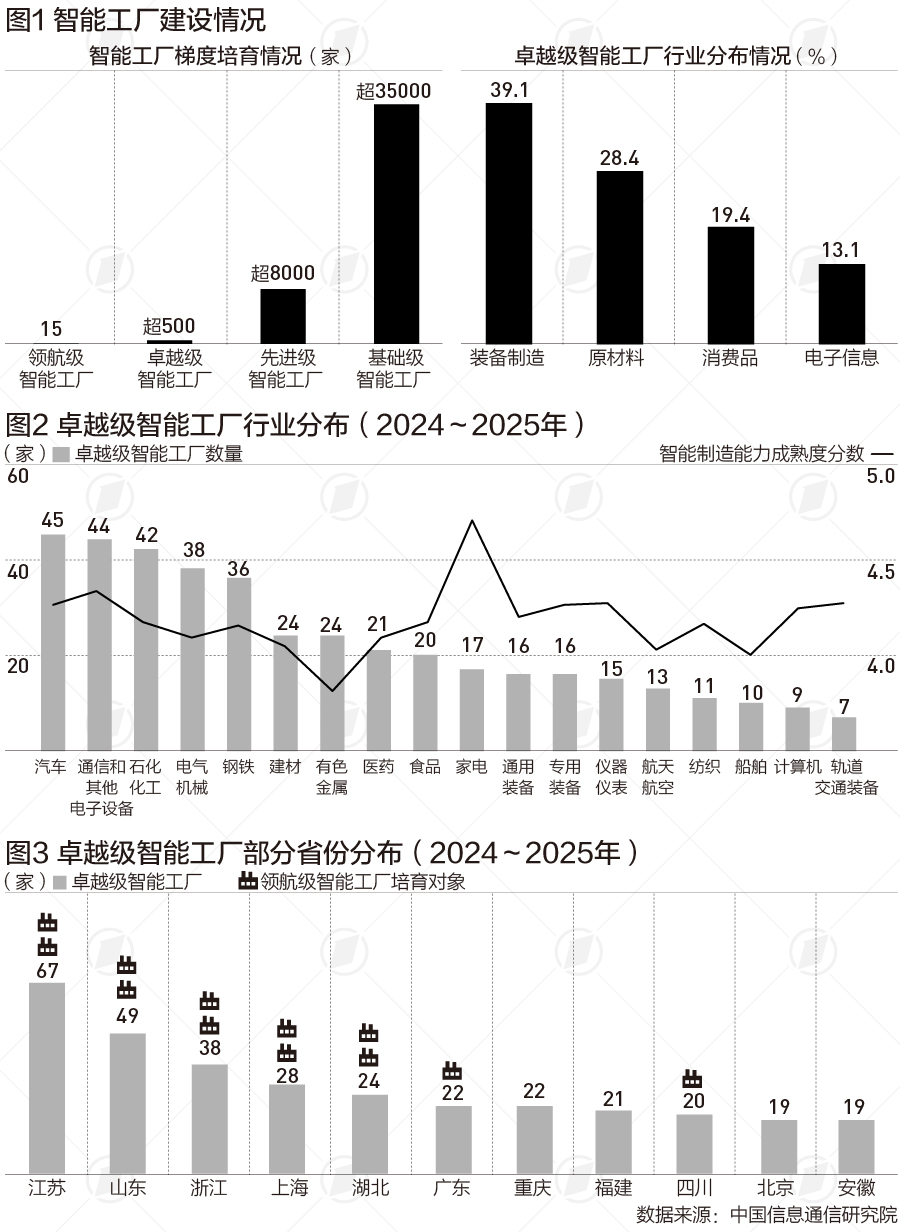
Core Viewpoint - The development of smart factories is becoming a crucial support for industries to respond to market changes, especially in the context of slowing global economic growth and increasing pressure on China's manufacturing sector [1][4]. Group 1: Current State of Smart Factories - As of 2024, China has cultivated 15 leading smart factories, over 500 excellent smart factories, more than 8,000 advanced smart factories, and over 35,000 basic smart factories, indicating a significant scale in smart factory construction [2]. - The report from the China Academy of Information and Communications Technology (CAICT) outlines that smart factories are expected to evolve from single factory construction to a "platform + cluster" collaboration model over the next five years [2]. - The nominal growth rate of global manufacturing has shown a declining trend, with the average growth rate dropping from 2.83% (2004-2013) to 2.66% (2014-2023), and is expected to decline further in the next decade [2]. Group 2: Government Initiatives and Industry Coverage - In October 2024, six ministries, including the Ministry of Industry and Information Technology, launched the 2024 Smart Factory Gradient Cultivation Action to accelerate the digital transformation and intelligent upgrade of the manufacturing sector [3]. - The action plan categorizes smart factories into four levels: basic, advanced, excellent, and leading, with over 90% of manufacturing industry categories covered by various levels of smart factories [3]. - The construction goal for excellent smart factories includes enhancing digital and network optimization capabilities and integrating design, production, and operational data [3]. Group 3: Industry Distribution and Regional Insights - Industries such as petrochemical, electrical machinery, steel, and building materials have over 32% of their factories classified as excellent smart factories, driven by the need for digital transformation and efficiency improvements [4]. - Jiangsu province leads in the number of excellent smart factories, with 67, followed by Shandong (49), Zhejiang (38), and others, indicating a strong regional focus on smart manufacturing [7]. - Large enterprises account for 92.5% of participation in smart factory initiatives in Jiangsu, which is 12.1 percentage points higher than the national average, showcasing the province's robust industrial structure [7]. Group 4: Future Trends in Smart Factory Development - The report identifies five future trends for smart factories: transitioning from physical construction to virtual-digital twin models, shifting from traditional experience-based R&D to data and model-driven paradigms, evolving production from localized flexibility to large-scale reconfigurable systems, advancing management from predetermined rules to dynamic optimization, and enhancing operational management from data-assisted decision-making to intelligent decision-making and proactive services [8].
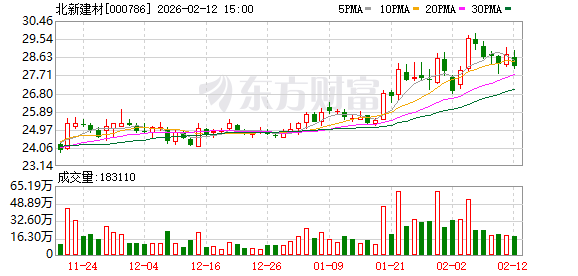
北新建材:截至2026年2月10日公司股东总户数约为5.7万户
Zheng Quan Ri Bao· 2026-02-12 12:17
Core Viewpoint - As of February 10, 2026, the total number of shareholders for Beixin Building Materials is approximately 57,000 [2] Company Summary - Beixin Building Materials has engaged with investors through an interactive platform, providing transparency regarding its shareholder base [2] - The company is actively communicating with its investors, indicating a focus on shareholder engagement and investor relations [2]