稀土

Search documents
未知机构:再call稀土击球区20260203国金金属-20260210
未知机构· 2026-02-10 01:35
Summary of Conference Call on Rare Earth Industry Industry Overview - The rare earth sector is expected to continue its upward trend despite overall setbacks in the non-ferrous metals sector, driven by favorable fundamentals and market expectations [1][2] - Rare earth prices are anticipated to reach historical highs, with fundamentals performing better than expected and negative sentiment not worsening, indicating that previous bearish factors have been digested [1][2] Key Points and Arguments - **Supply-Side Structural Reform**: The rare earth industry is advancing supply-side structural reforms, with expectations of tightening supply and simultaneous growth in domestic and international demand, providing solid support for prices [1][4] - **Investment Recommendations**: Key recommended stocks include China Rare Earth and CITIC Metal, which are expected to have significant growth potential. The current market is viewed as a good opportunity for investors to enter the rare earth sector [2][6] - **Valuation Analysis**: The rare earth sector is currently undervalued, having experienced a continuous decline in valuation since mid-October of the previous year, primarily due to global regulatory upgrades. Despite geopolitical tensions easing, valuations are not expected to decline further due to increased overseas demand for strategic resources [5][9] - **Future Price Predictions**: There is a strong possibility of valuation recovery to 30-40 times earnings, supported by robust demand logic within the sector [5][9] Additional Insights - **Market Dynamics**: The discussion highlighted the significant volatility in the rare earth sector, influenced by the performance of precious metals. Despite overall deleveraging pressures in the non-ferrous sector, the unique supply-demand structure and policy support for rare earths indicate strong investment potential [7][8] - **Export Demand**: In 2025, China's rare earth exports reached historical highs in Q3 and Q4, despite an annual decline of 1%. This suggests strong replenishment demand overseas, particularly in the latter half of the year [10][11] - **Strategic Stockpiling**: The increase in overseas strategic stockpiling demand is driven by concerns over supply chain disruptions, leading to longer inventory days to ensure supply security [11] - **Impact of Policy Changes**: Recent policy changes in China regarding rare earth mining and smelting have created a comprehensive control framework, which is expected to reduce non-compliant supply and further support price increases [9][12] Conclusion - The rare earth sector is positioned for growth, with strong fundamentals, favorable market conditions, and significant investment opportunities. Investors are encouraged to consider entering the market during this favorable timing, as the sector is expected to experience substantial price increases and valuation recovery in the near future [3][6][8]
上证早知道|12.51亿元,688498投资光芯片;稀土价格,加速上涨;两家公司收购资产,复牌
Shang Hai Zheng Quan Bao· 2026-02-09 23:17
Company News - ST Cuihua announced that it has received a "Notice of Investigation" from the China Securities Regulatory Commission due to suspected violations of information disclosure regulations [1] - Hainan Mining is planning to acquire 69.90% of Fengrui Fluorine Industry through a combination of issuing shares and cash payment, and will resume trading on February 10, 2026 [1] - Evert plans to acquire 100% of Shanghai Shengpu Fluid Equipment Co., Ltd. through a combination of issuing shares and cash payment, with trading resuming on February 10, 2026 [1] - Zhiguang Electric's subsidiary signed a sales contract worth a total of RMB 1.004 billion for energy storage systems [8] - Yuanjie Technology plans to invest approximately RMB 1.251 billion to build a second-phase R&D and production base for optoelectronic semiconductor chips and devices [8] - Mengguli plans to invest RMB 929 million to construct a project for producing 30,000 tons of lithium-ion battery cathode materials annually [8] - Jinhui Co. intends to acquire 100% of Fusheng Mining for RMB 210 million, aiming to develop gold resources as a new economic growth point [8] Industry Insights - The A-share market saw a strong rebound, with major indices rising significantly, indicating market expectations for a "spring red envelope" rally [4] - The AI application sector experienced a surge, with multiple stocks hitting the daily limit, driven by advancements in AI models and their commercial viability [5][6] - The rare earth product prices have accelerated, with praseodymium and neodymium oxide prices rising by 7.59% and 6.27% respectively, indicating potential profitability improvements in the industry [7] - The number of private equity firms with over RMB 10 billion in assets reached a historical high of 122, reflecting a strong market interest in equity assets [3]

55国围堵中国稀土!70%产量被卡脖子,万斯喊破喉咙能成功吗?
Sou Hu Cai Jing· 2026-02-09 18:42
第三,市场规律教做人。 鲁比奥喊着"设价格底线",可2023年稀土价格暴跌40%,中国企业照样赚钱,为啥?因为成本压得低!中国稀土企业的加工成本 比美国低58%,真打价格战,盟友先得跪。 稀土这玩意儿,看着不起眼,实则是高科技的"命根子"。造芯片、搞新能源电池、做导弹雷达,缺了它全得趴窝。咱中国有多牛?据美国地质调查局2023年 数据,中国稀土储量占全球38%,但产量却占了70%! 更绝的是提炼技术——中国掌握了全球90%的稀土分离提纯产能,就连美国最大的稀土矿芒廷帕 斯,挖出来的矿石还得运到中国加工。老外嘴上喊着"去风险",身体倒挺诚实,2023年中国稀土出口量同比涨了12.3%,其中70%流向了美国盟友日韩和欧 洲。这就像开饭馆的厨师没上桌,客人还得偷摸去后厨求着炒菜,你说滑稽不? 美国这回是真急眼了。会上抛出一堆"大招":搞"关键矿产优惠贸易区"、定"参考价格线"、甚至要用关税当大棒。还许诺掏1000亿美元"金库计划"给盟友砸 钱。可细扒拉一下,这事儿漏洞比筛子还多! 第一,盟友各怀鬼胎。 澳大利亚有矿,但2023年对华稀土出口占其总出口的82%,真跟中国翻脸,矿卖给谁?德国车企天天喊着要"摆脱中国依赖 ...


镨钕系价格大幅上涨,产业链盈利能力或提升
Xuan Gu Bao· 2026-02-09 15:23
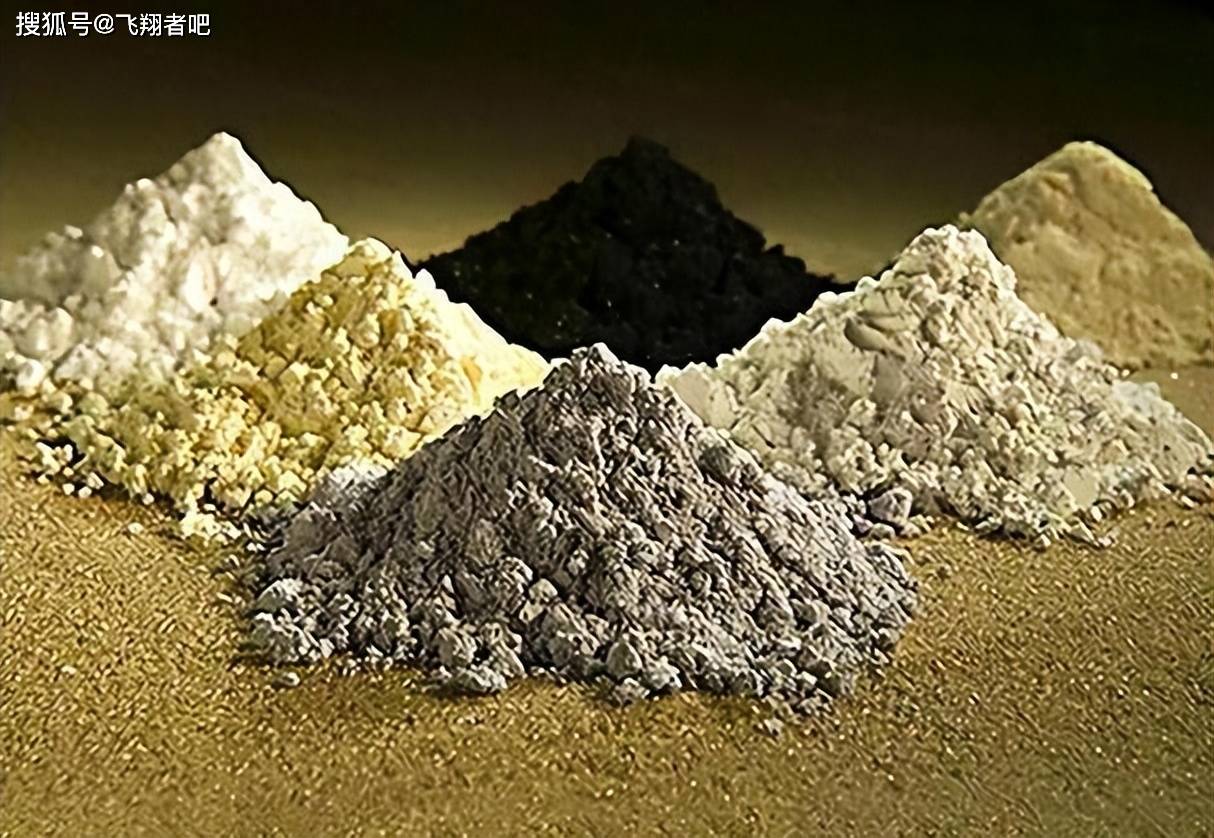
百川盈孚数据显示,稀土产品价格加速上涨。2月9日,氧化镨钕,金属镨钕分别大涨7.59%和6.27%。 氧化镨钕今年以来累计涨幅达34%。 研究机构认为,供应端方面,1月镨钕金属产量环比下降,原材料现货供应紧张导致部分区域减产,预 计2月份镨钕产量或进一步下降,稀土价格有望继续上涨。 全球稀土资源战略地位持续提升,稀土产业进入高质量发展阶段。供给层面,配额管制叠加管制政策, 刚性逻辑或持续加强;需求层面,新能源汽车,人形机器人和低空经济等新兴领域,有望成为需求长期 高速增长的核心驱动。 中国稀土:专注于稀土矿的开采加工和冶炼分离业务,正积极配合中国稀土集团开展解决同业竞争问题 的相关工作,择机开展并购重组。 中稀有色:拥有广东地区丰富的稀土资源,还布局钨,铜硫等多元产业。 *免责声明:文章内容仅供参考,不构成投资建议 *风险提示:股市有风险,入市需谨慎 机构预计2026年起全球稀土供需缺口或持续扩大,产业链盈利能力或提升。 公司方面,据上证报表示, ...
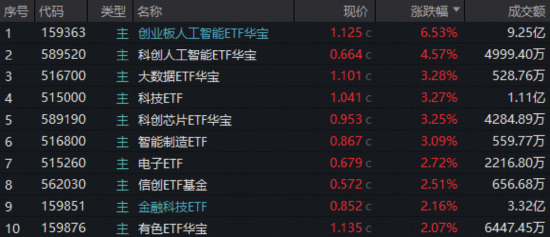
ETF复盘资讯|王者归来!算力+应用全爆发!创业板人工智能ETF跳空暴涨6.53%,科创AI放量反弹!全“芯”589190同步猛攻
Sou Hu Cai Jing· 2026-02-09 14:54
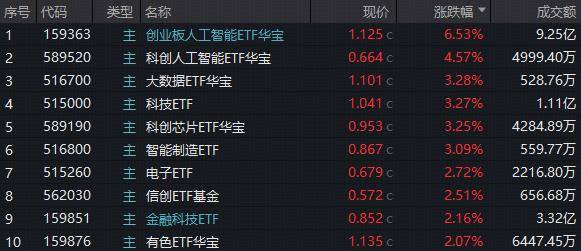
Core Viewpoint - The A-share market experienced a significant rally, with the Shanghai Composite Index rising over 1% and the Shenzhen Component Index increasing over 2%, driven by strong performance in AI, chip, and resource sectors [1][3][5]. Group 1: Market Performance - The total trading volume in the market reached 22.5 trillion yuan, with over 4,600 stocks rising [1]. - The ChiNext AI ETF (159363) surged by 6.53%, breaking through all moving averages, while the Huabao AI ETF (589520) rebounded by 4.57% [1][2]. - The "all-chip" Huabao ETF (589190) also saw a rise of over 3%, recovering its 5-day moving average [1]. Group 2: Sector Highlights - The AI sector is experiencing a resurgence, with significant gains in companies involved in AI applications and computing power, such as Tianfu Communication and Guangke Technology, which rose over 17% [3][5]. - The chip sector is also benefiting from a global chip shortage, with the "all-chip" ETF seeing a collective rise among its constituent stocks, with 47 out of 50 stocks increasing in value [6][7]. - Resource stocks, particularly in rare earths, are gaining traction, with Shenghe Resources hitting the daily limit and the Huabao resource ETF rising by 2% [12][14]. Group 3: Driving Factors - Major overseas cloud providers are significantly increasing their capital expenditures for AI computing, with a projected total of $660 billion by 2026, marking a 60% year-on-year increase [5]. - The Ministry of Industry and Information Technology has initiated the construction of national computing power interconnection nodes, optimizing resource allocation across the country [6][7]. - ByteDance's launch of the Seedance 2.0 video generation model is expected to catalyze a new wave of AI applications, particularly in short content [5][6].

国泰海通|有色:关注企稳后的布局机会
国泰海通证券研究· 2026-02-09 13:58
Group 1: Precious Metals - The core viewpoint emphasizes the importance of macroeconomic factors on metal prices, particularly in a tight supply-demand balance, with monetary policy, macro expectations, geopolitical dynamics, and supply disruptions being critical influences [1] - Recent adjustments in precious metal prices are attributed to a decline in risk appetite, influenced by disappointing earnings reports from US tech stocks and expectations of a strong dollar and Federal Reserve's balance sheet reduction [1] - China's central bank continued gold purchases in January, and the increase in gold ETF holdings will support gold prices [1] Group 2: Copper - Ongoing macroeconomic pressures are impacting copper prices, with expectations of strategic reserves providing some support [2] - The establishment of a "copper concentrate strategic reserve" aims to enhance resource control and mitigate overseas supply disruptions, while AI-driven infrastructure demands are expected to support copper prices [2] - Despite macroeconomic pressures, copper prices are anticipated to stabilize due to strategic premium support [2] Group 3: Aluminum - Aluminum prices are under pressure due to a combination of macroeconomic factors and seasonal demand weakness, with a decline in processing rates observed [2] - The ISM services PMI in the US returned to expansion, but lower-than-expected ADP employment figures contributed to price fluctuations [2] - Social inventory trends indicate a continued accumulation during the off-season [2] Group 4: Tin - Tin prices are experiencing downward pressure due to macroeconomic factors and reduced funding, but there is resilience in downstream purchasing as prices decline [2] - Increased activity in the Indonesian tin market and supply recovery in Myanmar may lead to marginally looser supply conditions [2] Group 5: Energy Metals - Demand for lithium remains strong despite a four-week inventory reduction, with expectations of preemptive battery demand due to changes in export tax policies [3] - The cobalt sector faces high prices due to tight raw material supplies, while companies are extending their reach into downstream markets to enhance competitive advantages [3] - Rare earth prices, particularly for praseodymium and neodymium oxides, are rising due to tight supply-demand dynamics [3] Group 6: Strategic Metals - Tungsten prices are on the rise due to long-term contracts and supply-demand dynamics, with a notable increase in prices across the industry [3] - The uranium market is seeing long-term contract prices reach a ten-year high, driven by rigid supply and ongoing nuclear power development [3]

稀土价格持续上行,盛和资源强势涨停!有色ETF华宝(159876)劲涨2%,机构:资源股中期有望重拾升势!
Xin Lang Cai Jing· 2026-02-09 11:45
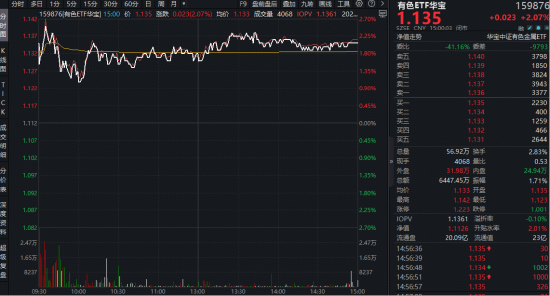
Group 1 - The core viewpoint of the article highlights the positive market sentiment driven by spot gold returning to $5,000, leading to significant activity in the non-ferrous metals sector, particularly the Huabao ETF (159876), which saw a price increase of 2.07% on February 9 [1][7] - The Huabao ETF includes leading companies in the non-ferrous metals industry, with notable stocks such as Shenghe Resources and Hunan Silver reaching their daily price limits, while silver and rare earth stocks also experienced substantial gains [1][7] - The article emphasizes the ongoing bullish trend in the rare earth market, with prices for praseodymium and neodymium rising significantly, indicating a tightening supply and increasing demand in emerging sectors [10] Group 2 - The People's Bank of China has increased its gold reserves for 15 consecutive months, with the latest figures showing reserves of 7.419 million ounces as of January 2026, which is expected to support gold prices [10] - The article discusses the structural demand for commodities driven by AI computing expansion and energy transition, suggesting that the market for related resource stocks is likely to continue its upward trajectory after a short-term adjustment [10] - The Huabao ETF and its linked funds provide comprehensive coverage of various metals, including copper, aluminum, gold, rare earths, and lithium, making it an efficient tool for investors looking to gain exposure to the non-ferrous metals sector [10]

稀土价格持续上行,盛和资源强势涨停!有色ETF华宝劲涨2%,机构:资源股中期有望重拾升势!
Xin Lang Ji Jin· 2026-02-09 11:42
Core Viewpoint - The resurgence of spot gold prices above $5,000 has boosted market sentiment, leading to significant activity in the non-ferrous metals sector, particularly with the Huabao ETF [1] Group 1: Market Performance - The Huabao non-ferrous ETF (159876) saw a high level of activity, with intraday prices rising by 2.5% and closing up by 2.07% [1] - Key constituent stocks such as Shenghe Resources and Hunan Silver reached their daily limit, while other stocks like Silver Nonferrous and China Rare Earth saw increases of over 8% and 6%, respectively [1] Group 2: Industry Trends - The People's Bank of China has increased its gold reserves for 15 consecutive months, with reserves reaching 7.419 million ounces by the end of January 2026, up from 7.415 million ounces in December 2025 [3] - The price of light rare earths has been on the rise, with praseodymium and neodymium prices increasing by 5,000 yuan/ton to 925,000 yuan/ton, and praseodymium oxide prices rising by 7,500 yuan/ton to 752,500 yuan/ton [3] - The demand for gold from central banks is expected to provide a strong support for gold prices, while the ongoing rise in rare earth prices is anticipated to bolster the profitability of the industry [3] Group 3: Investment Opportunities - The Huabao non-ferrous ETF and its linked funds cover a wide range of sectors including copper, aluminum, gold, rare earths, and lithium, allowing investors to capture the beta performance across different economic cycles [3] - The ETF serves as an efficient tool for investors looking to gain exposure to the non-ferrous metals sector, being a financing and margin trading target [3]
王者归来!算力+应用全爆发!创业板人工智能ETF跳空暴涨6.53%,科创AI放量反弹!全“芯”589190同步猛攻
Xin Lang Ji Jin· 2026-02-09 11:36
Core Viewpoint - The A-share market experienced a significant rally, with the Shanghai Composite Index rising over 1% and the Shenzhen Component Index increasing over 2%, driven by strong performance in AI applications and related sectors [1][3]. Group 1: Market Performance - The total trading volume in the market reached 22.5 trillion yuan, with over 4,600 stocks rising [1]. - The ChiNext AI ETF (159363) surged by 6.53%, breaking through all moving averages, while the Huabao Sci-Tech AI ETF (589520) rebounded by 4.57% [1][2]. - The Huabao Sci-Tech Chip ETF (589190) also saw a strong performance, rising over 3% and recovering its 5-day moving average [1][2]. Group 2: Sector Highlights - The AI sector saw a resurgence, with significant gains in companies involved in light modules and IDC, such as Tianfu Communication and Guangku Technology, which rose over 17% [3][4]. - The chemical and cyclical stocks also became active, with rare earth stocks experiencing notable increases, such as Shenghe Resources hitting the daily limit [1][5]. Group 3: Investment Drivers - Major overseas cloud companies, including Amazon and Google, are expected to significantly increase their capital expenditures for AI computing, projected to reach $660 billion by 2026, a 60% year-on-year increase [4]. - The Chinese government is promoting the construction of national computing interconnection nodes, which is expected to enhance resource allocation and boost the IDC rental market [4][7]. - The launch of ByteDance's Seedance 2.0 video generation model is anticipated to catalyze a new wave of AI applications, particularly in short content [4][6]. Group 4: Chip Sector Insights - The chip sector is experiencing a collective rally, with the Huabao Sci-Tech Chip ETF (589190) rising over 3%, supported by a significant increase in demand for chips [5][9]. - Goldman Sachs has indicated that a severe chip shortage is approaching, which is expected to benefit companies in the semiconductor industry [5][9]. Group 5: Commodity Trends - The price of rare earth elements continues to rise, with significant increases in the prices of praseodymium and neodymium, indicating a tightening supply and growing demand in emerging sectors [12][13]. - The Huabao Nonferrous ETF (159876) saw a 2% increase, reflecting positive market sentiment driven by rising gold prices [12][14].
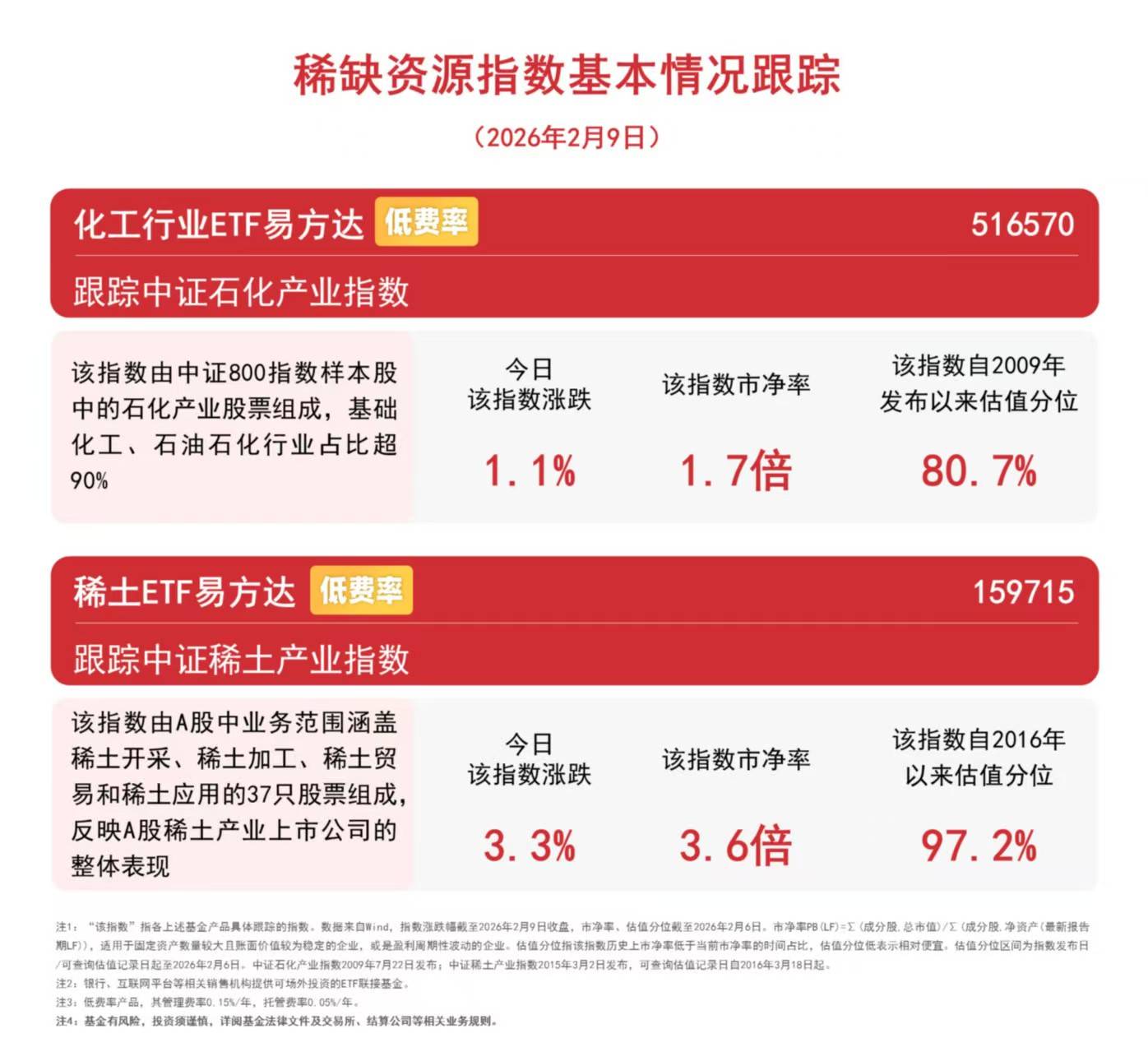
稀土、化工等板块表现强势,稀土ETF易方达(159715)、化工行业ETF易方达(516570)等产品受市场关注
Sou Hu Cai Jing· 2026-02-09 11:24
截至收盘,中证稀土产业指数上涨3.3%,中证石化产业指数上涨1.1%。稀土ETF易方达(159715)、化工行业ETF易方达(516570)分别跟踪以上指数,均 实行ETF中最低一档0.15%/年的管理费率,其中化工行业ETF易方达(516570)已连续16个交易日"吸金",累计净流入超14亿元。 每日经济新闻 ...