
AI芯片

Search documents
寒武纪Q3营收同比暴增13倍,净利润5.7亿元,为连续三个季度盈利 | 财报见闻
Sou Hu Cai Jing· 2025-10-17 12:20
Core Viewpoint - The company, Cambricon, has reported a remarkable financial performance in Q3, with a significant increase in revenue and a transition from losses to stable profitability, driven by the booming demand for AI infrastructure and applications [1][4]. Financial Performance - Q3 revenue reached 1.73 billion yuan, a year-on-year increase of over 1,332% [3][10]. - Net profit for Q3 was 567 million yuan, marking the third consecutive quarter of profitability [4][10]. - For the first three quarters, total revenue was 4.61 billion yuan, reflecting a year-on-year growth of 2,386% [3][10]. - The net profit for the first three quarters amounted to 1.60 billion yuan, indicating a historic turnaround from losses [10]. Profitability Metrics - The adjusted net profit (excluding non-recurring gains and losses) for the first three quarters was 1.42 billion yuan, demonstrating that profitability is driven by core business operations rather than government subsidies [5][10]. - The weighted average return on equity reached 25.21%, an increase of 38.69 percentage points compared to the same period last year [6][10]. - Basic earnings per share were 3.85 yuan, a significant improvement from a loss of 1.74 yuan in the previous year [6][10]. Research and Development - R&D investment for the first three quarters was 715 million yuan, up 8.45% year-on-year, indicating continued commitment to innovation [8][10]. - The proportion of R&D expenditure relative to revenue dropped sharply from 455.65% to 15.51%, reflecting a shift towards a more balanced approach between R&D and commercialization [8][10]. Inventory and Cash Flow - Inventory surged from 1.77 billion yuan at the beginning of the year to 3.73 billion yuan, an increase of over 110%, suggesting anticipation of strong future demand [9][10]. - Operating cash flow for the first three quarters showed a net outflow of only 29 million yuan, a significant improvement from a 1.81 billion yuan outflow in the previous year [11][10]. Capital Structure and Funding - Total assets increased to 12.59 billion yuan, a year-on-year growth of 87%, primarily due to a private placement that raised 3.98 billion yuan [10][11]. - Cash and cash equivalents rose from 1.99 billion yuan to 5.18 billion yuan, enhancing the company's financial safety margin [12].


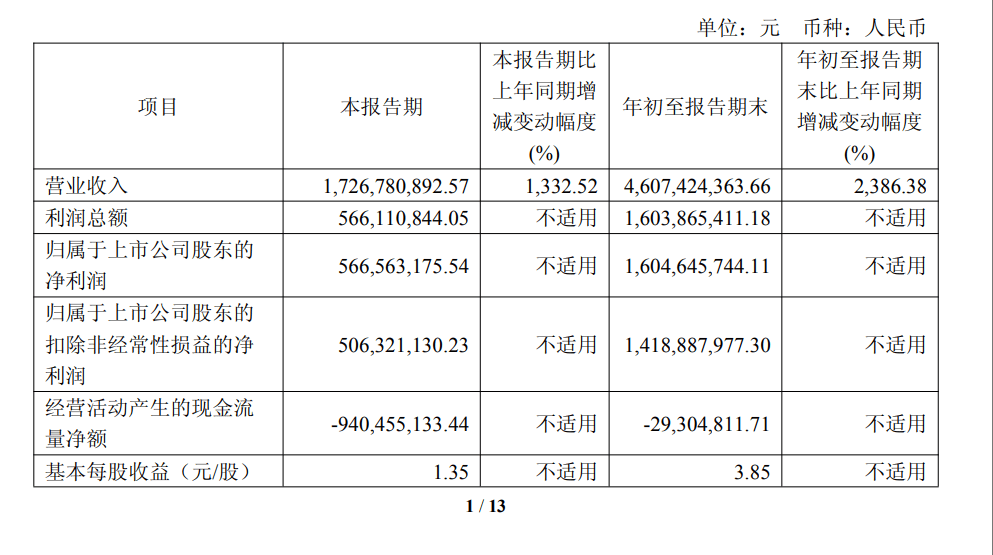
寒武纪,营收大增1332.52%
Di Yi Cai Jing· 2025-10-17 12:18
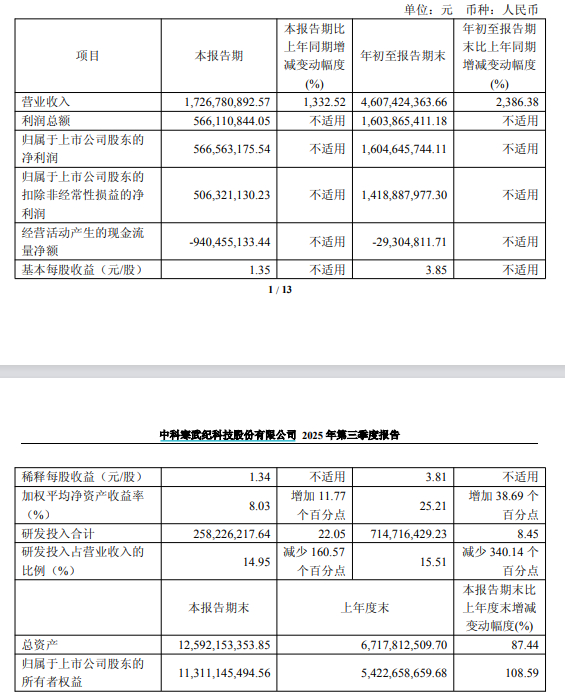
Core Insights - The company reported a significant increase in revenue and net profit for the third quarter of 2025, with revenue reaching 1.73 billion yuan, a year-on-year growth of 1332.52%, and a net profit of 566 million yuan [1][2] - For the first three quarters of 2025, the company achieved a revenue of 4.61 billion yuan, reflecting a year-on-year increase of 2386.38%, with a net profit of 1.60 billion yuan [1][2] Financial Performance - Revenue for the third quarter was 1,726,780,892.57 yuan, showing a year-on-year increase of 1,332.52% [2] - Net profit attributable to shareholders for the third quarter was 566,110,844.05 yuan [2] - For the first three quarters, total revenue was 4,607,424,363.66 yuan, with a year-on-year growth of 2,386.38% [2] Profitability Metrics - Basic earnings per share for the third quarter were 1.35 yuan, while diluted earnings per share were 1.34 yuan [4] - The weighted average return on equity increased to 8.03%, up by 11.77 percentage points [4] Research and Development - Total R&D expenditure for the third quarter was 258,226,217.64 yuan, representing a year-on-year increase of 22.05% [4] - R&D expenditure as a percentage of revenue was 14.95%, a decrease of 160.57 basis points compared to the previous year [4] Asset and Equity Growth - Total assets at the end of the reporting period were 12,592,153,353.85 yuan, an increase of 87.44% compared to the previous year [4] - Equity attributable to shareholders reached 11,311,145,494.56 yuan, reflecting a growth of 108.59% year-on-year [4]
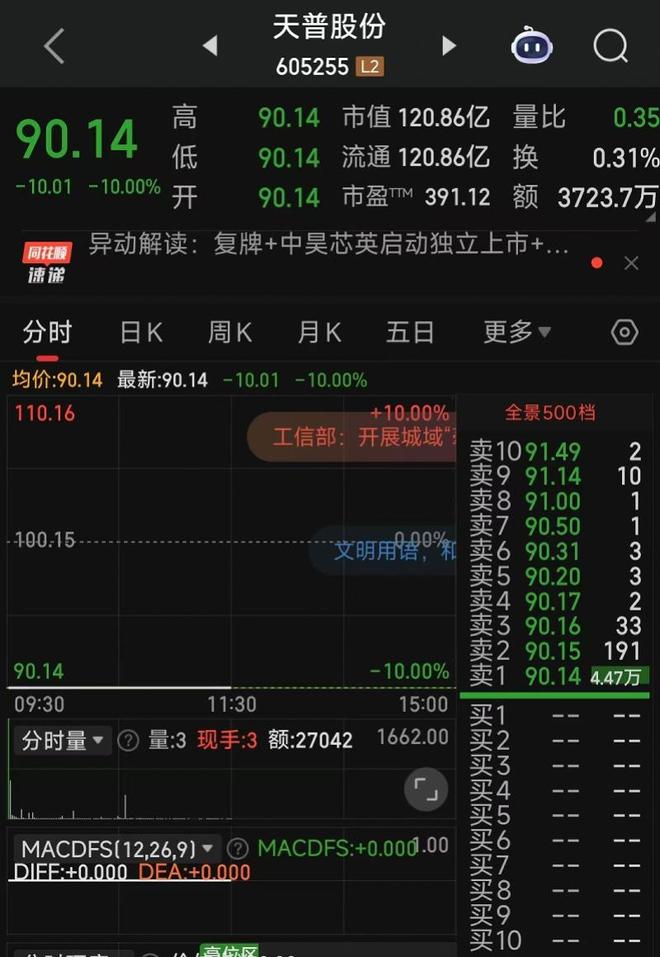
收购方独立IPO,借壳梦碎!“15连板王”天普股份再跌停
Nan Fang Du Shi Bao· 2025-10-17 04:37
Core Viewpoint - Tianpu Co., Ltd. (605255.SH) has experienced significant volatility in its stock price, with a sharp decline following a period of rapid gains, highlighting the risks associated with speculative trading and the lack of fundamental support for its valuation [1][5]. Group 1: Stock Performance - Tianpu Co., Ltd. faced a second consecutive trading halt on October 17, closing at 100.15 CNY per share, resulting in a market value loss exceeding 2.5 billion CNY over two days [1]. - The stock had previously surged by 317.72% over 15 consecutive trading days, leading to a peak price-to-earnings ratio of 482.85 [1]. Group 2: Market Dynamics - The initial surge in Tianpu's stock price was fueled by speculation surrounding a potential acquisition by Zhonghao Xinying, which is associated with the AI chip sector, creating a narrative of a "shell acquisition" [3]. - The company's small market capitalization of 3.5 billion CNY and low circulation ratio facilitated speculative trading [3]. Group 3: Financial Performance - For the first half of the year, Tianpu reported revenues of 151 million CNY, a year-on-year decrease of 3.44%, and a net profit of 11.3 million CNY, down 16.08%, indicating ongoing challenges in its core fuel vehicle pipeline business [5]. Group 4: Acquisition Developments - On October 15, Tianpu announced that Zhonghao Xinying had initiated an independent IPO process, which negated the earlier speculation of asset injection into Tianpu [6]. - Zhonghao Xinying's financials raised concerns, with projected revenues of 598 million CNY and a net profit of 85.9 million CNY for 2024, while reporting a loss of 143 million CNY in the first half of the year [7]. Group 5: Regulatory Environment - The recent trading activity has drawn regulatory scrutiny, with the Shanghai Stock Exchange monitoring for potential misleading trading practices [5][10]. - The tightening of regulations surrounding cross-border acquisitions and the requirement for significant synergy between the target and acquirer further complicate the feasibility of such transactions [9].

茅台跌下神坛!先输给寒武纪又败北宁德,白酒行业为啥失宠了?
Sou Hu Cai Jing· 2025-10-16 10:29
Core Viewpoint - The white liquor industry in China is experiencing a significant downturn, contrasting sharply with the booming performance of sectors like AI and new energy, leading to a reevaluation of its market position [2][4][5]. Market Dynamics - In 2025, the market capitalization of leading white liquor company Kweichow Moutai has been surpassed by AI chip leader Cambricon and battery giant CATL, indicating a shift in investor sentiment [5]. - Moutai's revenue for the first half of 2025 was 89.39 billion yuan, with a net profit of 45.40 billion yuan, both showing single-digit growth rates, highlighting a decline in growth momentum [5]. - The wholesale price of Moutai has dropped from 1,845 yuan to around 1,760 yuan, marking a historical low and breaking market expectations for high-end liquor price resilience [5]. Inventory and Cash Flow Issues - A significant 58.1% of liquor distributors report increasing inventory levels, with over 40% facing cash flow pressures, particularly in regions like Northwest and Central China where orders have plummeted by over 70% [7]. - The average inventory turnover days for the white liquor industry reached 900 days, suggesting that the market could sustain itself for two and a half years without production [9]. Price and Profitability Challenges - High inventory levels have led to price inversions, particularly in the 800-1,500 yuan price range, forcing distributors to sell at lower prices to recover funds, creating a vicious cycle of declining prices [11]. - The share of business dining alcohol consumption has dropped below 50%, with a 10%-20% contraction in demand for the business consumption market, directly impacting high-end liquor sales [11]. Industry Outlook - The consensus is that the white liquor industry will not see a rapid recovery akin to the V-shaped rebound of 2012, but rather a prolonged adjustment period expected to last until the second half of 2026 [13]. - The industry is likely to experience a "K-shaped" differentiation, where leading brands maintain resilience while smaller companies face significant challenges, with over 100 licensed liquor companies exiting the market in the first half of 2025 [13]. Strategic Shifts - Companies are attempting to pivot towards lower-alcohol and younger consumer markets, but the effectiveness of these strategies remains uncertain in the short term [15]. - Investors are advised to adopt a cautious approach, focusing on inventory reduction and potential mergers or acquisitions among smaller firms before making significant investments [15].

我的阶段性投资理念和思考
佩妮Penny的世界· 2025-10-16 07:26
Core Insights - The article reflects on the current volatile market and the importance of understanding personal risk tolerance and investment strategies. It emphasizes the need for a disciplined approach to investing, particularly for individual investors who may be influenced by market noise and trends [1][3]. Investment Strategy - The article suggests that individual investors should prioritize capital preservation and manage their portfolios according to their risk tolerance. It recommends allocating funds to safer investments like bonds for those who cannot accept any loss, while a portion can be allocated to higher-risk investments [5]. - The risk-return spectrum is outlined, indicating that higher potential returns come with increased risks. The hierarchy of investment risk is presented, ranging from bank deposits to venture capital investments [5]. Market Trends - The article identifies a significant trend in the technology sector, particularly in areas related to AI, computing power, and robotics. It suggests that these sectors will continue to thrive as long as the AI performance bubble remains intact [9]. - It highlights the importance of understanding macroeconomic trends, particularly the impact of fiscal and monetary policies on liquidity and market conditions. The expectation is that global liquidity will improve over the next few years, creating favorable conditions for investment [7][9]. Investment Approach - The article stresses the importance of patience and a long-term perspective in investing. It suggests that capital markets will eventually reflect economic fundamentals, and investors should avoid panic during market fluctuations [11]. - It encourages investors to conduct thorough research and maintain a clear investment logic to avoid falling into traps during rapid market changes. The need for continuous observation of market trends and fundamentals is emphasized [9][11].
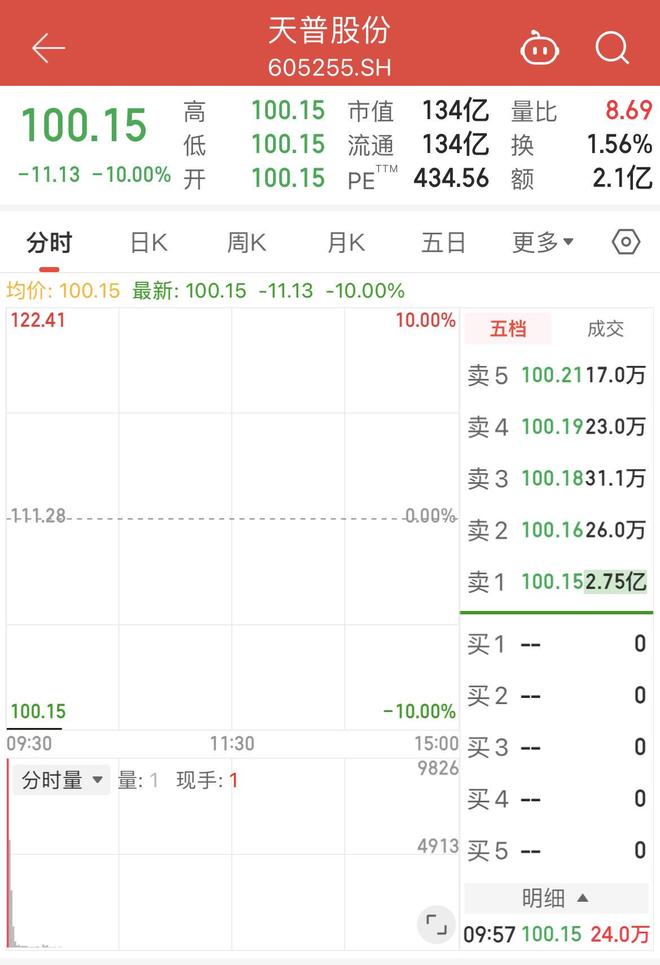
15连板大牛股熄火!天普股份复牌一字跌停
2 1 Shi Ji Jing Ji Bao Dao· 2025-10-16 02:41
Core Viewpoint - Tianpu Co., Ltd. (605255.SH) experienced a significant drop in stock price following the announcement of its third suspension review results, with a reported price of 100.15 CNY per share and a market cap of 13.4 billion CNY [1][4] Group 1: Company Developments - Tianpu Co., Ltd. disclosed that the acquirer, Zhonghao Xinying, has initiated its independent IPO process and is currently undergoing a share reform, which is unrelated to the acquisition of Tianpu [1][2] - The stock price of Tianpu Co., Ltd. surged by 794.5% year-to-date, making it the top performer among all listed companies in Zhejiang province [1] - The surge began after the announcement on August 21 regarding the transfer of 10.75% of shares to Zhonghao Xinying, which would result in the latter becoming the actual controller of Tianpu [1] Group 2: Financial Performance - For the first half of the year, Tianpu Co., Ltd. reported revenues of approximately 151 million CNY, a year-on-year decrease of 3.44%, and a net profit attributable to shareholders of 11.3 million CNY, down 16.08% [3] - The company emphasized that the capital path of Zhonghao Xinying is independent of the acquisition and that there are no plans for asset injection [2] Group 3: Market Activity - Following the announcement, Tianpu Co., Ltd. faced a trading halt and subsequently a drop in stock price, with a trading volume of 2.75 billion CNY at the time of the price drop [1][4] - The company warned of potential risks related to insider trading and market manipulation, although it stated that previous stock transactions by insiders occurred before the formation of insider information [2]
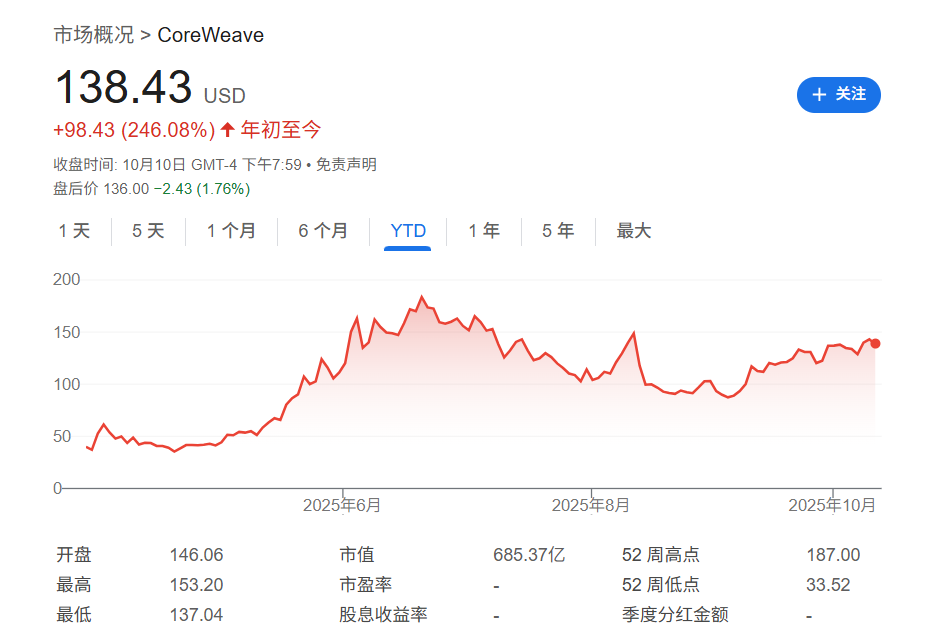
美股异动|Arista Networks股价遭遇重挫AI芯片市场风云再起
Xin Lang Cai Jing· 2025-10-15 00:01
Core Viewpoint - Arista Networks has faced significant stock price declines, dropping over 12% since October 14, amid volatility in the AI chip market and concerns over potential investment bubbles [1][2] Group 1: Market Context - The stock price decline coincides with major partnerships between Nvidia, AMD, and OpenAI, which have spurred a surge in AI infrastructure investments [1] - The demand for AI chips has led to a reconfiguration of the entire supply chain, benefiting network equipment suppliers like Arista Networks [1] Group 2: Company Outlook - Despite recent stock pressure, Arista Networks is expected to benefit from the ongoing development of AI infrastructure and an increase in market share [2] - The long-term growth potential of the company remains strong, even amidst short-term market fluctuations [2]
谁说中国出不了马斯克?90后天才学霸造火箭,立志超越SpaceX
Sou Hu Cai Jing· 2025-10-13 13:27
Core Insights - Yao Song, at the age of 26, achieved significant entrepreneurial success by founding AI chip company Deep Insight Technology, which was acquired by global FPGA chip giant Xilinx for approximately $300 million, leading to his financial independence [2] - Instead of typical choices like luxury homes or global travel, Yao chose to pivot into venture capital, focusing on the high-risk, high-reward sector of commercial aerospace [4] Group 1: Entrepreneurial Journey - After selling his company, Yao joined venture capital firm Jingwei China as a risk partner, shifting his focus to commercial aerospace, which he views as a sector with substantial potential despite its challenges [4] - Yao's entrepreneurial experience in AI provided him with valuable insights and technical expertise that are applicable to the aerospace industry, particularly in areas requiring precise algorithms for rocket launch and satellite positioning [6] Group 2: Commercial Aerospace Strategy - In 2021, Yao partnered with a classmate from Tsinghua University to co-found a rocket company, taking on the role of co-CEO at Dongfang Space, with an ambitious goal of developing a heavy-lift rocket capable of launching multiple satellites simultaneously [8][10] - This decision was controversial, as most companies were focusing on smaller rockets to mitigate risks, but Yao's strategy aligned with the national demand for large-scale satellite deployment as outlined in the GW constellation plan [10] Group 3: Technological Innovation - Yao's team opted for a challenging "all-solid bundled configuration" for their rocket, a globally pioneering approach that differs fundamentally from existing liquid-fueled rockets [12] - The successful launch of the "Gravity One" rocket in January 2024 set six world records, including being the largest solid rocket and the first bundled rocket launched from the sea, while also reducing launch costs by over 50% [14] Group 4: Industry Context - The urgency of the commercial aerospace sector is underscored by the need for rapid satellite deployment, with a significant gap in the number of commercial satellites launched by China compared to competitors like SpaceX [16][18] - The shift from a state-centric aerospace development model to a dual-driven approach involving both state and private enterprises is crucial for meeting the increasing demand for satellite launches [18] Conclusion - The historical context of China's aerospace achievements suggests that, despite current challenges, the combination of strategic leaders like Yao, experienced technical talent, and a supportive dual-driven system positions the country to potentially close the gap with global leaders in commercial aerospace [20]

自火爆的IPO以来“AI云新贵”CoreWeave高管已“套现”超10亿美元
Hua Er Jie Jian Wen· 2025-10-12 10:13
Core Viewpoint - The AI boom is reshaping market dynamics and creating significant wealth for insiders, who are converting paper gains into real cash [1] Group 1: Insider Selling Trends - CoreWeave insiders sold over $1 billion worth of stock after the IPO lock-up period ended in mid-August [1][2] - In the third quarter, seven of the top ten insider sellers were from companies benefiting from AI [3] - CoreWeave executives led the selling trend, with board member Jack Cogen selling $477 million and co-founder Brannin McBee selling $426 million [4] Group 2: Institutional Selling - CoreWeave's largest institutional shareholder, Magnetar Financial LLC, sold nearly $1.9 billion in shares but still holds over 20% of the company's Class A stock [6] Group 3: Notable Sales in the AI Sector - Arista Networks CEO Jayshree Ullal sold over 6 million shares for $861 million, ranking second among sellers [9] - NVIDIA CEO Jensen Huang sold over $743 million in the third quarter, with total insider sales nearing $1.5 billion for the first three quarters of 2025 [10] Group 4: Other Major Sellers - Amazon founder Jeff Bezos topped the list with $4.917 billion in sales, significantly exceeding other sellers [11] - Other notable sellers included Frank Slootman of Snowflake ($463 million), Tony Ressler of Ares Management ($357 million), and Brian Armstrong of Coinbase ($268 million) [12]
摩尔线程:生态、架构、集群
Shenwan Hongyuan Securities· 2025-10-10 10:42
Investment Rating - The report maintains a positive outlook on the domestic AI chip industry, particularly highlighting the advancements of leading companies such as Huawei, Cambricon, and Moore Threads [4]. Core Insights - The domestic AI computing industry is undergoing significant changes in both supply and demand, with a rapid increase in Token consumption driving AI capital expenditure growth [14][5]. - Moore Threads, founded in 2020, focuses on the development of fully functional GPU chips and has a strong team with backgrounds from NVIDIA, positioning itself as a leading player in the domestic AI chip market [4][25]. - The company's products are designed to meet diverse computing needs, integrating AI acceleration, graphics rendering, and other capabilities into a single GPU chip [38][25]. Summary by Sections 1. Domestic AI Chip Industry - The domestic AI Token consumption has increased by 300 times over 1.5 years, with daily consumption surpassing 30 trillion by mid-2025 [14]. - Major internet companies are significantly increasing their AI-related capital expenditures, with Alibaba's projected spending exceeding 380 billion over three years [15][19]. 2. Moore Threads: Ecosystem, Architecture, and Clusters - Moore Threads has launched four generations of GPU architectures, covering AI computing, cloud computing, and personal computing [25][38]. - The company’s AI computing products are primarily delivered in cluster form, with significant revenue growth expected from AI computing cards starting in 2024 [49][50]. 3. Company Positioning and Product Development - Moore Threads' products are positioned as fully functional GPUs, supporting various computing precisions to cater to different application scenarios [38][39]. - The company has a robust product matrix that includes AI computing cards, professional graphics acceleration products, and desktop graphics cards [26][39]. 4. Competitive Landscape - The leading domestic AI chip manufacturers include Huawei, Cambricon, and Moore Threads, with their latest products nearing NVIDIA's H100 performance levels [4][19]. - The report emphasizes the importance of software ecosystems and interconnectivity protocols being developed by companies like Huawei and Haiguang to enhance the overall AI chip ecosystem [6][7]. 5. Financial Performance and Projections - Moore Threads is expected to achieve significant revenue growth, with total revenue projected to reach 7.01 billion in the first half of 2025, a 60% increase from the previous year [42][43]. - The company maintains a stable gross margin of around 70%, with expectations of turning profitable as AI computing cards gain market traction [43][44].