零售

Search documents
四部门:延长服务业经营主体贷款贴息政策实施期限 将数字、绿色、零售3类消费领域纳入支持范围
智通财经网· 2026-01-20 04:21
Core Viewpoint - The Ministry of Finance, Ministry of Commerce, People's Bank of China, and Financial Regulatory Bureau have announced an optimization of the loan interest subsidy policy for service industry operators, expanding support to new sectors and extending the policy's implementation period until December 31, 2026 [1][3]. Group 1: Policy Extension and Support - The implementation period for the loan interest subsidy policy has been extended to December 31, 2026, with loans issued between March 16, 2025, and December 31, 2025, following the existing subsidy guidelines [3][4]. - The maximum loan amount eligible for interest subsidies has been increased to 10 million yuan per borrower, with a subsidy period not exceeding one year and an annual subsidy rate of 1% [4][5]. Group 2: Expanded Support Areas - The policy now includes three additional consumption sectors: digital, green, and retail, alongside the existing eight sectors such as catering, health, and tourism [4][5]. - The digital sector corresponds to "Internet and related services" and "digital content services," while the green sector includes categories like "property management" and "green transportation" [4][5]. Group 3: Banking and Operational Mechanisms - A total of 21 national banks and various commercial banks are designated as eligible institutions for processing these loans, enhancing the accessibility of the subsidy program [5][6]. - The operational mechanism will be optimized to improve efficiency, including a joint review process among financial institutions and regulatory bodies [6][7]. Group 4: Financial Management and Reporting - The subsidy funds will be managed through a "pre-allocation + settlement" method, ensuring timely disbursement and settlement of funds between banks and provincial finance departments [6][7]. - Banks are required to report on the execution of the policy monthly, detailing loan issuance and subsidy usage, to ensure transparency and accountability [8].
创业板指半日跌近2%,商业航天、光模块重挫,芯片股走强,分析:高波题材或将降温
2 1 Shi Ji Jing Ji Bao Dao· 2026-01-20 04:15
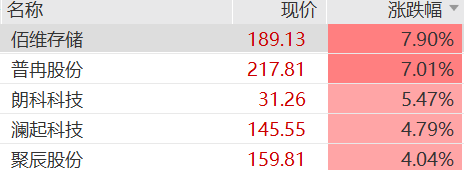
Market Overview - On January 20, A-shares experienced a significant drop, with the ChiNext Index falling over 2% at one point, ultimately closing down 1.8% [1] - The chemical sector showed resilience, with several stocks such as Hongbaoli and Shandong Heda hitting the daily limit [1] AI and Semiconductor Sector - AI application stocks rose, with companies like Jiayun Technology and Yue Media hitting the daily limit [2] - The storage chip concept remained active, with Yingfang Micro, which plans to acquire shares in two semiconductor companies, also hitting the daily limit; Bawei Storage saw a nearly 200% increase over the last 120 trading days [2] - Micron Technology reported a worsening shortage of memory chips, indicating that supply tightness will persist beyond this year [2] Retail and Real Estate Sector - The retail sector strengthened, with Shanghai Jiubai and Xinhua Department Store hitting the daily limit, following the National Development and Reform Commission's announcement to develop a strategy for expanding domestic demand from 2026 to 2030 [2] - The real estate sector also saw gains, with stocks like Dayue City and Wo Ai Wo Jia hitting the daily limit [2] Financing and Market Dynamics - A-shares' financing balance decreased for the first time in two weeks, with a reported balance of 27,059 billion yuan, down 8.5 billion yuan from the previous day [4] - The electronic, communication, defense, computer, and basic chemical sectors were the main areas of net selling by financing clients, each exceeding 1 billion yuan in net sell amounts [5] - Analysts noted that the recent increase in margin requirements is likely aimed at cooling off overheated speculative trends, particularly affecting high-volatility sectors [6] - Despite short-term fluctuations, the long-term outlook for A-shares remains bullish, with expectations for new highs in the cross-year market [6]


到底是谁还在花钱?
首席商业评论· 2026-01-20 04:15
Core Viewpoint - The article discusses the shift in consumer behavior in China, highlighting the emergence of new consumption trends driven by emotional value and the growing importance of quality-price ratio in purchasing decisions [6][10][18]. Group 1: Emerging Consumption Trends - Cities like Changsha and Guiyang are leading new consumption trends, with Changsha's comedy clubs and tea houses attracting significant consumer interest due to their affordable pricing and cultural elements [10][13]. - The coffee culture in Guiyang has flourished, with over 3,000 coffee shops catering to a discerning consumer base, indicating a strong local demand for quality products [15]. - The report from Boxed Market indicates that cities like Yibin and Bengbu are experiencing unique consumption patterns, such as high demand for fresh salmon and specialty cakes, reflecting a desire for quality and novelty in daily life [16][18]. Group 2: Emotional Consumption - Emotional value is becoming a key driver in consumer purchasing decisions, with the emotional consumption market projected to grow from 2.31 trillion yuan in 2024 to 2.72 trillion yuan in 2025 [18][20]. - Consumers are increasingly focused on self-fulfillment and emotional satisfaction rather than external validation, leading to a rise in "self-reward" purchases like desserts and small alcoholic beverages [19][20]. - Health-conscious consumption is also on the rise, with 71% of consumers actively researching product ingredients, indicating a shift towards healthier lifestyle choices [20][22]. Group 3: Market Dynamics in Emerging Cities - The growth engine of China's consumer market is shifting from traditional first-tier cities to emerging cities, with retail sales growth in these areas outpacing that of first-tier cities [26][29]. - Brands that adapt to the unique demands of these emerging markets, such as Domino's Pizza and local snack brands, are finding success by offering affordable and innovative products [31][34]. - Companies like Hema are expanding into new cities, recognizing the stable and diverse consumer demands in these regions, and focusing on high-end products rather than local specialties [34][35].

近3400只个股下跌
Di Yi Cai Jing Zi Xun· 2026-01-20 04:09
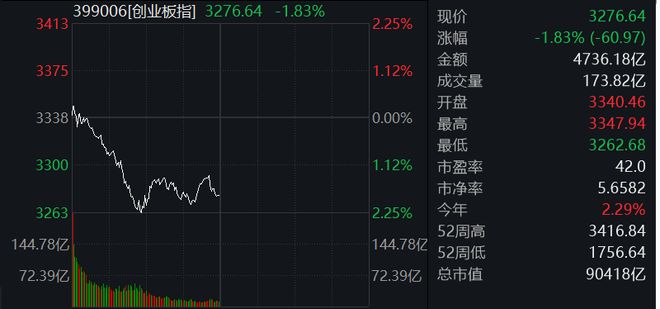
Market Overview - The A-share market showed a decline at midday, with the Shanghai Composite Index down 0.3%, the Shenzhen Component down 1.22%, and the ChiNext Index down 1.83% [1][4] - The total trading volume in the Shanghai and Shenzhen markets reached 1.85 trillion yuan, an increase of 568 billion yuan compared to the previous trading day [3] Sector Performance - The ChiNext Index fell by 1.83%, closing at 3276.64, with a trading volume of 473.618 billion yuan [2] - Sectors such as satellite internet, commercial aerospace, and 6G concepts experienced significant declines, while real estate, advanced packaging, cultural media, and retail sectors saw gains [2][4] Notable Stocks - Pop Mart International Holdings saw a rise of over 10% after announcing a share buyback of 2.51 billion Hong Kong dollars, marking its first buyback since early 2024 [5][13] - The coal sector showed some upward movement, with companies like Dayou Energy hitting the daily limit up, influenced by cold weather forecasts affecting several regions [3][4] Economic Indicators - The National Development and Reform Commission announced plans to formulate a strategy for expanding domestic demand from 2026 to 2030, which may impact retail and consumer sectors positively [3] - The People's Bank of China conducted a reverse repurchase operation of 324 billion yuan with a rate of 1.40%, with 358 billion yuan maturing today [12]





近3400只个股下跌
第一财经· 2026-01-20 04:08
Market Overview - The A-share market showed a decline with the ChiNext index dropping by 1.83% to 3276.64, while the Shanghai Composite Index fell by 0.3% and the Shenzhen Component Index decreased by 1.22% [4][5] - The total trading volume in the Shanghai and Shenzhen markets reached 1.85 trillion yuan, an increase of 568 billion yuan compared to the previous trading day, with nearly 3400 stocks declining [5][6] Sector Performance - The satellite internet, commercial aerospace, and 6G concept sectors experienced significant declines, while the real estate, advanced packaging, cultural media, and retail sectors saw gains [4][5] - The retail sector showed strength with stocks like Xinhua Department Store and Shanghai Jiubai hitting the daily limit, following news from the National Development and Reform Commission about plans for a demand expansion strategy from 2026 to 2030 [5] Individual Stock Movements - Pop Mart saw a rise of over 10% after announcing a share buyback of 2.51 billion Hong Kong dollars, marking its first buyback since early 2024 [8][18] - Hualing Cable opened down over 9% and approached the daily limit down after announcing the termination of its acquisition of Hunan Xingxin Aerospace New Materials Co., Ltd [14] - Yidian Tianxia faced a limit down upon resuming trading [16] Economic Indicators - The People's Bank of China conducted a reverse repurchase operation of 324 billion yuan for 7-day terms at an interest rate of 1.40%, with 358.6 billion yuan of reverse repos maturing today [19]

午评:创业板指半日跌1.83%,商业航天、算力硬件股跌幅居前
Xin Lang Cai Jing· 2026-01-20 03:33
A股三大指数早盘集体下挫,截至午盘,沪指跌0.3%,深成指跌1.22%,创业板指跌1.83%,北证50指数 跌1.83%,沪深京三市半日成交额18654亿元,较上日放量589亿元。全市场超3300只个股下跌。 板块题 材上,化学化工、文化传媒、房地产、保险、银行、机场航运、零售、半导体板块涨幅居前;商业航 天、CPO、可控核聚变、小金属、电池、军工板块跌幅居前。盘面上,多只化工股早盘走强,红墙股 份、红宝丽涨停,研究机构指出,大宗化学品正迎来产能与库存周期的双重拐点。部分AI应用概念股 逆势走强,粤传媒、天地在线、浙文互联等股封板,中信证券表示后续ai应用催化仍多。半导体板块同 样表现活跃,中微半导20cm涨停。美光科技公司表示,内存芯片短缺在过去一个季度愈演愈烈。此 外,房地产、零售大消费、保险等板块均有异动。另一方面,商业航天板块多股下跌,海格通信、神剑 股份连续3日跌停后打开跌停板,但仍有较大程度下跌。算力硬件股同样表现不佳,胜宏科技、剑桥科 技多股下探,此前公司业绩指引均逊于市场预期。 ...
掘金银发、冰雪、AI+新增长点,港股通消费ETF华夏(513230)现涨近1.5%
Mei Ri Jing Ji Xin Wen· 2026-01-20 03:30
财通证券预计,未来以银发经济(智慧养老、康养旅居等)、冰雪经济、体育赛事为代表的细分领域, 以及由技术赋能(AI+)和情感体验驱动的服务新模式,有望成为新兴增长极。 港股通消费ETF华夏(513230)跟踪中证港股通消费主题指数,一键打包消费龙头,成分股近乎囊括港 股消费的各个领域,包括泡泡玛特、百胜中国、安踏体育、农夫山泉、蜜雪冰城等消费龙头。 1月20日,港股消费板块持续飘红,港股通消费ETF华夏(513230)现涨近1.5%。持仓股中,泡泡玛 特、布鲁可、中烟香港、上美股份、毛戈平、蜜雪集团等涨幅靠前;裕元集团、卫龙美味、晶苑国际、 珍酒李渡等跌幅靠前。 消息方面,1月19日,国新办举行新闻发布会介绍2025年国民经济运行情况。2025年,我国社会消费品 零售总额突破50万亿元大关,达到501202亿元,同比增长3.7%,增速较2024年加快0.2个百分点,规模 居全球零售市场前列。新型消费不断增长,消费结构升级趋势明显。随着居民生活水平提高,消费正 从"商品主导"向"商品与服务并重"转变,2025年服务消费成为最亮眼的增长点。 ...
零售板块冲高,新华百货、上海九百涨停
Jin Rong Jie· 2026-01-20 03:20
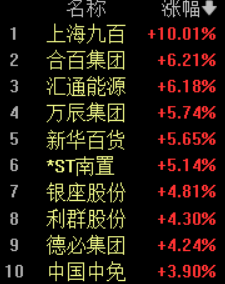
零售板块冲高, 新华百货、 上海九百涨停, 合百集团、 汇通能源、 万辰集团、 中国中免、 广百股份 跟涨。消息面上,此前发改委称,将研究制定出台2026年—2030年扩大内需战略实施方案 ...
新华百货5连板!10时49分再度涨停,背后逻辑揭晓
Jin Rong Jie· 2026-01-20 03:20
Core Insights - Xinhua Department Store has achieved a five-day consecutive limit-up, indicating strong market interest and momentum in the stock [1] - The stock reached a trading halt at 10:49 AM with a transaction volume of 815 million yuan and a turnover rate of 16.75% [1] - Recent developments include the signing of a share transfer agreement by the controlling shareholder, which has drawn attention to changes in the company's equity structure [1] - Ongoing policies aimed at boosting consumption, such as special actions to stimulate consumption and strategies to expand domestic demand, are creating a positive market atmosphere for the retail sector [1]
零售概念逆势拉升!上海九百涨停,新华百货一度5连板,扩大内需成2026开年关键词
Jin Rong Jie· 2026-01-20 03:12
零售概念逆势拉升,上海九百涨停,新华百货一度5连板,合百集团、银座股份、利群股份等跟涨。 | | 名称 | 张帽� | | --- | --- | --- | | 1 | 上海九百 +10.01% | | | 2 | 合百集团 | +6.21% | | 3 | 汇通能源 | +6.18% | | ঘ | 万辰集团 | +5.74% | | 5 | 新华百货 | +5.65% | | 6 | *ST南置 | +5.14% | | 7 | 银座股份 | +4.81% | | 8 | 利群股份 | +4.30% | | 9 | 德必集团 | +4.24% | | 10 | 中国中免 | +3.90% | 国家发展改革委国民经济综合司司长周陈表示,在提振内需方面,目前,正在研究制定稳岗扩容体制行 动和城乡居民增收计划,目的就是增强居民的消费能力,优化消费升级。2026年,将推动实施服务业扩 能提质行动,推出一批具有含金量的政策,加力支持服务业优质高效发展。 相关行业: 实体零售:随着扩大内需政策持续推进,线下消费场景将不断得到激活,拥有成熟线下门店网络、能够 提供沉浸式购物体验的实体零售企业,将直接受益于客流回升与消 ...