券商

Search documents
廖市无双-风格切换成长轮休-该如何应对
2026-02-02 02:22
Summary of Conference Call Records Industry and Company Overview - The conference call discusses the current state of the market, focusing on various sectors including technology, resources, and financial services. The analysis highlights the performance of indices such as the CSI 500, CSI 1000, and the Shanghai Composite Index. Key Points and Arguments Market Conditions - The market is experiencing a weakening momentum, necessitating risk control and attention to the 20-day moving average and external factors affecting resource prices [1][3] - In January, the first three weeks saw strong performance from small-cap indices like CSI 500 and CSI 1000, but a cooling trend began in the third week, with large-cap indices like the Shanghai 50 and CSI 300 breaking below the 20-day moving average [2][4] Sector Performance - The non-ferrous metals sector is under pressure, with expectations of a prolonged adjustment phase, potentially lasting six months to a year. The previous year's surge of 97.5% in the non-ferrous index makes it unlikely to replicate such gains this year [5][6] - The technology growth sector is showing signs of weakness, with various industries including defense, electronics, and computing experiencing pullbacks [6][7] Investment Strategy - Investors are advised to maintain a balanced portfolio with a focus on sectors that are currently undervalued and have a high risk awareness. Caution is recommended for technology growth stocks due to potential short-term volatility [3][4] - Recommended sectors for investment include construction materials, electronics, and communication, which are considered to have a favorable risk-reward ratio [2][12] Market Trends and Predictions - The market is expected to enter a phase of strong oscillation leading up to the Spring Festival, with large-cap indices outperforming small-cap growth indices [8][11] - The brokerage sector is anticipated to enter a bullish cycle, with a potential for upward movement despite current low market sentiment [9][10] Risk Factors - The volatility in global resource prices, such as a 35% drop in silver prices, is impacting related assets and indices, particularly those with significant exposure to non-ferrous resources [4][5] - The potential for further declines in small-cap indices if they do not rebound quickly is a concern, indicating a need for careful monitoring of technical indicators [4][8] Future Outlook - The overall market is expected to remain in a state of fluctuation, with opportunities for growth anticipated towards the end of 2026. Investors are encouraged to adjust their portfolios accordingly and focus on sectors with solid fundamentals [11][18] Additional Important Content - The call emphasizes the importance of monitoring technical indicators such as the 20-day and 5-week moving averages to make timely adjustments to investment positions [4][11] - The discussion includes insights on the cyclical nature of certain sectors, particularly those related to commodities and technology, suggesting a strategic approach to investing in these areas [13][15]
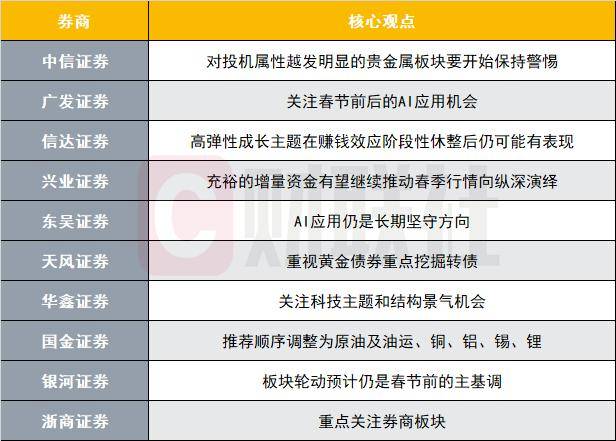
十大券商一周策略:贵金属板块投机属性越发明显,要开始保持警惕;关注春节前后的AI应用机会
Jin Rong Jie· 2026-02-01 23:51
Group 1 - The current market sentiment is supported by ample liquidity and a favorable policy environment, with a clear focus on technology growth driven by global industrial trends, particularly in AI applications and computing power [1][5] - There is a notable shift from speculative investments in precious metals to a focus on quality assets with pricing power and profit recovery potential in sectors like chemicals and non-ferrous metals [2][5] - The spring market is characterized by a rotation among sectors, with an emphasis on selecting high-quality assets in sectors experiencing marginal improvements in fundamentals [1][2][10] Group 2 - The AI sector is expected to see significant opportunities, particularly in applications related to computing power and energy storage, with a focus on recovery trends in Q4 [3][6] - The manufacturing and consumption sectors are anticipated to benefit from marginal improvements in fundamentals, aligning with the broader market recovery narrative [2][10] - The cyclical sectors are showing signs of profit margin recovery, driven by a shift in Chinese policy from expansion to quality improvement [2][5] Group 3 - The market is witnessing a rotation from small-cap to large-cap stocks, with a focus on quality over themes, indicating a potential for continued performance in high-growth sectors [4][5] - The upcoming months are expected to see increased activity in the AI sector, supported by government initiatives and technological advancements [6][10] - The focus on structural opportunities in technology and resource sectors is expected to persist, with an emphasis on sectors like chemicals, non-ferrous metals, and renewable energy [2][8][10]
调查:近八成投资者看涨2026年行情 七成投资者配置了黄金
Shang Hai Zheng Quan Bao· 2026-02-01 23:31
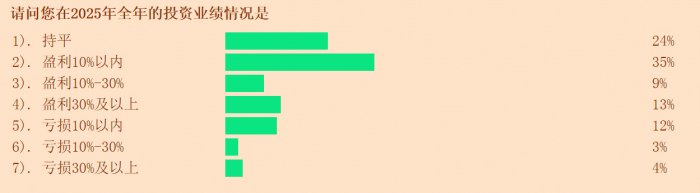
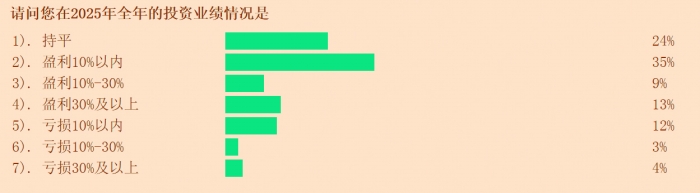
Core Viewpoint - The report indicates a significant improvement in investor sentiment, with nearly 80% of investors optimistic about the 2026 market, driven by a strong performance in 2025 and expectations for continued growth in technology sectors, particularly AI and chips [1][7][22]. Group 1: Market Performance and Investor Sentiment - In 2025, major stock indices in A-shares showed strong performance, with the Shanghai Composite Index rising nearly 20%, marking its best annual performance in six years [7][30]. - Approximately 57% of surveyed investors reported profits in 2025, a notable increase from previous years, with a 15 percentage point rise from 2024 [8][32]. - The average asset allocation in securities accounts increased to 41.68% by the end of 2025, reflecting a shift of funds from savings to equity investments [10][34]. Group 2: Sector Performance - The technology sector, particularly AI and chips, was identified as the primary source of investment returns, with 26% of investors citing it as their top-performing sector [3][42]. - Other notable sectors included the new energy industry at 24% and cyclical stocks at 18%, while traditional consumer sectors lagged behind [3][42]. Group 3: Future Expectations - Looking ahead to 2026, 78% of investors expect the market to rise, with 47% anticipating gains of over 5% [24][49]. - Investors are particularly optimistic about the technology sector, with 39% believing that tech stocks will continue to outperform [24][49]. - A significant 81% of investors are optimistic about the spring market in 2026, with a focus on technology growth [51]. Group 4: Investment Strategies - The report highlights a trend of increasing allocations to equity assets, with 42% of investors planning to increase their investments in stocks [48][35]. - There is a notable interest in gold investments, with 71% of investors having allocated funds to gold, reflecting its status as a safe haven amid market volatility [37][13]. - The preference for indirect investment methods, such as ETFs, is growing, particularly in the Hong Kong stock market, where 58% of investors chose this route [40][39]. Group 5: Economic Factors - The report notes that the decline in risk-free interest rates has prompted a shift in investment strategies, with more investors considering equities over traditional savings [11][36]. - Expectations for liquidity in the market remain high, with over 60% of investors anticipating a continued influx of capital into equities [48][22].

春季行情蓄力更健康,春节大红包更靠结构
Haitong Securities International· 2026-02-01 23:30
Investment Focus - The report emphasizes a balanced allocation between technology and value sectors, focusing on market structure rather than short-term index fluctuations [1][11] - Recent market movements show a stronger rebound in value sectors compared to high-tech, with increased expectations for policies supporting the real estate sector [1][12] - Rising commodity prices and stabilization in certain product prices are aiding valuation recovery in undervalued sectors like real estate and baijiu [1][12] Market Outlook - The report anticipates stabilization and upward movement in Chinese equities (A-shares and Hong Kong stocks) leading into the Lunar New Year, driven by domestic fundamentals and liquidity conditions [2][13] - A series of political and economic catalysts, including local and national meetings and the rollout of the 15th Five-Year Plan, are expected to enhance market sentiment [2][13] Investment Strategy - The report suggests positioning for the Lunar New Year "red packet" rally by focusing on industries benefiting from holiday effects and macroeconomic catalysts [2][14] - Key areas of focus include AI applications, high-quality tech manufacturing, and future industries such as defense and domestic chip production [2][14] Sector Analysis - Non-bank financials, particularly brokers and insurers, are expected to recover from previous outflows due to their strong fundamentals [3][19] - The holiday consumption chain, including sectors like gaming, food and beverage, and travel, is highlighted as a potential growth area [3][19] - Hong Kong dividend assets with earnings leverage, such as real estate and chemicals, are also noted for their potential upside following policy support [3][19] Liquidity Data - A-share ETF flows show a divergence, with broad-based ETFs experiencing significant outflows while sector-specific ETFs saw inflows, particularly in metals and chemicals [4][16] - In Hong Kong, short-selling activity has returned to historical averages, with notable inflows into energy and property sectors [5][17]


中信、申万等头部券商最新发声:房地产市场现积极信号
Zhong Guo Ji Jin Bao· 2026-02-01 22:45
Core Viewpoint - The worst period for the real estate industry is gradually passing, with policy support and fundamental adjustments paving the way for a recovery in profitability for quality real estate companies [1][4]. Group 1: Market Performance and Predictions - In 2025, among 78 A-share real estate companies that released performance forecasts, 58 reported losses, with total net losses ranging from 206.04 billion to 239.75 billion yuan; 5 companies forecasted a profit decrease of 75% to 78% compared to 2024; only 6 companies expected profit increases, with net profits between 1.76 billion and 1.94 billion yuan [2]. - The estimated net losses for the A-share real estate sector in 2025 are between 145.5 billion and 198.42 billion yuan, compared to 161.4 billion yuan in 2024 [2]. - The decline in performance is attributed to market adjustments over the past few years, but there are emerging positive signals in the real estate market, including a slight decrease in the number of second-hand homes listed for sale [2]. Group 2: Policy and Economic Environment - The central government emphasizes stabilizing the real estate market, with recent publications suggesting that policies should be comprehensive and timely to boost market confidence [5]. - The central economic work conference in December 2025 highlighted the need to manage risks in key areas and stabilize the real estate market, indicating a more positive policy stance [5]. - The focus on urban renewal and the importance of the real estate economy are expected to become significant economic drivers in 2026 [5]. Group 3: Asset Valuation and Investment Opportunities - The introduction of commercial real estate REITs is expected to enhance the efficiency of asset securitization and reduce debt burdens for real estate companies, allowing investors to access quality low-volatility equity assets [3]. - The cash flow situation for households remains strong, supporting the potential for continued recovery in operating cash flows for companies [3]. - The deep clearing of supply-side issues in the real estate sector is expected to optimize the industry landscape, with quality companies likely to see earlier and more elastic profit recovery [6].


宏利基金李坤元: “四好”原则掘金 聚焦周期共振
Zhong Guo Zheng Quan Bao· 2026-02-01 21:04
Core Viewpoint - The A-share market has shown a "good start" in 2026 due to favorable policies and expectations of global liquidity shifts, but structural differentiation remains significant. The focus should be on "good industries, good phases, good companies, and good prices" to capture opportunities in technology growth and cyclical reversals [1] Investment Framework - The investment framework emphasizes a top-down approach, with a strong focus on macroeconomic conditions. The manager conducts quarterly reviews of macro conditions and adjusts positions accordingly, prioritizing risk management during uncertain times [2] - The "Four Good" stock selection principle includes: - Good Industry: Focus on sectors with upward cycles and explosive potential, particularly those nearing market penetration inflection points - Good Phase: Concentrate on segments with upward economic momentum and visible performance growth for at least one year - Good Company: Identify not only leading companies but also hidden champions and potential leaders in niche markets - Good Price: Emphasize reasonable valuations, especially critical during market downturns [2] Sector Opportunities - The macro environment in 2026 is expected to see positive turning points, with a high likelihood of interest rate cuts by the Federal Reserve and a coordinated policy push in China, enhancing the attractiveness of Chinese equity assets [3] - Key investment areas include: - Technology and advanced manufacturing, particularly in semiconductors, robotics, and commercial aerospace, focusing on sectors with low domestic production rates and significant growth potential - Cyclical industries that may benefit from short-term growth policies, providing stability and potential returns over a two to three-year horizon [3][4] Specific Sectors - The AI industry is anticipated to transition towards application sectors, with significant growth potential in AI computing and applications [3] - The commercial aerospace sector is at a critical growth stage, with long-term investment value, though caution is advised regarding short-term speculative volatility [4] - The renewable energy sector is expected to experience a rebound due to policy support, with a focus on lithium battery supply chains benefiting from storage demand [4] - The chemical industry is projected to have structural investment opportunities, with key indicators to monitor including supply growth, demand conditions, and raw material price trends [5] Investment Strategy - The newly launched fund reflects the investment philosophy of balanced market exposure, with a maximum of 50% allocation to Hong Kong stocks. The strategy includes: - Balanced allocation to reduce volatility - Capitalizing on cyclical reversals - Combining quantitative screening with in-depth research to select leading companies [6] - The goal is to help investors navigate market fluctuations and benefit from long-term industrial upgrades and corporate growth in China [6]
“四好”原则掘金 聚焦周期共振
Zhong Guo Zheng Quan Bao· 2026-02-01 20:53
Core Viewpoint - The A-share market has shown a "good start" in 2026 due to favorable policies and expectations of global liquidity shifts, but structural differentiation remains significant. The focus should be on "good industries, good phases, good companies, and good prices" to capture opportunities in technology growth and cyclical reversals [1][2]. Investment Framework - The investment framework emphasizes a top-down approach, with a strong focus on macroeconomic conditions. The manager conducts quarterly assessments of macro conditions and adjusts positions accordingly, prioritizing risk management during uncertain times [1][2]. - The "Four Good" stock selection principle includes: - Good Industry: Focus on sectors with upward cycles and explosive potential, particularly those nearing market penetration inflection points. - Good Phase: Concentrate on segments with upward economic momentum and visible performance growth for at least one year. - Good Company: Identify not only leading firms but also hidden champions and potential leaders that can deliver excess returns post-industry stabilization. - Good Price: Emphasize reasonable valuations, especially critical during market downturns [2][3]. Macro Environment and Opportunities - The macro environment in 2026 is expected to see positive turning points, with high certainty of interest rate cuts by the Federal Reserve and a coordinated policy push in China, enhancing the attractiveness of Chinese equity assets [2][3]. - Key investment areas include: - Technology and advanced manufacturing, particularly in semiconductor, robotics, and commercial aerospace sectors, focusing on low domestic production rates and high growth potential. - Cyclical industries that are bottoming out, which can smooth portfolio volatility and provide substantial returns over a two to three-year horizon [3][4]. Sector-Specific Insights - The AI industry is anticipated to transition towards application sectors, with significant growth potential in AI computing and applications [3]. - The commercial aerospace sector is at a critical growth stage, with increasing technological advancements and commercialization, although caution is advised regarding speculative volatility [3]. - The renewable energy sector is expected to benefit from policy support and supply-side adjustments, particularly in the lithium battery supply chain, which may see valuation increases due to rising storage demand [3][4]. - The chemical industry is projected to have structural investment opportunities, with profitability expected to improve in the second half of 2026 [4]. Investment Strategy - The investment strategy involves balanced allocation across sectors to mitigate volatility, capitalizing on cyclical reversals, and employing both quantitative screening and qualitative research to select leading companies [5]. - The focus is on long-term value creation rather than short-term trends, aiming to help investors benefit from China's industrial upgrades and corporate growth [5].
盈利连续改善 近八成投资者看涨2026年行情——上海证券报·个人投资者2026年第一季度调查报告
Shang Hai Zheng Quan Bao· 2026-02-01 18:14
Core Viewpoint - The A-share market showed resilience in 2025, with nearly 60% of surveyed investors achieving profits, driven primarily by the technology sector, particularly artificial intelligence [9][10][11]. Market Performance - The major indices in the A-share market experienced significant gains, with the Shanghai Composite Index rising 18.41% to close at 3968.84 points, marking its best annual performance since 2020 [10][11]. - The ChiNext Index and the STAR Market Index saw even higher annual increases of approximately 49.57% and 46.3%, respectively [10][11]. Investor Sentiment - Nearly 80% of investors are optimistic about the 2026 stock market, with expectations for a robust spring market [24][27]. - The proportion of investors anticipating a bullish trend in the A-share market reached its highest level since 2022, with 78% expecting an overall increase [27][28]. Asset Allocation Trends - There is a noticeable shift in asset allocation, with 42% of investors planning to increase their investments in equity assets, reflecting a 10 percentage point increase from the end of 2024 [26]. - The average proportion of securities in personal financial assets rose to 41.68%, up from 38.84% at the end of 2024, indicating a trend of moving funds from savings to equities [12][13]. Gold Investment - Approximately 71% of investors allocated funds to gold in 2025, with 44% reporting profits from their gold investments [15][16]. - The price of gold increased by over 60% throughout the year, making it a focal point in asset allocation [14][15]. Hong Kong Market Performance - The Hong Kong stock market also showed strong performance, with 37% of investors reporting profits, an increase of 9 percentage points from the previous year [16][17]. - 27% of investors increased their investments in Hong Kong stocks, reflecting a growing interest in this market [16][17]. Sector Performance - The technology sector, particularly AI and semiconductor stocks, was identified as the primary source of investment returns, with 26% of investors attributing their gains to this sector [19][20]. - Traditional consumer sectors underperformed, with only 3% of investors citing them as their main source of returns, the lowest in five years [19][20]. Future Outlook - Investors are expected to maintain a rational approach towards market expectations, with a focus on structural opportunities rather than speculative index movements [28][29]. - The anticipated liquidity in 2026 is expected to support continued investment in equity markets, particularly in technology and high-dividend sectors [25][26].
金融行业周报(2026、02、01):券商业绩预告亮眼,保险有望延续估值修复-20260201
Western Securities· 2026-02-01 13:06
Investment Rating - The report indicates a positive outlook for the non-bank financial sector, with specific recommendations for insurance, brokerage, and banking stocks [1][2][3]. Core Insights - The non-bank financial index increased by 1.04%, outperforming the CSI 300 index by 0.95 percentage points. The insurance sector showed a significant increase of 5.50%, while the brokerage sector declined by 0.69% [1][2]. - The insurance sector is expected to continue its valuation recovery, driven by strong performance in premium growth and favorable market conditions. The brokerage sector is anticipated to see a fundamental recovery in profitability by 2025, supported by potential policy easing [2][3]. - The banking sector is projected to benefit from a stabilization in interest margins and a recovery in macroeconomic conditions, leading to improved profitability and valuation recovery [3][21]. Summary by Sections Insurance Sector - The insurance sector's index rose by 5.50%, significantly outperforming the CSI 300 index by 5.42 percentage points. The sector is expected to maintain a valuation recovery trend, supported by strong premium growth and favorable asset conditions [2][14][15]. - Key recommendations include New China Life Insurance, China Pacific Insurance, China Life Insurance (H), and China Taiping Insurance, focusing on companies with strong dividend yields and robust operational stability [15][16]. Brokerage Sector - The brokerage sector's index decreased by 0.69%, underperforming the CSI 300 index by 0.77 percentage points. Despite this, 21 out of 42 listed brokerages reported positive earnings forecasts for 2025, indicating an overall improvement in industry performance [2][17][18]. - Recommended stocks include Guotai Junan, Huatai Securities, and other major brokerages with strong fundamentals and potential for mergers and acquisitions [18][19]. Banking Sector - The banking sector's index increased by 0.86%, outperforming the CSI 300 index by 0.78 percentage points. The sector is expected to see a recovery in net interest income and a reduction in risks associated with real estate lending [3][21][22]. - Recommended banks include Hangzhou Bank, with additional attention on Ningbo Bank, Nanjing Bank, and others that show strong dividend yields and potential for valuation recovery [22][60].
海外市场持续动荡,A股如何应对?十大券商策略来了
Sou Hu Cai Jing· 2026-02-01 11:56
Group 1: Precious Metals and Market Trends - The precious metals sector is showing increasing speculative attributes, warranting caution [2] - The current market is experiencing a style shift from small-cap to large-cap stocks and from themes to quality [2] - The overall trend indicates a potential for profit margin recovery in cyclical sectors, driven by a shift in Chinese policy from expansion to quality improvement [2] Group 2: AI and Technology Opportunities - There is a focus on AI applications and energy storage as key growth areas, with expectations for recovery in lithium battery materials and storage sectors [3] - The AI industry remains a long-term focus, with significant policy support and market optimism surrounding its applications [5] - The technology theme, including AI applications and structural recovery opportunities, is highlighted as a key area for investment [7] Group 3: Spring Market Dynamics - The spring market is expected to continue its upward trend, supported by ample liquidity and positive domestic fundamentals [5] - High elasticity growth themes may still perform well after a phase of profit-taking, with potential for further gains in February [4] - Sector rotation is anticipated to be a dominant theme leading up to the Spring Festival, with a focus on structural opportunities [9] Group 4: Commodity Recommendations - A recommendation has been made to adjust the order of investment focus to include crude oil, copper, aluminum, tin, and lithium, reflecting a shift towards industrial pricing [8] - The emphasis on physical assets is expected to strengthen, with a focus on sectors like chemicals and consumer goods benefiting from domestic recovery [8] Group 5: Market Sentiment and Future Outlook - The market sentiment remains cautious but optimistic, with expectations for continued support from domestic policies and liquidity [5][6] - The potential for structural recovery in manufacturing and resource sectors is noted, with clear paths for profit recovery [9] - The upcoming credit and inflation data in January may provide additional positive signals for the market [4]