基金

Search documents
基金选品系列研究之六:养老FOF如何实现绝对收益
HTSC· 2026-02-01 13:30
Investment Rating - The report indicates a positive investment outlook for public pension FOFs, particularly those with low volatility and stable returns [2][3][19]. Core Insights - The public pension FOF market in China has shown significant growth, with a total scale of 244 billion yuan by the end of 2025, reflecting an increase of over 80% compared to the previous year [2][8]. - The report highlights the trend of public pension FOFs embracing passive investment strategies and diversifying asset classes to achieve absolute returns [1][3]. - The analysis of historical performance reveals that certain pension FOFs exhibit low volatility and strong stability, achieving absolute return characteristics [3][19]. Summary by Sections Public Pension FOF Market Overview - As of the end of 2025, there are 545 public pension FOF products with a total scale of 244 billion yuan, marking an increase of approximately 110 billion yuan from 2024 [2][8]. - Among these, the mixed bond FOF category dominates with a scale of about 150 billion yuan, indicating a preference for low-volatility products among investors [2][8]. Performance Analysis of Pension FOFs - Recent years have seen public pension FOFs continuously optimizing their investment frameworks, with some products demonstrating stable and excellent performance [3][7]. - Notable pension FOFs, such as the Invesco Great Wall Conservative Pension Target FOF, have shown a Sharpe ratio exceeding 2.5 and a maximum drawdown below 1% during the observed period [3][21]. Case Study: Invesco Great Wall Conservative Pension Target FOF - The Invesco Great Wall Conservative Pension Target FOF (A share code: 019665) has diversified its asset allocation across U.S. stocks, Hong Kong stocks, A-shares, gold, and bonds, achieving a high investment success rate [4][27]. - The fund manager's accurate macroeconomic assessments and asset allocation strategies have contributed to its stable performance, with a maximum drawdown of only 0.88% [22][24]. - The fund's asset allocation strategy includes a significant portion in cash during uncertain market conditions, effectively controlling risk during market shocks [27][31]. Fund Selection and Performance Metrics - The report identifies several pension FOFs with low risk and stable performance, focusing on those with a high Sharpe ratio and consistent positive returns [17][19]. - The analysis includes metrics such as annualized returns, volatility, and maximum drawdown, emphasizing the importance of consistent performance in varying market conditions [19][20].
规模达2.99万亿元,仍将持续爆发!这类基金有望成低风险理财“压舱石”
Zhong Guo Ji Jin Bao· 2026-02-01 13:13
进入2026年以来,基金公司继续加大力度布局"固收+"基金,包括汇添富、富国、易方达、国泰、摩根 等多家基金公司。 兴业基金固定收益投资部总经理助理腊博表示,"固收+"产品规模快速增长是多方面因素共同影响的结 果,低利率环境是重要的背景,较低的存款利率和债券收益率难以满足投资者对收益的诉求,经济结构 转型和政策支持使市场风险偏好显著提升。 腊博认为,随着存款利率的吸引力下降,存款向"固收+"产品、保险产品、理财产品和权益类产品转化 的比例也会相应提升。而从产品布局的角度来看,基金公司布局不同风险梯度的"固收+"产品,可以更 好地契合投资者不同的风险收益偏好。 随着天量存款到期、低利率环境延续,"固收+"基金规模和业绩迎来"双丰收"。 受访公募机构表示,当前,居民资产配置持续向金融资产转移,"固收+"产品凭借其清晰的风险收益特 征,有望成为承接稳健类资金的重要载体,市场规模或进一步增长。 "固收+"产品规模快速增长 "固收+"产品规模持续扩张。中金公司(601995)研报数据显示,截至2025年末,全市场2292只"固收 +"基金规模合计达2.99万亿元(统计一级债基、二级债基、可转债、偏债混、低仓位灵活配置基 ...
“顶流”暗淡了星光,新秀“杀了个痛快”,罕见大洗牌来了
Xin Lang Cai Jing· 2026-02-01 13:12
Core Insights - The number of active equity fund managers managing over 10 billion yuan increased from 77 at the end of 2024 to 93 by the end of 2025, indicating a significant reshuffling in the "billion club" of fund managers [1][2][10] - Traditional top fund managers have seen a decline in their management scale, while new managers focusing on technology sectors have emerged rapidly, reflecting a shift in investor preferences towards strategies that align with market trends [1][2][3][5] Fund Manager Changes - As of Q4 2025, 93 active equity fund managers manage over 10 billion yuan, an increase of 16 from the previous year, with notable names like Zhang Kun and Xie Zhiyu still leading the pack [2][10] - Some star fund managers, particularly those heavily invested in consumer stocks, have experienced significant scale reductions, with losses exceeding 10 billion yuan for managers like Liu Yanchun and Zhang Kun [2][10] - New entrants in the technology sector, such as Ren Jie and Zhang Haixiao, have seen their management scales grow from under 1 billion yuan to over 10 billion yuan, showcasing the rapid rise of new talent [2][10] Market Structure and Style Changes - The changes in the billion club are attributed to a combination of short-term market style shifts and a long-term feedback mechanism between scale and performance [3][11] - The transition from a focus on large-scale fund managers to those offering sustainable performance indicates a maturation of investor behavior, moving away from merely chasing historical performance [3][11][12] Industry Trends - The public fund industry is currently undergoing a high-quality development phase, with regulatory actions promoting long-term assessments and fee reforms, pushing the industry to prioritize investor returns over sheer scale [4][12] - The trend of "de-starring" fund managers is gaining traction, as firms seek to reduce reliance on individual managers and focus on building robust research teams [5][12][13] Investment Strengths - Future success in the billion club will depend on fund managers' abilities to control drawdowns and adapt investment strategies, emphasizing the importance of "hard skills" in investment management [6][14] - The industry is expected to evolve towards two main types of funds: those providing stable excess returns and those with clear investment styles, while poorly defined products are likely to be phased out [6][14][15]
公募REITs周报(第52期):指数震荡上行,首批商业不动产REITs已申报-20260201
Guoxin Securities· 2026-02-01 12:50
Report Industry Investment Rating - Not provided in the given content Core Viewpoints of the Report - This week, REITs fluctuated upwards, outperforming major stock and bond indices. The CSI REIT Index rose 0.8% this week, with water conservancy, energy, and transportation REITs leading the gains, while data center REITs, which had significant increases earlier, adjusted significantly. The order of weekly returns of major indices was: CSI REIT > CSI 300 > CSI Aggregate Bond > CSI Convertible Bond. As of January 30, 2026, the dividend yield of equity REITs was 60 basis points lower than the average dividend yield of CSI Dividend stocks, and the spread between the average internal rate of return of concession - type REITs and the 10 - year Treasury yield was 326 basis points. The submission and acceptance of the first 8 commercial real - estate REITs by the Shanghai Stock Exchange signify a key expansion of China's public REITs market from the infrastructure sector to the commercial real - estate sector [1] Summary by Relevant Catalogs Secondary Market Trends - **Index Performance**: As of January 30, 2026, the closing price of the CSI REIT (Closing) Index was 809.56 points, with a weekly return of 0.8% from January 24 - 30, 2026, outperforming the CSI Convertible Bond Index (-2.6%), the CSI Aggregate Bond Index (0.0%), and the CSI 300 Index (0.1%). Year - to - date, the order of returns of major indices was: CSI Convertible Bond (+5.8%) > CSI REIT (+4.4%) > CSI 300 (+1.7%) > CSI Aggregate Bond (+0.4%). In the past year, the return of the CSI REIT Index was -2.8%, with a volatility of 7.5%. Its return was lower than that of the CSI Convertible Bond Index, the CSI 300 Index, and the CSI Aggregate Bond Index; its volatility was lower than that of the CSI 300 Index and the CSI Convertible Bond Index, but higher than that of the CSI Aggregate Bond Index [1][2][6] - **Market Size and Turnover**: The total market capitalization of REITs on January 30 was 228.7 billion yuan, an increase of 700 million yuan from the previous week. The average daily turnover rate for the whole week was 0.60%, a decrease of 0.16 percentage points from the previous week [2][8] - **Sector - Specific Performance**: As of January 23, 2026, the average weekly returns of equity REITs and concession - type REITs were 0.3% and 0.8% respectively. Among different project - type REITs, water conservancy, energy, and transportation REITs led the gains. The top three REITs in terms of weekly returns were Bosera Tianjin Binhai New Area Industrial Park REIT (+4.94%), ICBC Mongolia Energy Clean Energy REIT (+4.64%), and China Asset Management CNOOC Commercial REIT (+4.52%) [1][3][15] - **Trading Activity and Fund Flow**: Among different project - type REITs, new infrastructure REITs had the highest average daily turnover rate in the period, at 1.065%. Park infrastructure REITs had the highest proportion of trading volume this week, accounting for 20.251% of the total REIT trading volume. The top three REITs in terms of net inflow of main funds this week were China Asset Management China Resources Commercial REIT (38.6 million yuan), CICC Yizhuang Industrial Park REIT (15.9 million yuan), and CICC InCity Mall REIT (14.46 million yuan) [3][22][23] Primary Market Issuance - From January 1 to January 30, 2026, there were 3 REIT products in the in - inquiry stage, 3 in the feedback stage, 8 in the submitted stage on the exchange, and 8 commercial real - estate REITs were officially submitted [25] Valuation Tracking - **Valuation Metrics**: REITs have both bond - like and stock - like characteristics. As of January 30, the average annualized cash distribution rate of public REITs was 6.11%. From the stock - like perspective, relative net value premium rate, IRR, and P/FFO were used to evaluate REITs' valuations. The relative net value premium rate reflects the relationship between the market value and fair value of the fund, similar to the PB indicator of stocks. IRR is the internal rate of return calculated using the discounted cash - flow method, and P/FFO is the current price divided by the operating cash flow [27] - **Sector - Specific Valuation**: Different project - type REITs had different valuation levels. For example, the relative net value premium rate of affordable rental housing REITs was 42.40%, with a P/FFO of 38.43, an IRR of 3.50%, and an annualized dividend rate of 2.76% [28] - **Comparison of Equity and Concession - type REITs**: As of January 30, 2026, the dividend yield of equity REITs was 60 basis points lower than the average dividend yield of CSI Dividend stocks, and the spread between the average internal rate of return of concession - type REITs and the 10 - year Treasury yield was 316 basis points [1][30] Industry News - The first 8 commercial real - estate REITs' applications were accepted by the Shanghai Stock Exchange. On January 29, 2026, Hua'an Jinjiang Closed - end Commercial Real - Estate REIT, Huitianfu Shanghai Real - Estate Closed - end Commercial Real - Estate REIT, and CICC Vipshop Closed - end Commercial Real - Estate REIT were submitted and accepted. On January 30, another 5 commercial real - estate REITs were submitted, marking a key expansion of China's public REITs market from the infrastructure sector to the commercial real - estate sector [1][4][32]
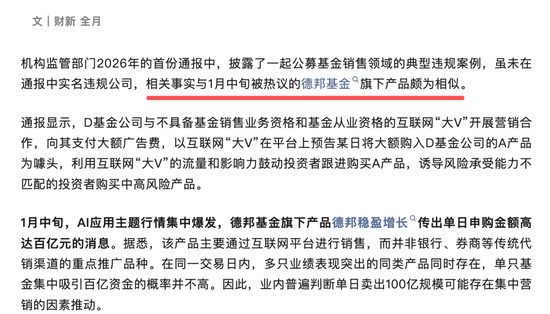
一天卖100亿的德邦基金,出大事了
Xin Lang Cai Jing· 2026-02-01 12:38
Core Viewpoint - The regulatory body has penalized a public fund company, Debang Fund, for collaborating with an unqualified internet influencer to promote a fund, leading to significant investor inflows and subsequent regulatory actions [1][3][32]. Group 1: Regulatory Actions - The regulatory agency issued a notice on January 29, 2026, stating that Debang Fund engaged in marketing cooperation with an internet influencer lacking the necessary qualifications, resulting in the payment of substantial advertising fees [1][32]. - As a consequence, Debang Fund was ordered to rectify its practices and had its public fund product registration suspended, with accountability measures taken against senior management [3][32][51]. Group 2: Fund Performance and Investor Impact - The fund involved, Debang Stable Growth, has underperformed, with a total return of only 25.23% since its inception nearly nine years ago, translating to an annualized return of just 2.56% [12][41]. - On January 12, 2026, the influencer's promotion led to over 10 billion yuan in subscriptions for the fund in a single day, despite its poor historical performance [2][40]. - The fund's performance has been particularly weak, with a return of only 8.06% in 2025, placing it at the bottom of its peer group [44][48]. Group 3: Marketing Practices and Industry Implications - The collaboration involved the influencer leveraging their significant following to encourage investors to purchase a high-risk product, which may not align with their risk tolerance [5][34]. - The incident highlights a broader issue within the industry regarding the adequacy of risk disclosures and the appropriateness of marketing strategies employed by fund companies [21][50]. - The regulatory notice emphasized the need for fund companies to adhere to compliance standards and not prioritize short-term growth over professional integrity [21][50]. Group 4: Broader Industry Reactions - The incident has sparked a regulatory storm that may affect not only Debang Fund but also platforms like Ant Wealth, which facilitated the influencer's promotion [28][58]. - The regulatory body has called for enhanced self-regulation among fund sales institutions and third-party platforms to prevent misleading advertising practices [29][58].

创金合信基金的灵魂人物:苏彦祝从研究员到总经理成长之路
Xin Lang Cai Jing· 2026-02-01 12:38
炒股就看金麒麟分析师研报,权威,专业,及时,全面,助您挖掘潜力主题机会! 来源:小基慢跑 在资产管理行业,一个优秀的领航员能够带领机构穿越市场波动,创造持续回报;而一个不合适的掌舵 人,则可能让巨轮偏离航道甚至触礁沉没。 而创金合信基金的灵魂人物就是苏彦祝。 在竞争激烈的公募基金行业,创金合信基金总经理苏彦祝带领公司走出了一条特色化发展道路。从昔日 的清华学霸到如今的基金公司掌舵人,苏彦祝用二十余年的从业经历诠释了长期主义和价值投资。 从研究员到总经理的扎实成长 苏彦祝的职业生涯始于2000年。从清华大学硕士毕业后,他加入南方基金,从研究员做起,三年时间就 成长为基金经理。他管理的南方避险增值基金连续四年蝉联中国保本型基金冠军,这一成绩业内罕见。 在南方基金期间,他管理的基金规模最高时接近400亿元,即使是放到今天,也是不折不扣的"顶流"基 金经理。 2010年,苏彦祝转型券商资管业务,加入第一创业证券担任副总裁兼资产管理部总经理。四年后,他带 领团队筹建创金合信基金,并担任总经理至今。 独特的"合伙人"机制与企业文化 苏彦祝在创金合信基金成立之初就做了一件开创性的事——实施员工持股计划,成为业内首家成立时即 ...
创金合信基金员工持股名单:第一创业证券持股51.07%,其余48.9%的股份由7家员工持股平台共同持有
Xin Lang Cai Jing· 2026-02-01 12:38
炒股就看金麒麟分析师研报,权威,专业,及时,全面,助您挖掘潜力主题机会! 来源:小基慢跑 之前发过一篇文章: 创金合信基金的灵魂人物 苏总确实很厉害,在公司成立时,就搞了员工持股,这对于核心成员稳定发挥了至关重要的作用,尤其 是在限薪的大形势下。 员工持股平台架构 创金合信基金的股权结构显示,公司由第一创业证券股份有限公司控股(持股51.07%),其余48.9%的 股份由7家员工持股平台共同持有。这些平台包括深圳市金合信投资合伙企业(持股23.3%)及其他6家 有限合伙企业(各持股约3.5%-4.9%)。 2019年5月,创金合信完成增资扩股,注册资本增额全部由新增的6家员工持股平台认购,使员工持股平 台的合计持股比例增至48.9%。这一架构为公司核心团队提供了长期利益绑定机制。 | 股东名称 | 持股数量 | | --- | --- | | 苏彦祝 | 2.025.00万元 | | 钱龙海 | 1.186.40万元 | | 黄先智 | 900.00万元 | | 苏彦祝 | 751.00万元 | | 苏彦祝 | 470.00万元 | | 黄越岷 | 445.00万元 | | 刘婧竹 | 410.00万元 | ...


告别“基金盲盒”,防范“风格漂移”,重磅新规剑指公募基金顽疾
Zhong Guo Ji Jin Bao· 2026-02-01 12:13
Core Viewpoint - The new regulations for public fund performance benchmarks aim to address industry issues such as "benchmark ambiguity," "style drift," and "fund blind boxes," establishing a more standardized and transparent framework for fund evaluation and performance comparison [1] Group 1: Return to Benchmark Fundamentals - The new regulations break traditional fund classifications by setting targeted requirements for different underlying asset categories, enhancing the accuracy of performance benchmarks for mixed funds [2] - The public fund industry is shifting focus from scale expansion to quality improvement, with increasing investor demand for clear risk-return characteristics [2] Group 2: Improving Disclosure Efficiency - The final version of the regulations introduces three main changes to the disclosure requirements for performance benchmarks in periodic reports, including relaxed requirements for certain fund types and a focus on core investor concerns [3] - These adjustments aim to enhance operational efficiency in the industry and ensure that disclosures are more aligned with investor needs [3] Group 3: Enhancing Fund Classification Evaluation Precision - The new regulations provide detailed suggestions and key indicators for fund evaluation institutions, allowing fund managers and sales organizations to adopt these standardized classification results [4] - This standardization helps investors better identify the risk-return characteristics of funds and reduces communication costs for fund companies [4] Group 4: Regulating Sales Display Behavior - The new regulations adjust sales display requirements by including performance displays from evaluation institutions and limiting fund types to stock funds, mixed funds, and FOFs [6] - The regulations are seen as a significant milestone for the public fund industry, promoting high-quality development and better serving wealth management and economic growth [6]
新规落地,基金业迈向“基准约束”时代
Zhong Guo Ji Jin Bao· 2026-02-01 12:08
【导读】新规落地,基金行业迈向"基准约束"新时代 1月23日,中国证监会正式发布《公开募集证券投资基金业绩比较基准指引》(以下简称《指引》),基 金业协会同步发布《公开募集证券投资基金业绩比较基准操作细则》(以下简称《细则》),旨在遏制长 期以来部分基金存在的"风格漂移""挂羊头卖狗肉"等现象,推动行业回归"持有人利益优先"的本质。 业内人士普遍认为,这是继费率改革后,公募基金行业又一项以投资者为中心的制度改革,不仅从源头 上规范了产品设计,更通过强化基准的"锚定"作用,推动基金经理投资行为透明化、纪律化。 行业主题基金风格更加清晰 同泰基金相关人士认为,在新规指引下,各类型基金都将获得更清晰的标签,工具属性提升,而超额收 益仍可在既定策略内获取。 推动基金公司转向"产品驱动" 《指引》不仅影响投资端,也将重塑基金公司的产品布局、投研构建与激励机制,推动基金行业从依赖 明星基金经理的"造星"模式,向工具化、策略化产品线战略转型。 创金合信基金指出,新规将促进基金公司从主动"造星"向发展工具化、策略化产品转型。新规禁止不同 类型基金混合排名及强制展示基准表现,打破了靠"风格漂移"博取短期排名的营销模式,促使产品 ...
4只石油基金,提示溢价风险
财联社· 2026-02-01 11:54
Core Viewpoint - Several public fund companies, including E Fund, GF Fund, Huaan Fund, and Harvest Fund, have collectively issued announcements regarding significant premiums in the secondary market trading prices of their oil and petroleum-themed funds, urging investors to pay attention to investment risks [1][2][3]. Group 1: E Fund Announcement - E Fund's oil securities investment fund (QDII) A-class RMB shares (Fund Code: 161129) have seen a secondary market trading price significantly higher than the net asset value (NAV), with the NAV at 1.1514 RMB on January 28, 2026, and a closing price of 1.340 RMB on January 30, 2026 [1]. - Investors are warned that purchasing at a high premium may lead to substantial losses, and if the premium does not effectively decrease, the fund may apply for temporary suspension of trading on the Shenzhen Stock Exchange [1]. Group 2: GF Fund Announcement - GF Fund's Dow Jones U.S. Oil Development and Production Index Securities Investment Fund (QDII-LOF) (Fund Code: 162719) has experienced a significant premium in its secondary market trading price, deviating from the previous valuation date's NAV [2]. - The fund will suspend trading from February 2, 2026, at market open until 10:30 AM, with a potential for further suspension if the premium does not decrease [2]. Group 3: Huaan Fund Announcement - Huaan Fund's S&P Global Oil Index Securities Investment Fund (LOF) (Trading Code: 160416) has also reported a significant premium in its secondary market trading price, diverging from the previous NAV [3]. - Similar to GF Fund, it will suspend trading on February 2, 2026, until 10:30 AM, with the possibility of further actions if the premium persists [3]. Group 4: Harvest Fund Announcement - Harvest Fund's oil securities investment fund (QDII-LOF) (Fund Code: 160723) has seen its secondary market trading price exceed the NAV, indicating a significant premium [3]. - Investors are cautioned against blind investments, and the fund may take measures to suspend trading if the premium does not effectively decline [3].