
中药

Search documents
每日市场观察-20250825
Caida Securities· 2025-08-25 05:23
Market Overview - As of August 22, the Shanghai Composite Index rose by 1.45%, closing above 3800 points, while the ChiNext Index increased by 3.36%[2][3] - The market is experiencing a strong upward trend, with the weekly high reaching a nearly ten-year peak, indicating no significant signs of decline[1] Capital Flow - On August 22, net inflows into the Shanghai Stock Exchange were 765.67 billion yuan, and 604.72 billion yuan into the Shenzhen Stock Exchange[4] - The top three sectors for capital inflow were semiconductors, securities, and software development, while the sectors with the highest outflows included city commercial banks, medical devices, and traditional Chinese medicine[4] Industry Dynamics - The semiconductor, education, and computer sectors showed strong performance this week, suggesting ongoing market momentum[1] - Traditional sectors such as mining and brewing are recommended for short-term attention due to their lower recent gains, while previously high-performing sectors like pharmaceuticals and shipbuilding are showing signs of stagnation[1] Policy and Regulatory Updates - The upcoming Shanghai Cooperation Organization summit will take place from August 31 to September 1, marking China's fifth hosting of the event[5] - New regulations on rare earth mining and processing have been introduced, emphasizing total quantity control to align with national economic goals[6][7] - Over 13,000 new national standards have been released during the "14th Five-Year Plan" period, contributing to a total of over 47,000 standards[8] Fund Dynamics - The number of industry-themed ETFs exceeding 10 billion yuan has increased to 22, with total ETF assets reaching 4.85 trillion yuan[12] - In July, the newly registered private equity fund scale surpassed 100 billion yuan for the first time this year, totaling 1074.27 billion yuan, a 114.6% increase from June[14]
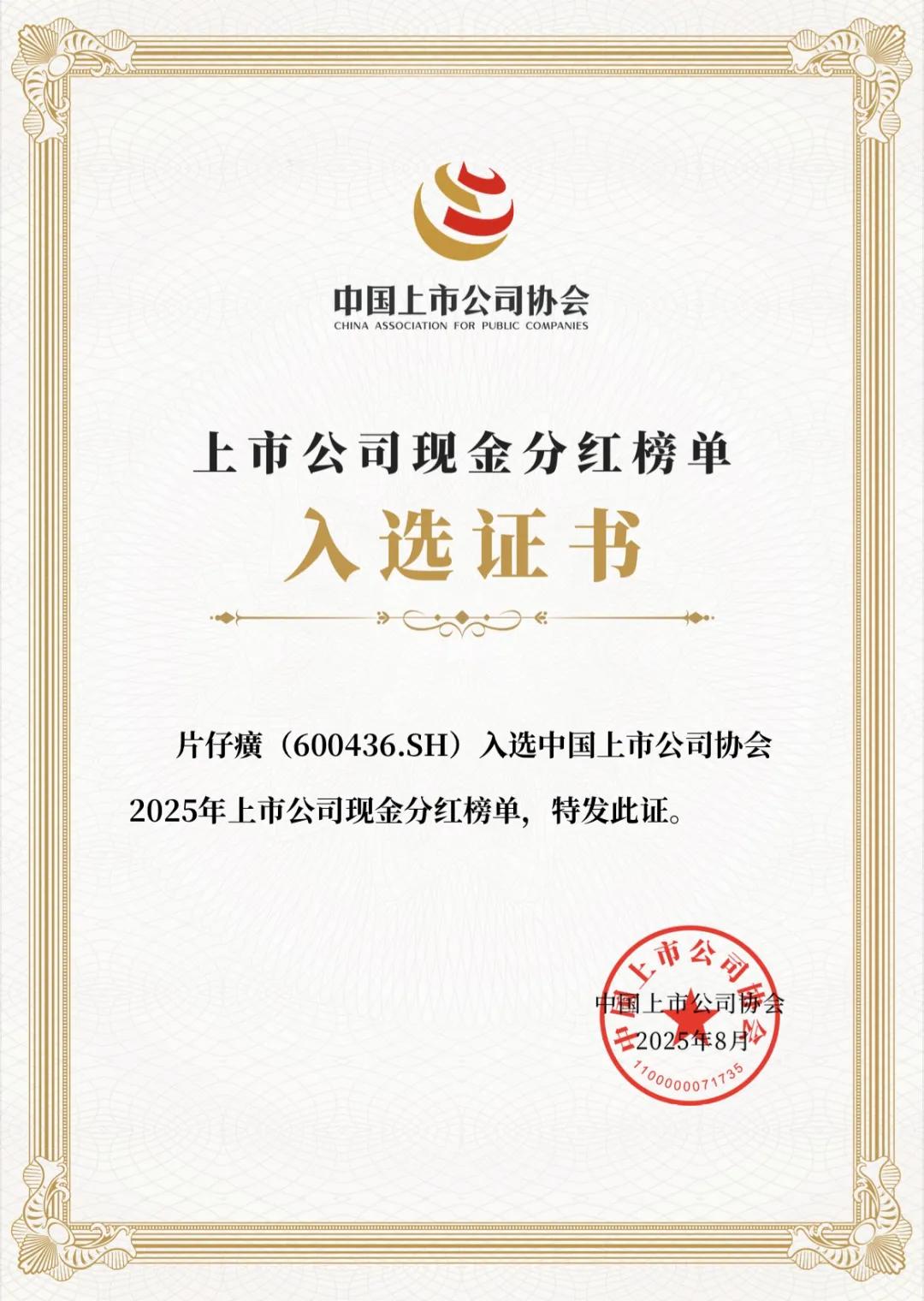
片仔癀入选 2025年上市公司现金分红榜单
Zheng Quan Shi Bao Wang· 2025-08-25 03:35
Core Points - The China Listed Companies Association has officially released the 2025 cash dividend ranking, with Zhangzhou Pien Tze Huang Pharmaceutical Co., Ltd. making the list due to its long-standing commitment to sharing development results with investors [1][4] - Pien Tze Huang has maintained a consistent cash dividend policy since its A-share market debut in 2003, with a total dividend payout exceeding 7.7 billion yuan over 22 years [4] - For 2024, the company plans to distribute a total cash dividend of 1.792 billion yuan, representing 60.19% of the annual net profit attributable to shareholders, reflecting a strong financial foundation and operational stability [4] Company Performance - In 2024, despite a complex market environment, Pien Tze Huang achieved steady growth, with increasing revenue and an expanded market share for its core Pien Tze Huang product series [4] - The company has been optimizing its industrial layout by increasing investments in traditional Chinese medicine research and smart manufacturing, significantly enhancing its overall competitiveness [4] Future Outlook - Pien Tze Huang aims to continue its long-term win-win philosophy with investors, adhering to regulatory requirements for cash dividends and enhancing the stability, sustainability, and predictability of its dividend planning [4]


中药板块狂掀涨停潮!千亿级政策红利引爆产业升级 这些领域将强势领跑
Sou Hu Cai Jing· 2025-08-25 02:39
Core Viewpoint - The traditional Chinese medicine (TCM) sector is experiencing a significant surge in stock performance, driven by strong policy support and increasing market demand for TCM products [1][2]. Group 1: Market Performance - The TCM sector has shown rapid growth, with companies like Xintian Pharmaceutical leading the charge by hitting the daily limit on stock price increases, accompanied by a notable increase in trading volume [1]. - Other companies in the sector, such as Yibai Pharmaceutical, Zhendong Pharmaceutical, and others, are also witnessing substantial gains, indicating a broad-based rally within the TCM industry [1]. Group 2: Policy Support - The Chinese government is enhancing support for the TCM industry, as evidenced by the State Council's issuance of guidelines aimed at improving TCM quality and promoting high-quality development within the sector [1][2]. - The guidelines emphasize the protection and utilization of TCM resources, as well as optimizing the industrial structure and strengthening the TCM supply chain [1]. Group 3: Market Demand - There is a growing demand for TCM driven by increasing health awareness among the population and the aging demographic, which is expected to continue fueling the sector's growth [1][2]. - The expansion of the TCM market is anticipated to create new opportunities in related fields, such as TCM raw material cultivation, which will benefit farmers and agricultural service providers [1]. Group 4: Related Sectors - The TCM research and development sector is poised to benefit from government encouragement for innovation, leading to increased investment in new TCM drugs and classic formulations [2]. - The healthcare sector is closely linked to TCM, with the development of TCM products expected to drive innovation and upgrades in healthcare offerings, including TCM therapies and wellness services [2]. Group 5: Challenges and Future Potential - Despite the positive outlook, the TCM industry faces challenges such as the need for unified quality standards and sustainable resource utilization [2]. - However, the combination of policy support, growing market demand, and the industry's own development trends suggests that the TCM sector and its related fields have significant growth potential in the future [2].


开评:三大指数集体高开 AI芯片概念开盘活跃
Zheng Quan Shi Bao Wang· 2025-08-25 02:10
Core Viewpoint - On August 25, the three major indices opened collectively higher, indicating a positive market sentiment at the start of the trading day [1] Market Performance - The Shanghai Composite Index opened up by 0.59% - The Shenzhen Component Index opened up by 1.03% - The ChiNext Index opened up by 1.41% [1] Sector Performance - Active sectors at the opening included small metals, semiconductors, securities, education, and AI chip concepts - Declining sectors included banks, traditional Chinese medicine, food and beverage, and CRO concepts [1]
医药生物行业周报(8月第4周):MRD有望成为新的免疫伴随诊断-20250825
Century Securities· 2025-08-25 00:01
Investment Rating - The report provides an investment rating of "G" for the pharmaceutical and biotechnology industry [1]. Core Viewpoints - The report highlights that MRD (Minimal Residual Disease) is expected to become a new paradigm in immune companion diagnostics, with significant advancements in tumor treatment and the development of new tumor markers [2][3]. - The pharmaceutical and biotechnology sector saw a weekly increase of 1.05%, underperforming compared to the Wind All A index (3.87%) and the CSI 300 index (4.18%) [3][8]. - Key sectors within the industry that performed well include medical devices (4.49%), vaccines (4.41%), and traditional Chinese medicine (2.86%), while medical research outsourcing (-3%), raw materials (-1.44%), and medical consumables (-0.01%) lagged [3][9]. Summary by Sections Market Weekly Review - The pharmaceutical and biotechnology sector increased by 1.05% from August 18 to August 22, 2025, underperforming against the Wind All A index and CSI 300 index [3][8]. - Notable stock performances included Xiangxue Pharmaceutical (40.4%), Olin Bio (38.3%), and Tuo Jing Life (29.5%) with significant declines seen in Linuo Pharmaceutical (-22.1%), Nanmo Bio (-17.9%), and Fuyuan Pharmaceutical (-17.9%) [3][11]. Industry News and Key Company Announcements - On August 22, Daiichi Sankyo's targeted TROP2 ADC Datopotamab deruxtecan was approved for treating HR-positive, HER2-negative breast cancer [12]. - Natera announced positive results from its IMvigor011 trial for muscle-invasive bladder cancer, leading to a submission for FDA approval of Signatera as a companion diagnostic [13]. - The report emphasizes the importance of MRD in tumor treatment, with advancements in both US and China regarding MRD products [3][12].
片仔癀十年首度出现中报净利下滑
Bei Jing Shang Bao· 2025-08-24 16:34
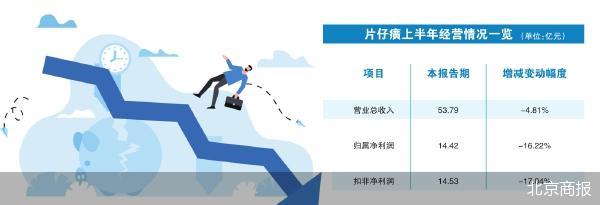
Core Viewpoint - The traditional Chinese medicine giant Pianzaihuang (600436) is experiencing its first decline in net profit in nearly 11 years, with a significant drop in both revenue and net profit in the first half of 2025 compared to the previous year [1][3]. Financial Performance - In the first half of 2025, Pianzaihuang reported revenue of 5.379 billion yuan, a year-on-year decrease of 4.81%, and a net profit attributable to shareholders of 1.442 billion yuan, down 16.22% [1]. - The last time the company saw a decline in net profit was in 2014, with consistent growth in revenue and profit from 2015 to 2024 [1]. Cost Pressures - Despite stable revenue, the company faces significant cost pressures due to historically high prices of key raw materials, which have squeezed profit margins [3]. - The price of natural cow bile, a critical raw material, rose from 650,000 yuan per kilogram in January 2023 to 1.65 million yuan per kilogram, before slightly decreasing to 1.5 million yuan per kilogram [3]. Price Adjustments - In response to rising costs, Pianzaihuang announced a price increase for its main product, Pianzaihuang tablets, from 590 yuan to 760 yuan per piece, effective from May 2023 [3]. - The price adjustment had some positive impact on revenue but did not lead to significant profit growth [4]. Diversification Efforts - Pianzaihuang is actively seeking a "second growth curve" through diversification into cardiovascular drugs, cosmetics, and daily chemical products, but these new ventures have not yet contributed significantly to profits [5]. - The company's diversification strategy, initiated in 2014, includes a focus on pharmaceutical manufacturing as the core, with health products and cosmetics as supplementary areas [5]. Performance of New Ventures - Revenue from the cosmetics and daily chemical segments has been declining, with 2021 revenues of 840 million yuan down 7.05% year-on-year, and further declines in subsequent years [6]. - The company is facing challenges from both healthcare policy adjustments and a contracting consumer market, prompting a focus on core business operations [6]. Investment Strategies - Pianzaihuang has made several investments in industry funds within the past year, aiming to discover and cultivate new business growth points [6]. - The company’s investment management subsidiary plans to invest in health-related industries to reduce reliance on traditional products [6].
调研速递|东阿阿胶接受中金公司等19家机构调研 业绩增长与业务布局成焦点
Xin Lang Cai Jing· 2025-08-24 14:54
Core Viewpoint - Dong'e Ejiao held a performance briefing on August 22, attracting 19 institutional analysts and investors, where the company outlined its operational development and future plans, emphasizing steady growth under the "1238" development strategy [1] Group 1: Financial Performance - For the first half of 2025, Dong'e Ejiao reported revenue of 3.051 billion yuan, a year-on-year increase of 11.02% [1] - The net profit attributable to shareholders was 818 million yuan, reflecting a year-on-year growth of 10.74% [1] - The net cash flow from operating activities reached 965 million yuan, up 4.70% year-on-year [1] - Basic earnings per share were 1.27 yuan, marking a 10.52% increase compared to the previous year [1] Group 2: Business Strategy and Development - The company has established a layout across primary, secondary, and tertiary industries, focusing on innovation in the supply chain for donkey hide, health supplements, and cultural tourism activities [1] - Future plans include upgrading the procurement system in the primary sector, enhancing brand and R&D in the secondary sector, and optimizing health and wellness experiences in the tertiary sector [1] Group 3: Product and Market Strategy - The company positions the compound Ejiao paste as a strategic core product and is launching new products to enhance its health supplement offerings [2] - Digital marketing efforts are focused on online channels, with a goal to strengthen the deer product category through product development and industry integration [2] - The company is adopting a cautious yet open attitude towards share buybacks while prioritizing high cash dividends in the short term [2] - The overseas strategy focuses on Hong Kong and Southeast Asia, enhancing raw material imports and product introductions [2]


九州通九信中药品牌重塑战略正式启动
Cai Jing Wang· 2025-08-24 14:26
Core Viewpoint - The launch of the brand revitalization project for Jiuzhitong's Jiuxin Traditional Chinese Medicine (TCM) marks a significant step in enhancing the company's presence in the health sector, focusing on modernizing the brand while emphasizing the importance of authentic medicinal materials [1][2]. Group 1: Brand Revitalization Strategy - Jiuxin TCM aims to integrate the entire TCM industry chain, from cultivation to processing and sales, to create a comprehensive ecosystem [1]. - The brand revitalization will be approached from four dimensions: brand strategy, product strategy, visual identity, and communication promotion [2]. - The company plans to focus on cultivating star products and expanding into health-related consumer goods, addressing the need for brand strategy upgrades to enhance scale, operations, and brand strength [1][2]. Group 2: Strategic Partnerships - Shanghai Sandy Brand Consulting, with 15 years of experience in the health sector, will serve as a strategic partner for the brand revitalization, having previously worked with notable companies like Yunnan Baiyao and Tongrentang [3]. - The consulting firm aims to leverage its expertise to help Jiuxin TCM clarify its strategic direction, build a core product cluster, and establish a modern visual system to enhance brand competitiveness [3]. - The goal is to position Jiuxin TCM as the "first brand of authentic Chinese medicine" through a scientifically backed and forward-looking brand revitalization strategy [3].

东阿阿胶:将重点推进东南亚出口业务
Zheng Quan Shi Bao Wang· 2025-08-24 13:59
Group 1 - The company, Dong-E E-Jiao, is focusing on expanding its export business in Southeast Asia [1] - The company aims to overcome key challenges related to quality and certification to enhance its product distribution channels [1] - There is a strategic emphasis on promoting products with pharmaceutical qualifications while simultaneously accelerating cultural outreach efforts [1]
中药行业周报:关注中报业绩超预期标的-20250824
Xiangcai Securities· 2025-08-24 13:49
Investment Rating - The industry maintains an "Overweight" rating, suggesting a positive outlook for investment opportunities in the sector [6]. Core Insights - The Chinese herbal medicine sector has shown strong performance, with the sub-sector index rising by 2.86%, outperforming other pharmaceutical sub-sectors [2]. - The price governance policies are expected to create a more pronounced differentiation within the industry, favoring companies with competitive advantages [6]. - The upcoming disclosure period for mid-year reports from herbal medicine companies is anticipated to provide insights into their performance, with 43 companies set to report [5]. Market Performance - The Chinese herbal medicine index closed at 6973.18 points, reflecting a 2.86% increase over the past week, while the overall pharmaceutical index rose by 1.05% [2][12]. - The performance of individual companies varied, with ST Xiangxue and Renhe Pharmaceutical leading, while Weikang Pharmaceutical and Xinguang Pharmaceutical lagged [2][17][19]. Valuation Metrics - The price-to-earnings (PE) ratio for the herbal medicine sector is currently at 30.11X, up by 0.85X week-on-week, indicating a relatively high valuation compared to historical levels [3]. - The price-to-book (PB) ratio stands at 2.5X, also reflecting an increase, suggesting that the sector is trading at a premium compared to its historical averages [3]. Supply Chain Insights - The herbal medicine raw material market is experiencing significant inventory pressure, with a slight decline in prices due to weak demand [4]. - The price index for herbal materials has decreased by 0.8% week-on-week, indicating a potential ongoing downward trend in pricing [4]. Investment Recommendations - The report suggests focusing on three main investment themes: price governance, consumption recovery, and state-owned enterprise reform [6][9]. - Specific investment targets include companies with strong R&D capabilities, those less affected by price collection policies, and leading brand herbal medicine firms [10].