
数字经济产业

Search documents
国家统计局新闻发言人就2025年11月份国民经济运行情况答记者问
Guo Jia Tong Ji Ju· 2025-12-15 08:42
Economic Performance Overview - In November, China's economy showed a steady growth trend with industrial production increasing by 4.8% year-on-year, maintaining the same growth rate as the previous month [5][40] - The manufacturing sector, particularly the equipment manufacturing industry, experienced significant growth, with an increase of 7.7% in added value, contributing 59.4% to the overall industrial growth [5][41] - The service sector also demonstrated stability, with a production index growth of 4.2%, particularly in information technology and business services, which grew by 12.9% and 8.4% respectively [5][41] Market Sales and Consumption - Retail sales of consumer goods rose by 1.3% year-on-year in November, with notable growth in upgraded products such as cosmetics and jewelry, which increased by 6.1% and 8.5% respectively [6][21] - Service retail sales showed a robust growth of 5.4% from January to November, indicating a shift towards service consumption [6][20] - The overall consumption market remains stable, with a continuous expansion in service consumption and a trend towards quality upgrades in consumer goods [20][22] Foreign Trade - China's foreign trade maintained stability with a total import and export growth of 4.1% year-on-year in November, marking a 4 percentage point increase from the previous month [6][9] - Exports specifically grew by 5.7%, reversing the previous month's decline, supported by diversified trade partnerships, particularly with Belt and Road Initiative countries, which saw a 6% increase in trade volume [6][9] Employment and Prices - The urban unemployment rate remained stable at 5.1%, with specific demographics such as agricultural workers and those aged 30-59 showing lower unemployment rates [7][9] - Consumer prices rose by 0.7% year-on-year in November, with core CPI (excluding food and energy) remaining stable at 1.2%, indicating a gradual recovery in price levels [8][16] Investment Trends - Investment in fixed assets (excluding rural households) saw a decline of 2.6% year-on-year, but project investments excluding real estate increased by 0.8% [29][30] - Significant growth was observed in emerging sectors, with equipment manufacturing investment rising by 8.9% and renewable energy investments increasing by 7.4% [29][30] New Quality Productivity - The growth of new quality productivity is evident, with high-tech manufacturing value added increasing by 9.2% year-on-year, and significant growth in sectors like integrated circuits and electronic materials [24][25] - Traditional industries are undergoing transformation, with notable increases in investment and production in sectors such as biomass fuel processing and chemical fiber manufacturing [25][26] Future Outlook - The economic outlook remains positive, with expectations for continued growth driven by domestic demand expansion and policy support [35][38] - The focus on innovation and high-quality development is expected to bolster economic resilience and adaptability in the face of external challenges [35][38]

经济大省展现强劲发展动能
Ren Min Wang· 2025-12-10 00:45
Group 1 - The core viewpoint of the article highlights the strong development momentum of major economic provinces in China, which are playing a crucial role in stabilizing the national economy while also driving growth as the 14th Five-Year Plan progresses [1][2]. - Major economic provinces, including Guangdong, Jiangsu, Shandong, and others, contribute significantly to the national GDP, accounting for over 60% of the total, and have shown impressive growth rates in the first three quarters of the year [2][3]. - Specific achievements include Jiangsu's GDP surpassing 10 trillion yuan for the first time and Shanghai and Hunan exceeding 4 trillion yuan, indicating a higher entry threshold for the top ten economic provinces [2]. Group 2 - Five out of the ten major economic provinces have set ambitious goals for themselves, focusing on high-quality development and technological innovation, with Guangdong aiming for economic doubling by 2035 [3][4]. - The provinces are prioritizing emerging industries such as digital economy and artificial intelligence, with Guangdong outlining specific targets for AI and digital transformation by 2027 [4][5]. - The article emphasizes the importance of collaboration between major economic provinces and central and western regions to promote technological transfer and industrial cooperation [5]. Group 3 - Major economic provinces are actively working to boost domestic demand and stabilize investment through various initiatives, including financial incentives and major infrastructure projects [6][7]. - For instance, Guangdong has allocated 3.5 billion yuan for new fiscal policies, while Jiangsu plans to distribute over 400 million yuan in consumer vouchers [7]. - Significant infrastructure projects are underway, such as the completion of key railway and water resource projects, which are expected to enhance regional connectivity and benefit millions [7]. Group 4 - In terms of reform and high-level openness, major economic provinces are implementing measures to improve the business environment and integrate into the national market [8]. - For example, Sichuan has introduced 25 measures to address challenges in the business environment, while Henan has developed a plan to support the national market integration [8]. - The article suggests that further breakthroughs in regional collaboration and innovative practices are necessary to inject stronger momentum into local economic development [8].
国办印发,事关加快场景培育和开放推动新场景大规模应用
Zhong Guo Zheng Quan Bao· 2025-11-07 10:00
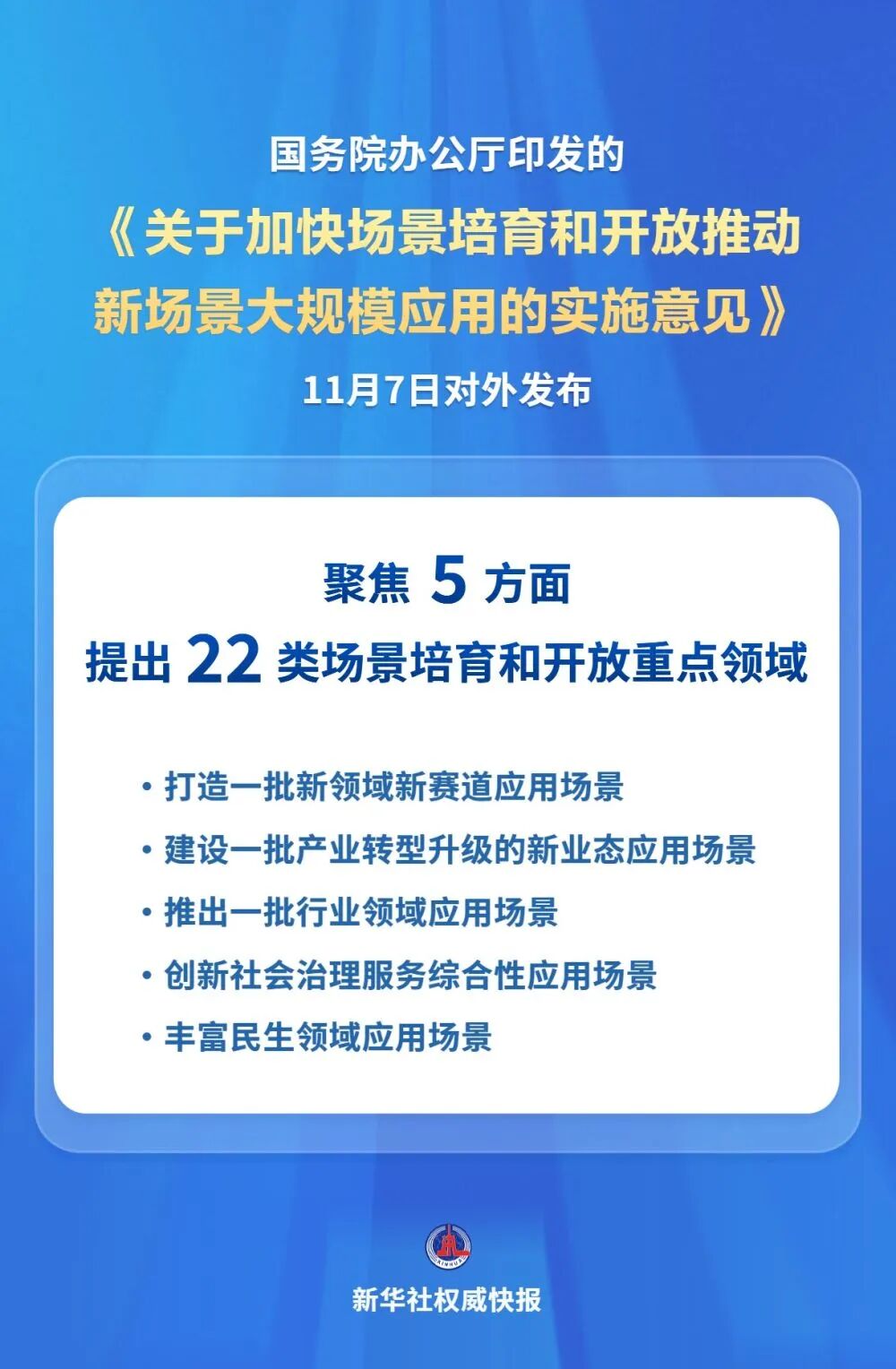
Core Viewpoint - The State Council's implementation opinion focuses on accelerating the cultivation and large-scale application of new scenarios, emphasizing the importance of scenarios as a bridge connecting technology and industry, and promoting the integration of technological and industrial innovation [5][6]. Group 1: Overall Requirements - The implementation opinion is guided by Xi Jinping's thoughts and aims to fully leverage China's large-scale market and rich application scenarios to support the construction of various significant application scenarios [8]. - It emphasizes the need for a systematic approach to promote the large-scale application of new scenarios, forming a path from technological breakthroughs to industrial applications [5][8]. Group 2: Key Areas of Focus - The opinion outlines five key areas for scenario development: new field applications, new business model applications for industrial transformation, industry-specific applications, innovative social governance applications, and enriched livelihood applications [6][8]. - It proposes 22 categories of key areas for scenario cultivation and opening, highlighting the need for collaborative efforts across various sectors [6][8]. Group 3: Specific Application Scenarios - In the digital economy, the focus is on exploring applications of technologies like the metaverse and virtual reality to enhance the integration of the digital and real economies [8][9]. - The artificial intelligence sector aims to accelerate the cultivation and opening of high-value application scenarios to meet diverse development needs [8][9]. - The clean energy sector is encouraged to develop applications in transportation and energy management, promoting a low-carbon transition [9][10]. Group 4: Social Governance and Livelihood Applications - The opinion emphasizes the need for innovative applications in emergency management, mining safety, and smart water management to enhance operational efficiency and safety [13][14]. - In the healthcare sector, the integration of new technologies like big data and IoT is encouraged to improve medical services and patient care [16][17]. Group 5: Implementation and Coordination - Local governments and relevant departments are urged to strengthen collaboration and increase efforts in scenario cultivation and opening, ensuring effective implementation of the opinion [21]. - The National Development and Reform Commission is tasked with guiding and coordinating the efforts, proposing clear and executable requirements for scenario development [21].
四川正形成以创新驱动为导向的金融支持格局 金融精准“灌溉”实体经济
Si Chuan Ri Bao· 2025-10-30 00:26
Core Insights - The financial environment in Sichuan has shown significant improvement, with both loans and deposits increasing, indicating a robust economic recovery [1][2][3] Group 1: Loan and Deposit Growth - As of the end of September, the total loan balance in Sichuan reached 12.8 trillion yuan, a year-on-year increase of 11%, ranking among the top in the country [1][2] - The total deposit balance was 14.55 trillion yuan, reflecting a 10% year-on-year growth, with non-financial enterprise demand deposits increasing by 16%, which is 27.3 percentage points higher than the same period last year [1][2] Group 2: Interest Rate Trends - The weighted average interest rates for newly issued corporate loans, inclusive microloans, and personal housing loans dropped to 3.79%, 3.77%, and 3.14% respectively, with year-on-year declines of 47, 49, and 19 basis points [1][5] - The stock loan interest rate fell to 3.87%, marking a historical low, which alleviates the financial burden on both enterprises and residents [5] Group 3: Structural Optimization - The financial structure in Sichuan is being optimized, with more credit directed towards key sectors such as manufacturing, technological innovation, and infrastructure [3][4] - As of August, loans for technology increased by 13.4%, while loans for the elderly care industry surged by 36.9%, and loans for the digital economy rose by 17.1% [3] Group 4: Long-term Loan Trends - Long-term loans increased by 864.3 billion yuan, accounting for over 80% of the total loan increment, indicating a focus on major project construction and manufacturing upgrades [4] - The balance of long-term loans for infrastructure and manufacturing grew by 7.8% and 12.7% year-on-year, respectively [4] Group 5: Future Financial Strategy - The People's Bank of China Sichuan Branch plans to continue guiding financial institutions to focus on serving the real economy, aligning financial resources with economic structural adjustments [6]
智慧养老新设机构成最大增长点
Sou Hu Cai Jing· 2025-10-27 21:10
Group 1 - The number of newly established institutions in the city reached 278,100 in the first three quarters of this year, representing a year-on-year increase of 21%, indicating a strong growth momentum [1][2] - The smart elderly care service sector saw the establishment of 11,300 new institutions, a significant year-on-year growth of 70.87%, making it the largest growth point in the industry [1][2] - The central urban area accounted for 115,200 new institutions, with a year-on-year increase of 42.42%, representing 41.43% of the total new establishments in the city [1][2] Group 2 - The elderly care industry expanded with 138,600 new institutions established, a year-on-year increase of 30.54%, surpassing the city's average growth rate by 9.54 percentage points [2] - The number of new institutions in the digital economy sector reached 18,100, reflecting a year-on-year growth of 46.97% [2] - The cultural and related industries continued to recover, with 33,600 new institutions established, marking a year-on-year increase of 17.57% [2]
划重点:二十届四中全会公报对A股投资的启示
Yin He Zheng Quan· 2025-10-23 12:11
Core Insights - The report emphasizes the importance of high-quality economic development during the "15th Five-Year Plan" period, highlighting the need for significant improvements in technological self-reliance and national security [2][6] - The "15th Five-Year Plan" suggests favorable conditions for various themes and industries, including the construction of a modern industrial system, development of new quality productivity, and expansion of domestic demand [2][7] Summary by Sections 1. Main Content of the 20th Central Committee's Fourth Plenary Session - The session reviewed and approved the "Suggestions on Formulating the 15th Five-Year Plan for National Economic and Social Development" [4] 2. Deep Impact on the A-Share Market - Short-term, the session provides new policy expectations and investment clues for the A-share market, potentially boosting market confidence and attracting incremental capital [10] - Long-term, the strategic direction outlined in the session reinforces confidence in the long-term resilience of the Chinese economy, particularly in key areas like modern industrial system construction [10] 3. Theme Investment Opportunities - New Quality Productivity: The focus on enhancing technological self-reliance is a key investment theme, with technology companies that align with national strategies expected to be significant investment targets [11] - Consumption Sector: The emphasis on expanding domestic demand and promoting consumption indicates that consumer sectors, especially new consumption trends, will be critical areas for investment [12][13] - "Two Heavy" Projects: The report highlights the importance of major strategic projects and infrastructure development, which will benefit related sectors such as construction and machinery [13][14] - Anti-Overcompetition: The report discusses the need to address disordered competition, which will enhance the long-term investment value of related sectors [14] - Real Estate Chain: The focus on promoting high-quality development in real estate suggests potential trading opportunities within the real estate sector [15]
北京西城将构建“政产学研用”协同创新生态
Bei Jing Shang Bao· 2025-10-13 15:33
Group 1 - The core viewpoint of the news is that Xicheng District in Beijing is launching 12 support measures for integrated development in education, technology, and talent, along with 10 initiatives to support youth innovation and entrepreneurship, with an annual investment of 100 million yuan in talent funding [1][5] - Xicheng District has achieved a GDP of 603.8 billion yuan in 2024, with an economic density of 119 billion yuan per square kilometer and a per capita GDP exceeding 550,000 yuan, ranking first in the city and among the top in the country [2] - The financial sector in Xicheng is highlighted, with the Financial Street area managing assets totaling 156 trillion yuan, accounting for one-third of the national total, and the digital economy surpassing 240 billion yuan [2] Group 2 - Xicheng District has a total talent pool of 1.054 million, representing 82.1% of the workforce, with 83.7% of the main labor force holding higher education degrees, significantly above the city average [4] - The "Xirong Plan" is a key initiative that allocates 100 million yuan annually to reward outstanding talents, with awards of 1 million, 500,000, and 300,000 yuan, and provides comprehensive services through the Xirong Talent Service Card [5][6] - The district has established a multi-layered talent platform, including the GNIS Sino-European Innovation Center and the Sino-European Youth Talent Home, to connect overseas talents and resources [6]
全岛封关后,还会采取哪些举措 支持海南自贸港进一步扩大对外开放?
Sou Hu Cai Jing· 2025-08-12 01:52
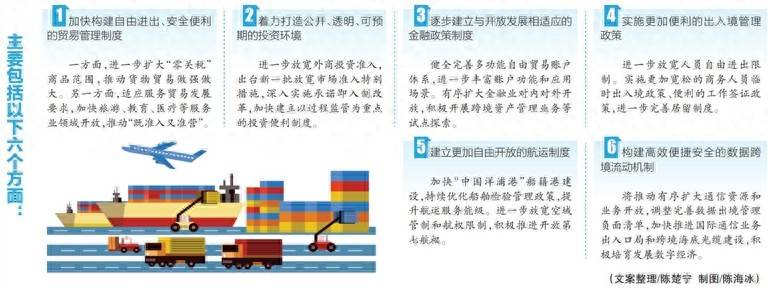
Group 1 - The core viewpoint is that the full island closure marks a new starting point for the construction of Hainan Free Trade Port, with plans to further expand its openness to the outside world [2] - Hainan will enhance its policy system in line with high-level free trade port standards, focusing on both goal-oriented and problem-oriented approaches to accelerate external opening [2] Group 2 - The first initiative is to accelerate the establishment of a trade management system that allows free entry and exit, expanding the range of "zero tariff" goods and promoting the growth of goods trade [2] - The second initiative focuses on creating a transparent and predictable investment environment by relaxing foreign investment access and implementing new market entry measures [2] - The third initiative aims to gradually establish financial policies that align with open development, enhancing the multi-functional free trade account system and expanding financial sector openness [2] Group 3 - The fourth initiative involves implementing more convenient entry and exit management policies, including relaxed restrictions on personnel movement and improved work visa policies [3] - The fifth initiative is to establish a more open shipping system, enhancing the construction of "China Yangpu Port" and optimizing ship inspection management policies [4] - The sixth initiative focuses on building an efficient and secure mechanism for cross-border data flow, promoting the expansion of communication resources and adjusting data exit management [5]
AI驱动算力需求持续增长,数字经济ETF(560800)上涨1.01%
Xin Lang Cai Jing· 2025-08-11 07:35
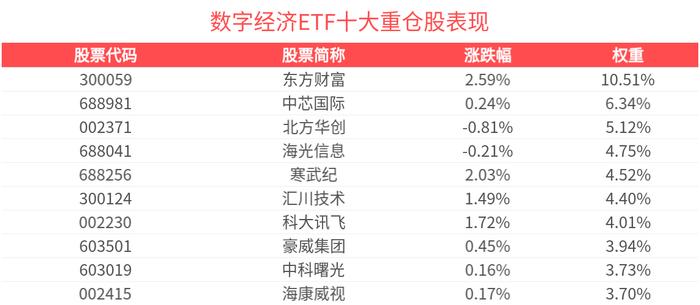
Core Viewpoint - The digital economy sector is experiencing strong growth, with significant increases in stock performance and sales revenue in high-tech industries, indicating a robust investment opportunity in this area [1][2]. Group 1: Market Performance - As of August 11, 2025, the CSI Digital Economy Theme Index (931582) rose by 1.17%, with notable increases in constituent stocks such as Tonghuashun (300033) up 7.30% and Wealth Trend (688318) up 4.98% [1]. - The Digital Economy ETF (560800) increased by 1.01%, with a trading volume of 12.2785 million yuan and a turnover rate of 1.67% [1]. - Over the past year, the average daily trading volume of the Digital Economy ETF reached 24.0452 million yuan, ranking it first among comparable funds [1]. Group 2: Industry Insights - The National Development and Reform Commission reported that high-tech industry sales revenue grew by 14.3% in the first half of the year, with the share of high-tech manufacturing in total manufacturing rising from 15.3% in 2020 to 16.9% in the first half of this year [1]. - First Shanghai Securities expresses optimism about the sustained high growth in computing power demand driven by AI applications, indicating a pivotal moment for AI application proliferation both domestically and internationally [2]. - The domestic computing power industry is expected to continue its tight balance, with advancements in key areas such as advanced process capacity and HBM supply anticipated to catalyze market growth [2]. Group 3: Index Composition - As of July 31, 2025, the top ten weighted stocks in the CSI Digital Economy Theme Index (931582) accounted for 50.74% of the index, including companies like Dongfang Wealth (300059) and SMIC (688981) [2]. - The top ten stocks by weight include Dongfang Wealth (10.51%), SMIC (6.34%), and North Huachuang (5.12%), among others, reflecting a diverse representation of the digital economy sector [3].
扎根高原建藏兴藏
Jing Ji Ri Bao· 2025-07-28 21:57
Core Viewpoint - The private economy is essential for the high-quality development of Tibet's economy, playing a significant role in stabilizing economic growth, promoting innovation, increasing employment, and improving people's livelihoods [1][2] Group 1: Challenges and Policies - The development of Tibet's private economy faces challenges due to geographical environment, infrastructure, and talent shortages [1] - The central government has granted special preferential policies to Tibet, and the region has implemented various measures to support the private economy, including the "Tibet Autonomous Region Optimization of Business Environment Regulations" [1] - The core of these policies is to eliminate institutional barriers and create a favorable business environment for private enterprises [1] Group 2: Opportunities and Industry Goals - Private enterprises should leverage the unique opportunities and characteristics of Tibet to enhance their development levels, taking advantage of support from central ministries and state-owned enterprises [2] - Tibet has abundant resources, such as cultural tourism and clean environmental resources, which create favorable conditions for developing industries like cultural tourism and organic agriculture [2] - The region has established nine major industry goals, including the development of clean energy, cultural tourism, specialty agriculture, and digital economy [2] Group 3: Market Dynamics and Future Prospects - Over the past decade, the focus of private enterprises investing in Tibet has shifted from merely seeking policy subsidies to considering market potential and development prospects [2] - Many enterprises are now investing in the high-altitude oxygen supply industry, which is a new billion-level market segment [2] - Overall, Tibet's private economy is currently in a phase of policy opportunities, industrial transformation, and market expansion, with substantial support policies enhancing the confidence of private enterprises [2]