
有色金属冶炼及压延加工

Search documents
1月份我国制造业生产保持扩张
Xin Lang Cai Jing· 2026-01-31 20:32
Group 1 - The manufacturing Purchasing Managers' Index (PMI) for January is reported at 49.3%, indicating a slight contraction in the manufacturing sector [1] - The non-manufacturing business activity index stands at 49.4%, while the comprehensive PMI output index is at 49.8%, suggesting overall economic activity is below the expansion threshold [1] - The production index is at 50.6%, indicating that manufacturing production is still expanding [1] Group 2 - The price indices for major raw materials and factory output have risen, with the purchasing price index at 56.1% and the factory price index at 50.6%, marking a significant increase from the previous month [1] - The factory price index has risen above the critical point for the first time in nearly 20 months, indicating an overall improvement in market prices within the manufacturing sector [1] - High-tech manufacturing continues to lead with a PMI of 52.0%, remaining above 52.0% for two consecutive months, reflecting a positive development trend in related industries [2] Group 3 - Large enterprises maintain a PMI of 50.3%, indicating continued expansion, while small and medium-sized enterprises show a decline in their PMIs to 48.7% and 47.4%, respectively [2] - The production and business activity expectation index is at 52.6%, indicating optimistic expectations among enterprises [2] - Industries such as agricultural product processing and food and beverage sectors have maintained high expectation indices above 56.0%, reflecting strong confidence in recent industry developments [2]
2026 年 1 月 PMI 数据点评:PMI 淡季回落,价格回升
GUOTAI HAITONG SECURITIES· 2026-01-31 13:34
Group 1: Manufacturing PMI Insights - In January 2026, the manufacturing PMI was 49.3%, a decrease of 0.8 percentage points from the previous month[9] - The production index was 50.6%, down 1.1 percentage points, indicating cautious expansion due to demand decline[16] - New orders and new export orders indices were 49.2% and 47.8%, respectively, both declining by 1.6 and 1.2 percentage points[16] Group 2: Price and Inventory Trends - The main raw materials purchase price index rose to 56.1%, an increase of 3.0 percentage points, while the factory price index reached 50.6%, marking the first time in 20 months above the critical point[19] - Raw material inventory and finished goods inventory indices were 47.4% and 48.6%, respectively, indicating a decrease in raw material stock[21] Group 3: Non-Manufacturing Sector Performance - The service sector's business activity index was stable at 49.5%, with significant divergence among industries[22] - The construction sector's business activity index fell to 48.8%, down 4.0 percentage points, reflecting seasonal slowdowns[24] Group 4: Economic Outlook and Risks - The macroeconomic policy is expected to be more proactive, with a focus on boosting overall demand and ensuring spending increases[27] - A risk remains in the real estate sector, where demand needs to be stimulated[28]
1月制造业PMI回落至49.3%,超3成企业反映利润下降
第一财经· 2026-01-31 10:46
Core Viewpoint - The manufacturing PMI in January fell below the growth line, indicating a decline in economic activity and a need for stronger foundational support for economic recovery [3][5]. Manufacturing Sector - The manufacturing PMI for January is reported at 49.3%, a decrease of 0.8 percentage points from the previous month, indicating fluctuations in manufacturing operations [5]. - The new orders index dropped to 49.2%, down 1.6 percentage points, reflecting a tightening of market demand [5]. - Seasonal factors and changes in the export environment are contributing to the slowdown in market demand, with the new export orders index at 47.8%, a decline of 1.2 percentage points [5][7]. - The production index remains in the expansion zone at 50.6%, despite a decrease of 1.1 percentage points, suggesting continued overall expansion in manufacturing [7]. - The prices of major raw materials and factory output have increased, with the purchasing price index at 56.1% and the factory price index at 50.6%, indicating an improvement in overall price levels in the manufacturing market [7]. Non-Manufacturing Sector - The non-manufacturing business activity index is at 49.4%, down 0.8 percentage points, primarily due to a decline in the construction sector [10]. - The service sector remains relatively stable, with the business activity index slightly decreasing by 0.2 percentage points, maintaining around 49.5% [10][11]. - The service industry anticipates a boost from the upcoming Spring Festival, with a business activity expectation index of 57.1%, indicating optimism for consumer-related services [10][11]. Economic Outlook - The overall economic climate is expected to be influenced by changes in export growth, the domestic real estate market, and the timing and intensity of growth-stimulating policies [8]. - There is potential for monetary policy easing in the second quarter, with fiscal policies aimed at boosting consumption and investment expected to gain momentum [8].

1月份制造业采购经理指数有所回落
Xin Hua Cai Jing· 2026-01-31 06:59
Group 1: Manufacturing Sector - The manufacturing Purchasing Managers' Index (PMI) for January is 49.3%, indicating a decline from the previous month [1][2] - The production index remains above the critical point at 50.6%, showing continued expansion in manufacturing production [2] - New orders index is at 49.2%, reflecting a decrease in market demand [2] - Certain industries, such as agricultural processing and aerospace, show strong production and new orders indices above 56.0%, while sectors like automotive and fuel processing are below the critical point [2] - Price indices for raw materials and factory output have risen, with the raw material purchase price index at 56.1% and the factory price index at 50.6%, marking an improvement in overall market prices [2] Group 2: Large vs. Small Enterprises - Large enterprises have a PMI of 50.3%, indicating continued expansion, while medium and small enterprises have PMIs of 48.7% and 47.4%, respectively, showing a decline [3] - High-tech manufacturing leads with a PMI of 52.0%, indicating a positive development trend [3] - Consumer goods and high-energy industries show lower PMIs of 48.3% and 47.9%, respectively, indicating a downturn in these sectors [3] Group 3: Non-Manufacturing Sector - The non-manufacturing business activity index is at 49.4%, reflecting a decrease from the previous month [4] - The service sector's business activity index is at 49.5%, with financial services showing high activity levels above 65.0%, while the real estate sector is below 40.0% [4] - The construction sector's business activity index has dropped to 48.8%, indicating a significant decline in activity due to seasonal factors [4] Group 4: Composite PMI - The composite PMI output index is at 49.8%, indicating a slowdown in overall business activities compared to the previous month [5] - The manufacturing production index is at 50.6%, while the non-manufacturing business activity index is at 49.4%, contributing to the composite index's decline [5]
1月制造业PMI回落至49.3% 超3成企业反映利润下降
Di Yi Cai Jing· 2026-01-31 03:43
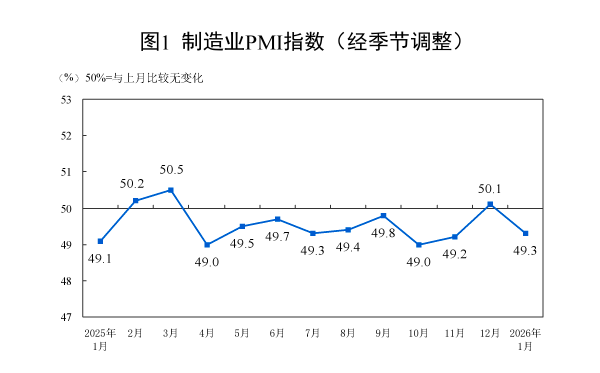
Group 1: Manufacturing Sector Overview - In January, the manufacturing PMI fell to 49.3%, a decrease of 0.8 percentage points from the previous month, indicating fluctuations in manufacturing operations [4][5] - The new orders index for January was 49.2%, down 1.6 percentage points, reflecting a tightening of market demand due to seasonal factors and changes in export environments [4][5] - The production index remained in the expansion zone at 50.6%, despite a decline of 1.1 percentage points, suggesting continued overall expansion in manufacturing production [5] Group 2: Price Levels and Economic Conditions - The purchasing price index for raw materials rose to 56.1%, and the factory price index increased to 50.6%, marking the first time in nearly 20 months that the factory price index exceeded the critical point [5] - The proportion of manufacturing enterprises reporting insufficient market demand decreased to 54.9%, down 9.4 percentage points, indicating a stabilization in market demand [5] - Analysts suggest that the overall economic climate is affected by seasonal fluctuations, high previous month bases, and ongoing adjustments in the real estate market [6] Group 3: Non-Manufacturing Sector Insights - The non-manufacturing business activity index for January was 49.4%, a decline of 0.8 percentage points, primarily due to a decrease in the construction sector [9] - The service sector showed relative stability, with the service business activity index slightly declining by 0.2 percentage points, remaining around 49.5% [10] - The business activity expectation index for the service sector rose to 57.1%, indicating an optimistic outlook, particularly for consumption-related services during the upcoming Spring Festival [10]
1月制造业PMI回落至49.3%,超3成企业反映利润下降
Di Yi Cai Jing· 2026-01-31 03:39
Core Viewpoint - The manufacturing sector in China is experiencing a decline in economic activity, as indicated by the drop in the Purchasing Managers' Index (PMI) below the growth threshold, reflecting insufficient market demand and the need for stronger economic recovery measures [1][4][6]. Manufacturing Sector - The manufacturing PMI for January is reported at 49.3%, a decrease of 0.8 percentage points from the previous month, indicating fluctuations in manufacturing operations [4]. - New orders index fell to 49.2%, down 1.6 percentage points, suggesting a tightening of market demand [4]. - The production index remains in the expansion zone at 50.6%, but has decreased by 1.1 percentage points, indicating a slowdown in manufacturing production growth [5]. - The prices of raw materials and finished products are rising, with the raw material purchase price index at 56.1% and the factory price index at 50.6%, marking the first time in nearly 20 months that the factory price index has risen above the critical point [5][6]. - Over 34% of manufacturing companies reported a decline in profits, highlighting concerns regarding profitability amid rising raw material costs [6]. Non-Manufacturing Sector - The non-manufacturing business activity index is at 49.4%, down 0.8 percentage points, with the construction sector experiencing a significant decline [9]. - The service sector remains relatively stable, with a slight decrease in the service business activity index to around 49.5% [10]. - The service industry shows optimistic expectations, with a business activity expectation index of 57.1%, indicating a positive outlook for the upcoming Spring Festival consumption [10].
统计局:1月官方制造业PMI为49.3% 比上月下降0.8个百分点
Guo Jia Tong Ji Ju· 2026-01-31 02:39
Group 1: Manufacturing PMI Overview - In January, the Manufacturing Purchasing Managers' Index (PMI) was 49.3%, a decrease of 0.8 percentage points from the previous month, indicating a decline in manufacturing activity [1][12] - Large enterprises had a PMI of 50.3%, down 0.5 percentage points, remaining above the critical point; small and medium-sized enterprises had PMIs of 48.7% and 47.4%, down 1.1 and 1.2 percentage points respectively, both below the critical point [1][15] - The production index was 50.6%, down 1.1 percentage points but still indicating expansion; the new orders index was 49.2%, down 1.6 percentage points, showing a slowdown in market demand [1][14] - The raw materials inventory index was 47.4%, down 0.4 percentage points, indicating a continued decrease in inventory levels; the employment index was 48.1%, down 0.1 percentage points, suggesting a slight decline in employment levels [1][14] Group 2: Non-Manufacturing PMI Overview - In January, the Non-Manufacturing Business Activity Index was 49.4%, a decrease of 0.8 percentage points from the previous month [2][12] - The construction industry Business Activity Index was 48.8%, down 4.0 percentage points, while the services industry Business Activity Index was 49.5%, down 0.2 percentage points [2][16] - The new orders index was 46.1%, down 1.2 percentage points, indicating a decline in market demand; the construction new orders index was 40.1%, down 7.3 percentage points [2][16] - The input prices index was 50.0%, indicating stability in input prices; the construction input prices index was 52.0%, up 1.2 percentage points, while the services input prices index was 49.7%, down 0.4 percentage points [2][3] Group 3: Price and Employment Trends - The sales price index was 48.8%, up 0.8 percentage points, indicating a narrowing decline in sales prices; the construction sales price index was 48.2%, up 0.8 percentage points, and the services sales price index was 48.9%, also up 0.8 percentage points [3] - The employment index for non-manufacturing was 46.1%, stable from the previous month, indicating stable employment conditions; the construction employment index was 41.1%, up 0.1 percentage points, while the services employment index was 47.0%, unchanged [3][16] - The business activity expectation index was 56.0%, down 0.5 percentage points but still indicating optimism among non-manufacturing enterprises; the construction expectation index was 49.8%, below the critical point, while the services expectation index was 57.1%, up 0.7 percentage points [3][16] Group 4: Comprehensive PMI Overview - The Comprehensive PMI Output Index was 49.8%, down 0.9 percentage points, indicating a slowdown in overall production and business activities compared to the previous month [4][12] - The manufacturing production index was 50.6%, while the non-manufacturing business activity index was 49.4%, contributing to the overall decline in the Comprehensive PMI [17]
国家统计局解读2026年1月中国采购经理指数
Guo Jia Tong Ji Ju· 2026-01-31 02:26
Group 1: Manufacturing Sector - The manufacturing Purchasing Managers' Index (PMI) decreased to 49.3% in January, indicating a decline in economic sentiment compared to the previous month [2][3] - The production index remains above the critical point at 50.6%, suggesting continued expansion in manufacturing production, while the new orders index fell to 49.2%, indicating a drop in market demand [3] - Large enterprises maintain a PMI of 50.3%, indicating ongoing expansion, while small and medium enterprises show lower PMIs of 48.7% and 47.4%, respectively, reflecting a decline in economic activity [4] - High-tech manufacturing continues to lead with a PMI of 52.0%, indicating a positive development trend, while consumer goods and high-energy industries show lower PMIs of 48.3% and 47.9% [4] Group 2: Non-Manufacturing Sector - The non-manufacturing business activity index fell to 49.4%, reflecting a decrease in overall economic sentiment in the non-manufacturing sector [7] - The service sector's business activity index is at 49.5%, with financial services and capital market services showing high activity levels above 65.0%, while the real estate sector's index dropped below 40.0% [7] - The construction sector's business activity index decreased to 48.8%, indicating a significant decline in activity due to adverse weather and upcoming holidays [7] Group 3: Overall Economic Indicators - The comprehensive PMI output index is at 49.8%, indicating a slowdown in overall production and business activities compared to the previous month [8] - The manufacturing production index and non-manufacturing business activity index are at 50.6% and 49.4%, respectively, contributing to the overall PMI output index [8]
国家统计局:1月PMI呈现分化特征 高技术制造业保持较高景气
智通财经网· 2026-01-31 01:59
Group 1: Manufacturing Sector - The manufacturing Purchasing Managers' Index (PMI) decreased to 49.3% in January, indicating a decline in economic sentiment compared to the previous month [2] - The production index remains above the critical point at 50.6%, suggesting continued expansion in manufacturing production, while the new orders index fell to 49.2%, indicating a drop in market demand [2] - Large enterprises maintain a PMI of 50.3%, indicating ongoing expansion, while small and medium-sized enterprises saw PMIs of 48.7% and 47.4%, respectively, reflecting a decline in economic activity [3] - High-tech manufacturing continues to lead with a PMI of 52.0%, indicating a positive development trend, while consumer goods and high-energy industries show lower PMIs of 48.3% and 47.9% [3] - The price indices for major raw materials and factory prices increased to 56.1% and 50.6%, respectively, indicating an overall improvement in manufacturing market prices [2] Group 2: Non-Manufacturing Sector - The non-manufacturing business activity index fell to 49.4% in January, reflecting a decrease in overall economic sentiment [4] - The service sector's business activity index decreased slightly to 49.5%, with financial services and capital market services showing high activity levels above 65.0%, while the real estate sector dropped below 40.0% [4] - The construction sector's business activity index fell significantly to 48.8%, influenced by adverse weather and the upcoming holiday, indicating a notable decline in construction activity [4] Group 3: Composite PMI - The composite PMI output index is at 49.8%, down 0.9 percentage points from the previous month, indicating a slowdown in overall business activities [5] - The manufacturing production index and non-manufacturing business activity index are reported at 50.6% and 49.4%, respectively, contributing to the composite PMI's decline [5]
周期论剑|地产链,逻辑再梳理
2026-01-26 02:50
Summary of Conference Call Industry Overview - The conference focused on the real estate chain logic and investment opportunities within the real estate sector, highlighting the recent strong performance of real estate-related stocks [1][2]. Key Points and Arguments Market Sentiment - The speaker emphasized a positive outlook for the market, predicting a potential rise to 4200 points before the Spring Festival, indicating a strong market sentiment despite regulatory interventions [2][3]. - The speaker noted that while 300 stocks appeared constrained, the majority of stocks performed well, suggesting a broader market strength [2][3]. Real Estate Sector Insights - The real estate sector has seen significant declines, with residential investment as a percentage of GDP dropping to 4.5%, and real estate investment growth decreasing by nearly 60% [6]. - Sales area has fallen by approximately 50% from peak levels, and housing prices have decreased by 30% to 40% [6]. - The speaker highlighted the critical role of stabilizing the real estate market for national economic stability and internal demand growth, especially in the face of external uncertainties [6][7]. Investment Opportunities - The speaker identified three key investment directions: 1. Quality real estate companies with a price-to-book (PB) ratio below one, indicating deep discounts [9]. 2. Companies in the real estate supply chain, particularly in construction materials, chemicals, and appliances, which have seen improved competitive dynamics due to market consolidation [10]. 3. Urban renewal projects that will drive demand for construction materials and related services [10]. Regulatory Environment - The speaker discussed the regulatory environment, suggesting that early interventions by regulators could lead to a more stable market and longer-term growth [4][5]. Additional Insights - The real estate and related sectors currently represent only 8.1% of the total A-share market capitalization, while consumer goods account for 9.4% despite contributing 43% to GDP [8]. - The speaker noted that the current low expectations and stock valuations create a favorable environment for potential recovery in the real estate sector [8]. Transportation Sector Insights - The transportation sector, particularly aviation and oil shipping, is expected to see increased demand during the upcoming Spring Festival, with passenger traffic projected to reach 9.5 billion, a 5% increase from the previous year [12][13]. - The oil shipping market has seen a significant rise in freight rates, with expectations for continued profitability in Q1 2026 [14]. Chemical Sector Insights - The chemical sector is closely tied to the real estate chain, with optimism regarding demand recovery for products like MDI, PVC, and soda ash due to improving internal demand [17][18]. - Key companies in the chemical sector, such as Wanhua Chemical and Boryung Chemical, are highlighted for their competitive advantages and growth potential [19][21]. Metal Sector Insights - The metal sector remains bullish, with expectations for continued price increases driven by supply disruptions and strong demand from sectors like AI and renewable energy [26][29]. - Industrial metals, particularly copper and aluminum, are seen as strategic resources with strong long-term demand prospects [29][30]. Energy Sector Insights - Oil prices are expected to remain stable around $60-$65 per barrel, with limited downside risk due to production cost considerations [34][35]. - The speaker noted that geopolitical factors could temporarily influence prices, but the overall supply-demand balance suggests a bearish outlook for the next 1-2 years [35][36]. Coal Sector Insights - The coal market is experiencing fluctuations due to seasonal demand, with expectations for price pressures in the spring as new projects commence [42][43]. - The speaker indicated that without significant fiscal stimulus, coal prices may face downward pressure in the upcoming quarters [42][43].