
未来产业

Search documents
坚持政策支持和改革创新并举
Qi Huo Ri Bao Wang· 2026-01-21 03:06
Core Viewpoint - The National Development and Reform Commission (NDRC) emphasizes the importance of macroeconomic policies aimed at strengthening domestic circulation and expanding domestic demand, while also focusing on the development of the real economy and the construction of a unified national market [1][2][5]. Group 1: Macroeconomic Policies - The NDRC plans to formulate a strategic implementation plan for expanding domestic demand from 2026 to 2030, aligning with the trends of demand upgrades and technological revolutions [1]. - The focus will be on enhancing the quality of key industries and fostering emerging and future industries, particularly through initiatives like "Artificial Intelligence+" [1]. - The NDRC aims to implement a more proactive fiscal policy and moderately loose monetary policy, with a key goal of promoting reasonable price recovery [2]. Group 2: Market Regulation and Competition - The NDRC intends to address "involution" competition by shifting from price competition to value competition, improving market access, and enhancing fair competition mechanisms [2]. - There will be a focus on regulating key industry prices and ensuring a healthy market order through the implementation of quality brand strategies [2]. - The NDRC plans to establish a national unified market construction regulation to standardize behaviors of local governments and enterprises [3]. Group 3: Energy Transition and Carbon Neutrality - The NDRC emphasizes the acceleration of energy transition by increasing the development of non-fossil energy and enhancing the capacity of the power grid [4]. - There will be a strong push for industrial upgrades towards green and low-carbon industries, including the promotion of zero-carbon parks and factories [4]. - The NDRC will implement comprehensive resource management and promote a circular economy to support carbon peak and neutrality goals [4]. Group 4: Economic Outlook - The NDRC forecasts a continuous improvement in economic structure and development momentum, with significant potential in consumption, investment, technology, and regional development [5]. - The focus will be on combining policy support with reform and innovation to transform development potential into new economic growth [5].
未来5年大方向定了!发改委:扩大内需战略实施方案将出台
Xin Lang Cai Jing· 2026-01-20 03:29
Core Viewpoint - The National Development and Reform Commission (NDRC) has outlined the successful completion of major economic and social development goals for 2025, emphasizing steady economic performance and improved resilience, alongside enhanced welfare policies for the populace [2][10]. Group 1: Economic Policies and Goals - The NDRC is implementing more proactive macroeconomic policies to elevate economic strength [3]. - A focus on accelerating high-level technological self-reliance and breakthroughs in new productive forces is being prioritized [3]. - The NDRC has conducted over 120 meetings with private enterprises to address development challenges directly [3][12]. - Urbanization rate reached 67.89% by year-end, an increase of 0.89 percentage points from the previous year [3]. Group 2: Future Economic Outlook - The NDRC is planning to advance significant high-tech industry projects during the 14th Five-Year Plan period [4]. - The digital economy's added value is expected to reach 49 trillion yuan, accounting for approximately 35% of GDP by 2025 [4]. - China is home to 24 of the world's top 100 innovation clusters, maintaining its leading position globally [4]. Group 3: Domestic Demand and Supply Balance - The NDRC aims to address the current imbalance of strong supply and weak demand by expanding domestic demand and optimizing supply [5]. - A strategic plan for expanding domestic demand from 2026 to 2030 is being developed [5]. - Emphasis is placed on strengthening the domestic economic cycle and adapting to demand upgrades [5]. Group 4: Market Regulation and Competition - The NDRC is focused on enhancing the modern industrial system and promoting quality upgrades in key industries [6]. - Measures are being taken to regulate market operations and eliminate "involution" competition, shifting focus from price competition to value [6]. - The establishment of a unified national market is a priority to stimulate market vitality [6]. Group 5: Monetary Policy and Price Stability - Promoting reasonable price recovery is a key goal of macroeconomic regulation, with positive changes observed in price trends since Q4 2025 [7]. - A combination of proactive fiscal policies and moderately loose monetary policies will be implemented to foster economic growth and price recovery [7]. Group 6: Investment and Project Management - The NDRC is lowering investment thresholds for project applications to support small and medium-sized enterprises [9]. - Enhanced scrutiny and management of project conditions and standards are being established to prevent resource wastage [9]. - A closed-loop management system for equipment renewal projects is being developed to ensure accountability and improve project implementation efficiency [9]. Group 7: Social Welfare and Employment - The NDRC is committed to enhancing public welfare and addressing urgent societal needs, with an average urban unemployment rate of 5.2% for the year [10]. - Initiatives such as childcare subsidies and free preschool education are being implemented to improve quality of life [10]. - The upcoming 2026 Spring Festival holiday will be extended to nine days, responding to public demand for better holiday arrangements [11].
国家发改委:完全有信心、有能力、有条件、有底气推动“十五五”开好局、起好步
Xin Lang Cai Jing· 2026-01-20 03:29
Core Viewpoint - The Chinese government is committed to implementing proactive macroeconomic policies and reforms to ensure a strong start for the 14th Five-Year Plan, aiming for high-quality economic development and improved living standards [1][2][3][4]. Group 1: Economic Policies and Growth - The government plans to implement a series of proactive macroeconomic policies to enhance economic strength, targeting a total economic output of 140 trillion yuan with a growth rate of 5%, maintaining a leading position among major global economies [1]. - The focus will be on stabilizing employment and promoting high-quality development through various measures, including the continuation of policies initiated in the previous year [1]. Group 2: Technological Innovation - There is a strong emphasis on accelerating self-reliance in technology, with significant breakthroughs in new productive forces, particularly in artificial intelligence, biomedicine, and robotics, positioning China at the forefront of global innovation [2]. - The manufacturing sector has maintained its position as the world's largest for 16 consecutive years, showcasing the country's robust innovation capabilities [2]. Group 3: Reform and Opening Up - The government is addressing systemic barriers and deep-seated contradictions through targeted reforms, enhancing the competitive landscape in key industries and promoting a unified national market [3]. - The implementation of the Private Economy Promotion Law and regular communication with private enterprises aims to resolve development challenges, with over 120 meetings held to support private sector growth [3]. Group 4: Regional Development and Urbanization - Efforts are being made to promote balanced regional development and urbanization, with a focus on integrating regional strategies and enhancing the urbanization rate, which reached 67.89%, reflecting an increase of 0.89 percentage points from the previous year [4]. - The development of green economic corridors along the Yangtze and Yellow Rivers is being advanced to support sustainable growth [4]. Group 5: Social Welfare and Employment - The government is enhancing social welfare initiatives to meet public expectations, with an average urban unemployment rate of 5.2% and the introduction of childcare subsidies and free preschool education [4]. - These measures aim to improve the quality of life for citizens and create a sense of tangible benefits from economic growth [4].
《经济日报》金观平:坚持把实体经济作为发展着力点
Jing Ji Ri Bao· 2026-01-16 02:49
Group 1 - The core focus of economic development should be on the real economy, emphasizing the optimization and upgrading of traditional industries while nurturing emerging and future industries [1] - As of 2024, China's manufacturing sector has maintained its position as the largest in the world for 15 consecutive years, providing a solid foundation for economic stability [1] - The real economy serves as a major channel for job creation, providing billions of jobs and reinforcing social stability [1] Group 2 - The development of the real economy faces significant challenges, including pressure on traditional industries to upgrade, resource and environmental constraints, and a lag in high-end and intelligent manufacturing [2] - There is a notable gap in core technology capabilities, with weak basic research and low patent conversion rates, alongside high financing costs for small and medium-sized enterprises [2] - To strengthen the foundation of the real economy, it is essential to optimize traditional industries through technological innovation, digital transformation, and a focus on green and low-carbon development [2] Group 3 - Strengthening the real economy also involves the development of emerging and future industries, which can drive collaborative upgrades across the industrial chain and create new demand [3] - The service sector is a crucial component of the real economy, and its efficient development can facilitate manufacturing upgrades and enhance employment opportunities [3] - Ultimately, the goal is to establish a modern industrial system centered on advanced manufacturing, balancing domestic and international markets while promoting quality and brand transformation in Chinese products [3]
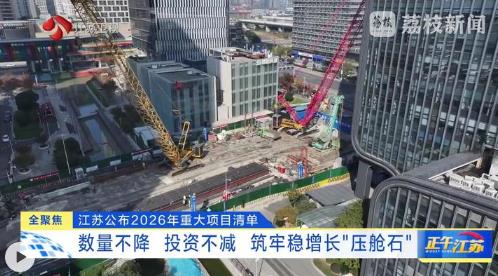
江苏公布2026年重大项目清单:数量不降 投资不减 筑牢稳增长“压舱石”
Xin Lang Cai Jing· 2026-01-11 18:13
Core Insights - Jiangsu Province has officially released the major project list for 2026, which includes 670 projects with an annual planned investment of 664.6 billion yuan, marking an increase of 12 billion yuan year-on-year [2] Group 1: Major Projects Overview - The list includes 550 implementation projects, an increase of 50 projects compared to the previous year, and 120 reserve projects, up by 20 projects [2] - The characteristics of the 2026 major project list include a significant increase in industrial projects, steady growth in investment scale, rapid rise in innovative investments, and deep integration of soft and hard investments [2] Group 2: Industrial Projects - A total of 414 industrial projects are planned, with an annual investment of 295 billion yuan, representing a shift towards strategic emerging industries and future industries, which now account for 80% of manufacturing projects, up from 74% [4] - New projects initiated this year total 269, accounting for approximately 50% of the total, with planned investments exceeding 200 billion yuan, contributing to high-quality development [4] Group 3: Focus Areas for Investment - The province will prioritize support for industrial technological transformation and foreign investment reinvestment projects [5] - Key projects include the construction of underground pipeline networks, livable and business-friendly rural areas, and urban renewal initiatives such as the renovation of old urban communities [5]

2026年省重大项目清单发布“量增”的同时更重“质优”
Xin Hua Ri Bao· 2026-01-11 00:05
Group 1 - The core viewpoint of the news is the announcement of the 2026 Jiangsu Province major project list and key industries for private investment, highlighting an increase in both the number and investment scale of projects compared to the previous year [1] - A total of 670 major projects are planned for the year, with 550 projects to be implemented, reflecting an increase of 50 projects year-on-year, and an annual planned investment of 664.6 billion yuan, up by 12 billion yuan [1] - The list emphasizes quality alongside quantity, with strategic emerging industries and future industry projects in manufacturing increasing from 74% to 80%, while high-energy-consuming projects in sectors like chemicals and metallurgy are significantly reduced [1] Group 2 - In 2025, 507 major provincial projects completed investments of 729 billion yuan, and 200 key private investment projects achieved 81 billion yuan, exceeding annual targets [2] - The provincial development and reform commission aims to enhance service support for major projects, targeting a new project commencement rate of over 50% in the first quarter and full commencement by the third quarter [2] - The characteristics of the 2026 project list include a significant increase in industrial projects, steady growth in investment scale, rapid growth in innovative investments, and deep integration of soft and hard investments [1]
“量增”的同时更重“质优”
Xin Lang Cai Jing· 2026-01-10 21:36
Group 1 - The core viewpoint of the news is the announcement of Jiangsu Province's major project list for 2026, which includes 670 major projects with a planned investment of 664.6 billion yuan, reflecting an increase in both the number of projects and investment compared to the previous year [1] - The list includes 414 industrial projects with an investment of 295 billion yuan, accounting for over 75% of the total number of implemented projects, indicating a strong focus on industrial development [1] - Infrastructure projects total 118, with a planned investment of 323.6 billion yuan, while livelihood and environmental projects consist of 18 projects with an investment of 46 billion yuan, showcasing a balanced approach to development [1] Group 2 - The 2026 project list emphasizes quality alongside quantity, with strategic emerging industries and future industry projects increasing from 74% to 80% of manufacturing projects, while high-energy-consuming industries are significantly reduced [1] - The provincial economic research institute highlights characteristics of the 2026 project list, including a notable increase in industrial projects, steady growth in investment scale, rapid innovation investment, and deep integration of soft and hard investments [2] - The provincial development and reform commission aims for over 50% of new projects to start construction in the first quarter and for all projects to commence by the third quarter, indicating a strong push for effective project management and execution [2]
为发展聚力 把蓝图绘美——学习贯彻党的二十届四中全会精神省委宣讲团报告会在我省各地举行(三)
Si Chuan Ri Bao· 2026-01-10 01:50
Group 1 - The recent speeches by the provincial propaganda team emphasize the importance of high-quality development and the need for local governments to align their actions with the spirit of the 20th Central Committee's Fourth Plenary Session [1][2] - The achievements during the "14th Five-Year Plan" period have been highlighted, showcasing significant progress in healthcare reform, service industry transformation, and overall public welfare [2] - Local leaders express commitment to industrial revitalization, with specific plans for new industrialization and enhancing traditional industries, particularly in regions like Dazhou and Bazhong [3][6] Group 2 - Various local governments are focusing on tailored strategies to implement the directives from the plenary session, aiming to create a conducive business environment and develop robust industrial frameworks [5][6] - The emphasis on consumer upgrades and the development of unique consumption brands is noted as a strategy to support regional economic growth [3][6] - The need for comprehensive planning for the "15th Five-Year Plan" is underscored, with local authorities aiming to translate the plenary session's spirit into actionable development plans [5][6]
锚定目标 接续奋斗 推动“十五五”开好局起好步
Xin Lang Cai Jing· 2026-01-07 23:22
当前,全省上下正以"开局起势"的拼搏之志、实干之姿,全力以赴拼经济、促发展,奋力实现"十五 五"良好开局。作为宏观管理和经济综合协调部门,省发改委将如何贯彻落实省委经济工作会议精神, 谋划好2026年经济工作? 省发改委党组书记、主任孟芊表示,2025年,省发改委深入学习贯彻习近平总书记在福建考察时的重要 讲话精神,坚决贯彻落实党中央国务院决策部署和省委省政府工作要求,坚持扭住目标不放松、一张蓝 图绘到底,紧盯"奋勇争先、再上台阶",履职尽责、担当作为,推动全省经济运行呈现总体平稳、稳中 有进的良好态势,全年主要预期目标预计顺利完成,"十四五"圆满收官。我们领会到,这些成绩来之不 易,根本在于习近平总书记领航掌舵,在于习近平新时代中国特色社会主义思想科学指引。回望"十四 五"时期,是我省发展历程中极不寻常、极不平凡的五年,习近平总书记两次莅临福建考察并发表重要 讲话,为新时代新福建建设把脉定向、指路引航。我们带着特殊感情、特殊使命、特殊责任,全面学 习、全面把握、全面贯彻落实。 2026年是"十五五"开局之年,也是福建在中国式现代化建设中奋勇争先、谱写新征程新福建建设新篇章 的关键之年。省发改委将深入学习贯彻 ...
《山东省民营经济促进条例》为市场主体提供更完善法治保障
Da Zhong Ri Bao· 2026-01-03 01:15
Core Viewpoint - The implementation of the "Shandong Province Private Economy Promotion Regulations" aims to provide a more comprehensive legal guarantee for over 14.4 million private market entities, enhancing fair competition and addressing financing challenges for private enterprises [2][3]. Group 1: Legal Framework and Fair Competition - The regulations explicitly prohibit nine types of behaviors that hinder fair competition in public resource transactions, such as setting unreasonable performance thresholds and limiting ownership forms [2]. - The regulations emphasize the need for a negative list for market access and a strict review system for fair competition, aiming to eliminate hidden barriers to market entry for private capital [2][3]. Group 2: Financing Support for Private Enterprises - The regulations encourage financial institutions to optimize credit services and increase tolerance for non-performing loans to private enterprises, aiming to lower financing costs and broaden financing channels [3]. - Specific measures include enhancing support for first-time loans, credit loans, and loans backed by accounts receivable, warehouse receipts, equity, and intellectual property [3]. Group 3: Rights Protection and Government Accountability - The regulations establish a mechanism for government integrity in fulfilling contracts, imposing clear obligations on state agencies and state-owned enterprises regarding timely payments to private enterprises [3]. - It prohibits delays in payments due to administrative changes or internal processes, ensuring that private enterprises receive their dues without undue hindrance [3]. Group 4: High-Quality Development of Private Economy - The regulations support private enterprises in investing in strategic emerging industries and participating in major project construction, promoting their integration into provincial development strategies [4]. - Service optimization measures include elevating existing service models to legal status, shifting government services from passive approval to proactive empowerment [4].