
油脂行业

Search documents
棕榈油:短期技术反弹,等待产量拐点确认,豆油:美豆驱动有限,区间震荡运行
Guo Tai Jun An Qi Huo· 2025-11-30 10:13
1. Report Industry Investment Rating - Not provided in the content 2. Core Viewpoints of the Report - Palm oil is waiting for the December production reduction in Malaysia to confirm the price bottom, and the destocking of the producing areas and lower - than - expected production in the first quarter will bring new - year imagination [3][6] - The short - term rebound height of US soybeans is limited. China's recent procurement rhythm and South American weather will determine the callback level. If the problem of rainfall in South America persists or the Brazilian shipping issue recurs, the soybean complex will still have room to rise in the first quarter. During the short - term rebound of palm oil, soybean oil should be mainly lightly long - allocated, running in a range for the time being, waiting for the thematic resonance of the oil and fat sector after overall stabilization in the first quarter [5][6] 3. Summary by Relevant Catalogs 3.1 Previous Week's View and Logic Palm oil - The market was worried that Malaysia's palm oil production in the fourth quarter would still be high, and there was a lack of effective demand stories for B50 and US soybean oil. Palm oil continued to move in a range, but the marginal trading of high - yield was temporarily fully priced. After a short - term over - decline, technical rebound supported it, and the palm oil 01 contract rose 0.19% last week [2] Soybean oil - The sales progress of US soybeans was slow. Without South American weather speculation, there was limited upward driving force. It mainly followed the oil and fat sector in a range - bound movement, waiting for a premium story. The soybean oil 01 contract rose 0.46% last week [2] 3.2 This Week's View and Logic Palm oil - Malaysia's production and rainfall conditions this year are generally favorable, which may lead to fourth - quarter production above last year's level. After the inventory reached nearly 2.5 million tons in October, the high - frequency production data from November 1 - 20 still showed an upward trend, and the ITS export data decreased by about 18% month - on - month. There is a possibility of non - destocking in November, and the year - end inventory may remain at a relatively high historical level of around 2.45 million tons, dropping to about 2 million tons by March next year [3] - The market's trading of high production from November - December is currently fully priced. With the arrival of the rainy season and high - intensity precipitation from typhoons, if the production in December is successfully reduced to 1.7 million tons on a month - on - month basis, the bottom of palm oil prices can be short - term confirmed [3] - In Indonesia, the export tax was successfully reduced by one level in December, but there is a possibility of an increase in January. So, exports are likely to be good in December. The rapid rebound of the Indonesia - Malaysia price difference, the stabilization and rebound of the fruit bunch price in North Sumatra, and the rapid decline of Indonesia's refining profit all indicate that the marginal negative factors in Indonesia are limited, and Malaysia's production will be the key factor for price support [3] - The September data released by GAPKI shows that the export and domestic consumption are in full agreement with the previous estimates, but the production decline is extreme. It can be almost judged that Indonesia calculates the production by maintaining a neutral inventory figure, so the data is highly distorted, not only having no trading value but also increasing the difficulty of estimating future monthly production. However, the export data from October - November confirms that the average monthly production in these two months is at least 4.8 million tons, and Indonesia's year - end inventory can be maintained above 3 million tons [3] - In the consumer areas, India's CPO import profit has been good recently, which stimulates India to make a large number of purchase orders, showing a certain marginal restocking demand. China also provides some relief for the pressure on the producing areas through the carry structure and the narrowing import profit [3] Soybean oil - The WASDE announced the new - crop yield of US soybeans at 53 bushels per acre and the ending inventory at 290 million bushels. With a favorable yield, the inventory is slightly loose. The new - crop CBOT soybean price needs a further reduction in yield or China's unexpected purchase exceeding the commitment to have room for further increase, so there are currently no factors for significant fluctuations [4][5] - Since the second half of October, the actual rainfall in the central - western, northeastern, and southeastern regions of Brazil has been continuously low, which has a certain impact on sowing and early growth. In the next month, the rainfall in the southern producing areas will be significantly less. While it is conducive to the acceleration of sowing in the state of Rio Grande do Sul and the core producing areas of Argentina, the soybean conditions in the southern part of Mato Grosso do Sul, the state of Paraná, and Paraguay will face a certain decline in pressure [5] - The short - term rebound height of US soybeans is limited. China's recent procurement rhythm and South American weather will determine the callback level. Currently, US soybeans have a too high discount to South American soybeans. If the premium period is too long, the future pressure on US soybeans will be greater. However, if the problem of rainfall in South America persists or the Brazilian shipping issue recurs, there will still be upward space for the soybean complex in the first quarter [5] - In the domestic market, there are almost no gaps in soybean arrivals until January, but the estimated arrivals from February - March are currently lower than the same period last year. At the same time, export demand enables domestic soybean oil to maintain a monthly destocking process until March - April next year. Therefore, during the short - term rebound of palm oil, soybean oil should be mainly lightly long - allocated, running in a range for the time being, waiting for the thematic resonance of the oil and fat sector after overall stabilization in the first quarter [5] 3.3 Disk Basic Market Data - **Price and price change**: The palm oil main - continuous contract closed at 8,626 yuan/ton, up 0.19%; the soybean oil main - continuous contract closed at 8,244 yuan/ton, up 0.46%; the rapeseed oil main - continuous contract closed at 9,757 yuan/ton, down 0.85%; the Malaysian palm oil main - continuous contract closed at 4,114 ringgit/ton, up 1.13%; the CBOT soybean oil main - continuous contract closed at 52.08 cents/pound, up 2.90% [8] - **Trading volume and position changes**: The trading volume of the palm oil main - continuous contract was 2,473,903 lots, with a change of - 670,410 lots; the position was 331,361 lots, with a change of - 94,546 lots. The trading volume of the soybean oil main - continuous contract was 3,144,313 lots, with a change of - 576,061 lots; the position was 347,390 lots, with a change of - 72,801 lots. The trading volume of the rapeseed oil main - continuous contract was 2,673,029 lots, with a change of 76,582 lots; the position was 175,955 lots, with a change of - 67,969 lots [8] - **Price difference and change**: The rapeseed - soybean 01 price difference was 1,513 yuan/ton, down 6.95%; the soybean - palm 01 price difference was - 382 yuan/ton, down 6.11%; the palm oil 15 price difference was - 52 yuan/ton, up 55.93%; the soybean oil 15 price difference was 204 yuan/ton, down 1.92%; the rapeseed oil 15 price difference was 256 yuan/ton, down 34.53% [8] - **Warehouse receipt change**: The number of palm oil warehouse receipts was 352 lots, an increase of 302 lots compared with last week; the number of soybean oil warehouse receipts was 0 lots, a decrease of 24,625 lots compared with last week; the number of rapeseed oil warehouse receipts was 3,965 lots, a decrease of 68 lots compared with last week [8] 3.4 Core Data of Oil and Fat Fundamentals - **Production and inventory**: Malaysia's palm oil production in the fourth quarter is likely to be above last year's level, and the year - end inventory remains high. Indonesia's year - end inventory is expected to return to a moderately loose level [10][11][12] - **Price difference and profit**: The Indonesia - Malaysia price difference has rebounded rapidly, the fruit bunch price in North Sumatra has stabilized and rebounded, and Indonesia's refining profit has dropped significantly. The POGO price difference has rebounded, India's palm oil import profit has improved rapidly, and the India - soybean - palm CNF price difference has strengthened [12][13] - **Export data**: ITS shows that Malaysia's palm oil export volume from November 1 - 25 was 1,041,935 tons, a decrease of 18.8% compared with the same period last month [12] - **Rainfall situation**: The weekly rainfall situation in Malaysia and Indonesia is provided, including a two - week forecast [13] - **Import situation**: The cumulative import volume of palm oil in the EU in 2025 has decreased by 400,000 tons, and the cumulative import volume of four major oils and fats has decreased by 600,000 tons [14] - **Basis situation**: The basis of palm oil (South China) for 01 is - 50, and the basis of soybean oil (Jiangsu) has stabilized [13]
国内累库增加 预计棕榈油阶段性见底概率偏大
Jin Tou Wang· 2025-11-20 07:08
Market Overview - As of November 19, the CNF price for 24-degree palm oil imports for December and January is reported at $1060/ton and $1080/ton, reflecting a week-on-week increase of $10 to $22/ton [1] - Malaysia's MENTIGA CORPORATION reported October crude palm oil production at 999.11 million tons, fresh fruit bunch production at 5157.34 million tons, and palm kernel production at 239.82 million tons [1] - On November 19, the national port transaction volume for 24-degree palm oil was 800 tons, a decrease of 33.33% compared to the previous trading day [1] Institutional Insights - Donghai Futures noted that palm oil futures on the Malaysian Derivatives Exchange (BMD) continued to rise, supported by the strength in soybean oil. However, concerns over demand and a stronger ringgit have led to palm oil prices retreating from intraday highs. Domestic palm oil inventory is increasing, putting pressure on spot prices, and a wide fluctuation in palm oil prices is expected in the short term [2] - Guotou Anxin Futures highlighted that the U.S. diesel market is experiencing lower-than-average production but strong exports and domestic demand, leading to a tight supply-demand balance. This situation is expected to have a marginal spillover effect on vegetable oils. The recent strength in international soybean oil prices has also influenced palm oil, which is following the upward trend. However, short-term supply-demand indicators for palm oil in Malaysia appear weak. Domestic soybean crushing margins remain poor, with soybean oil outperforming soybean meal. The market is closely watching potential changes in U.S. biodiesel policies, which could lead to an improvement in palm oil margins and a higher probability of a bottoming phase for palm oil prices [3]
2025年全球棕榈油大会——高增长周期的终结,共识与分歧
对冲研投· 2025-11-19 11:50
Core Insights - The global palm oil market is undergoing a significant transformation characterized by high volatility, high premiums, and policy-driven dynamics. The era of supply growth is ending, with demand being reshaped by biodiesel policies, making regulations more critical than traditional supply-demand factors in price formation [4][5][20]. Market Reality - The palm oil market has entered a structurally tight phase due to a fundamental shift in the supply and demand landscape. Key drivers include capacity constraints, policy interventions, and resilient demand. Major producers Indonesia and Malaysia are experiencing a slowdown in growth, while biodiesel policies are reshaping global trade flows [5][6][8]. Supply Dynamics - Indonesia's palm oil production is reaching a ceiling, with forecasts indicating a slowdown or even negative growth by 2026 due to aging trees, slow replanting rates, and land ownership uncertainties. Malaysia's production is also stagnating, with a slight decline expected [6][7]. - Thailand is a rare bright spot, with a production increase of 0.8% due to advantages in EU compliance [7]. Demand Dynamics - Indonesia's domestic biodiesel policies are significantly influencing demand, with the B40 policy consuming approximately 15.62 million kiloliters of crude palm oil (CPO). The proposed B50 policy could further increase demand by 1.5 to 3 million tons, squeezing export supplies [8]. - Import markets remain resilient, with India expected to increase palm oil imports from 8.1 million tons to 9.1 million tons in the 2025/26 period, supported by strategic reserves in China and demand from ASEAN and Africa [8]. Consensus Expectations - There is a clear consensus among institutions regarding a bullish long-term outlook for palm oil prices, driven by structural supply tightness. However, short-term price fluctuations are expected due to inventory pressures and policy uncertainties [9][10]. - The average annual growth rate for global palm oil production is projected to drop from 2.9 million tons in the past decade to 1.4 million tons in the next decade, marking the end of the capacity expansion era [9]. Price Outlook - In the short term (Q4 2025 - Q1 2026), prices are expected to be under pressure due to high Malaysian production and seasonal increases in Indonesian output, potentially dropping to $920-$950 per ton. In the medium to long term, prices may rebound to $1,100 per ton due to seasonal low production and the potential implementation of the B50 policy [10]. Institutional Divergence - Significant differences exist among institutions regarding price forecasts, focusing on the extent of supply declines, timing of policies, and external factors. Some institutions predict a price rebound starting in Q1 2026, while others emphasize the need for policy triggers [11][12][14]. Core Variables and Drivers - The future market direction hinges on several core variables, including the timing of Indonesia's B50 policy implementation, the execution details of the EU Deforestation Regulation (EUDR), weather and production risks, and dynamics of competing oils [16][18][21]. - Indonesia's strategic approach to palm oil, driven by resource nationalism, aims to enhance its global pricing power while reducing reliance on imported fossil fuels through biodiesel policies [21][22].


2025年9月中国豆油进口数量和进口金额分别为7万吨和0.77亿美元
Chan Ye Xin Xi Wang· 2025-11-03 03:12
Core Insights - The report by Zhiyan Consulting highlights the significant increase in China's soybean oil imports, with a notable rise in both quantity and value in September 2025 compared to the previous year [1] Import Data Summary - In September 2025, China's soybean oil imports reached 70,000 tons, marking an 81.1% year-on-year increase [1] - The import value for the same period was $0.77 million, which represents a 105.4% year-on-year growth [1] Company Profile - Zhiyan Consulting is recognized as a leading industry consulting firm in China, specializing in in-depth industry research reports, business plans, feasibility studies, and customized services [1] - The company has over a decade of experience in the industry research field, providing comprehensive industry solutions to empower investment decisions [1]

B40计划仍支持印尼需求 棕榈油期货下方空间有限
Jin Tou Wang· 2025-10-29 07:02
Core Viewpoint - Palm oil futures are experiencing a downward trend, with the main contract down 1.91% to 8838.00 yuan/ton as of the latest report [1] Group 1: Market Data - As of October 26, the EU's palm oil import volume for the 2025/26 season is 890,000 tons, down from 1,130,000 tons in the same period last year [2] - Indonesia's palm oil inventory decreased slightly to 2.54 million tons in August, a 1% decline from the previous month, as production declines offset reduced export volumes [2] - Indonesia's palm oil export volume in August was 3.47 million tons, a month-on-month decrease of 1.8%, while crude palm oil production was 5.06 million tons [2] - Domestic palm oil inventory reached 565,000 tons by the end of the 43rd week of 2025, an increase of 16,000 tons from the previous week [2] Group 2: Institutional Insights - According to Everbright Futures, the decline in Indonesia's palm oil inventory is attributed to a decrease in production, which offset the impact of reduced exports [3] - Domestic palm oil prices have significantly corrected, reaching a one-month low, with an increase in open interest [3] - Nanhua Futures reports that Malaysia's palm oil production increased in October, contrary to market expectations of an early onset of the production decline season [3] - The Indonesian mining association has called for a halt to the B50 plan, raising concerns about future palm oil demand if the plan is not implemented [3]
国富棕榈油研究周报:多空因素交织,棕榈油价格走势震荡-20250922
Guo Fu Qi Huo· 2025-09-22 02:56
Report Title - The report is titled "Guofu Palm Oil Research Weekly: Bullish and Bearish Factors Intertwined, Palm Oil Price Trends Volatile" [1] Report Date - The report was released on September 22, 2025 [1] Content Summary by Section 1. Market Review - The market review includes BMD Malaysian palm oil and DCE palm oil, but specific data is not provided in the given content [4] 2. Producing Area Weather - The section focuses on palm oil producing area weather, but no detailed information is given [4] 3. International Supply and Demand 3.1 Indian SEA August Report - No content related to the Indian SEA August report is provided [4] 3.2 Malaysian Palm Oil September Forecast - AmSpec data shows that Malaysia's palm oil exports from September 1 - 15, 2025 were 695,716 tons, a 0.10% decrease from the same period last month and a 5.29% increase from the same period last year. Among them, crude palm oil exports were 95,625 tons, a 31.27% decrease from the same period last month and a 36.50% decrease from the same period last year; 24 - degree palm oil exports were 142,401 tons, a 6.08% increase from the same period last month and a 1.41% decrease from the same period last year; 33 - degree palm oil exports were 96,540 tons, a 67.02% increase from the same period last month and a 5.98% increase from the same period last year; 44 - degree palm oil exports were 70,365 tons, a 12.39% decrease from the same period last month and a 19.59% increase from the same period last year [20] - ITS data shows that Malaysia's palm oil exports from September 1 - 15, 2025 were 742,648 tons, a 12.55% increase from the same period last month and a 16.83% increase from the same period last year. Major markets include the EU with 167,330 tons (a 20.18% decrease from the same period last month and a 19.17% increase from the same period last year), China with 11,000 tons (a 25.00% increase from the same period last month and an 83.80% decrease from the same period last year), and India and the Indian sub - continent with 122,325 tons (a 5.98% decrease from the same period last month and an 18.02% decrease from the same period last year). Among different types, crude palm oil exports were 99,825 tons (a 27.89% decrease from the same period last month and a 35.24% decrease from the same period last year); 24 - degree palm oil exports were 178,500 tons (a 39.69% increase from the same period last month and a 30.16% increase from the same period last year); 33 - degree palm oil exports were 57,460 tons (a 9.46% increase from the same period last month and a 5.09% decrease from the same period last year); 44 - degree palm oil exports were 71,645 tons (a 4.62% decrease from the same period last month and a 13.12% increase from the same period last year) [21] - SPPOMA data shows that as of September 15, 2025, palm oil production increased by 8.05% compared to September 10, 2025, decreased by 3.17% compared to September 5, 2025, and increased by 6.28% compared to September 5, 2025. FFB yield increased by 6.94% compared to September 10, 2025, decreased by 2.70% compared to September 5, 2025, and decreased by 5.70% compared to September 5, 2025. The extraction rate decreased by 0.21% compared to September 10, 2025, increased by 0.09% compared to September 5, 2025, and decreased by 0.11% compared to September 5, 2025 [22] 3.3 Other Important Information - No other important information content is provided [4] 4. Domestic Supply and Demand - This section includes import profit, palm oil transactions, and palm oil inventory, but no specific data is given [4] 5. Domestic and International Oil Futures and Spot Prices, Spread Situations - This section includes basis, monthly spreads, variety spreads, palm oil warehouse receipt quantity and futures open interest, and FOB quotes, but no specific data is provided [4]
棕榈油近况与展望
2025-09-10 14:35
Summary of Palm Oil Market Conference Call Industry Overview - The palm oil market has recently experienced a correction, but there is significant potential for mid-term price increases. The current market sentiment is weak due to a lack of news, leading to profit-taking and price volatility [1][3] - The U.S. and Brazil's biofuel policies are increasing the use of soybean oil, which is reducing soybean oil exports and raising the international price differential between soybean and palm oil, benefiting palm oil exports [1][4] - Indonesia's B40 policy and potential B50 policy are expected to support long-term demand for palm oil [1] Supply and Demand Dynamics - Supply and demand in Malaysia and Indonesia are tightening. Malaysia's production is expected to continue declining, while Indonesia's crackdown on illegal plantations poses risks to production increases. Overall inventory in both countries is decreasing, providing price support [1][5] - India's vegetable oil inventory is low, indicating a need for replenishment. Indonesia's increased export taxes are reducing its competitiveness, while Malaysia's export data remains strong, suggesting ongoing support for India's replenishment needs [1][6] - The Indonesian government's crackdown on illegal plantations has significantly impacted production, involving millions of hectares and potentially leading to a decrease in output [1][7][29] Climate Impact - Global climate change may cause delayed impacts on palm oil production in Q1 2026, further tightening supply-demand relationships and supporting prices [1][9] Production Trends - Global palm oil production growth is expected to slow significantly by 2026, with Indonesia's production increase projected to be limited to around 1 million tons [2][11] - The concentration of palm oil production is high, primarily in Indonesia and Malaysia, with both countries facing challenges such as aging plantations and limited expansion potential [1][10] Biofuel Demand - The demand for biodiesel has increased significantly, particularly in Indonesia, where policies are expected to drive domestic palm oil demand. The potential implementation of B50 could add approximately 3 million tons of demand [1][12][18] - U.S. and Brazilian biodiesel policies are also expected to increase the demand for soybean oil and indirectly support palm oil exports [1][13][14] Market Outlook - The palm oil price has fluctuated significantly since July 2025, with expectations of further increases despite recent corrections. The price is projected to remain between 9,200 and 10,000, with potential for exceeding 10,000 in the long term [1][19][22] - India's low palm oil inventory is attributed to rising domestic consumption and reduced imports, indicating a need for replenishment in the coming months [1][23] Risks and Considerations - The transition of illegal plantation management to state-owned enterprises could significantly impact supply, with potential losses in production if not managed properly [1][25][29] - If palm oil prices remain high, it may affect the willingness of the government to increase biodiesel blending rates due to economic concerns [1][21] Conclusion - The palm oil market is facing a complex interplay of supply constraints, policy impacts, and climate considerations, with a generally optimistic long-term outlook despite short-term volatility. The focus should remain on monitoring production trends, policy developments, and global market dynamics to identify potential investment opportunities and risks.
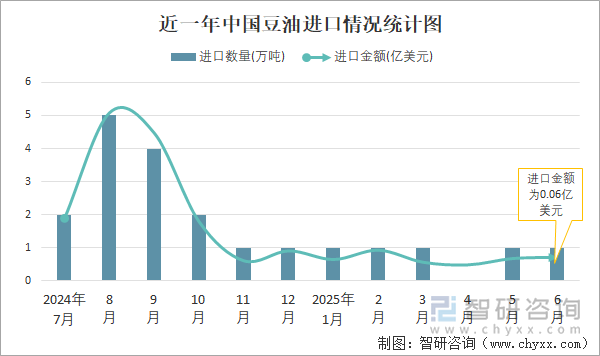
2025年6月中国豆油进口数量和进口金额分别为1万吨和0.06亿美元
Chan Ye Xin Xi Wang· 2025-08-24 00:16
Core Insights - China's soybean oil imports in June 2025 reached 10,000 tons, representing a year-on-year decline of 82.1% [1] - The import value for soybean oil was $0.06 million, which is a decrease of 81.5% compared to the previous year [1] Data Summary - Import Quantity: 10,000 tons, down 82.1% year-on-year [1] - Import Value: $0.06 million, down 81.5% year-on-year [1] - Data Source: Chinese Customs, organized by Zhiyan Consulting [3]
多重利多因素作用,棕榈油或震荡偏强
Tong Guan Jin Yuan Qi Huo· 2025-08-18 02:52
Report Title and Date - The report is titled "Palm Oil Weekly Report" and dated August 18, 2025 [1][3] Market Data - BMD Malaysian palm oil main contract rose 224 to close at 4,478 ringgit/ton, a 5.27% increase; palm oil 09 contract rose 414 to close at 9,394 yuan/ton, a 4.61% increase; soybean oil 09 contract rose 162 to close at 8,562 yuan/ton, a 1.93% increase; rapeseed oil 09 contract rose 233 to close at 9,807 yuan/ton, a 2.43% increase; CBOT US soybean oil main contract rose 0.79 to close at 53.22 cents/pound, a 1.51% increase; ICE canola active contract fell 9.5 to close at 660.5 Canadian dollars/ton, a 1.42% decrease [4][5][7] - The spot price of 24 - degree palm oil in Guangzhou, Guangdong rose 270 to 9,300 yuan/ton, a 2.99% increase; the spot price of first - grade soybean oil in Rizhao rose 110 to 8,600 yuan/ton, a 1.30% increase; the spot price of imported third - grade rapeseed oil in Zhangjiagang, Jiangsu rose 230 to 9,900 yuan/ton, a 2.38% increase [5] - The futures spread between soybean oil and palm oil decreased by 252 to - 832 yuan/ton, and the futures spread between rapeseed oil and palm oil decreased by 181 to 413 yuan/ton [5] Market Analysis and Outlook Market Performance - The domestic oil sector fluctuated and rose, with palm oil showing strength and rapeseed oil rising and then falling under policy influence. The long - term expansion of biodiesel policies in Indonesia and the US supports the long - term demand for soybean and palm oil. Rapeseed oil has a global supply, and policies may change the trade pattern, with relatively weak demand growth expectations compared to soybean and palm oil, but there is an expectation of tightening domestic long - term supply [4][8] MPOB Report - In July, Malaysia's palm oil ending inventory increased 4.02% to 2.113 million tons, lower than the market expectation of 2.25 million tons. Production increased 7.09% to 1.812 million tons, exports increased 3.82% to 1.309 million tons, imports decreased 12.82% to 61,000 tons, and domestic consumption increased 6.63% to 483,000 tons [8] US Department of Agriculture Report - The US Department of Agriculture's August oilseed report shows that the global palm oil production in the 2025/26 season is expected to be 80.736 million tons, unchanged from last month's estimate; the ending inventory is expected to be 15.034 million tons, a downward revision of 4,000 tons from last month's estimate; and exports are expected to be 46.163 million tons, unchanged from last month's estimate. Indonesia's palm oil exports are expected to be 24 million tons, and Malaysia's are expected to be 16.1 million tons, both unchanged from last month's estimates [9][10] Other Data - From August 1 - 5, 2025, Malaysia's palm oil yield per unit decreased 19.32% month - on - month, the oil extraction rate increased 0.39% month - on - month, and production decreased 17.27% month - on - month. From August 1 - 15, Malaysia's palm oil exports increased significantly compared to the previous period [10] - India's palm oil imports in July were 855,695 tons, down from 955,683 tons in June; sunflower oil imports were 200,010 tons, down from 216,141 tons in June; total vegetable oil imports were 1.579041 million tons, up from 1.549825 million tons in June; and soybean oil imports were 492,336 tons, up from 359,504 tons in June [11] - As of the week of August 8, 2025, the inventory of the three major oils in key domestic regions was 2.3967 million tons, an increase of 35,600 tons from last week and 284,700 tons from the same period last year. As of the week of August 15, 2025, the weekly average daily trading volume of soybean oil in key domestic regions was 27,540 tons, down from 30,880 tons the previous week; the weekly average daily trading volume of palm oil was 690 tons, up from 437 tons the previous week [12] Market Outlook - Macroscopically, the US - Russia presidential meeting ended, and the negotiation process may be difficult. The US retail sales in July increased 0.5% month - on - month, consumer demand remains resilient, the US dollar index fluctuates, and oil prices fluctuate within a narrow range. Fundamentally, Malaysia's export demand has increased significantly, Indonesia's B40 policy is being implemented with low inventory, and Malaysia's inventory build - up in July was lower than expected. In the short term, palm oil may fluctuate strongly [4][13] Industry News - Indonesia's trade authorities are asking palm oil producers to increase local market sales under the "Domestic Market Obligation (DMO)" plan to lower prices, with a monthly DMO level of 175,000 tons by the end of the year [14] - Analysts expect Malaysia's palm oil inventory to remain high in the near term. RHB Investment Bank believes that production will increase before the peak season, demand will improve, inventory will continue to increase above 2 million tons, palm oil prices will decline in Q3 and rise in Q4. Maybank Investment Bank also expects higher palm oil production in Malaysia and Indonesia in 2025 [15] - Indian traders estimate that in the 2024/25 season, soybean oil imports may increase 60% to 5.5 million tons, palm oil imports may decrease 13.5% to 7.8 million tons, sunflower oil imports may decrease 20% to 2.8 million tons, and total edible oil imports may increase 1% to 16.1 million tons [15] - Indonesia has saved at least $3.68 billion in foreign exchange this year through the use of palm - based biodiesel. As of June, 6.8 million kiloliters of B40 biodiesel have been distributed, and the goal of distributing 13.5 million kiloliters in 2025 is half - completed [16] Related Charts - The report includes charts on the price trends of Malaysian palm oil, US soybean oil, the three major oils, palm oil, soybean oil, and rapeseed oil in both futures and spot markets, as well as charts on inventory, production, and export volume of palm oil in Malaysia and Indonesia, and the commercial inventory of the three major oils in China [17][19][22]
油脂周报:MPOB7月报告超预期-20250814
Zi Jin Tian Feng Qi Huo· 2025-08-14 07:07
Report Industry Investment Rating - The investment rating for the palm oil industry is neutral [3] Core Viewpoints - The under - expected palm oil production in both Malaysia and Indonesia has supported the price increase of palm oil, but attention should be paid to whether the export demand can sustain the current price [4] - As of August 8, 2025, South American soybean prices strengthened on a weekly basis, while those in the US Gulf were weak, and rapeseed prices in many regions declined [7] - As of August 8, 2025, Argentine soybean oil prices dropped by over $50/ton on a weekly basis, and US Gulf soybean oil prices fell by $41/ton, while Malaysian and Indonesian palm oil prices rose slightly [10] Summary by Related Catalogs Supply - side Information - In July, Malaysian palm oil production increased by 7.09% month - on - month to 1.812417 million tons, lower than the institutional estimate of 1.83 million tons. Exports increased by 3.82% month - on - month to 1.31 million tons, higher than the estimate of 1.3 million tons. End - of - July inventory reached 2.11 million tons, lower than the estimate of 2.23 - 2.25 million tons [3] - In July, rainfall in many parts of Malaysia was lower than normal, and the oil extraction rate of palm fruit decreased instead of increasing [3] Price Information - The price difference between Argentine soybean oil and Indonesian crude palm oil was - $10/ton, compared with $51.5/ton the previous week, lower than the historical average of $124.4/ton [19] - The price difference between Indian port soybean oil and crude palm oil was $28/ton, lower than $67/ton the previous week. The price difference between crude sunflower oil and crude palm oil was $18/ton, compared with $115/ton the previous week. The price difference between refined soybean oil and refined palm oil was $23/ton, compared with $54/ton the previous week [24] Purchase and Demand Information - There were no reports of palm oil purchases last week [26] - Last week, domestic buyers purchased 3000 tons each of Dubai rapeseed oil for the October/November shipment, and there were rumors that domestic oil mills purchased rapeseed for the September shipment [33] - Last week, far - month soybean oil transactions remained high, especially against the backdrop of domestic non - procurement of US soybeans [127] Profit and Margin Information - Subsidies decreased, and processing and blending losses increased [120] - European RME prices weakened, but European rapeseed oil prices declined more, and RME processing profit remained at the average level [123] - Palm oil and rapeseed oil basis were stable, while soybean oil basis weakened again [131] Balance Sheet Information - The report provides monthly balance sheets for various oils, including overall oils, rapeseed oil, and palm oil, covering data from 2024 to 2025, showing information on beginning inventory, production, imports, total supply, exports, demand, end - inventory, inventory changes, inventory - to - consumption ratios, and surplus amounts [146]